
Direct answer: On 2 November 2026, Abu Dhabi and OpenAI signed four agreements after Crown Prince Sheikh Khaled bin Mohamed bin Zayed met OpenAI CEO Sam Altman (Abu Dhabi Media Office). The headline for builders is the Machine-Readable Government (MRG) initiative: a defined set of policies and regulations turned into machine-readable rules, so AI can help officials with routine compliance checks for permits and certificates. Every assessment is traceable to its rule, and officials make the final decision. The first pilot is live with ADAFSA on food imports, running on OpenAI’s UAE inference residency. ADNOC also becomes the first energy company to deploy OpenAI’s frontier technology. No deal values were disclosed.
Key facts (checked 2 November 2026, 10:00 Asia/Gaza)
- Government: Abu Dhabi Government and OpenAI launched what they call “the world’s first AI-native Machine-Readable Government initiative”, led and governed by the Department of Government Enablement (DGE).
- First pilot: already in production with the Abu Dhabi Agriculture and Food Safety Authority (ADAFSA), focused on food imports.
- Guardrails stated: each assessment is traceable to the governing rule; officials retain oversight and accountability for final decisions.
- Residency: AI processing on OpenAI’s UAE inference residency, with real-time computation on GPUs in UAE data centres.
- Energy: ADNOC, G42 (through Inception42) and OpenAI: ADNOC is the first energy company to deploy OpenAI’s frontier technology, on GPT models with in-country inference.
- Investment: Mubadala, Inception42 and OpenAI: AI for investment analysis, opportunity identification and risk assessment.
- Five years: Inception42 and OpenAI will jointly support AI adoption across UAE government, enterprise and education.
- Not disclosed: deal values, timelines for more pilots, and which regulations come next.
Most AI-in-government announcements describe chatbots. This one is different, and it matters to anyone who builds permit, licensing, import or compliance software in the Gulf. Abu Dhabi is not just putting a model in front of citizens. It is converting the rules themselves into a form a machine can check, and it says every AI assessment can be traced back to the exact rule behind it. That is an engineering pattern, usually called rules as code, and it changes what regulators will expect from the apps that feed them data.
This article reports only what Abu Dhabi Media Office, WAM and the two UAE newspapers published today. Where we explain how such systems are usually built, we say clearly that it is iFynx’s engineering view, not a description of the DGE system.
What are the four Abu Dhabi OpenAI agreements?
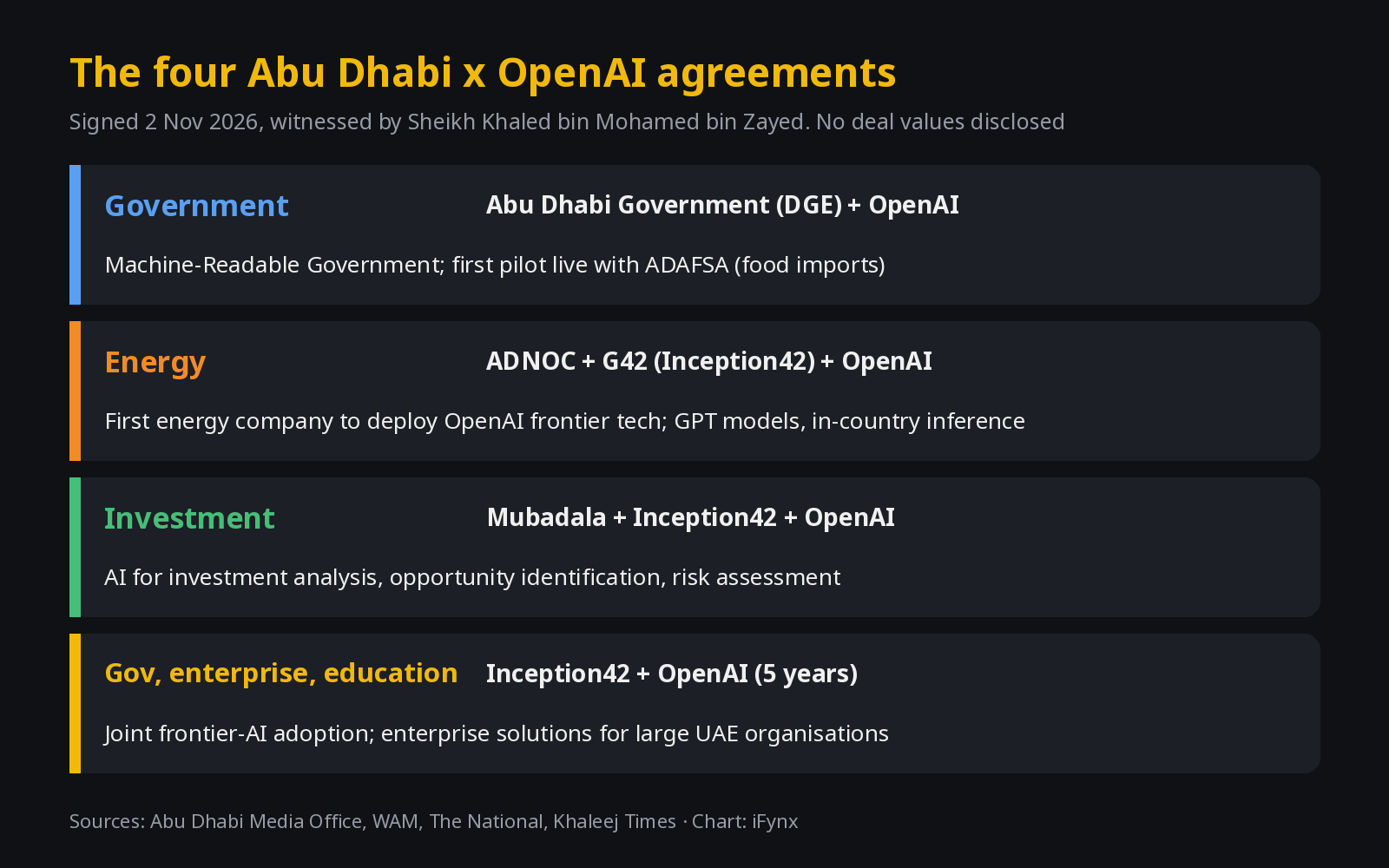
According to the Abu Dhabi Media Office and WAM, Sheikh Khaled witnessed the signing of four agreements “between Abu Dhabi-based entities and OpenAI, spanning the government, energy and investment sectors” after the meeting with Sam Altman, who was in Abu Dhabi for ADIPEC (The National).
| Sector | Parties | What the release says |
|---|---|---|
| Government | Abu Dhabi Government (DGE) + OpenAI | Machine-Readable Government initiative; first pilot in production with ADAFSA on food imports; UAE inference residency |
| Energy | ADNOC + G42 (via Inception42) + OpenAI | ADNOC first energy company to deploy OpenAI’s frontier technology; GPT models on in-country inference |
| Investment | Mubadala + Inception42 + OpenAI | AI for investment analysis, opportunity identification and risk assessment |
| Government, enterprise, education | Inception42 + OpenAI | Five-year agreement; enterprise solutions for large UAE organisations with consultancy-led services |
Abu Dhabi and the UAE are setting a bold, global standard for AI integration across both the public and private sectors to make sure the benefits of AI reach everyone.
Sam Altman, OpenAI CEO, via Abu Dhabi Media Office, 2 November 2026
How does Abu Dhabi’s Machine-Readable Government work?
The official description is short and specific. The initiative “translates a defined set of government policies and regulations into machine-readable form, enabling AI-powered systems to assist officials with routine regulatory compliance assessments, including those related to issuing permits and certificates. Each assessment is traceable to the governing rule, while government officials retain oversight and accountability for final decisions” (Abu Dhabi Media Office).
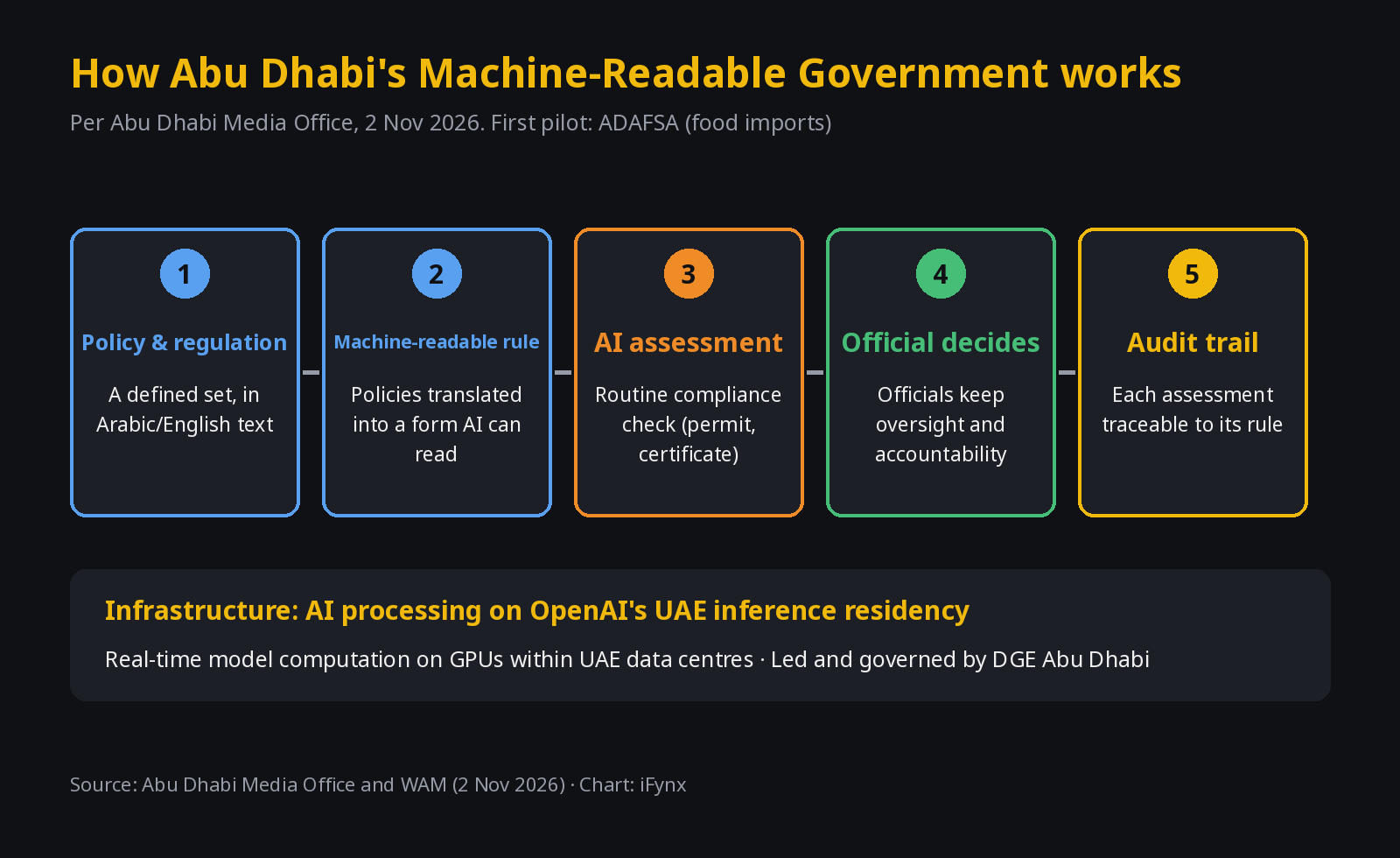
Three words in that description carry the design: defined set (it starts narrow, not with all law), routine (repeatable checks, not judgment calls), and traceable (every output links to a rule). Food imports are a sensible first pilot. The checks are document-heavy and repeatable: certificates, origins, product categories and conditions that a rule can state precisely.
What is officially confirmed vs. our engineering view
Confirmed: the scope (a defined set of rules), the use (routine compliance assessments for permits and certificates), traceability to the rule, officials keeping the final decision, DGE leadership, the ADAFSA food-import pilot and UAE inference residency. Not published: the rule format, which models are used for the pilot, the review workflow, or the next agencies. Everything in the next section is how iFynx would build such a system, not a description of DGE’s.
Rules as code: how regulations become machine-readable
In our experience building bilingual permit and onboarding flows, turning an Arabic and English regulation into something a machine can check takes four layers:
- Source text, kept verbatim. Each rule keeps a link to the article and clause it comes from, in both Arabic and English. If the two texts differ, the legally binding language must be marked.
- A structured rule. Conditions become fields and operators (“temperature at or below 4°C”, “issuer country in the approved list”), with lookup tables kept separate so a list can change without rewriting the rule.
- Versions and effective dates. A permit filed on 30 October must be checked against the rule in force that day. Without versioning there is no real traceability.
- An outcome that refers, not refuses. When a check fails or the evidence is unclear, the safe default is “refer to an officer”, which matches Abu Dhabi’s statement that officials keep the final decision.
{
  "rule_id": "ADAFSA-IMPORT-EXAMPLE-014",
  "version": "2026.11.1",
  "source": {"doc": "Example food-import regulation", "article": "14(2)",
             "text_ar": "...", "text_en": "..."},
  "effective_from": "2026-11-01",
  "applies_when": {"product_category": "chilled_meat"},
  "requires": [
    {"field": "health_certificate.issuer_country", "op": "in", "value_ref": "approved_countries"},
    {"field": "shipment.temperature_c", "op": "<=", "value": 4}
  ],
  "on_fail": "refer_to_officer"
}
*Illustrative only. This is iFynx’s example of a rules-as-code record, not the DGE or ADAFSA format, which has not been published.*
Where does a large language model fit? Usually in reading the messy inputs (scanned certificates, invoices, Arabic free text) and mapping them to the rule’s fields, then explaining the result in plain language. The pass/fail logic itself is best kept in deterministic, testable rules. That split is what makes an assessment “traceable to the governing rule” instead of “the model said so”.
Traceable AI decisions: what the audit trail UX should show
If officials are accountable, the screen in front of them has to make the AI’s work easy to check, not easy to rubber-stamp. For any team designing an officer console or an applicant portal, we recommend each assessment shows:
| Element | Why it matters |
|---|---|
| Rule ID, version and clause, with the source text in AR and EN | The official can verify the rule, not trust a summary |
| The evidence used (which document, which field, page) | Shows exactly what the AI read |
| Result per condition: met, not met, unclear | Separates hard failures from missing data |
| The officer’s decision, reason and timestamp | Accountability stays with a named person |
| An immutable log entry and export | Needed for appeals, audits and model reviews |
For applicants, the same trail becomes better UX: “Your certificate does not list the origin country required by Article 14(2)” is a fixable message, while “Application rejected” creates a phone call. We covered similar trust patterns for identity in our Nafath and UAE Pass eKYC guide.
Data residency: ADNOC Frontier and UAE inference residency
Both the government pilot and ADNOC’s deployment stress where the computing happens. The MRG pilot runs on “OpenAI’s UAE inference residency, with real-time model computation running on GPUs within UAE data centres”. ADNOC’s agreement is “deployed on OpenAI’s GPT models using in-country inference infrastructure in the UAE” (Abu Dhabi Media Office). OpenAI launched Frontier on 5 February as an enterprise platform for building, deploying and managing AI agents (The National).

For app teams the practical lesson is architectural. Inference residency covers where the model runs. Your own system still decides where prompts, uploaded documents, logs, embeddings and backups live. A compliant design keeps all of those in-country too, and documents it. Saudi teams face the same question under PDPL and SDAIA rules; see our Saudi PDPL checklist. Egypt’s Personal Data Protection Law No. 151 of 2020 also restricts cross-border transfers, so Egyptian government and bank projects should plan for local or approved processing from day one.
What should permit and licensing app teams in the UAE, Saudi Arabia and Egypt prepare?
Nothing in today’s release asks private companies to change anything yet. But once a regulator can check rules automatically, the quality of the data coming in from apps becomes the bottleneck. Our checklist:
- Structure your forms around rules, not pages. Capture each value a rule needs as a typed field (dates, codes, countries, units), not free text.
- Keep documents machine-readable. Prefer digital certificates and structured data; when you accept scans, extract and confirm the key fields with the user.
- Bilingual by design. Store Arabic and English labels and error messages per rule ID, so a failed check explains itself in the user’s language.
- Version everything. Record which form version and which rule version applied to each submission.
- Plan residency end to end. Map where every prompt, file and log goes. Inference in-country is not enough if your logs sit abroad.
- Design the human step. Make “refer to an officer” a first-class state with SLA tracking, not an error.
- Prepare for agents. As AI agents start filing on behalf of users, clear APIs matter as much as screens; see UAE open finance and AI agents.
Gulf and Egypt angle
Saudi Arabia’s digital-government stack (Absher, Nafath) and Egypt’s Digital Egypt services already run large volumes of permits. The Abu Dhabi model, rules as data plus traceable AI plus a human decision, is a pattern those teams can adopt without any OpenAI contract. The model choice is separate; we compared pricing and Arabic skills in our GPT-6.1 Terra review.
What is still unknown?
- Deal values and duration, except the five-year Inception42 agreement.
- The machine-readable rule format and whether it will be published as an open standard.
- Which agencies and permit types follow the ADAFSA food-import pilot.
- How Inception42’s enterprise solutions will be packaged for private companies.
We will add a dated update if DGE, ADAFSA or OpenAI publish more details.
How iFynx can help
iFynx builds bilingual Arabic and English apps, portals and automation for organisations in the UAE, Saudi Arabia and Egypt. For permit and compliance teams we design rule-ready forms, audit-trail screens and data-residency maps. See our services or read what is iFynx. Running a self-hosted payment stack too? Read our BTCPay Server hack guide, and our note on opting out of AI training in robots.txt.
FAQ
What did Abu Dhabi and OpenAI sign on 2 November 2026?
Four agreements, witnessed by Sheikh Khaled bin Mohamed bin Zayed: the Abu Dhabi Government’s Machine-Readable Government initiative with OpenAI; ADNOC, G42 (via Inception42) and OpenAI on deploying OpenAI’s frontier technology; Mubadala, Inception42 and OpenAI on investment analysis; and a five-year Inception42 and OpenAI agreement for government, enterprise and education.
What is a Machine-Readable Government?
Abu Dhabi says it translates a defined set of government policies and regulations into machine-readable form, so AI can help officials with routine compliance assessments such as permits and certificates. Each assessment is traceable to its rule, and officials keep oversight and accountability for the final decision.
Where is the first pilot running?
With the Abu Dhabi Agriculture and Food Safety Authority (ADAFSA), on food imports. It is led and governed by the Department of Government Enablement (DGE) and is already in production.
Is the data processed inside the UAE?
For the government pilot, AI processing runs on OpenAI’s UAE inference residency, with real-time model computation on GPUs in UAE data centres. ADNOC’s deployment uses GPT models on in-country inference infrastructure.
How much are the deals worth?
No values were disclosed by Abu Dhabi Media Office or WAM. iFynx does not estimate them.
Sources
- Abu Dhabi Media Office, 2 November 2026
- WAM, 2 November 2026
- The National: ADNOC and Frontier; government and education deals
- Khaleej Times, 2 November 2026
- Hero photo: Wadiia, Wikimedia Commons, CC BY-SA 4.0, cropped. In-body photo: Alexander McNabb, Wikimedia Commons, CC BY-SA 4.0, cropped. Charts: iFynx.

