Published 2 November 2026, 16:20 Asia/Gaza. Developing story: the review is reported, not officially announced. We will add dated updates if the RBI, Visa, Mastercard or RedotPay comment.
Quick answer: The RedotPay card is under review in India, not banned. On 2 November The Economic Times reported that the Reserve Bank of India and the Financial Intelligence Unit (FIU-IND) are examining offshore crypto cards, including RedotPay’s, and that several users say their cards stopped working. There is no official statement yet from the RBI, Visa, Mastercard or RedotPay. For readers in the Middle East, the bigger question is local law: Egypt, Saudi Arabia and Palestine prohibit or warn against dealing in crypto, and the UAE bars merchants from accepting foreign stablecoins as payment. This is not legal advice.
Key facts
- What happened: the RBI and FIU-IND are “understood to be examining” offshore crypto cards, two people told ET. Sources say they are in touch with Visa and Mastercard.
- Users: since Thursday 29 October, users in India have posted that their crypto cards no longer work there. The reason is not confirmed.
- Concern: possible breaches of India’s payment rules and the Foreign Exchange Management Act (FEMA), and weak identity checks.
- Official word: none. RBI, Visa and Mastercard did not reply to ET, and CCN found no public statement. RedotPay’s X account has not commented; its latest posts are about Hong Kong FinTech Week.
- Not a ban: no nationwide shutdown has been announced, and RedotPay has not been formally accused of wrongdoing.
What is happening with the RedotPay card in India
A crypto card lets you hold stablecoins such as USDT in an app and spend them anywhere Visa or Mastercard works. At the moment you pay, the crypto is sold and the merchant gets local currency. ET says the cards cost $40 to $50, last three years and carry high daily limits. Indian users were using them for online shopping, phone top-ups, flights and even cash at ATMs.
According to ET, the review may have been prompted by Digital South Trust, a Bengaluru non-profit that got a Visa-backed RedotPay virtual card in August, made domestic purchases with it and sent the findings to the authorities. Lawyers quoted by ET and TokenPost say the cards may sidestep India’s prepaid-instrument rules and FEMA because the balance sits with a foreign custodian. Separately, India’s FIU issued notices to 15 offshore crypto service providers on 9 September, which shows the agency is already active on offshore crypto.
Today, even routine Visa or Mastercard payments in India can be funded by cryptocurrencies or dollar-backed stablecoins through offshore card programmes.
Sudhakar Lakshmanaraja, Digital South Trust, to The Economic Times
Is RedotPay safe and legal in Egypt, the UAE, Saudi Arabia and Palestine?
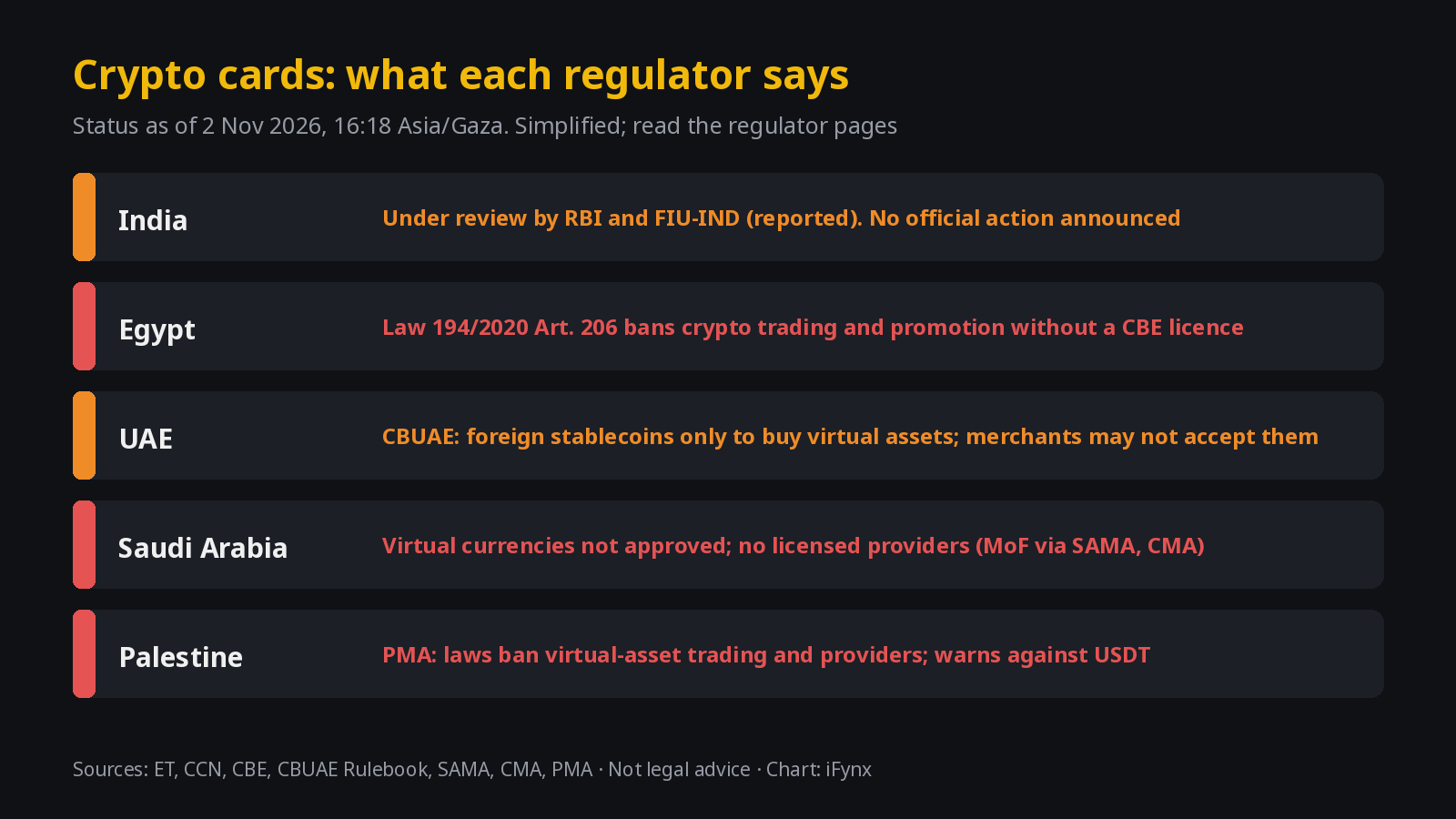
India’s review does not change the rules in our region, but it is a reminder that a card can stop working when a regulator looks closely. Here is what each regulator’s own page says, status as of 2 November 2026, 16:20 Asia/Gaza:
| Country | What the rule says | Status | Source |
|---|---|---|---|
| India | Under review by RBI and FIU-IND (reported); users report deactivations | No official statement or ban | ET |
| Egypt | Law 194/2020 Art. 206 bans crypto trading, promotion and related activity without a licence | Long-standing ban; CBE warning 2022 | CBE |
| UAE | Merchants may not accept virtual assets except licensed dirham tokens; foreign stablecoins only to buy virtual assets | CBUAE regulation in force | CBUAE Rulebook |
| Saudi Arabia | Virtual currencies not approved; no licensed providers | Official warnings | SAMA, CMA |
| Palestine | Laws prohibit virtual-asset trading and providers; warns against USDT | Official warnings 2017, 2023 | PMA, WAFA |
Egypt
The Central Bank of Egypt says Law 194 of 2020 prohibits issuing, trading or promoting crypto, running platforms for it, or carrying out related activities. Penalties include prison and fines of EGP 1 million to 10 million. The CBE adds that only official currencies approved by it may be used in Egypt. Searches for «redotpay مصر» are rising, but the legal risk sits with the user too.
UAE
The UAE is the most open market in the region, but the CBUAE Payment Token Services Regulation says no merchant in the UAE may accept a virtual asset as payment unless it is a licensed dirham payment token, or a registered foreign stablecoin used to buy other virtual assets. A crypto card that converts USDT to dirhams at checkout sits in a grey zone that depends on how the issuer is set up. For licensed crypto banking, see Standard Chartered crypto trading in the UAE; for licensed prepaid cards, see the Jaywan card from Botim.
Saudi Arabia
The Ministry of Finance warning on SAMA’s site says virtual currencies are not approved in the Kingdom and are outside the regulatory umbrella. The CMA-led committee adds that no parties are licensed to deal in them.
Palestine
The Palestine Monetary Authority has warned against all virtual currencies since 2017, and in 2023 it said, as WAFA reported, that Palestinian legislation prohibits trading in virtual assets and acting as a provider, naming Bitcoin and USDT. Anyone searching «redotpay في فلسطين» should know a card can also be cut off without notice, as Indian users found.
What RedotPay users should do now
- Keep balances small. Treat a crypto card wallet like a travel wallet, not a savings account. A deactivation can freeze spending overnight.
- Know your issuer. The card is issued by a licensed partner of the card network, not by the app brand. Read who that is in the card terms.
- Do not use it where local law bans crypto payments. In Egypt, Saudi Arabia and Palestine, the regulators’ warnings above apply to you, not just to the provider.
- Keep records. Save top-up, conversion and spending history. Banks and tax authorities can ask where funds came from.
- Avoid “no KYC” offers. Programmes that promise little or no identity checks are exactly what India’s review is about, and they are the first to be cut off.
- For businesses, use licensed rails. Pay salaries and suppliers through licensed banks and payment firms, such as WPS-linked prepaid cards in the UAE.
Under review is not banned
India has not banned RedotPay. Regulators are reportedly reviewing offshore crypto cards, and some cards have stopped working. Plan for disruption, keep balances small, and wait for an official statement.
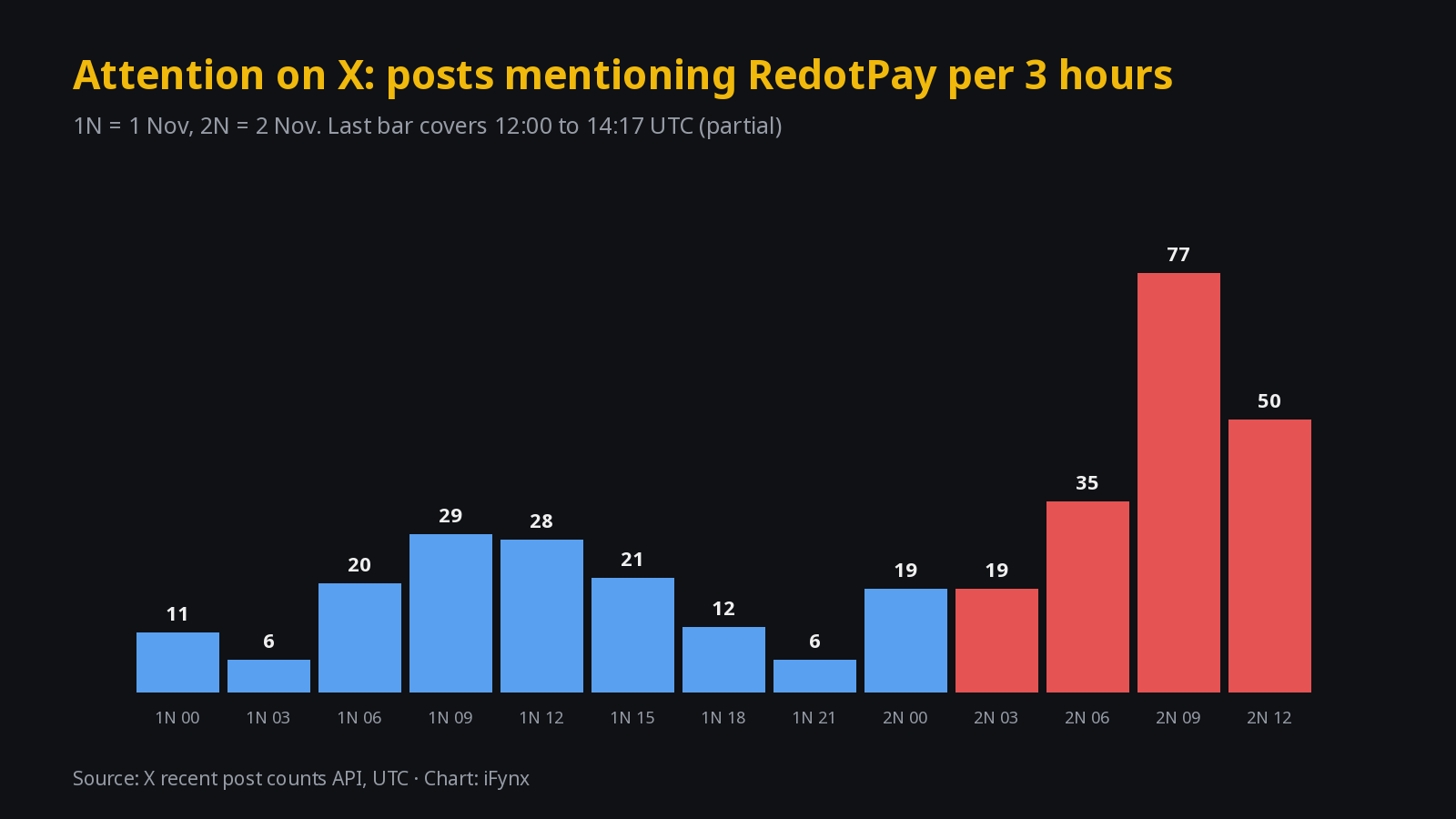
Attention on X
What we are watching next
- Any statement from the RBI, FIU-IND, Visa, Mastercard or RedotPay.
- Whether deactivations spread to other offshore crypto cards in India.
- Whether Gulf regulators issue new guidance on crypto-funded cards.
How iFynx can help
iFynx builds bilingual fintech products for the UAE, Saudi Arabia and Egypt, including card and wallet apps built on licensed partners with KYC and transaction monitoring. See our services. Related: Reap and Visa stablecoin cards in 100+ markets.
Frequently asked questions
Is RedotPay banned in India?
No ban has been announced. The Economic Times reports that the RBI and FIU-IND are examining offshore crypto cards, including RedotPay’s, and some users report deactivated cards. As of 2 November 2026 there is no official statement from the RBI, Visa, Mastercard or RedotPay.
Is the RedotPay card legal in Egypt?
Egypt’s Banking Law 194 of 2020, Article 206, bans issuing, trading or promoting cryptocurrencies, or running related activities, without a Central Bank of Egypt licence. The CBE says only official currencies may be used in Egypt. Spending crypto through a card is a legal risk there.
Can I use RedotPay in the UAE?
Under the CBUAE Payment Token Services Regulation, merchants in the UAE may not accept virtual assets as payment, except licensed dirham tokens, and foreign stablecoins may be used only to buy virtual assets. Check your card’s issuer and the rules with a licensed adviser.
Is RedotPay allowed in Saudi Arabia?
Saudi authorities say virtual currencies are not approved in the Kingdom and no one is licensed to deal in them. The Ministry of Finance warning is published on SAMA’s site, and the CMA committee says the same.
Is RedotPay legal in Palestine?
The Palestine Monetary Authority says Palestinian legislation prohibits trading in virtual assets and acting as a virtual-asset service provider, and warns against coins such as Bitcoin and USDT.
What happens to my money if my card is deactivated?
A disabled card does not mean your crypto is gone, but you may not be able to spend or move it until the provider allows it. Keep only small balances on any card wallet.
Sources
- The Economic Times, 2 November 2026
- CCN, 2 November 2026
- TokenPost, 2 November 2026
- PIB: FIU-IND notices to 15 VDA service providers, 9 September 2026
- Central Bank of Egypt warning; CBUAE Rulebook; SAMA; CMA; Palestine Monetary Authority; WAFA
- RedotPay on X, checked 2 November 2026
- X post counts: X recent counts API, queried 2 November 2026
- Cover photo: Basile Morin, Wikimedia Commons, CC BY-SA 4.0, cropped. In-article photo: AmarinderBrar, Wikimedia Commons, CC BY-SA 4.0. Charts: iFynx.

