SUPPLY-CHAIN ATTACK · OPTIMIZELY CONFIRMS A NOW-FIXED PRODUCT FLAW · UPDATED 13:10 ASIA/GAZA, 17 NOV 2026
For about 17 hours on Monday 16 November 2026, Optimizely’s own CDN served poisoned A/B-testing snippets to visitors of 178 organisations, including HSBC, IKEA, Zoom, the BBC and CNN. The added code swapped crypto wallet addresses, skimmed cards typed into site forms, and sent older iPhones to exploit kits.
The campaign was found by Scott Helme of Report URI, who counted 188 infected snippets among 1,611 he checked. StepSecurity confirmed the loader chain independently. None of the websites had to be hacked directly: the code came from the trusted Optimizely script every one of them loads.
Most snippets were cleaned by 21:52 UTC (23:52 in Gaza) on 16 November. Optimizely has since confirmed that the attacker exploited a vulnerability in its Experimentation product, which it says is now fixed. If you run Optimizely Web, or used an affected site that day, the checklists below are for you.
Update 17 November 2026, 13:10 Asia/Gaza: Optimizely confirms a product vulnerability
Optimizely told SecurityWeek that an unauthorised party exploited a vulnerability in its Experimentation product to add malicious JavaScript to some customer projects. The company says it has fixed the vulnerability, removed the injected code from affected projects, secured the affected accounts and added protections. It has not said how many customers were affected or published technical details of the flaw, so the 178-organisation count still comes from Report URI.
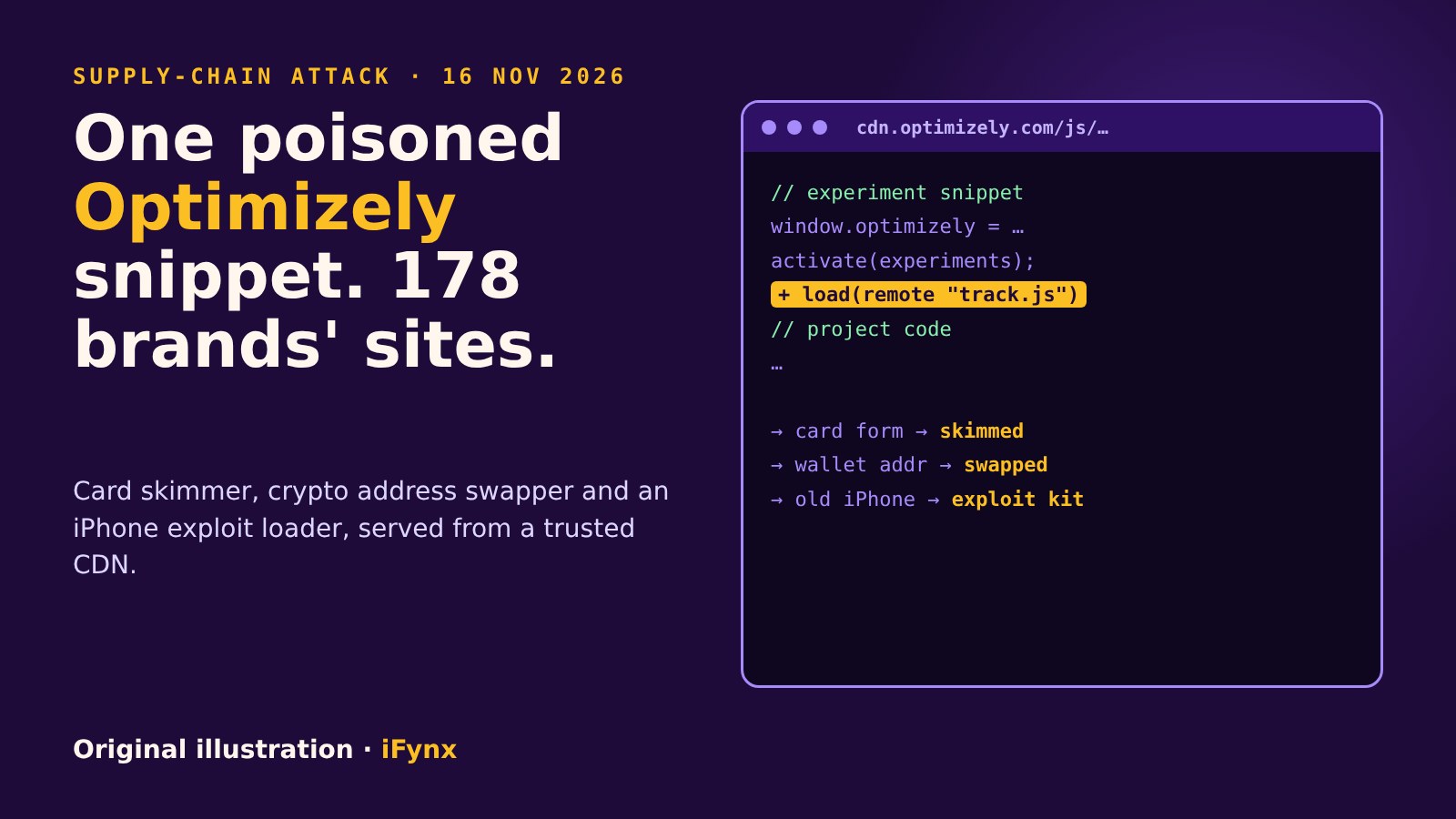
At iFynx we build websites, checkout flows and mobile apps for banks, retailers and SaaS teams in the Gulf and Egypt, and almost all of them load third-party scripts for analytics, A/B testing or chat. This attack is the clearest example yet of why those scripts are part of your attack surface. HSBC, Vodafone and IKEA all serve large customer bases in the UAE, Saudi Arabia and Egypt, yet we found no Arabic coverage of this incident. This guide sticks to what the researchers published and gives no attack code.
Hour by hour: how one day went (UTC and Gaza time)
What the injected code did
Crypto address swapper
- Replaced wallet addresses for Bitcoin, Ethereum, TRON, Solana, TON, Litecoin, Bitcoin Cash and Dogecoin
- Proceeds visible on-chain were small: about $7,040 (Report URI) or $6,600 (StepSecurity)
Card skimmer
- Read card number, expiry and CVV from forms the site itself rendered
- Did not reach cards typed into hosted frames from providers such as Stripe or Adyen
Data grabber
- Sent page URLs, readable cookies and html2canvas screenshots to the attacker’s server
- Any secret stored in a non-HttpOnly cookie should be treated as exposed
iPhone exploit loader
- Picked an exploit chain by iOS version: Coruna for iOS 13–17, DarkSword for iOS 18, fingerprinting only on iOS 26
- Symptom on iOS 18.6 or earlier: the page reloads every 60 seconds
Google’s threat intelligence team has documented both Coruna and DarkSword before. Their reuse here means a visit to a well-known site was enough to put an unpatched iPhone at risk.
Confirmed vs not known
| Status | Detail |
|---|---|
| Confirmed | Malicious loader in Optimizely Web Project JavaScript, served from cdn.optimizely.com (Report URI, StepSecurity, Amirul Cyber) |
| Confirmed | 178 organisations and 188 infected snippets per Report URI; StepSecurity cites Helme’s 186 infected sites at one sweep |
| Confirmed | Most code removed by 21:52 UTC on 16 November |
| Confirmed | How the attacker got in: a vulnerability in Optimizely’s Experimentation product, now fixed (technical details not published) |
| Not known | How many cards and cookies were stolen; only on-chain crypto is visible |
| Not known | How many Optimizely customers were affected: Optimizely has not given a number |
Who should do what today
If you visited an affected site on 16 Nov
- Check card statements for 16 November onward; ask for a new card if anything is odd
- Recheck any crypto address you copied that day
- Update iPhone and iPad: Report URI says iOS 18.7.3+ or 26.3+ (newer versions also fine)
If your company runs Optimizely Web
- Open every Project JavaScript field and experiment custom code; look for the attacker’s domain (1688360.cc), atob( and anything you didn’t write
- Read the change history to see what changed on 16 Nov and whether it came via REST API or the web UI
- Review users, API tokens and integrations, then rotate them
- Treat card data entered on your own forms on 16 Nov as exposed, and consider telling customers
If you run security for a bank or retailer
- Block 1688360.cc and the .icu hosts Report URI lists in DNS and proxies; search logs back to 08:00 UTC on 16 Nov
- Check CSP reports for blocked requests to those hosts
- Keep third-party tags off checkout and login; use hosted payment fields
- Add a CSP with tight script-src and connect-src, and avoid ‘unsafe-eval’ and ‘strict-dynamic’ where you can
A trusted domain is not a trusted script. Every affected site loaded the code from Optimizely’s real CDN with a valid certificate, so browsers and most security tools saw nothing wrong. The defences that worked were a strict Content Security Policy and monitoring of what third-party scripts actually do in the browser.
Why this hits the Gulf and Egypt
Banks, airlines, telecoms and e-commerce brands across the region run the same marketing stack as their global peers: A/B testing, tag managers, analytics and chat widgets loaded from other companies’ servers. Several of the named brands, including HSBC, IKEA and Vodafone, operate in or serve customers in the UAE, Saudi Arabia, Qatar and Egypt. Crypto use is also high in the Gulf, which makes a clipper that silently swaps wallet addresses especially relevant. And many regional organisations still let marketing teams add scripts to production pages without a security review. That is the habit this attack exploited.
How iFynx can help
iFynx builds and secures websites, checkout flows and apps for companies across the Gulf and Egypt. We can help you:
- Inventory every third-party script on your public pages, see who can change each one, and remove what checkout and login don’t need.
- Design and roll out a Content Security Policy with reporting, starting in report-only mode so nothing breaks.
- Move card entry to hosted payment fields and harden cookies (HttpOnly, Secure, SameSite).
- Set up client-side script monitoring and an incident runbook for ‘a vendor script went bad’ days like 16 November.
Frequently asked questions
What happened with Optimizely on 16 November 2026?
An attacker added a small loader to the Project JavaScript of many Optimizely Web customer projects. The poisoned snippets, served from cdn.optimizely.com, pulled in a script that swapped crypto wallet addresses, skimmed card details typed into site-owned forms, stole readable cookies and screenshots, and sent older iPhones and iPads to exploit kits. Report URI counted 178 affected organisations.
Which websites were affected?
Report URI names Zoom, the BBC, CNN, Salesforce, GitLab, IKEA, HSBC, Equifax, Air France-KLM, Ledger and Peacock, plus Optimizely’s own website and login page. Other reports add Smartsheet, Vodafone Australia and TalkTalk. Report URI has not published its full list.
I visited one of these sites on 16 November. What should I do?
If you typed a card number into a form on an affected site that day, watch your statement and ask your bank to replace the card if anything looks wrong. If you copied a crypto address there, check the transaction went where you meant. If you used an iPhone or iPad, update to the latest iOS: Report URI says iOS 18.7.3 or later, or iOS 26.3 or later, is protected from the chains it saw.
Were cards entered in Stripe or Adyen payment frames stolen?
Report URI says no. The skimmer read card fields that belonged to the website itself. Cards typed into a payment provider’s hosted frame on a different origin were out of its reach.
How did the attacker get into Optimizely customer projects?
Optimizely says an unauthorised party exploited a vulnerability in its Experimentation product to add code to some customer projects, and that the flaw is now fixed. It has not published technical details. Report URI had already ruled out CDN cache poisoning and said Optimizely served exactly what it was given.
Does a Content Security Policy stop this kind of attack?
A strict one helps a lot. Among affected sites Report URI checked, 68 had no CSP and only 24 blocked the payload completely. Policies with ‘unsafe-eval’ or ‘strict-dynamic’ let it through. A tight script-src host list blocks the download, and a tight connect-src blocks the data theft.
Sources
- Report URI (Scott Helme): World’s largest brands infected with malware via Optimizely
- StepSecurity: OPTIMJACK analysis
- Amirul Cyber: OPTIMJACK write-up
- Scott Helme on X
- Optimizely docs: Project JavaScript and custom code
- Optimizely support: view change history
- Google Threat Intelligence: Coruna iOS exploit kit
- Google Threat Intelligence: DarkSword iOS chain