Direct answer — 10 November 2026: In the AaaS vs SaaS question, SaaS (software as a service) rents your team a tool, usually priced per user seat, and your people do the work inside it. AaaS (agents as a service) rents you an AI agent that does a defined piece of the work itself, usually priced per action, per conversation or per resolved outcome. On the vendors’ own pages today, Intercom Fin lists $0.99 per outcome, Zendesk $1.50 (committed) or $2.00 (pay-as-you-go) per automated resolution, Salesforce Agentforce $2 per conversation or $500 per 100,000 Flex Credits, and Microsoft Copilot Studio $200 a month for 25,000 Copilot Credits. Choose AaaS for high-volume, well-defined work with a safe hand-off to a human; keep SaaS where judgement, collaboration or legal accountability sit with people. For Gulf and Egypt companies, the deciding questions are where the agent stores and processes data, how well it handles Arabic, and what happens to the bill when volume spikes.


This iFynx guide is built from primary sources, read on 10 November 2026: four vendors’ pricing pages and documentation, a Gartner press release, and the Sequoia Capital essay that popularised the “selling work, not seats” idea. We did not rewrite other AaaS explainers, and we have no access to negotiated contract prices: every figure below is a public list price, in US dollars, and your quote may differ. Where we could not confirm something on a primary page, we say so.
Key facts (checked 10 November 2026)
- AaaS = agents as a service: you pay for work an AI agent completes (an action, a conversation, a resolution), not for a person’s login.
- Intercom Fin: $0.99 per outcome; 50 outcomes a month minimum on other helpdesks; qualifications $9.99; Intercom bills in USD only.
- Zendesk AI agents: billed per automated resolution, $1.50 committed or $2.00 pay-as-you-go; plans include 5 to 10 resolutions per agent per month.
- Salesforce Agentforce: $2 per conversation, or Flex Credits at $500 per 100,000 (one standard action = 20 credits = $0.10); per-user add-ons from $125 a month.
- Microsoft Copilot Studio: $200 per pack of 25,000 Copilot Credits a month, or pay-as-you-go; a generative answer costs 2 credits, an agent action 5.
- Gartner (25 June 2025): over 40% of agentic AI projects will be cancelled by the end of 2027; only about 130 of thousands of “agentic” vendors are real.
- Gulf data: Microsoft lists a UAE North (Dubai) data location and Salesforce offers Hyperforce in the UAE; Intercom hosts only in the US, EU and Australia.
What is AaaS, and how is it different from SaaS?
SaaS is the model most Gulf and Egypt companies already run on: a CRM, a helpdesk, an accounting system or a scheduling tool delivered over the internet, paid monthly or yearly, usually per user. The software waits for a person to open it. If ticket volume doubles, you add people, and each new person needs a seat.
AaaS turns that around. The vendor supplies an AI agent that reads a request, looks things up in your systems, takes an action such as updating an order or booking a slot, and either finishes the job or hands it to a human. You are billed when the agent does something. Salesforce’s own wording is “Pay per Action” and “Pay per Conversation”. Intercom says you “only pay when Fin resolves the issue end to end”. Zendesk says you pay “only for customer requests that were successfully resolved by the AI agent, without any escalation to a human agent”.
The idea has a well-known source. In October 2024, Sequoia Capital’s “Generative AI’s Act o1” described the AI transition as “service-as-a-software” and contrasted it with the cloud era: cloud companies sold software per seat, AI companies sell work per outcome. Its example was Sierra, a customer-support agent company that “gets paid per resolution”.
“Cloud companies sold software ($ / seat). AI companies sell work ($ / outcome).”
Sonya Huang and Pat Grady, Sequoia Capital, 9 October 2024
AaaS is not a replacement for SaaS in most companies. The agent usually works on top of the SaaS you already have: Fin works with Salesforce, HubSpot, Freshworks and other helpdesks; Agentforce lives inside Salesforce; Copilot Studio agents run on Microsoft 365 and Power Platform. The real change is in who does the routine work and how you pay for it. We covered the vendors’ side of this shift in Dreamforce’s answer to the SaaSpocalypse.
How AI agent pricing works in 2026: four real price sheets
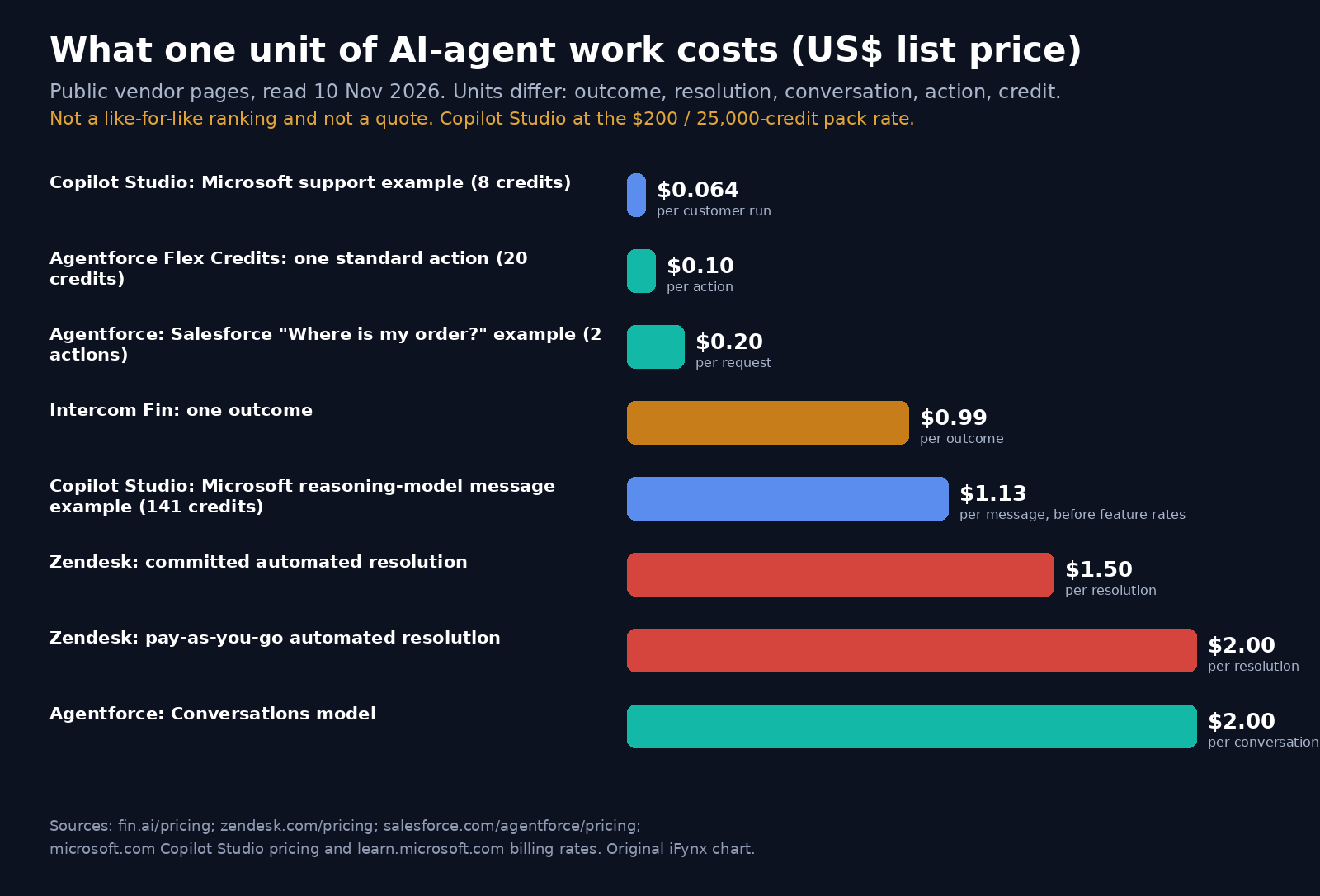
These are the list prices on each vendor’s public page on 10 November 2026. Each vendor counts a different unit, which is the first thing to understand before you compare.
Intercom Fin — per outcome. Fin costs $0.99 per outcome, with a minimum of 50 outcomes a month if you run it on another helpdesk. An outcome is a resolution (no further help requested after Fin’s last answer), a configured procedure hand-off, a disqualification or a self-serve routing, all at $0.99, or a lead qualification at $9.99. Intercom charges “one outcome per conversation, even if Fin takes multiple actions”, and nothing when a conversation is simply passed to your team. If you also use the Intercom helpdesk, human seats start at $19 per seat a month. Intercom says it bills in US dollars only.
Zendesk AI agents — per automated resolution. Zendesk’s pricing FAQ says AI agents are included in every Suite and Support plan, “with pricing based on the successful outcomes they deliver”. Plans include 5 automated resolutions per agent per month (Support Team and Suite Team) or 10 (Suite Professional). Beyond that, committed resolutions are $1.50 each and pay-as-you-go resolutions $2.00. Human-agent seats on Suite Team are $55 per agent a month on annual billing ($69 monthly).
Salesforce Agentforce — per conversation, per action, or per user. Salesforce offers three consumption routes: Flex Credits at $500 per 100,000 credits, where a standard Agentforce action uses 20 credits ($0.10) and a voice action 30 credits ($0.15); Conversations at $2 per conversation for customer-facing agents; or per-user add-ons at $125 a month ($150 for Industries clouds) with unmetered employee usage. Salesforce’s own “Where is my order?” example uses two actions, 40 credits or $0.20 per request. Two details matter for budgeting: Flex Credits and Conversations “will not be supported in the same org”, and unused Flex Credits “do not roll over”.
Microsoft Copilot Studio — per credit. Copilot Studio is sold as packs of 25,000 Copilot Credits at $200 a month, a pre-purchase plan, or a pay-as-you-go meter that needs an Azure subscription. Microsoft’s billing-rates page lists 1 credit for a classic (scripted) answer, 2 for a generative answer, 5 for an agent action and 10 for tenant-graph grounding. Reasoning models add 10 credits per 1,000 billed tokens. Internal agents used by staff who already hold Microsoft 365 Copilot ($30 per user a month, paid yearly) are listed as “No charge”, within fair-use limits.
| Vendor | Billing unit | List price (USD) | What you are charged for | Watch out for |
|---|---|---|---|---|
| Intercom Fin | Outcome | $0.99 ($9.99 qualification) | One per conversation, only on a resolution or configured outcome | 50/month minimum off-Intercom; USD billing only |
| Zendesk AI agents | Automated resolution | $1.50 committed, $2.00 pay-as-you-go | Requests resolved without escalation | Only 5–10 included per agent seat a month |
| Salesforce Agentforce | Conversation or action | $2 per conversation; $0.10 per action | Every conversation, or every action | Cannot mix both models in one org; credits expire |
| Microsoft Copilot Studio | Copilot Credit | $200 per 25,000 credits ($0.008 each) | Every answer, action and reasoning token | Agents are blocked at 125% of prepaid capacity unless pay-as-you-go is on |
The table shows why “cost per resolution” is not the same as “cost per conversation”. A per-outcome model such as Fin or Zendesk only bills when the agent finishes the job. A per-conversation or per-credit model bills for the attempt, whether or not the customer still needs a human afterwards. Microsoft’s own worked example shows the range inside one product: a website support agent answering with four scripted and two generative answers uses 8 credits ($0.064 at the pack rate), while a single follow-up message handled by a reasoning model in Microsoft’s example uses 141 credits ($1.13) before feature rates.
Per seat vs per resolution: what the bill looks like at volume
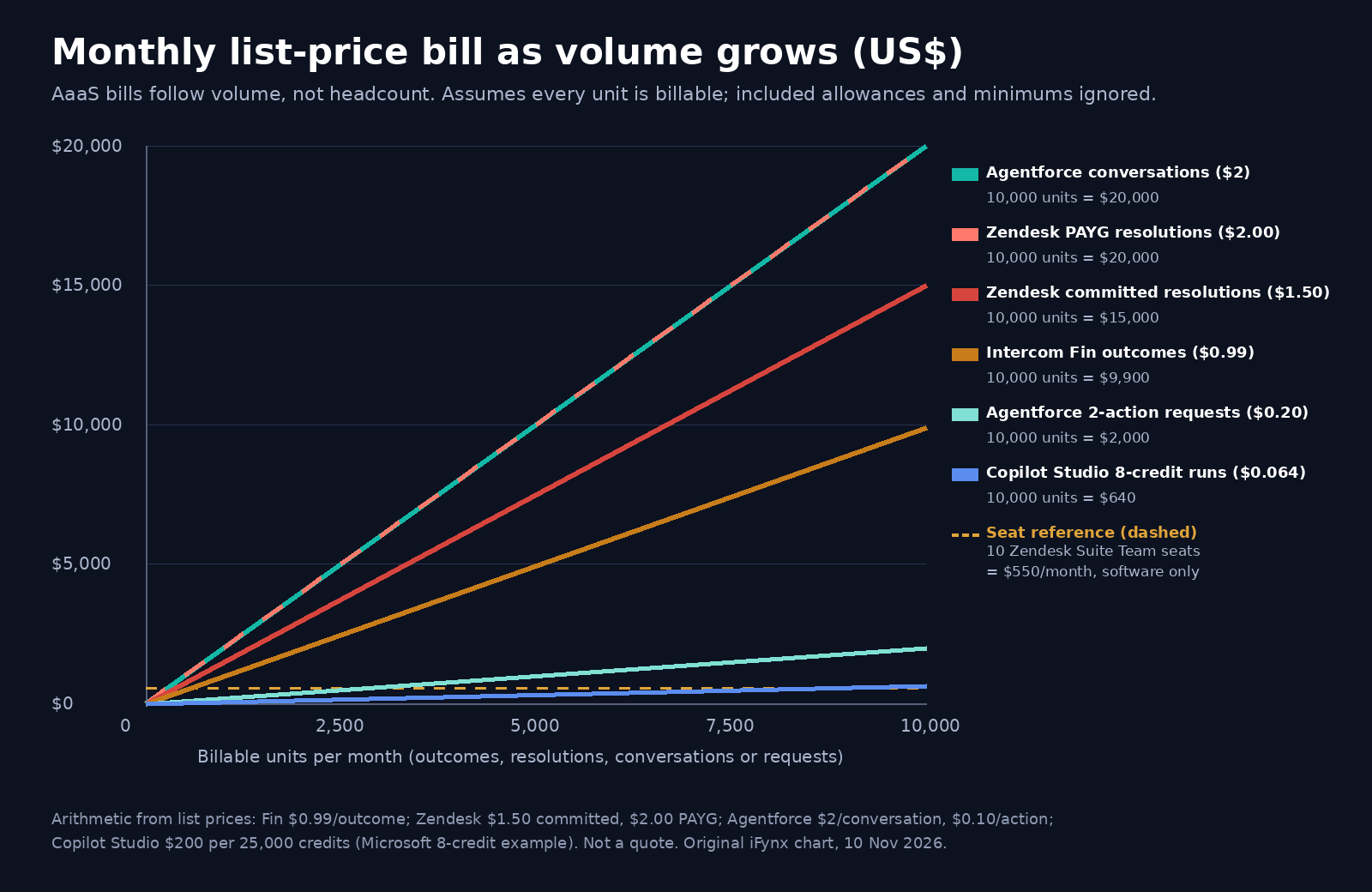
The arithmetic is simple, and that is the point: with AaaS, the bill follows volume, not headcount. At list prices, 1,000 billable Fin outcomes cost $990 a month; 5,000 cost $4,950; 10,000 cost $9,900. The same 10,000 units would cost $15,000 as committed Zendesk resolutions, $20,000 as Agentforce conversations, about $2,000 as two-action Agentforce requests on Flex Credits, or about $640 on Copilot Studio if every interaction looked like Microsoft’s light 8-credit example.
Those figures are not a like-for-like ranking. A two-action Agentforce request and a Fin “resolution” are not the same amount of work, and a Copilot Studio agent that calls a reasoning model on every turn can cost many times Microsoft’s light example. The honest comparison is against the cost of the human work being replaced or absorbed, not against the price of a SaaS seat: ten Zendesk Suite Team seats cost $550 a month in software, and the people in those seats cost far more. If an agent at $1 to $2 per resolved request clears a large share of repetitive questions, the saving comes from labour and waiting time. If it resolves few, an outcome-priced model costs little and a per-conversation model costs the full amount.
One more volume effect: an AaaS bill can jump in a peak month (Ramadan and Eid campaigns, White Friday, salary week or a service outage) exactly when a seat bill would stay flat. Every vendor here offers usage alerts or limits; set them before launch.
AaaS vs SaaS comparison table
| SaaS (software as a service) | AaaS (agents as a service) | |
|---|---|---|
| Who does the work | Your employee, inside the tool | The AI agent, with a human for exceptions |
| Pricing model | Per seat per month, sometimes tiered by features | Per action, conversation, credit or resolved outcome |
| What drives the bill | Headcount | Volume and how much the agent does per request |
| When it fails | A person makes a mistake or does not adopt the tool | The agent gives a wrong answer or takes a wrong action at scale |
| Data and security risk | Accounts, permissions and data held by the vendor | The same, plus an autonomous actor with API keys, tool access and prompt-injection exposure |
| Lock-in | Data export and retraining staff | Data export, plus agent instructions, procedures, credits and evaluation history tied to one platform |
| Budget predictability | High | Lower; needs alerts, caps and a fallback |
| Pick it when | Work needs judgement, collaboration, negotiation or a named accountable person | Work is frequent, rule-based, measurable and has a safe hand-off to a human |
The data and security risks are different, not smaller
A SaaS tool stores data. An agent acts on it. That difference shows up in incidents iFynx has covered this year. In the Mittwald MCP server breach, the connector that lets AI assistants reach a hosting account became the attack surface. In the WorkOS / ARTEX case, attackers used an AI-agent framework; in the Railway and Primcloud dispute, an employee’s agents probed a rival’s platform. And OpenAI’s Control Room shows how much engineering a reliable stop button takes.
Before you buy any agent service, ask the vendor for four things in writing: which permissions the agent’s tools need (read-only by default), how you revoke its keys in one place, how you cap spend and stop it, and what audit log you get for every action it takes. Gartner’s warning is worth taking seriously: in its 25 June 2025 press release, it predicted that over 40% of agentic AI projects will be cancelled by the end of 2027 because of escalating costs, unclear business value or inadequate risk controls. It also warned about “agent washing”, the rebranding of chatbots and RPA as agents, and estimated that only about 130 of the thousands of agentic AI vendors are real. In the same release, Gartner predicted that 33% of enterprise software applications will include agentic AI by 2028, up from less than 1% in 2024.
A decision checklist for Gulf and Egypt companies
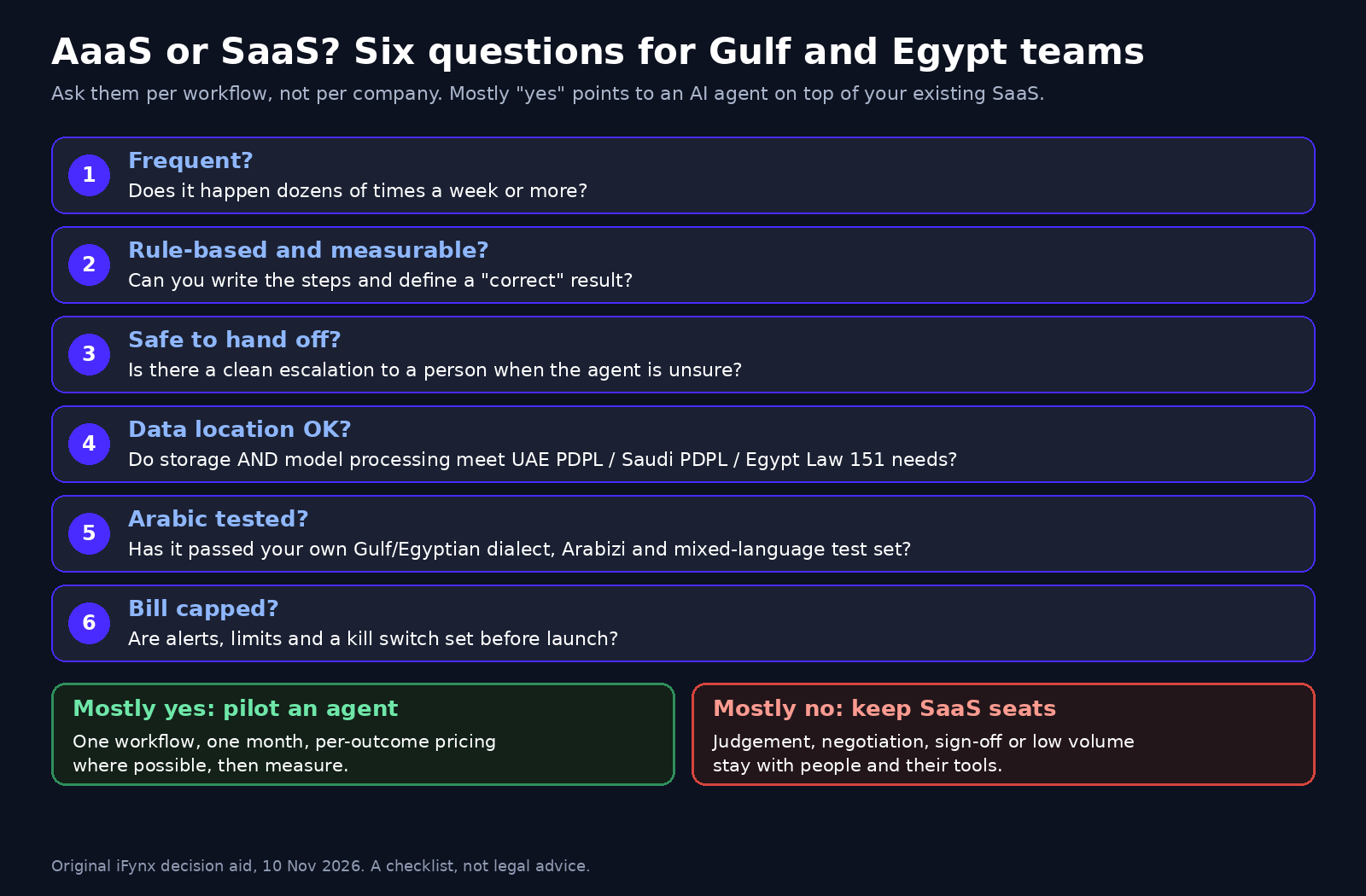
Run these checks before you sign, ideally on one real workflow with real Arabic messages.
- Where the data is stored. Microsoft lists UAE North (Dubai) as a Copilot Studio data location, and Salesforce says Hyperforce in the UAE supports UAE data residency (“not all services are available in all locations”). Salesforce announced in February 2025 that it would bring Hyperforce to Saudi Arabia; we did not confirm general availability on a Salesforce page. Intercom’s regional hosting is US, EU or Australia only, and Zendesk’s pricing page lists US, APAC, EEA or UK data centres.
- Where the AI actually runs. Storage is not processing. Microsoft’s Power Platform table says that for environments hosted in the United Arab Emirates, the Azure OpenAI service used by generative features is hosted in the United States when you allow data to move across regions. Ask every vendor the same question for the model behind its agent.
- The law that applies to you. UAE federal PDPL (Federal Decree-Law No. 45 of 2021) allows transfers abroad under Articles 22 and 23, for example to countries with adequate protection or under contract or consent, as summarised by the US International Trade Administration; DIFC and ADGM have their own data protection regimes, and health and financial data have separate rules. Saudi Arabia’s Regulation on Personal Data Transfer outside the Kingdom requires a risk assessment before certain transfers, including continuous or large-scale transfers of sensitive data (see our Saudi PDPL checklist). Egypt’s Executive Regulations to Law No. 151 of 2020 (Ministerial Decision No. 816 of 2025) entered into force on 2 November 2025 with cross-border transfer rules. This is a checklist, not legal advice; confirm with counsel.
- Arabic that customers actually write. Intercom lists Arabic (Modern) among Fin’s AI-answer languages. Microsoft lists Arabic for generative answers and orchestration, but event triggers, which start autonomous agents, are listed for English (US) only. Salesforce’s multi-language guide explains that for “beta” languages the customer is responsible for quality assurance; check Arabic’s current status on its language list. Test Gulf and Egyptian dialects, Arabizi and mixed Arabic-English, not only Modern Standard Arabic.
- Cost per resolution vs cost per seat. Estimate your monthly volume, the share an agent can realistically resolve, and the price of an escalated case. Compare that with the human time it saves, not with the seat price.
- Billing currency and caps. Intercom bills in USD only; Zendesk lists USD, EUR, GBP and BRL. Copilot Studio blocks agents at 125% of prepaid capacity unless pay-as-you-go is linked. Decide whether you would rather be blocked or billed in a peak month.
- Exit and lock-in. Intercom says workspace data cannot be migrated directly between regions; Salesforce credits do not roll over. Keep your knowledge base, procedures and test set in a format you own.
- A human fallback and a stop button. Every agent needs a clear hand-off to a person, an audit log and a single place to switch it off.
When SaaS is still the right answer
Keep paying per seat where the work is the human judgement: sales relationships, negotiations, design, legal sign-off, credit decisions and anything a regulator expects a named person to own. Our guide to AI agents for banks explains why explainability and consent matter in regulated journeys. SaaS also stays right for low-volume processes: if something happens twice a month, an agent’s setup and testing cost will not pay back.
For most companies, the practical answer to AaaS vs SaaS is “both”: keep the SaaS as the system of record and the place where people review exceptions, and add an agent for the repetitive slice. Start with one workflow that is frequent, measurable and safe to escalate, such as order status, appointment changes, delivery questions or first-line IT requests, and expand only when the numbers hold.
How iFynx can help
iFynx builds AI agents and automations that take over repetitive work across a company’s tools, with humans in the loop where judgement matters: workflow automation, custom AI agents and tool and API connectors, as described on our AI Agents & Automations service. Where a ready-made agent service fits, we can help you test it on your own Arabic and English data and set up guardrails and evaluation (AI Development); where it does not, our software development team can build the agent and the backend it needs. A good first step is a free 30-minute discovery call: contact us with one workflow and its monthly volume.
Frequently asked questions
What does AaaS mean in AI?
AaaS means agents as a service: a vendor supplies an AI agent that completes tasks such as answering, updating records or routing requests, and charges per action, conversation, credit or resolved outcome rather than per user seat. It usually runs on top of existing SaaS such as a CRM or helpdesk.
Is AaaS replacing SaaS?
Not in most companies. The agent usually works inside or on top of existing SaaS, which remains the system of record. What changes is who does the routine work and how it is billed. Gartner predicted in June 2025 that 33% of enterprise software applications will include agentic AI by 2028, while warning that over 40% of agentic AI projects may be cancelled by the end of 2027.
How much does an AI agent cost per resolution in 2026?
On public list prices checked on 10 November 2026: Intercom Fin $0.99 per outcome, Zendesk $1.50 committed or $2.00 pay-as-you-go per automated resolution, Salesforce Agentforce $2 per conversation or $0.10 per action on Flex Credits, and Microsoft Copilot Studio $200 per 25,000 credits, where a generative answer uses 2 credits. Units differ, so compare the cost of a fully resolved request.
Can Gulf and Egyptian companies use AI agents under local data protection law?
Often yes, with checks. Confirm where the vendor stores and processes data, then apply the UAE PDPL transfer rules (Articles 22 and 23) or DIFC and ADGM rules, the Saudi transfer regulation and risk assessment, or Egypt’s Law 151 of 2020 and its 2025 executive regulations. Sector rules for banks, health and government can be stricter. Get legal advice for your case.
Which is cheaper for a small support team: per seat or per resolution?
It depends on volume and resolution rate. Seats are cheap compared with the people in them; an agent at $1 to $2 per resolved request saves money only if it resolves a meaningful share of real requests. Pilot one workflow for a month with spending alerts, measure resolutions and escalations, and then decide.
Sources and update policy
Prices and terms were read on 10 November 2026 from: Intercom Fin pricing; Zendesk pricing; Salesforce Agentforce pricing; Microsoft Copilot Studio pricing and billing rates; Copilot Studio data locations, cross-region data movement and language support; Intercom regional hosting and Fin languages; Salesforce Hyperforce UAE, Saudi investment release and multi-language guide; Gartner, 25 June 2025; Sequoia Capital, 9 October 2024; US ITA on the UAE PDPL; SDAIA transfer regulation; Egypt executive regulations tracker. Vendors change prices often; we will update this article when a listed price or term changes. Charts are original iFynx work based on these list prices.
Related reading
- Dreamforce’s Answer to the SaaSpocalypse: AIforce, Koa, and the Interface Layer
- AI Agents for Banks: Regulated Product UX & Explainability
- OpenAI Control Room Explained: How a 35-Second AI Kill Switch Works, and How Gulf and Egypt Teams Can Build One for Their Own AI Agents
- ChatGPT Wallet: How OpenAI's Agent Payments Work, and Is It Available in the UAE, Saudi Arabia or Egypt?