Direct answer: Claude commerce agents are Anthropic’s open-source pair of shopping and merchant agents. The shopping agent searches a real catalogue, compares options, plans a basket and fills a cart, then hands off to the merchant’s own checkout. The merchant agent reads store data and stages listing, price, inventory or campaign changes for a person to approve. Anthropic launched the blueprint around 2 September 2026. As of this 8 November 2026 refresh, the public repository, docs and commerce page remain the primary sources — not a newly announced hosted checkout product.
This page replaces a thinner September reading with a product, UX and engineering pass over Anthropic’s own materials: the commerce article, the solutions page, the platform guide, the GitHub blueprint and its safety, backend and deployment notes. We checked those sources again on 8 November 2026. Partner-reported conversion figures below are Anthropic’s or Reuters’, not iFynx measurements.
Key facts (checked 8 November 2026)
- Launch window: Anthropic announced the blueprint on 2 September 2026 (Reuters); the public GitHub repo
anthropics/commerce-agentswas created on 1 September 2026. - What it is: a forkable Apache 2.0 reference — shopping agent plus merchant agent — with runnable retail, travel, telecom and entertainment examples and a Claude Code plugin. Anthropic says it is not a supported product or hosted service.
- What it is not: a consumer shopping destination, a payment processor, or a system that places an order or charges a card.
checkoutrenders the cart; a hosted checkout URL is attached after the model call. - On 8 November 2026 the GitHub API showed 3,435 stars and 710 forks. The visible commit on
mainstill carries an 31 August 2026 author date, so this refresh is not claiming a silent November feature release. - Anthropic’s article says retailers running shopping agents on Claude have seen carts up to 35% larger and shoppers 60% more likely to complete a purchase. Reuters quoted Angela Jiang describing about 30–35% larger carts for one partner and customers about 60% more likely to complete a purchase. Treat both as vendor-reported, not a Gulf/Egypt benchmark.
- The default merchant path stages every write and requires host approval outside the chat. An approval typed in the conversation approves nothing.
- A deployment still has to add authentication, payment, fraud rules, abuse controls and a way for people to see and delete memory facts. The examples accept any caller and bind MCP servers to loopback.


What shipped in September — and why we are refreshing it now
On 2 September 2026 Anthropic published a blueprint “to help build commerce agents on Claude.” The article and GitHub README describe two agents defined once — prompt, skills, tool contracts and gates — and runnable on the Messages API, the Claude Agent SDK and Claude Managed Agents. Demos cover retail, travel, telecom and entertainment (the original announcement also spoke of ticketing; the repo’s fourth vertical is now named entertainment, with an ACME Tickets example). A Claude Code plugin scaffolds the same design against your systems.
The timing still matters. Anthropic’s commerce page continues to frame the work as a way to “win the sprint to holiday season this year.” 8 November 2026 sits inside that window for Gulf and Egyptian retailers heading into late-year promotions. The reason to refresh this page is not a new Anthropic launch today. It is that teams searching for claude commerce agents, the claude commerce agents blueprint, or building claude commerce agents still land on a September-era summary, while the official docs now spell out the hand-off, the safety gates and what a deployment — not the model — must own.
The repository license is Apache 2.0, copyright 2026 Anthropic PBC. Anthropic is explicit: “This is a reference implementation; it is not maintained and does not accept contributions.” The platform guide repeats that it is “not a supported product or hosted service.” That is useful honesty for a procurement review. You fork it, you own what you ship, and you do not inherit an SLA on the sample code.
Nothing places an order, charges a card, or changes a live listing: checkout renders the cart for the host to complete, and every merchant write is staged until a person approves it.
Anthropic, commerce-agents README
The two Claude commerce agents, without the brochure language
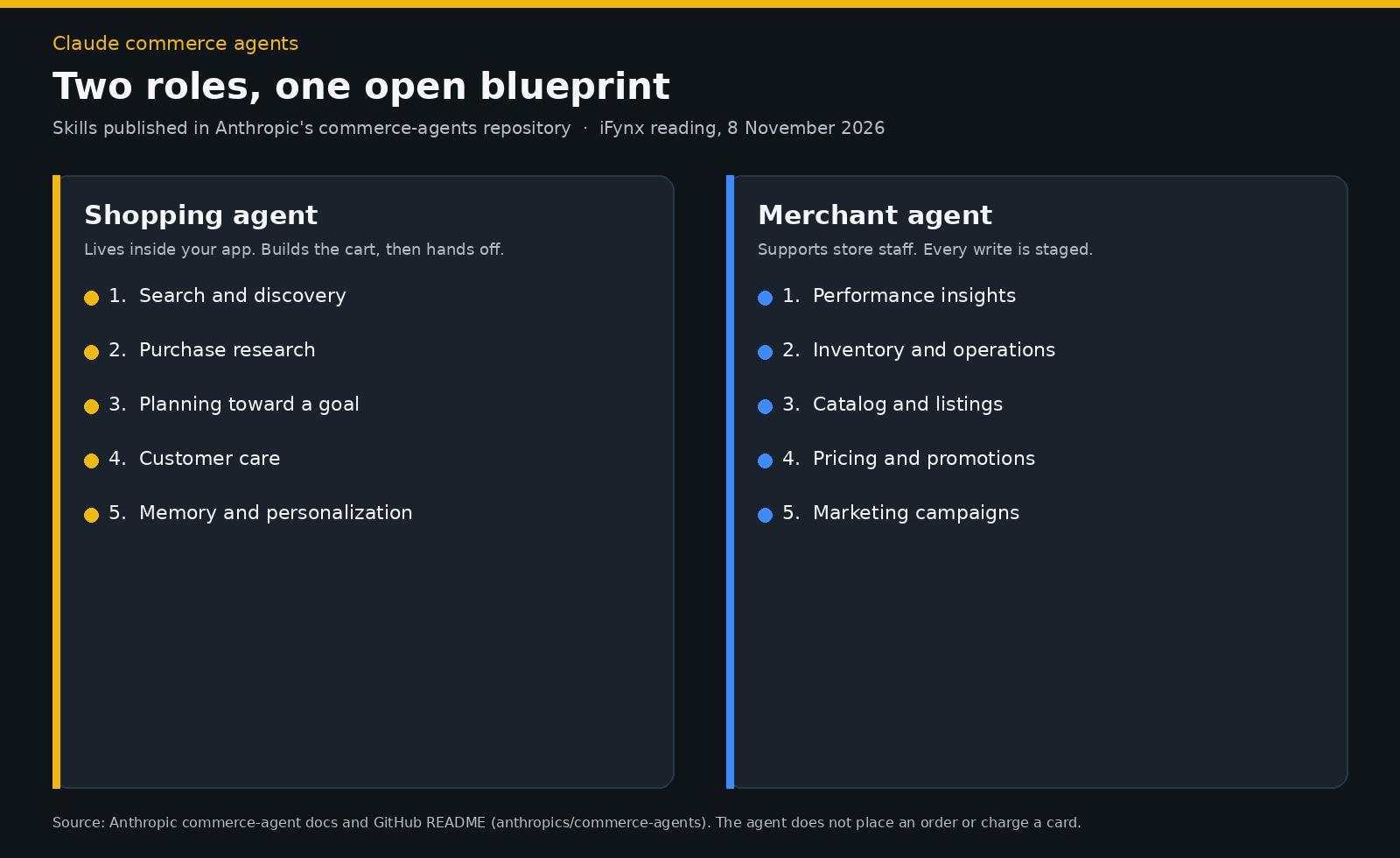
The platform guide is the cleanest official description. The shopping agent lives inside your app and reaches your catalogue, cart, preferences, order, policy and fulfilment systems through one backend interface you implement. In a conversation it can search and compare, turn a described need into a shortlist, plan a coordinated set of items toward a goal and a budget, show products and the cart as interface components rather than a wall of text, fill the cart, hand off to your checkout, answer order and policy questions from your own systems, and remember what a customer asks it to remember.
Its five on-demand skills cover search and discovery, purchase research, planning toward a goal, customer care, and memory and personalization. Rules the agent needs on most turns — grounding, cart and checkout semantics, presentation — live in the system prompt instead of being reloaded as skills.
The merchant agent supports the people running the store, whether that is your operations staff or sellers on a platform you operate. It can explain why a metric moved, present a daily digest (low stock, slow movers, order exceptions), improve listing content from material an operator supplies, recommend price changes and promotions within guardrails with a margin preview, and draft campaigns with audiences, placements and budget. An optional analysis delegate runs read-only queries under time and size limits.
Its five skills cover performance insights, inventory and operations, catalog and listings, pricing and promotions, and marketing campaigns. Every write — listing, price, inventory, promotion or campaign — becomes a staged change with a server-generated ID that the operator sees as a preview card.
| Surface | Who uses it | What it may do | What it must not do by default |
|---|---|---|---|
| Shopping agent | Customers, inside your app or site | Search, compare, plan, fill a cart, answer policy questions, remember stated preferences | Place an order, charge a card, invent a product or price, or see a hosted checkout URL |
| Merchant agent | Store staff or platform sellers | Explain performance, draft listing and campaign changes, flag inventory issues | Apply a live change without host approval, or treat a chat sentence as an approval |
Why the checkout hand-off is the actual product decision
Many rankings of Claude commerce agents stop at “AI that shops for you.” That is the wrong picture. Anthropic’s backend guide says the checkout tool ends the agent’s part: it renders the cart. Nothing in the repository places an order or takes payment. You pick one of three hand-offs: link to a checkout route in your own app (the default); open a platform-hosted checkout URL returned by checkout_handoff; or, on a marketplace, show one link per seller.
The safety document is even sharper. “A hosted checkout URL comes from checkout_handoff after the model’s call and never passes through the model.” Credentials your backend uses to call your services are resolved by the host from the session and never shown to the model. That matches the payment-UX stance we have argued on iFynx before, including in our notes on agentic payments and confirmation UX in MENA and Visa’s MENA survey on Egypt’s purchase intent: agents should assemble intent; rails should settle money.
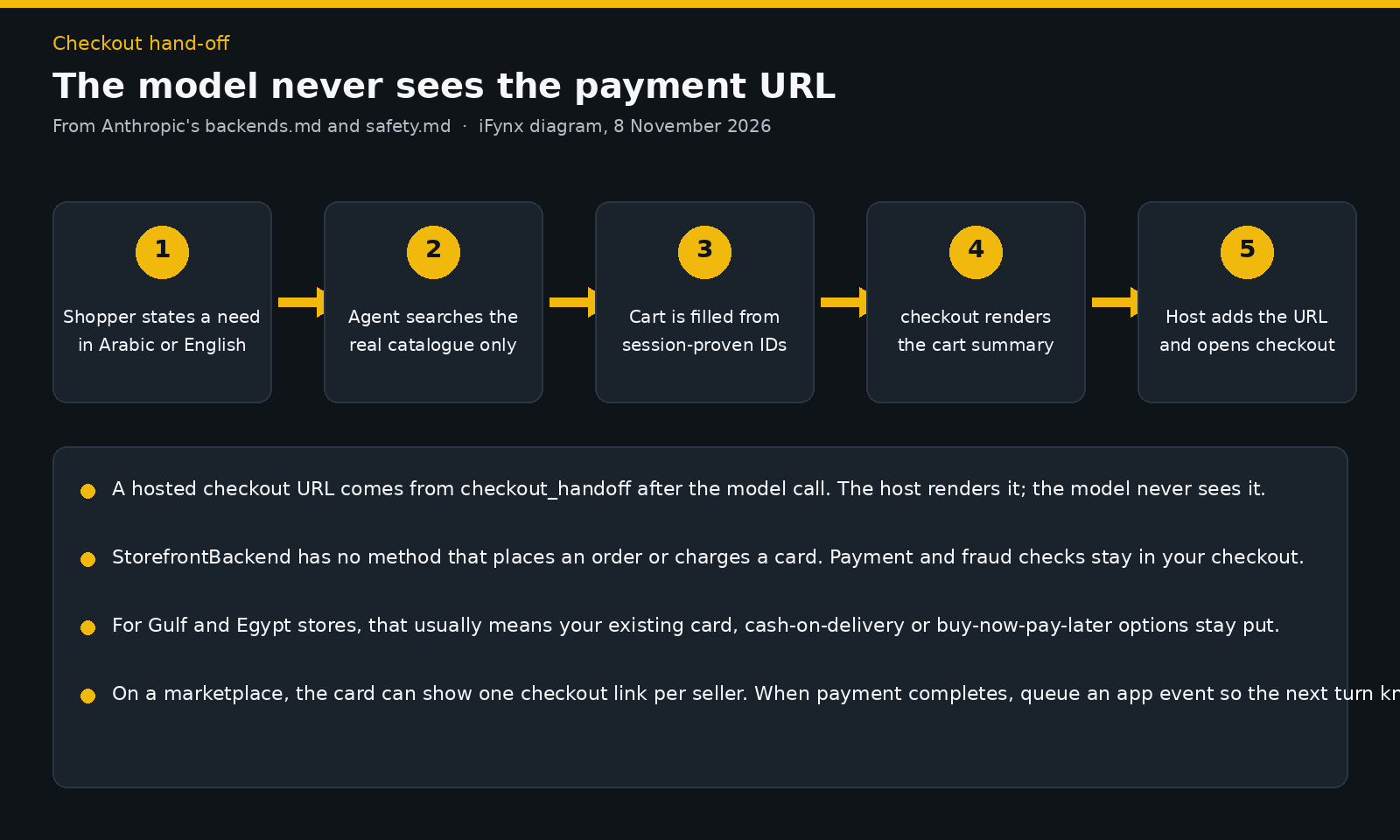


For a store in the UAE, Saudi Arabia, Qatar, Kuwait, Bahrain, Oman or Egypt, this boundary is not a limitation to apologise for. It is the only shape that keeps mada-style card flows, cash on delivery, bank transfers or a buy-now-pay-later option you already offer inside a checkout customers already recognise. We are not claiming those local methods are wired into Anthropic’s sample code. They are not. They live in your checkout, which is exactly where the blueprint stops.
The hand-off still has to feel continuous or shoppers will drop. Language should persist. The cart summary the agent just built should be visible on the payment screen. Fees that were disclosed in the conversation — delivery, cash-on-delivery, VAT — should match the totals at payment. When payment completes, Anthropic tells you to queue an application event so the next turn knows. That event is also how customer-care answers stay truthful after a failed or cancelled charge.
What the harness enforces, and what a Gulf deployment still owns
This is the part most recaps skip, and it is why the GitHub docs are worth reading before anyone demos a chat window to a board. Anthropic’s safety.md splits rules into three layers: enforced in code, still asked of the model, and owned by the deployment.
| Rule | Where it lives | Why it matters in the Gulf and Egypt |
|---|---|---|
| No payment | Code: StorefrontBackend has no pay/order method; checkout URL is attached after the model call | Card data, cash-on-delivery and local BNPL stay in your PCI and fraud stack, not in a prompt |
| Cart provenance | Code: cart writes accept only product IDs returned this session, or lines already in the cart | Stops the model adding a SKU it invented or copied from an untrusted page |
| Fencing | Code: third-party text is sanitised, wrapped in a fence and capped before the model reads it | Product reviews, tickets and policy PDFs cannot silently become new instructions |
| Merchant staging and host approval | Code, default on: apply succeeds only for IDs the host marked approved outside chat | A holiday price change cannot go live because someone typed “yes” in the sidebar |
| Memory limits | Code: short key/value facts; identifier-shaped values refused by default | National ID numbers and account identifiers should not become “helpful” memories |
| Authentication and abuse controls | Deployment-owned. Examples accept any caller | A public chat route without login or rate limits is not a storefront |
| Business rules | Deployment-owned: fraud, eligibility, pricing, inventory | Gates check provenance and caps; your backend decides whether a write is allowed at all |
| Memory as personal data | Deployment-owned: retention, access, deletion wired into account deletion | Needed wherever personal data rules apply to a store’s customers |
Anthropic is also clear about the demo’s limits. The examples have no authentication. The reference MCP servers bind to loopback unless an environment variable says an authenticating gateway sits in front of them. Default guardrail numbers in the sample config are demonstration values, not a pricing policy. If a team “had both agents running locally in well under an hour,” as one quote on Anthropic’s article puts it, that hour did not include production identity, payment or an Arabic catalogue.
Three ways to run the same design
The blueprint does not lock you to one Anthropic product SKU. The same agent definition can run as:
- Messages API — you own the loop. The examples are host applications around it, passing a session id in an
X-Session-Idheader. - Claude Agent SDK — the same prompt, skills and tools, with the SDK running the loop. The host prefetches grounding reads.
- Claude Managed Agents — a hosted agent over the same skills and contracts, calling your MCP server. This path runs on the Claude API; it is not a drop-in for every cloud.
The deployment guide says Messages API and Agent SDK runtimes can point at the Claude API, Google Cloud Vertex AI, Amazon Bedrock, Microsoft Foundry or an in-house gateway that serves /v1/messages with streaming. Managed Agents is “Yes” on the Claude API, “No” on Vertex and Foundry in the support matrix, and only via a pass-through proxy or Claude Platform on AWS for some other cases. Merchant analysis that uses hosted code execution is similarly narrower than analysis queries you run yourself. Choose the path for the controls you already have, not for the slide that lists the most logos.
A Claude Code plugin in the repo walks a team from nothing to a tested agent: /scaffold-commerce-agent, /add-commerce-flow, /author-commerce-evals and /review-commerce-agent. Those commands are scaffolding, not a substitute for catalogue work or evals written against your own Arabic queries.
A Gulf and Egypt reading the ranking articles do not give you
The unique work is not wrapping Claude around an English demo catalogue. It is making the conversation true in the languages and payment habits your shoppers already have.
Arabic catalogue quality comes before the chat window
The agent is allowed to state products, prices, availability and store terms only from tool results in the conversation. If your catalogue search is weak in Arabic — missing diacritics, mixing Egyptian and Gulf dialect, transliterating brand names three different ways, or storing size and colour only in English — the agent will look confident while retrieving the wrong variant. Family-and-variant handling in the backend guide is strict: cart, price and restock writes need a variant id when a listing has options. “The blue abaya, size 54” is exactly the sort of utterance that fails if search returns a family id and the gate then holds the write.
In-conversation UI has to work right-to-left
Anthropic’s shopping agent shows products, comparisons, plans, order status and the cart as UI components rendered in the conversation, not only as text. Those components are tools with validated payloads. A Gulf or Egyptian storefront that simply mirrors a left-to-right card will break price alignment, truncate Arabic titles, and put “Add to cart” on the wrong side of a comparison table. Brand voice (brand_name, assistant_name, brand_voice) can be set in config, but voice is not layout. RTL, bilingual strings and numeral handling are design-system work.
Keep the payment methods shoppers already finish
Egypt’s shoppers have told survey-takers they are open to agentic help and still need a confirmation they understand — the point of our earlier Visa MENA and Checkout.com readings. Gulf checkouts often combine cards, cash on delivery and instalments. Paymob’s raise was one reminder that the region’s rails are specialised. Claude commerce agents do not replace those rails. The product decision is whether the last screen the shopper sees still offers the method they came intending to use, with totals that match the conversation.
Merchant approval needs a bilingual queue, not a chat yes
Holiday trading is exactly when a merchant agent is most tempting: “what should we discount to clear last season’s inventory?” The blueprint’s answer is a staged change, guardrails on price move and promotion depth, and a person approving it in the portal, the SDK console, or an always-ask permission on Managed Agents. That person needs to see the old price, the new price, the margin preview and the Arabic storefront copy before clicking approve. A queue that only shows English internal SKUs will ship errors into the noisiest week of the year.
Use this iFynx checklist when you map Arabic catalogue fields, RTL cart components and the checkout hand-off; it is a delivery sequence, not a claim that the blueprint is already localised for the Gulf.
A practical checklist for companies
- Pick one category and one language pair for the pilot (for example Arabic-first fashion in Egypt, or bilingual electronics in the UAE). Do not start with the whole catalogue.
- Measure catalogue search against real shopper phrases, including dialect and transliterated brands, before connecting the agent.
- Decide the hand-off: your own checkout route, a hosted checkout URL, or per-seller links. Write down which payment methods must appear on that screen.
- Keep human approval on every merchant write that touches price, promotions, protected fees or live listings. Name the approver role for nights and weekends.
- Set memory policy: what a shopper may ask the agent to remember, how long it lives, and how it is deleted with the account. Do not store identifier-shaped values.
- Disclose delivery fees, cash-on-delivery fees and return rules from your policy system, not from a model paraphrase. Telecom-style “protected regulated fees” in the example is the right instinct for VAT and mandated charges too.
- Log model calls without treating debug bodies as ordinary logs. Anthropic notes that a debug request body can contain injected facts and the whole cart.
- Run evals on Arabic and English utterances, including multi-item planning, out-of-stock substitutions, and “where is my order?” after a failed payment.
- Tell customer care what the agent is allowed to promise. An agent that invents a return window will create tickets faster than it closes sales.
A practical checklist for developers
- Implement
StorefrontBackendorMerchantBackendserver-side. The model should see tool results, never the credentials used to call your services. - Switch off flows you do not have with the config flags so their tools and prompt lines disappear, instead of stubbing them with hallucinated success.
- Honour family versus variant IDs. If a parent platform id can collide with a child, prefix the family id as the backend guide warns.
- Attach hosted checkout URLs only through
checkout_handoffafter the model call. Never pass a payment link back through the assistant text. - Keep
require_host_approvalon until you have a written policy for any automatic apply. Do not treat a preview card as an approval. - Put authentication and rate limits in front of every chat and MCP route. The sample servers are not a security baseline.
- Add prompt-injection cases to evals: a product description or review that tries to raise a discount or leak another customer’s order.
- Verify grounding: terms questions, post-purchase questions and unseen product IDs should force a read tool before the model answers.
- Record
cache_read_input_tokens(or the runtime log line) so a bilingual prompt rewrite does not silently destroy prompt caching.
How iFynx can help
If you are mapping a Claude commerce agent onto a Gulf or Egyptian catalogue, the work usually sits across two iFynx services: AI Agents & Automations inside AI & Data, and Product Design / UX/UI Design for the in-conversation cards and the checkout hand-off. That means Arabic search quality, RTL components, a continuous cart summary and a human approval queue — not a promise that we resell Anthropic’s blueprint. Use the AI Solution Advisor to see whether an agent is the right shape, or start a discovery call.
Frequently asked questions
What are Claude commerce agents?
They are two reference agents in Anthropic’s open blueprint: a shopping agent that customers use inside your app, and a merchant agent that store staff use to inspect performance and stage operational changes. Anthropic published the blueprint around 2 September 2026.
Is the Claude commerce agents blueprint a hosted Anthropic product?
No. Anthropic’s docs say it is a reference implementation to fork and adapt, not a supported product or hosted service. There is no service-level agreement on the reference code, and Anthropic says it does not maintain the repository or accept contributions.
Do Claude commerce agents process payments or place orders?
No. The shopping-agent backend has no method that places an order or charges a card. The checkout tool renders the cart for the host to complete. If you use a hosted checkout, the URL is added after the model’s call and never passes through the model.
Can a merchant agent change prices or listings by itself?
Not with the default harness. Every merchant write is a staged change with a server-generated ID. Guardrails are checked when the change is staged and again when it is applied. The change applies only after a person approves it outside the conversation. An approval typed in chat approves nothing.
How do I start building Claude commerce agents?
Fork the GitHub repository, run a vertical demo (retail, travel, telecom or entertainment), then implement StorefrontBackend or MerchantBackend over your own systems. A Claude Code plugin can scaffold, add a flow, author evals or review an agent you already run. The code can call the Claude API, Amazon Bedrock, Microsoft Foundry, Google Cloud Vertex AI or your own gateway.
What should Gulf and Egypt stores add that the blueprint does not include?
Authentication, authorization, abuse controls, fraud and eligibility rules, actual payment, and a review path for memory that may hold personal data. You also have to supply Arabic catalogue quality, right-to-left conversation components, and a hand-off that keeps language, cart summary and the payment methods shoppers already trust.
Does the blueprint invent prices or run manipulative upsells?
Anthropic says the consumer agent is structurally prevented from inventing a price or a product, and that manipulative upsell patterns are prohibited. Cart writes accept only product IDs a catalogue or order tool returned in that session. You still owe your own pricing and promotion rules.
Will this work with Arabic and an RTL checkout?
The blueprint can render products, comparisons, plans, the cart and order status as UI components inside the conversation, and it leaves brand voice and the checkout route to you. Arabic search quality, RTL layout, bilingual policy answers and a continuous hand-off into an Arabic checkout are implementation work, not defaults we found documented as Gulf-ready.
Sources and how we will update this page
- Building commerce agents with Claude — Anthropic article
- Claude for commerce — Anthropic solutions page
- Commerce agent platform guide
- anthropics/commerce-agents on GitHub (Apache 2.0), including safety.md, backends.md and deployment.md
- A guide to the anatomy of effective commerce agents — engineering companion Anthropic points to from the docs
- Reuters, 2 September 2026: Anthropic launches AI agent blueprints for retailers
- GitHub API check by iFynx on 8 November 2026: 3,435 stars, 710 forks; visible
maincommit author date 31 August 2026
We will change launch claims, payment behaviour, approval rules or partner-reported figures only when a primary Anthropic, GitHub or named-partner source updates them. This 8 November 2026 refresh does not invent a new Anthropic product announcement.