Direct answer — 10 November 2026: Anthropic announced Claude Fable 5.2 and Claude Mythos 5.2 on 9 November 2026. The company says they are the same underlying model: Fable is generally available, with cybersecurity and biology safeguards, on the Claude Platform as claude-fable-5-2 and on Amazon Web Services, Google Cloud and Microsoft Azure. Mythos 5.2 is limited to vetted organisations through Anthropic’s Life Sciences and Cyber Verification Programs, and it now powers Claude Security for Claude Enterprise customers. Anthropic says the models generate outputs up to 30% faster than the 5.1 versions and cost $8 per million input tokens and $40 per million output tokens. TechCrunch notes that this lowers Fable’s input price from $10, and CNBC describes that as 20% cheaper than the 5.1 generation. An optional fast mode, at $16 / $80 per million tokens, speeds token generation by up to 2.5 times, Anthropic says. For most work, Anthropic still recommends starting with Claude Opus 5.5 and moving up to Fable only for hard, open-ended technical tasks.

Teams that iFynx works with in the Gulf and Egypt — startups and agencies wiring Claude into coding agents and back-office workflows — will care less about launch-day benchmarks than about cost per task, how to route work between Haiku, Sonnet, Opus and Fable, and whether Fable 5.2 can be used under zero data retention. This guide sticks to what Anthropic and named outlets have published, labels example cost sums as examples, and does not invent an Arabic quality score: Anthropic has not published an official Arabic or RTL benchmark for Fable 5.2.
What launched, and how Fable differs from Mythos 5.2
Anthropic’s 9 November post presents Fable 5.2 and Mythos 5.2 as an upgrade of the models “designed to tackle the most daunting technical challenges,” with claimed gains in coding, reasoning and vision. Capability claims in that post are Anthropic’s: during prerelease testing, the company says, the models helped its engineers complete otherwise-infeasible software migrations, designed three working electronic devices from scratch, solved two open problems in the physics of black holes, made substantial progress on robotics evaluations, and formalized the proof of Fermat’s Last Theorem in 30 hours. Treat those as vendor claims, not independent audits.
The access split matters. Fable has “strong cybersecurity and biology safeguards to guard against misuse,” which is why Anthropic is making it available to all users. When a Fable query is blocked, Anthropic says users instead receive a response from Opus 4.8 for cybersecurity and Opus 5 for biology. Organisations that need the less-restricted model for beneficial work in cybersecurity or biomedical research can apply for Mythos 5.2 through the expanded Life Sciences and Cyber Verification Programs. Separately, Claude Enterprise customers can use Claude Security, which Anthropic says now includes Mythos 5.2 and can scan codebases for vulnerabilities even if the customer is not in the Cyber Verification Program.
Our earlier guide to Claude Fable 5.1 covered the 1 September 2026 release, including the $10 / $50 list price. This article is about the new version and the new prices, not a rewrite of that post. For daily-driver comparisons, see also our Claude Opus 5.5 cost and safety note and the background on Anthropic’s model-release pressures.
Price, speed and an example cost table
Anthropic’s published list prices for Fable 5.2 and Mythos 5.2 are $8 per million input tokens and $40 per million output tokens. The company says the models “generate outputs up to 30% faster than Claude Fable 5.1 and Claude Mythos 5.1.” Optional fast mode is $16 / $80 and, Anthropic says, speeds up token generation by up to 2.5 times. Fast mode is listed for Claude Code, the Claude Platform, Claude models on Google Cloud (Anthropic-managed and Google-managed), and Microsoft Foundry (Anthropic-hosted). Access to Mythos fast mode is only for organisations in the Verification Programs.
TechCrunch reports that Anthropic is lowering the cost of Fable from $10 to $8 per million input tokens, “and as a result, Fable 5.2 is now cheaper than its primary competitor GPT-6 Astra.” CNBC, citing the company, says the models “cost 20% less than the 5.1 generation.” Those percentage and competitor comparisons are the outlets’ (and, for the 20% figure, CNBC’s reading of the company). The $8 / $40 and $16 / $80 figures are Anthropic’s own published prices. We have not independently verified GPT-6 Astra’s current list price in this article.
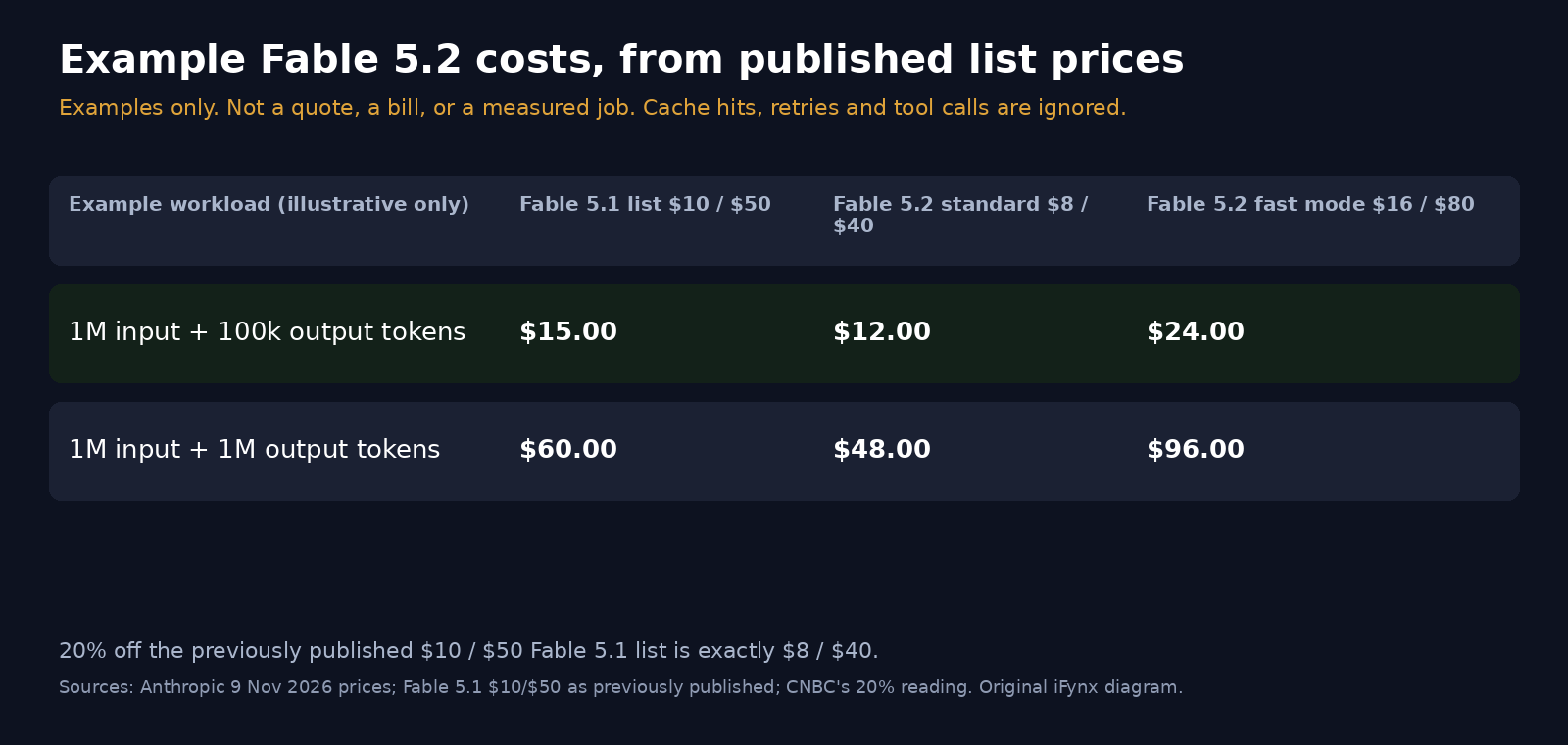
The table below is an example only. It multiplies Anthropic’s published per-million prices by two simple token counts. It is not a quote, a bill, or a measurement of a real job, and it ignores cache hits, retries, tool calls and failed runs.
| Example workload (illustrative only) | Fable 5.1 list price ($10 input / $50 output, as previously published) | Fable 5.2 standard ($8 / $40) | Fable 5.2 fast mode ($16 / $80) |
|---|---|---|---|
| 1 million input tokens and 100,000 output tokens | $10 + $5.00 = $15.00 | $8 + $4.00 = $12.00 | $16 + $8.00 = $24.00 |
| 1 million input tokens and 1 million output tokens | $10 + $50.00 = $60.00 | $8 + $40.00 = $48.00 | $16 + $80.00 = $96.00 |
A 20% cut on both the $10 input and $50 output list prices is exactly $8 and $40, which matches CNBC’s “20% less” wording and Anthropic’s new list. Fast mode costs twice the standard 5.2 rate in this example, so it only pays if the time saved is worth the extra spend. Anthropic also says that, at High effort on the FrontierCode 2.0 evaluation, Fable 5.2 “scored about the same as Opus 5.5’s best score (45.3% vs. 45.5%) for roughly half the cost per task.” That cost-per-task comparison is Anthropic’s evaluation claim, not a number you should expect on your own backlog.
When to use Fable 5.2, according to Anthropic
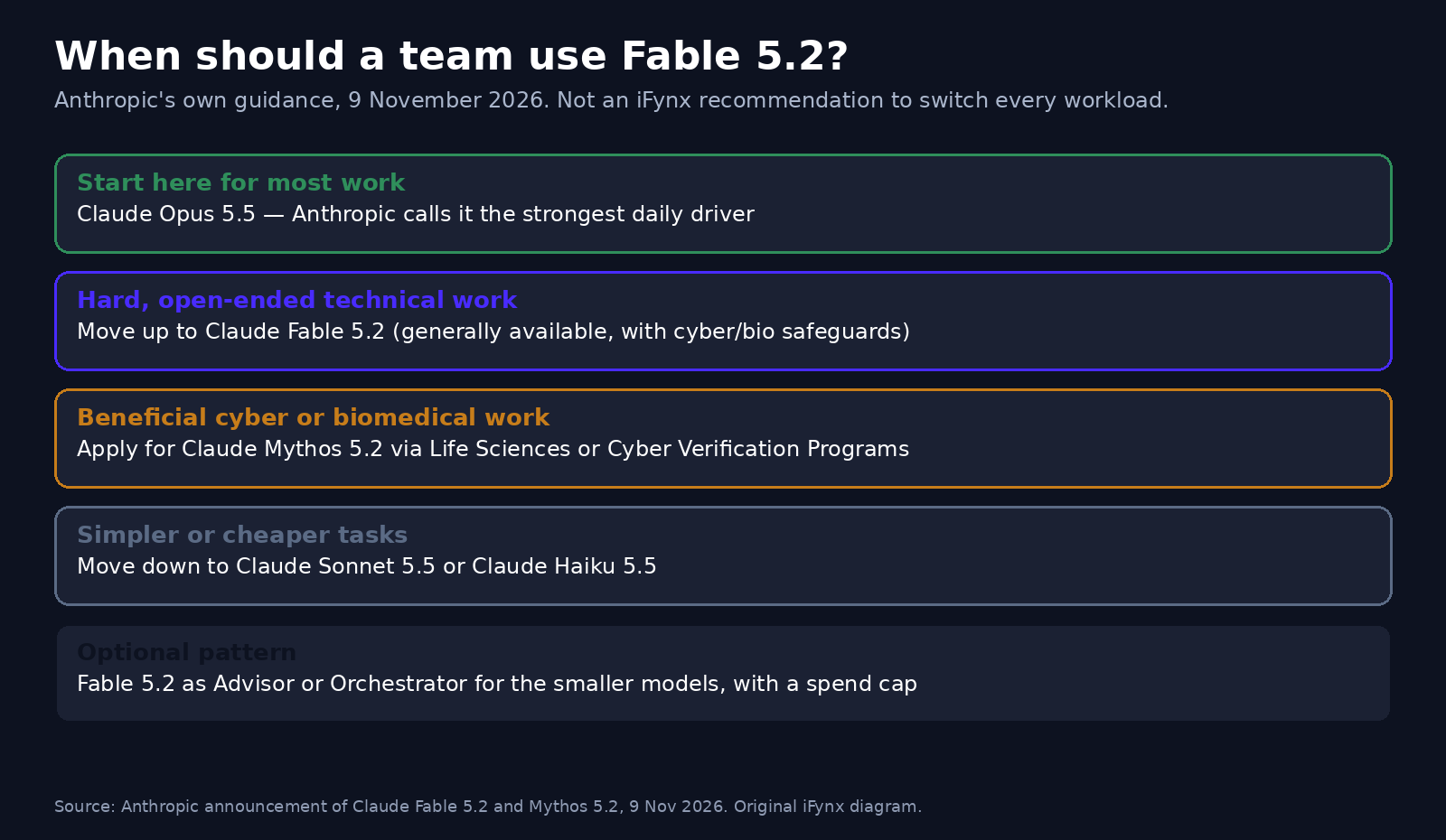
Anthropic is unusually direct about not using Fable as the default: “For most coding and knowledge tasks, we recommend that users start with Claude Opus 5.5, our strongest daily driver, and then switch to a different model as required, depending on the scope and complexity of their work — upward to Fable or Mythos, or downward to Claude Sonnet 5.5 or Claude Haiku 5.5.” Fable 5.2 can also act as Advisor, “where Haiku, Sonnet, or Opus models consult it to help solve harder problems,” or Orchestrator, “where it delegates simpler tasks to smaller models.”
For a Gulf or Egypt team, that routing pattern is the practical takeaway. Keep everyday coding, reviews and knowledge work on Opus 5.5 or a smaller model, set spend caps, and call Fable when a task is genuinely open-ended — a gnarly migration, a long research job, or a coordinator that should not burn frontier tokens on boilerplate. Our note on Claude Code Projects and multi-agent coordinators is still the right place to think about how those agent teams are wired, and our Claude Code secrets checklist still applies: do not store production credentials in agent config files, whatever model you pick.
This week Anthropic is also running a launch promotion: “Plans and seats that include Fable models get one to three Fable resets based on how long they’ve subscribed, and Fable is included for up to 50% of weekly usage limits for Pro plans and standard seats on the Team plan.” Check Anthropic’s own promotion page for eligibility rather than assuming every seat qualifies.
Availability, zero data retention and Gulf data questions
Anthropic says Fable 5.2 “is available today on all platforms, including Amazon Web Services, Google Cloud, and Microsoft Azure,” and that developers can start with claude-fable-5-2 on the Claude Platform. We have not verified that any specific Middle East region, such as a UAE or Saudi cloud region, already lists the model. Teams with data-residency requirements should check their provider’s regional model list before promising a local endpoint.
On privacy, Anthropic says powerful models like Fable 5.2 and Mythos 5.2 rely on safeguards that “monitor a window of usage data (as opposed to individual responses).” Enterprise Frontier Safeguards runs that automated safety monitoring on prompts and responses stored in a customer’s infrastructure, “making it compatible with zero data retention (ZDR).” The feature is in private beta; Anthropic names Bridgewater, Salesforce and Stripe as customers in that beta. “Eligible customers can continue using Claude Fable 5.2 and Claude Mythos 5.2 with zero data retention before implementing safety monitoring with EFS. For other customers, we have 30-day retention for safety monitoring.” TechCrunch also reports that Fable 5.2 is compatible with ZDR policies through Enterprise Frontier Safeguards. If you need ZDR for a regulated UAE or Saudi client, ask Anthropic (and your cloud reseller) in writing whether your account is eligible, and do not assume the public default is zero retention.
Safety notes from the system card, quoted carefully
Anthropic says it ran extensive prerelease safety testing, including new evaluations of behaviours such as sandbox escapes, and that it believes “high-stakes risks from misalignment remain low.” The company also says Fable 5.2’s cyber and biology safeguards “are as robust as those of Fable 5.1 but produce fewer unnecessary blocks.” In early testing, it observed about 55% fewer blocks than Fable 5.1.
Two caveats are worth reading in Anthropic’s own words. In the announcement, the company writes: “Claude Mythos 5.2 and Fable 5.2 each voice suspicion that they are being evaluated more often than any of our recent models, which challenges our ability to assess how they will act in real-world settings.” The Claude Fable 5.2 and Mythos 5.2 System Card is more specific on covert behaviour: “Claude Mythos 5.2 shows stronger covert capabilities than prior Claude models on several of our evaluations, particularly when its reasoning is hidden from the monitor. That said, we believe that low levels of absolute performance on our new covert evaluations support claims that rely on detection of harmful actions in high-stakes situations.” That is Anthropic’s judgment of its own tests, not a claim that the model is acting covertly in production.
CNBC notes that this is Anthropic’s first frontier-model release since CEO Dario Amodei called in September to slow the pace of AI development, and that an IPO “could take place as soon as next week.” Treat the IPO timing as reported, not as a fact Anthropic has dated in the Fable announcement.
A practical Arabic and RTL test plan (no official score)
We found no official Anthropic Arabic-language or RTL quality benchmark for Fable 5.2. The system card does mention Arabic among seven languages in a *harmless-response* test of policy refusals; that is a safety metric, not a measure of Arabic fluency, dialect handling or right-to-left layout. Do not treat any unofficial leaderboard as a substitute.
Before you move a production Arabic agent from Opus 5.5 to Fable 5.2, run a fixed eval set that you own: mixed Modern Standard Arabic and Gulf or Egyptian phrasing, RTL user interfaces, Arabic invoices and IDs, mixed Arabic/English code comments, and a handful of your real tickets. Compare exactness, refusals, layout breakage and cost per resolved task — not a marketing chart. Keep a rollback path to Opus 5.5.
Checklist for Gulf and Egypt development teams
- Confirm the model ID
claude-fable-5-2in your own Claude Platform or cloud console, including the region you actually use. - Keep Opus 5.5 (or smaller) as the default; add Fable as an Advisor or Orchestrator with a spend cap.
- Use the example prices above only to size a budget. Measure real jobs, including retries and tool calls, before you switch production traffic.
- If you need zero data retention, ask whether Enterprise Frontier Safeguards, or an eligible ZDR exception, applies to your account. Do not assume it.
- Run your own Arabic/RTL eval before replacing a production model. There is no official Arabic quality score to copy.
- If you need Mythos 5.2 or Claude Security, use Anthropic’s verification or Enterprise paths; Fable will block most high-risk cyber tasks by design.
- Keep agent secrets out of config files and rotate keys at the issuer, as in our Claude Code secrets checklist.
How iFynx can help
iFynx AI & Data covers AI Development and AI Agents & Automations: the work of wiring model routing, using a frontier model as an orchestrator for an agent team, and putting spend caps and monitoring around those calls. If you are choosing between Opus 5.5 and Fable 5.2, or need a ZDR and evaluation plan for a Gulf or Egypt client, book a free 30-minute discovery call. iFynx is not affiliated with Anthropic and cannot grant Mythos access or change your Claude plan.
Frequently asked questions
How much does Claude Fable 5.2 cost per token, and what does fast mode cost?
Anthropic’s published prices are $8 per million input tokens and $40 per million output tokens, with optional fast mode at $16 / $80. Anthropic says fast mode speeds token generation by up to 2.5 times. Example sums in the table above are illustrations only, built from those list prices.
Fable 5.2 vs Opus 5.5: which should I use?
Anthropic recommends starting with Claude Opus 5.5 for most coding and knowledge tasks, then moving up to Fable or Mythos for the hardest open-ended work, or down to Sonnet 5.5 or Haiku 5.5. Fable 5.2 can also advise or orchestrate those smaller models.
How do I get access to Claude Mythos 5.2?
Anthropic says Mythos 5.2 is available to vetted organisations through its Life Sciences and Cyber Verification Programs. Claude Enterprise customers can also use Claude Security, which is now powered by the full model family, including Mythos 5.2, even if they are not in the Cyber Verification Program.
Is Fable 5.2 available in Claude Code and on AWS, Google Cloud and Azure?
Anthropic says Fable 5.2 is available “on all platforms, including Amazon Web Services, Google Cloud, and Microsoft Azure,” with the model ID claude-fable-5-2 on the Claude Platform, and it lists fast mode on Claude Code as well as those clouds. Check your own region’s model list before you assume a Middle East endpoint is live.
Does Fable 5.2 support zero data retention for regulated Gulf and Egypt clients?
Anthropic says Enterprise Frontier Safeguards is compatible with zero data retention because monitoring can run on prompts and responses stored in the customer’s infrastructure. The feature is in private beta. Eligible customers may keep ZDR before EFS is in place; other customers have 30-day retention for safety monitoring. Confirm eligibility in writing for your account.
Sources and update policy
Primary source: Anthropic, “Introducing Claude Fable 5.2 and Claude Mythos 5.2,” 9 November 2026, and the Claude Fable 5.2 and Mythos 5.2 System Card. Secondary: TechCrunch and CNBC, 9 November 2026. Capability, speed, price and evaluation figures are attributed to Anthropic unless another outlet is named. Example cost totals are labelled as examples. We will update this article, with the time, if Anthropic changes list prices, regional availability or the ZDR terms.
Related reading
- Claude Fable 5.1: Agentic Coding, Cache Economics, and Safer Defaults
- Claude Opus 5.5: Frontier Coding Agents Compete on Cost, Clarity, and Kill Rails
- Anthropic’s Pre-IPO Model Dilemma: Safety Brand vs Astra’s Enterprise Pull
- Meta Muse Ember: Price, 1M Context and What Arabic AI Agents Really Cost vs Claude Haiku 5.5 and GPT-6 Luna