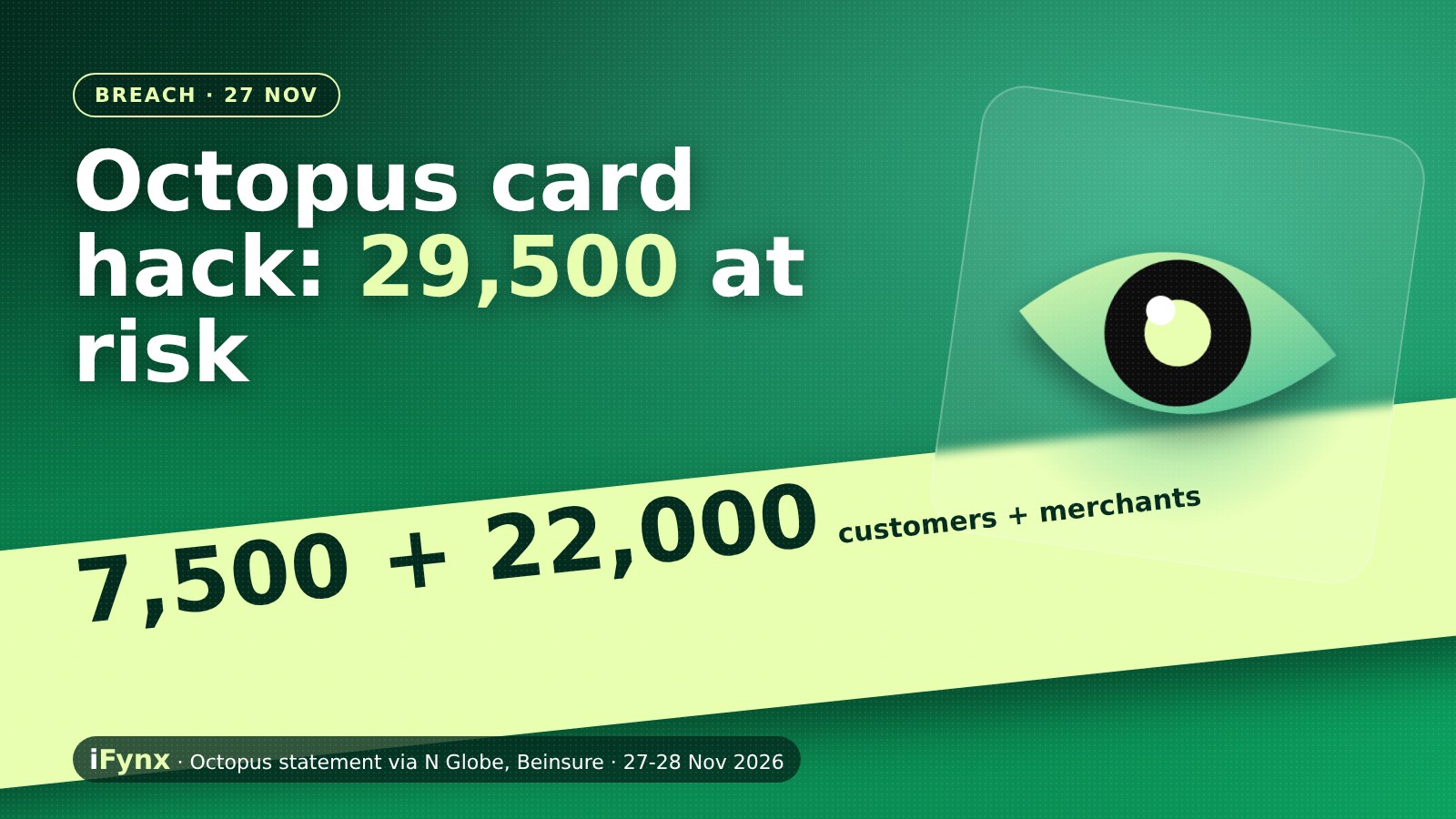
Octopus, the company behind Hong Kong’s most used payment and transit card, said it detected a cyberattack on the morning of 27 November 2026. Data of about 7,500 customers (names, photos and, for some, auto top-up bank codes and amounts) and about 22,000 merchant contacts may have been exposed. Octopus says no card or bank account numbers were exposed, no customer has lost money, and cards and the app work normally.
Checked 18:50 Asia/Gaza, 28 November 2026. We are updating this story.
Octopus is used every day by millions of people in Hong Kong, including many Gulf and Egyptian travellers, students and businesses with offices there. At iFynx we turned the company’s notice, as reported by N Globe, ZeroHour and Beinsure, into a simple action plan. We found no Arabic article on this breach yet.
What data was exposed in the Octopus hack?
- ! About 7,500 customers: names and photographs
- ! Some of them: automatic add-value (auto top-up) details, meaning bank codes and top-up amounts
- ! About 22,000 merchants: contact names, job titles, email addresses and phone numbers
- ✓ Credit card numbers
- ✓ Bank account numbers (a bank code is not an account number)
- ✓ Card and wallet balances, which Octopus says remain protected
The counts are Octopus’s own and most reports say the data “may have been” exposed. Headlines saying “30,000” simply add the two groups (7,500 + 22,000 = 29,500). Octopus has not said which system was hit or how attackers got in, and no hacker group has claimed the attack so far. Beinsure reports that Hong Kong’s privacy regulator, the PCPD, received a breach notification on Friday and opened a review.
Are Octopus cards and the app still safe to use?
According to Octopus, yes: Octopus cards, Mobile Octopus and the Octopus Wallet work as usual and no financial loss had been found. A small number of functions may be limited for a while as a precaution. Affected people will be contacted directly by email or SMS, and that is exactly the moment scammers like to copy.
Your Octopus breach playbook: now, today, this week
Why this matters for the Gulf and Egypt
Stored-value and transit cards with linked bank top-ups are common in the region too, such as Dubai’s Nol card. The Octopus case shows that the risky data is often not the card number but the profile around it: name, photo, bank code and contact details, which make scam calls convincing. Any operator of a card, wallet or merchant portal in the Gulf or Egypt should check what its customer profiles hold and who can export them. See our Gulf and Egypt data breach tracker for incidents in the region.
How iFynx can help
iFynx builds and secures payment apps, wallets and merchant portals for companies in the Gulf and Egypt. We review who can see and export customer data, harden logins, and add scam-resistant notification flows.
Ask iFynx for a wallet and merchant-portal security review · What we do
Frequently asked questions
Was Octopus hacked?
Yes. Octopus Cards said it detected a cyberattack on its systems on the morning of 27 November 2026 and is investigating with the relevant authorities notified.
How many Octopus users were affected?
About 7,500 customers and about 22,000 merchants may have had data exposed, according to Octopus. That is 29,500 records in total, often rounded to 30,000.
Was my Octopus card number or bank account leaked?
Octopus says no credit card numbers or bank account numbers were exposed. Some customers’ auto top-up bank codes and amounts may have been.
Can I still use my Octopus card and Octopus Wallet?
Yes. Octopus says cards, Mobile Octopus and the Octopus Wallet work normally and balances remain protected, though a few functions may be limited temporarily.
Who hacked Octopus?
No group has claimed the attack and Octopus has not disclosed the entry point as of 28 November 2026.
How can iFynx help protect a payment or wallet app?
iFynx reviews data access, logins and customer notification flows for payment apps, wallets and merchant portals in the Gulf and Egypt, and fixes the gaps it finds.
Sources: Octopus notice of 27 November 2026 as reported by N Globe (28 Nov, 02:16 GMT), ZeroHour (28 Nov, summarising GBHackers and DataBreaches.net) and Beinsure (28 Nov). PCPD detail from Beinsure only.
Related reading
- UK DWP confirms cyberattack: Universal Credit offline, payments continue
- Korea Post hacked: 113,855 customers and the delivery-scam risk
- GoDaddy data leak claim: 6 myths vs facts
Every Sunday: the most serious confirmed CVEs and breaches, who is exposed in Saudi Arabia, the UAE and Egypt, and what to patch first. Free, in English and Arabic, one-click unsubscribe.
✓ You’re subscribed. A welcome email is on its way; the first issue arrives on Sunday.