Direct answer — 14 November 2026: No, not yet. ChatGPT Wallet, which OpenAI launched on 13 November 2026, lets your ChatGPT agent pay for things on your behalf. According to OpenAI’s help page, it is rolling out gradually to ChatGPT Pro users in the United States who are 18 or older, live in the US, and have an eligible US-issued American Express, Chase, Mastercard or Visa credit card with a US billing address. Debit cards and virtual cards are not supported at launch. A Pro subscriber in Dubai, Riyadh or Cairo with a locally issued card does not meet those conditions, and OpenAI has not announced a date or a list of next countries. It says only that it will “expand availability” after learning from early use. What Gulf and Egyptian businesses can do now is get their online stores ready for agent shoppers.

ChatGPT Wallet is the clearest sign yet that AI agents will soon arrive at checkout pages, including the ones iFynx builds for retailers, fintechs and marketplaces in the UAE, Saudi Arabia and Egypt. This iFynx explainer covers how a purchase works, who can use it today, what it means for shoppers in the region, and what merchants and payment apps should prepare. We re-read OpenAI’s announcement and help page at about 13:05 Asia/Gaza on 14 November 2026 and use only what they state. Where OpenAI has not said something, such as a launch date outside the US, we say so rather than guess.
Key facts (checked 14 November 2026, before publishing)
- What it is: a wallet inside ChatGPT that lets your agent pay “without access to users’ actual card details” and requires “a security check for every purchase”, in OpenAI’s words.
- Launch: announced 13 November 2026 and “rolling out gradually”. It works in conversations with a dot (OpenAI’s agent in ChatGPT), not in Chat, Work or standalone Codex threads.
- Who can use it: ChatGPT Pro users aged 18 or older who live in the United States, with an eligible US-issued American Express, Chase, Mastercard or Visa card and a US billing address. For Chase cards you must be the primary cardholder.
- Cards not supported: debit cards and, at launch, virtual cards.
- How you approve: you review the items, total and selected card, then confirm with biometric verification such as Face ID or Touch ID on a supported device.
- How your card stays hidden: after approval, the payment network issues a payment token, a substitute card number, security code and expiry date. The business and the agent never see your real card details.
- What you keep: your card’s existing rewards and its protections for eligible disputes. You buy directly from the business, which handles fulfilment, returns and customer service.
- Partners: built with American Express, Mastercard and Visa. OpenAI says it is working with fraud-prevention firms Forter, Riskified, Sardine and Signifyd and payment providers Adyen, Checkout.com and Stripe.
- UAE, Saudi Arabia, Egypt: not available. OpenAI has given no date for other countries.
How a ChatGPT Wallet purchase works
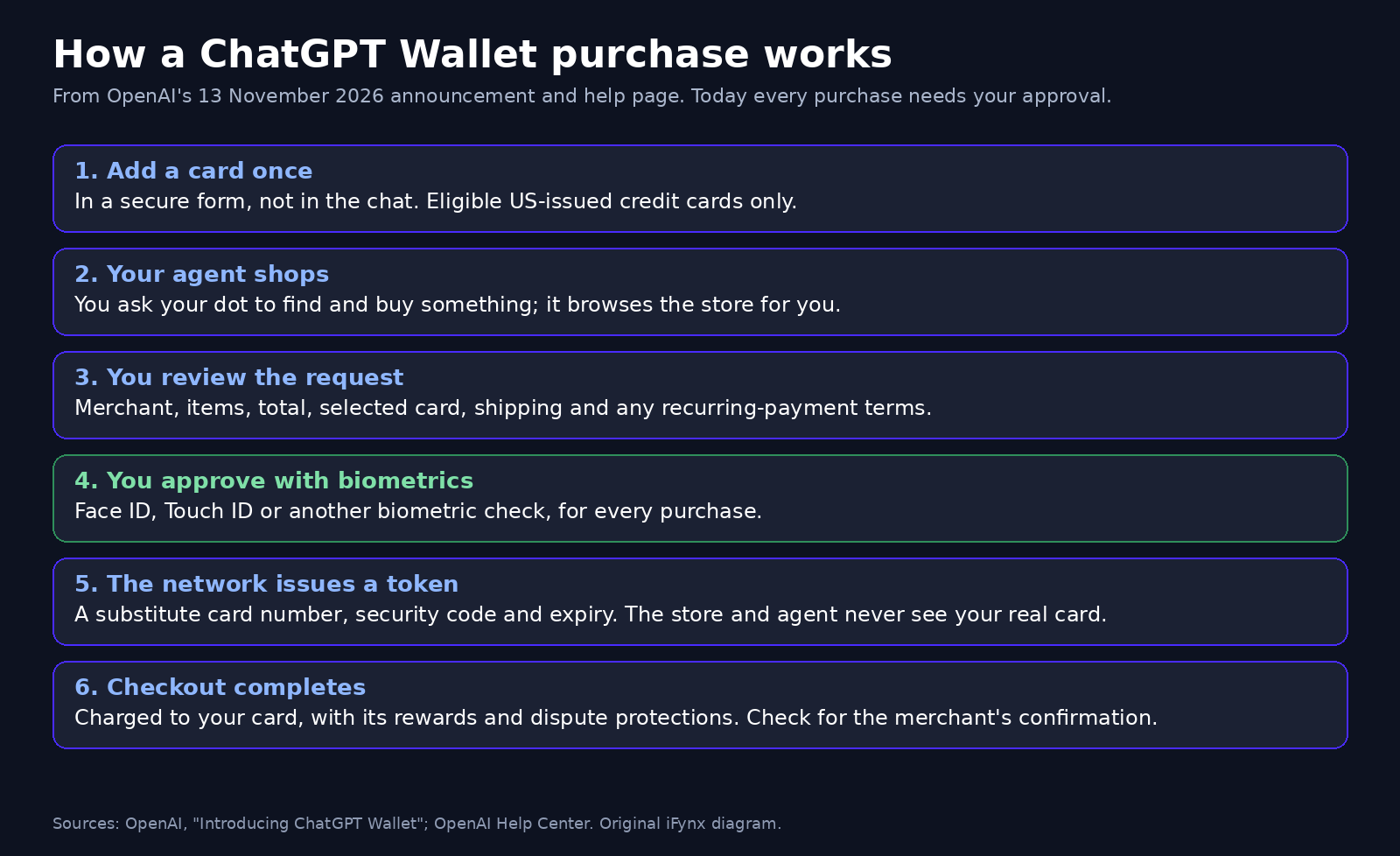
OpenAI describes a simple flow. You add a card once, in a secure form rather than in the chat. When you ask your agent to buy something, for example “Help me find a new sweater” or “Book me a hotel for my trip to Chicago next weekend” (OpenAI’s own examples), the agent does the browsing. At checkout, ChatGPT shows you a purchase request with the merchant, the items, the total, the selected card and any shipping or recurring-payment terms. You approve with a biometric check. The payment network then issues a payment token, a stand-in card number, security code and expiry date, and the agent uses it to finish checkout. The charge lands on your real card, but neither the agent nor the store sees your real card number.
Two details in OpenAI’s help page matter for anyone who has built a checkout. First, “Ready to check out” means your approval is complete; it does not confirm that the merchant placed the order. If the result is unclear, OpenAI tells users to look for a merchant confirmation before trying again, which is a good reason for stores to send clear order confirmations quickly. Second, if you agree to a recurring payment, the merchant may store the payment credential and charge it again under the terms you accepted, and cancelling is between you and the merchant.
OpenAI also describes where this is heading. Over time, it expects users to be able to delegate purchases entirely by setting limits, such as a spending cap, purchase categories or a time period, and to pre-approve those purchases with “enhanced safeguards”. That is not available today: every purchase now needs your approval.
Is ChatGPT Wallet available in the UAE, Saudi Arabia or Egypt?
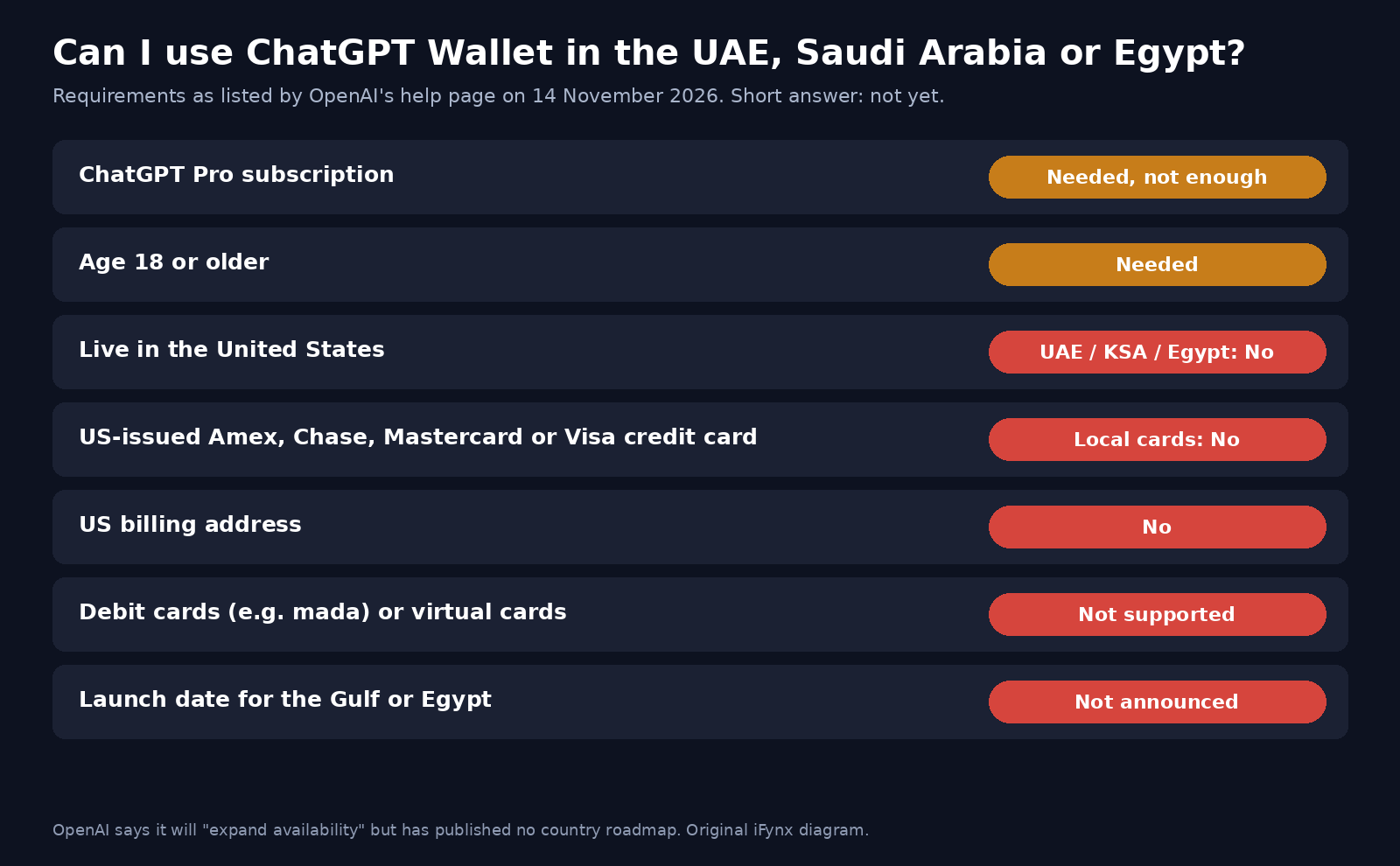
Not today, and OpenAI has not said when. The help page lists every condition, and each one rules out a typical user in the region:
| Requirement (OpenAI help page) | UAE | Saudi Arabia | Egypt |
|---|---|---|---|
| ChatGPT Pro subscription | Needed, but not enough on its own | Needed, but not enough on its own | Needed, but not enough on its own |
| Live in the United States | No | No | No |
| US-issued credit card (Amex, Chase, Mastercard or Visa) | Local cards are not US-issued | Local cards are not US-issued | Local cards are not US-issued |
| US billing address for the card | No | No | No |
| Debit cards (for example mada in Saudi Arabia) | Not supported anywhere | Not supported anywhere | Not supported anywhere |
| Launch date for this country | Not announced | Not announced | Not announced |
Paying for ChatGPT Pro does not unlock Wallet outside the US. A Gulf resident who happens to hold a US credit card still does not meet the “live in the United States” condition, so we do not recommend trying to work around it. Wallet ties every purchase to a card, a billing address and a biometric approval, and a mismatch is exactly what bank risk systems look for.
OpenAI’s announcement says it is “starting with limited availability to ChatGPT Pro users” so it can learn from real-world use, and that it will “expand availability”. It has not published a country roadmap. When it does, the key questions for the region will be which local cards qualify, whether debit networks such as mada are included, and how local rules on payment tokens and strong customer authentication apply.
Is ChatGPT Wallet safe?
OpenAI has designed it around three protections: you approve every purchase with a biometric check, the agent and the store only see a payment token instead of your real card, and your card’s normal dispute protections still apply. Each approval also creates “a clear record of the purchase the user authorized the agent to make”. Those are sensible choices, and they match what we recommended for agent access to bank accounts in our open finance consent spec for UAE and Saudi apps: no password sharing, scoped permissions and a record of every consent.
The risks that remain are mostly about the agent, not the card. An agent can pick the wrong size, the wrong seller or a copycat store, and a shopping page can contain text written to mislead an agent. The approval screen is your defence: OpenAI tells users to check the merchant, items, total, card and any recurring terms before approving, and to decline if they do not recognise the seller. OpenAI also tells users never to type card numbers, security codes or bank verification codes into the chat, only into the secure form. For an unrecognised charge, the help page says to contact your card issuer promptly.
What Gulf and Egypt online stores should do now
Agent shoppers will reach Gulf and Egyptian stores before ChatGPT Wallet launches here, through US visitors, through other agent payment products and through future rollouts. OpenAI’s announcement includes a Commerce Partner Playbook with four areas. Here is how we would apply them to a store in the region:
- Make product data machine-readable. OpenAI suggests claiming your business in ChatGPT and uploading a product feed with current prices and availability. Make sure prices, VAT, delivery fees and stock are correct in both Arabic and English, and that the feed matches what the checkout page shows.
- Do not block legitimate agents by accident. OpenAI asks sites to configure their CDN or firewall to recognise signed requests using Web Bot Auth. Many stores use bot protection that challenges automated visitors. Review those rules before agent traffic grows, so verified agents are allowed while scrapers and card-testing bots are still stopped.
- Talk to your payment and risk providers. Wallet’s tokens work with existing checkout flows, but OpenAI warns that risk systems may still flag legitimate agent purchases, causing declines or cancellations. If you use one of the providers OpenAI names (Adyen, Checkout.com or Stripe for payments; Forter, Riskified, Sardine or Signifyd for fraud), ask them how they will recognise these transactions.
- Make checkout agent-friendly. Clear field labels, no surprise steps after the payment page, a confirmation page and email with an order number, and plain cancellation and return policies. OpenAI also mentions plugins and WebMCP tools that let agents check availability or manage carts through your own systems.
- Keep your local payment options strong. Wallet today covers only US credit cards. Your customers in the region will keep using mada, local Visa and Mastercard, Apple Pay and buy-now-pay-later services. Agent readiness should add to those flows, not replace them.
What payment apps and banks in the region can learn
For banks, wallets and fintechs in the UAE, Saudi Arabia and Egypt, the design of ChatGPT Wallet is a useful reference even before it arrives. Its approval screen is a model consent screen: who is being paid, for what, how much, from which card, and whether it will repeat. Its use of network tokens means the agent never holds a reusable card number. Its plan for future delegation, with spending limits, categories and time windows, is close to the scoped, revocable consent that open finance rules in the Gulf already ask for. We covered how that consent works in our AI agent bank account access guide.
There is also a product question. As we argued in our piece on AaaS vs SaaS pricing, agents are becoming customers and buyers in their own right. Crypto platforms are moving the same way, as our look at Coinbase for Agents showed, and Gulf banks are adding new products at the edge of traditional banking, as in Standard Chartered’s crypto trading in the UAE. A regional bank or wallet that designs a clear agent-approval flow now, in Arabic and English, will be ready whichever global agent arrives first.
How iFynx can help
Get your checkout ready for AI agents, in Arabic and English.
iFynx designs and builds e-commerce, payment and fintech products for companies in the Gulf, Egypt and Palestine. When agents start shopping on behalf of your customers, we help you accept them safely:
- Software Development: Web Development, Mobile App Development and API & Backend Engineering: agent-ready checkout, product feeds, bot rules that let verified agents through, and payment-provider integrations.
- Product Design and UX/UI Design: purchase-approval and consent screens, spending-limit settings and clear order confirmations that users and regulators can trust.
Contact us for a free 30-minute agent-readiness review of your store or payment app.
Frequently asked questions
What is ChatGPT Wallet and how does a purchase work?
ChatGPT Wallet, launched by OpenAI on 13 November 2026, lets your ChatGPT agent pay on your behalf. You add a card once, review each purchase request (merchant, items, total, card and any recurring terms) and approve it with Face ID, Touch ID or another biometric check. The payment network then issues a payment token, so the agent and the store never see your real card number.
Is ChatGPT Wallet available in the UAE, Saudi Arabia or Egypt?
No. OpenAI says Wallet is rolling out to ChatGPT Pro users who are 18 or older, live in the United States and have an eligible US-issued credit card with a US billing address. OpenAI has not announced a launch date or a country list for the Gulf, Egypt or anywhere else outside the US.
Which cards work with ChatGPT Wallet?
Eligible US-issued American Express, Chase, Mastercard and Visa credit cards. For Chase cards you must be the primary cardholder. Debit cards are not supported, and virtual cards are not supported at launch. Cards issued in the UAE, Saudi Arabia or Egypt do not qualify because they are not US-issued.
Is ChatGPT Wallet safe to use?
OpenAI built it around a biometric approval for every purchase, payment tokens instead of your real card number, and your card’s normal dispute protections. The main remaining risk is the agent choosing the wrong item or seller, so check the approval screen carefully and decline anything you do not recognise. Never type card details or bank codes into the chat.
What should online stores in the Gulf and Egypt do now?
Keep product data, prices and stock accurate in Arabic and English, make sure bot protection does not block verified agents (OpenAI recommends recognising Web Bot Auth signed requests), ask your payment and fraud providers how they will treat agent purchases, and send clear order confirmations. Keep local options such as mada, Apple Pay and buy-now-pay-later strong.
Sources and update policy
Read on 14 November 2026 (about 13:05 Asia/Gaza): OpenAI, “Introducing ChatGPT Wallet”, 13 November 2026; OpenAI Help Center, “Making purchases with ChatGPT Wallet”. The table of requirements reflects OpenAI’s help page on that date. The merchant checklist is iFynx guidance based on OpenAI’s Commerce Partner Playbook summary, not legal or payments-compliance advice. We will update this article when OpenAI changes eligibility or announces availability in the UAE, Saudi Arabia, Egypt or the wider region.
Related reading
- AI Agent Bank Account Access: US Banks Block Password-Sharing Bots — The Open Finance Consent Spec for UAE and Saudi Apps (Al Tareq, SAMA)
- Coinbase Opens a Sign-Up Page for AI Trading Agents as Its $2M Champions Cup Starts 4 November: How Coinbase for Agents Works, What the Rules Say, and an Agent Safety Checklist for Gulf and Egypt Traders and Fintechs
- AaaS vs SaaS: What Agents as a Service Really Costs Per Seat, Per Action and Per Resolution, and Which One Your Gulf or Egypt Business Needs