Update 15 Nov 2026 (00:52 Asia/Gaza): Workday says service was restored and the outage was not a cybersecurity incident
A Workday spokesperson told ABC10, as reported by UC Today (updated 21:06 UTC on 14 November), that the disruption hit two data centers, was not related to a cybersecurity incident, and that service “was restored by 11 a.m. EST Saturday” (16:00 UTC, 18:00 Asia/Gaza on 14 November). Workday also told People that two data centers were affected and that service was restored by 11 a.m. Eastern, as reported by Edit USA. Some tenants came back later: Washington University in St. Louis called the outage resolved at 17:24 UTC, and the University of Chicago said Workday was “operating normally” at 19:35 UTC. Northeastern University’s latest note seen by UC Today, at 17:11 UTC, still described “limited recovery”. Workday has not published a post-incident report, and UC Today had seen no Workday post on X. Workday has still not said how many customers were affected; the 11,500+ figure below is its total customer count.
Direct answer — 14 November 2026: Workday says its outage started during a routine check of its disaster-recovery (DR) setup. In a customer notice quoted by university IT teams, Workday said that while validating the weekly maintenance window for Disaster Recovery tenants, “tenanted services within the DR Site unexpectedly connected to Production databases”, leaving data “in an inconsistent state”. It then put all WD1 production tenants into maintenance from the evening of 13 November (US time). Staff at affected employers could not clock in, check pay or finish benefits enrolment. Workday told customers it expected to release the majority of tenants by 16:00 UTC on 14 November after re-indexing them, and many employers reported service back from about 14:40 UTC (16:40 Asia/Gaza). A Workday spokesperson later said service was restored by 16:00 UTC on 14 November and that the disruption was not related to a cybersecurity incident; Workday has not published a post-incident report or said how many customers were hit.

The iFynx team builds and maintains HR, payroll-adjacent and internal business software for companies in the UAE, Saudi Arabia, Egypt and Palestine, and we run DR drills for the systems we look after. So this briefing does not stop at “what happened”. It starts with the current status, then shows the incident as a status-page timeline, then explains how a DR test can reach live data, and ends with three things you can use on Sunday morning: a DR isolation checklist, a payroll and HR fallback plan, and a bilingual staff notice you can copy. We re-checked the sources on the evening of 14 November (Asia/Gaza) and use only what they state; anything unconfirmed is labelled.
Status right now (checked 14 November, 22:00 Asia/Gaza)
| Item | Status |
|---|---|
| Cause | Workday’s notice: services in its DR site “unexpectedly connected to Production databases” while it validated the weekly maintenance window for DR tenants, leaving data inconsistent. |
| Scope | All WD1 production tenants were placed into maintenance; a later notice relayed by Georgia Tech also mentioned WD5 tenants. Workday said only that “some of our customers” were affected. |
| Data | A Workday notice relayed by Georgia Tech said the WD1 and WD5 production tenants are “intact”. Workday has not publicly reported data loss. |
| Service | Many customers reported Workday back on 14 November between about 14:40 and 17:24 UTC (Smith College, Calvin University, Emerson College, Florida Atlantic University, Washington University in St. Louis and others). WashU warned that updates between systems “may be temporarily delayed”. |
| Official all-clear | Update 15 Nov: a Workday spokesperson told ABC10 and People that service was restored by 11 a.m. EST on 14 November (16:00 UTC). No post-incident report yet. |
| Cyberattack? | No. A Workday spokesperson told ABC10 the disruption was not related to a cybersecurity incident (update 15 Nov). |
What happened, minute by minute (status-page view)
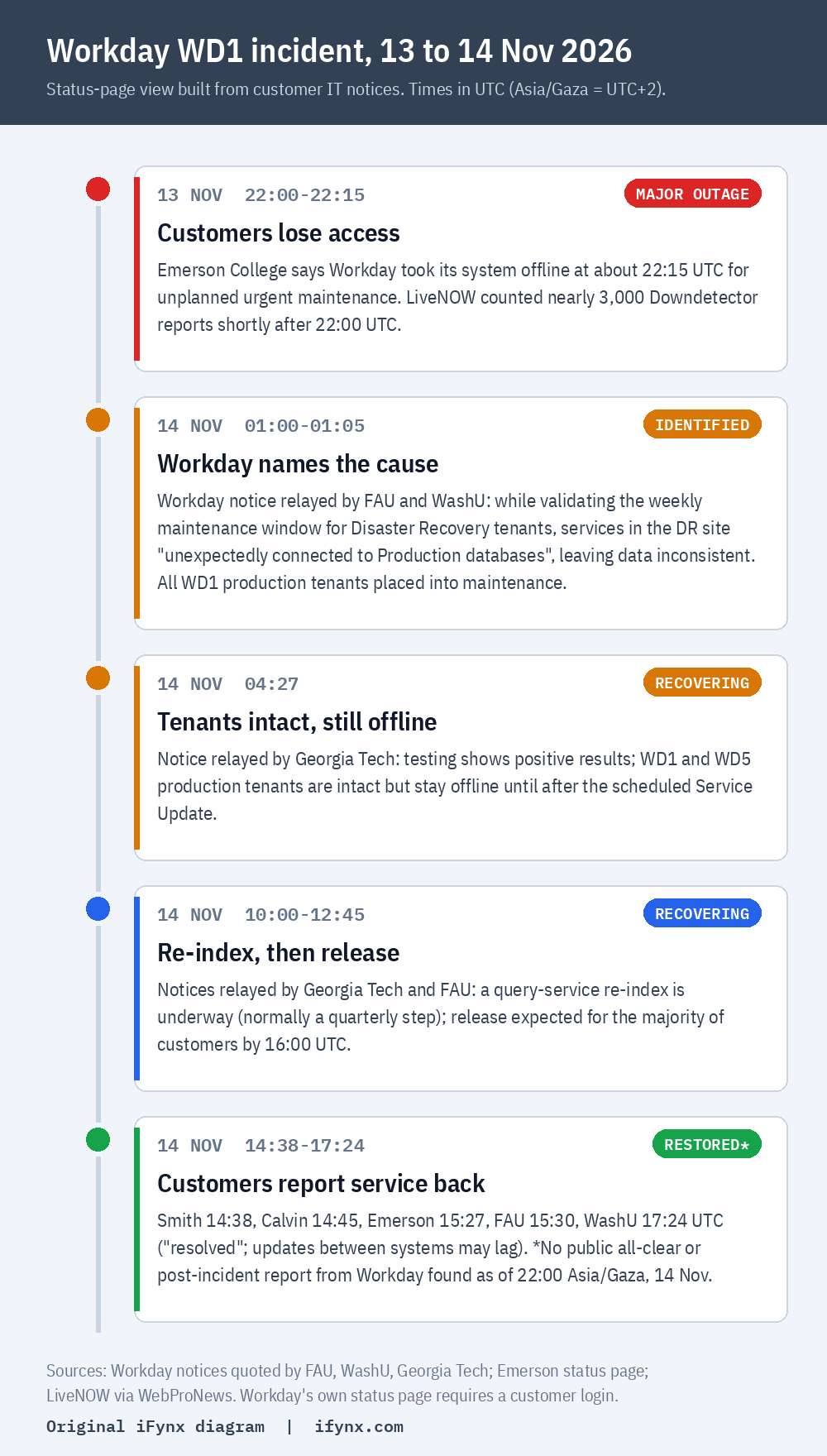
The timeline below rebuilds the incident from what customer IT teams posted, because Workday’s own status page sits behind a customer login. Times are UTC; add two hours for Asia/Gaza, three for Riyadh, and four for Dubai.
- 13 November, about 22:00 to 22:15 UTC: Emerson College says Workday took the system offline at about 5:15 p.m. US Eastern for urgent maintenance it had not planned. LiveNOW counted nearly 3,000 Downdetector reports shortly after 22:00 UTC.
- 14 November, about 01:00 UTC: Florida Atlantic University and Washington University post Workday’s notice naming the DR cause and saying all WD1 production tenants are in maintenance, with updates every 30 minutes.
- 04:27 UTC: A notice relayed by Georgia Tech says testing shows positive results and that WD1 and WD5 production tenants are intact but will stay offline until after the scheduled Service Update.
- 10:00 UTC: A later notice, also relayed by Georgia Tech, says Workday is re-indexing its query service, a step normally done during quarterly Service Updates, and that larger tenants will take longer.
- 12:45 UTC: Workday tells customers that “Reindexing and tenant release is now expected to complete for the majority of customers by 11 AM EST” (16:00 UTC), and that customers facing delays will get a proactive case.
- 14:38 to 17:24 UTC: Smith College, Calvin University, Emerson, FAU, Iowa State, Saint Joseph’s University and WashU report Workday available again. WashU calls the unplanned outage “resolved”.
What Workday actually said
These are the only Workday words we could confirm, all quoted by named customers or reporters:
- The cause (customer notice, quoted by WashU and FAU): “While validating the weekly Maintenance Window for Disaster Recovery tenants, we have identified that tenanted services within the DR Site unexpectedly connected to Production databases. As a result, this has left data in an inconsistent state that can cause errors accessing tenants or jobs/integrations/tasks to fail with missing transaction error messages.”
- The response: “Effective immediately, we are placing all WD1 Production tenants into Maintenance while our teams investigate the best recovery path.”
- The public statement (to KRON4 and LiveNOW): “Some of our customers are experiencing a service disruption and we’re working urgently to investigate and resolve the issue. We sincerely apologize for the challenges this is causing impacted customers.”
In plain language: a copy of the system meant for emergencies started talking to the real databases. Writes from the wrong place can leave records that disagree with each other, so Workday took the affected tenants offline, rebuilt its search indexes and released tenants once their data checked out.
What is not known yet
- How many customers were affected. Workday’s website says more than 11,500 companies use the platform. That is its total customer count, not the number affected; Workday has only said “some of our customers”.
- The exact start time inside Workday. Posts on Reddit claimed the DR site first connected to production hours before the outage and that only WD5 was involved at first. These claims are unverified and we do not rely on them.
- Whether any data changes were lost. The relayed notice says tenants are intact, but Workday has not published a full account. Check recent transactions, approvals and integrations from 13 November.
- The full root cause and fixes. No post-incident report has been published yet.
- Gulf and Egypt impact. We found no source naming a company in the region that was affected, so we do not name any. If your organisation uses Workday, check your own tenant notices.
How a DR test can break production
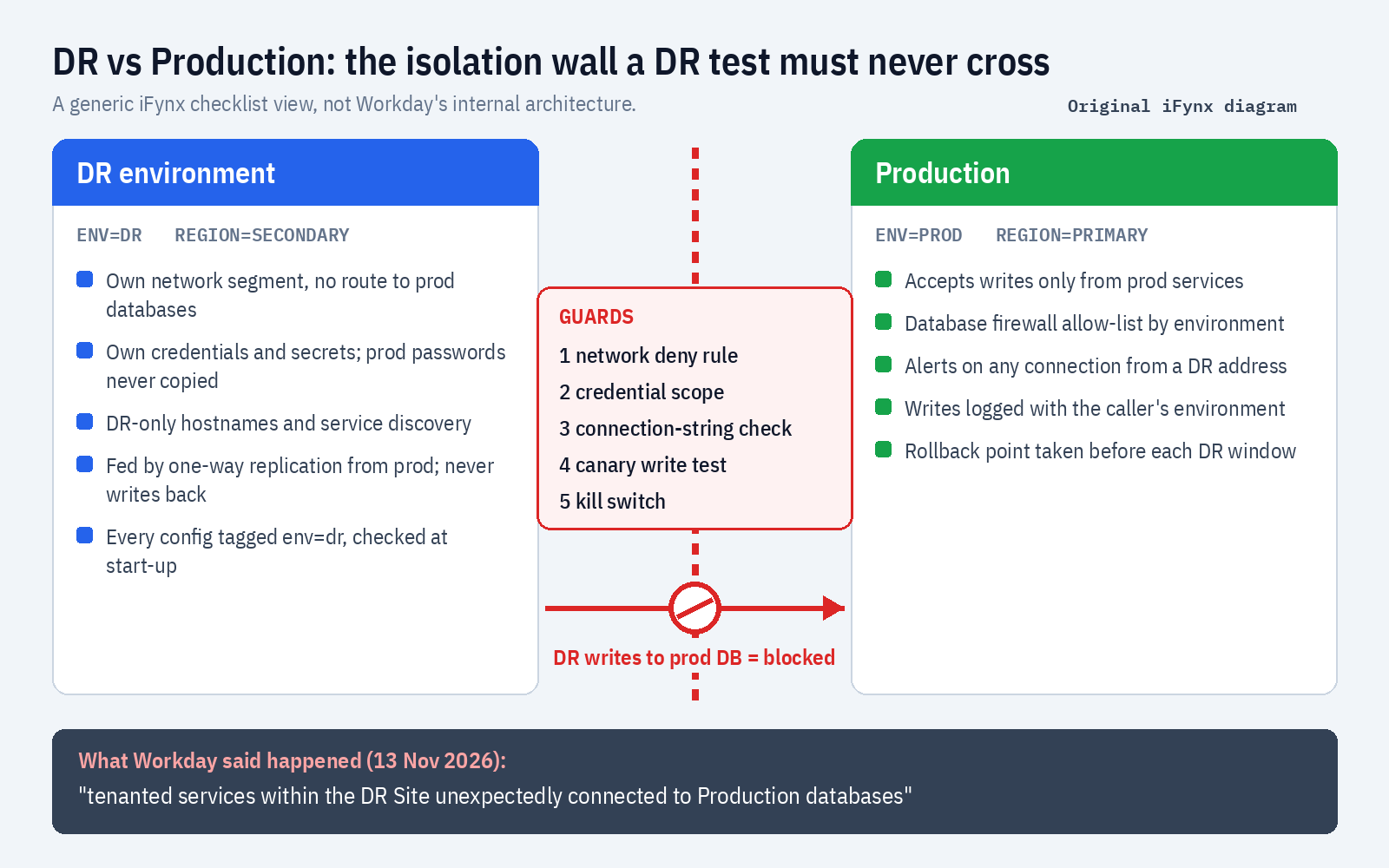
Disaster recovery means keeping a second copy of a system ready to take over if the main one fails. To be useful, that copy has to look almost exactly like production: same software, same configuration, often the same database names. That likeness is also the risk. If one connection string, DNS name or password points back to the live database, a “test” can write to real data. The diagram shows the isolation wall we put between the two, and the guards that should stop a DR service from writing to production even when someone makes a mistake.
The DR isolation checklist
- Separate the networks. The DR environment should have no network route to production databases. Use deny rules, not just “we never configured it”.
- Separate the credentials. DR services get their own database users and secrets. Never copy production passwords into DR, even temporarily.
- Separate the names. Use DR-only hostnames and service discovery entries, so a copied config file cannot resolve to a production address.
- Make the database say no. Production databases should accept connections only from an allow-list of production services, and alert on any attempt from a DR address.
- Check the environment at start-up. Every service reads an environment tag (for example env=dr) and refuses to start if its database target belongs to another environment.
- Replicate one way. DR is fed from production. Nothing in DR should be able to write back.
- Take a rollback point before every DR window. If something goes wrong, you can compare and restore.
- Run a canary first. Before a full DR validation, start one service and confirm where it actually writes.
- Have a kill switch and an owner. One named person can stop the drill in seconds, and knows when to call it.
- Write down the outcome. Every drill ends with a short note: what was tested, what failed, what will change.
Keep payroll and HR running when your HR platform is down
The Workday outage hit on a Friday evening in the US: people could not clock in, check pay stubs or finish benefits elections. Washington University asked staff to track their time manually. In the Gulf and Egypt, where the working week and pay dates differ, the same outage could land on a payroll cut-off. A simple fallback plan helps:
Before an outage
- Export the essentials every pay cycle: employee list, bank details on file, salary and allowances, and leave balances, stored encrypted and outside the HR platform.
- Keep a manual time sheet (a shared spreadsheet or paper form) ready, with one owner per site.
- Know your salary-transfer deadlines. In the UAE, payroll runs through the Wage Protection System (WPS); in Saudi Arabia, many employers use the Mudad platform. Check the exact dates for your company with your bank or payroll provider.
- Agree in advance who can approve paying last month’s figures if this month’s cannot be calculated.
During an outage
- Tell staff early, in Arabic and English (template below), even if you only know a little.
- Switch to manual time tracking and pause automated integrations that might send incomplete data to banks or ERP systems.
- Log every manual decision so it can be entered later.
After service returns
- Reconcile time, leave and approvals entered during the outage.
- Check integrations and scheduled jobs: Workday warned that jobs and integrations could fail with “missing transaction” errors.
- Ask your vendor for its post-incident report and add the findings to your risk register.
Bilingual staff notice template
Copy, edit the brackets, and send through email, WhatsApp or your intranet.
English: Our HR system [name] is currently unavailable because of a problem at our provider. Your salary and records are not affected as far as we know. Until it is back, please record your working hours on [form/link] and send leave requests to [email]. We will update you by [time]. Questions: [contact].
العربية: نظام الموارد البشرية [الاسم] غير متاح حاليًا بسبب مشكلة لدى المزوّد. حسب علمنا، لم تتأثر رواتبكم أو سجلاتكم. إلى حين عودته، يرجى تسجيل ساعات العمل عبر [النموذج/الرابط] وإرسال طلبات الإجازة إلى [البريد]. سنوافيكم بالمستجدات قبل [الوقت]. للاستفسار: [جهة الاتصال].
Change “not affected as far as we know” if your provider says otherwise. Do not promise a restore time your vendor has not given.
Companion case: Revolut’s 20 October outage post-mortem
Same lesson, different trigger. On 13 November, Revolut published a technical overview of its 20 October outage. At about 06:00 UTC, a power failure hit one Google Cloud zone in London. Revolut’s databases ran across three zones, with replicas in another region for disaster recovery, but failover did not work: the coordination servers that decide which database copy is in charge need three of five members to agree, and in some groups one member was already missing without an alert. When the zone went down, only two remained. Some monitoring tools also lived in the failed zone.
Card payments recovered by 12:40 UTC, app access from 15:45 UTC and all services by 17:15 UTC; Revolut says funds and data stayed safe. Its fixes include monitoring the health of those coordination groups, monitoring the alerting pipeline itself, and more frequent zonal failover tests. The takeaway for both incidents: a DR plan is only as good as the last time you tested it under real conditions.
What this means for regulated companies in the region
Banks, fintechs and other regulated firms in the Gulf and Egypt are generally expected by their regulators to keep tested business continuity and disaster recovery plans, and that includes critical outsourced services such as HR and payroll platforms. In Saudi Arabia, for example, SAMA has a Business Continuity Management framework. We do not quote clauses here; check the current wording of your own framework with your compliance team. The practical step is the same everywhere: list your critical SaaS vendors, ask each one how it isolates DR from production, and test your own manual fallback at least once a year.
For related reading, see how a vendor-side incident spread to customers in our Fireworks AI breach briefing, why one management tool can reach many clients in our N-able N-central checklist, and why backup systems are now targets in our FBI ARTEX warning briefing.
How iFynx can help
Frequently asked questions
What caused the Workday outage?
According to a Workday customer notice quoted by university IT teams, services in Workday’s disaster-recovery site unexpectedly connected to production databases while Workday was validating the weekly maintenance window for DR tenants. That left data in an inconsistent state, so Workday placed all WD1 production tenants into maintenance.
Is Workday back up?
Yes. A Workday spokesperson told ABC10 (reported by UC Today) and People (reported by Edit USA) that service was restored by 11 a.m. EST on Saturday 14 November, which is 16:00 UTC or 18:00 Asia/Gaza. Some tenants came back later: Washington University in St. Louis called the outage resolved at 17:24 UTC, and the University of Chicago said Workday was operating normally at 19:35 UTC. Workday has not published a post-incident report.
Was the Workday outage a cyberattack?
No. A Workday spokesperson told ABC10, as reported by UC Today, that the disruption was not related to a cybersecurity incident. Workday’s customer notices describe an internal disaster-recovery problem: services in its DR site unexpectedly connected to production databases.
How many companies were affected?
Workday has not said. Its website says more than 11,500 companies use Workday, but that is the total customer count, not the number affected. Workday’s public statement said only that “some of our customers” were disrupted.
How can we test disaster recovery without touching production?
Keep DR on its own network with its own credentials and hostnames, make production databases reject connections from DR addresses, have every service check its environment tag at start-up, take a rollback point before each drill, start with a single canary service, and name one person who can stop the drill.
Sources and update policy
Read on 14 November 2026 (evening, Asia/Gaza): Florida Atlantic University IT, Workday production service disruption (Workday notices and restoration update); Emerson College, status page; Washington University in St. Louis, IT status; UC Today, Workday outage report; WebProNews, Workday DR test report (Workday notice, LiveNOW and KRON4 statement, 11,500 figure); StatusStack, Workday outage tracker (Georgia Tech and other customer updates); Revolut, 20 October outage: technical overview, 13 November 2026. Workday’s own status page requires a customer login, so Workday’s words are quoted as relayed by customers. The checklist, fallback plan and template are iFynx guidance, not legal advice. We will update this article if Workday publishes an all-clear or a post-incident report.
Related reading
- FBI ARTEX Warning (FLASH-20261113-001): What the FBI Says About the AI Agent Hacking Tool, Its Mitigations, and a 10-Step Checklist for Gulf and Egypt Banks, Fintechs and SaaS Teams
- N-able N-central Vulnerability (Able2Shell): 33 Exploits, Emergency Hotfix 2026.4.1.26 and the RMM Security Checklist for Gulf and Egypt Companies