Direct answer — 11 November 2026: The N-able N-central vulnerability set known as Able2Shell is 33 security flaws in the N-central remote monitoring and management (RMM) server, published with proof-of-concept exploits by researcher Sean Bales late on Sunday 8 November. The worst chain needs no login and can end with an attacker creating an administrator account and running commands on the server. N-able took Hosted N-central offline on 9 November and on 10 November released N-central 2026.4 Hotfix 2, build 2026.4.1.26, which fixes seven CVEs. N-able’s release notes say on-premises customers must upgrade their servers as soon as possible, hosted servers are upgraded by N-able, and all customers, hosted and on-premises, must upgrade their Agents and Probes. N-able reports scanning activity but no evidence that any customer environment was successfully exploited. If an MSP runs your IT, ask them today whether they use N-central and whether they are on 2026.4.1.26.

This iFynx briefing is written for two groups in Saudi Arabia, the UAE, Egypt and the wider region: IT teams and managed service providers (MSPs) that run N-central, and the much larger group of clinics, schools, retailers, law firms and government suppliers whose computers are managed by an MSP and who may not even know which RMM tool sits behind it. We read N-able’s HF2 release notes, the Huntress advisory, BleepingComputer, CSO Online and Previdian again shortly before publishing (08:55–09:30 Asia/Gaza, 11 November). We do not link to the exploit code or describe how to use it.
Key facts (checked 11 November 2026, before publishing)
- What: 33 vulnerabilities in N-able N-central, grouped by the researcher into four exploit chains and named “Able2Shell”. Three chains lead to remote code execution and one to root privileges, according to Huntress.
- When: published on GitHub late on Sunday 8 November without notifying N-able first; N-able took Hosted N-central offline on 9 November; Hotfix 2 came out on 10 November.
- The fix: N-central 2026.4 HF2, build 2026.4.1.26. It supersedes 2026.4 (build 2026.4.0.27) and HF1 (build 2026.4.0.32). Supported upgrade paths start at 2025.4; older servers must first move to a supported version.
- Seven CVEs: CVE-2026-125883 (XXE), CVE-2026-125878 (OGNL injection), CVE-2026-125879 (privilege escalation via syslog-ng config), CVE-2026-125880 (stored XSS via patch metadata), CVE-2026-125881 (SSRF), CVE-2026-125882 (RCE via upload path traversal) and CVE-2026-91000 (insecure IPC privilege escalation).
- Who must act: on-premises customers upgrade the server; everyone upgrades Agents first, then Probes. Built-in remote control is temporarily disabled in HF2; Take Control still works.
- Exploitation status: N-able reports scanning activity and no evidence of a successful customer compromise. Huntress says it has seen no exploitation in its partners’ environments. Previdian recorded 68 probing and XXE / file-access events from one IP against its decoy, with no completed chain.
- Exposure: Censys found 1,728 internet-exposed N-central instances, as reported by CSO Online. No country breakdown has been published.
What is Able2Shell?
N-central is N-able’s RMM platform. MSPs and in-house IT teams use it to monitor, patch, script and remotely support Windows, Mac and Linux machines at many customers from one console. Every managed computer runs an N-able Agent, and Probes sit inside customer networks to discover and manage devices.
On 8 November, an offensive security researcher, Sean Bales, published a GitHub repository called Able2Shell with proof-of-concept exploits for 33 flaws. He told BleepingComputer that the discovery was AI-assisted, and that he released the flaws without warning N-able because earlier reports he had sent about a different N-able product went unpatched. N-able did not answer those claims; it called the release a “non-responsible communication of critical vulnerabilities”.
According to CSO Online and Huntress, the flaws form four chains:
- An unauthenticated XXE chain in a service-import function that steals a trusted local session, resets an account password and runs commands as the nable service user. The same chain can create an enabled Default Administrator account with credentials the attacker chooses. The researcher told BleepingComputer this is the most critical one.
- Two chains that start from a predictable appliance passcode and plant malicious patch metadata. When an administrator opens the patch details, stored cross-site scripting runs in their browser, and the hijacked session can be used to run commands, in one case as root.
- A path-traversal chain that writes an executable web page through a software-repository feature, then escalates to root through a passwordless installer.
The researcher tested against N-central Appliance 2026.4.0.31 and wrote that most, if not all, flaws should also work on earlier versions. N-able has not said how many of the 33 it reproduced; HF2 lists seven CVEs, several of which cover “multiple” flaws.
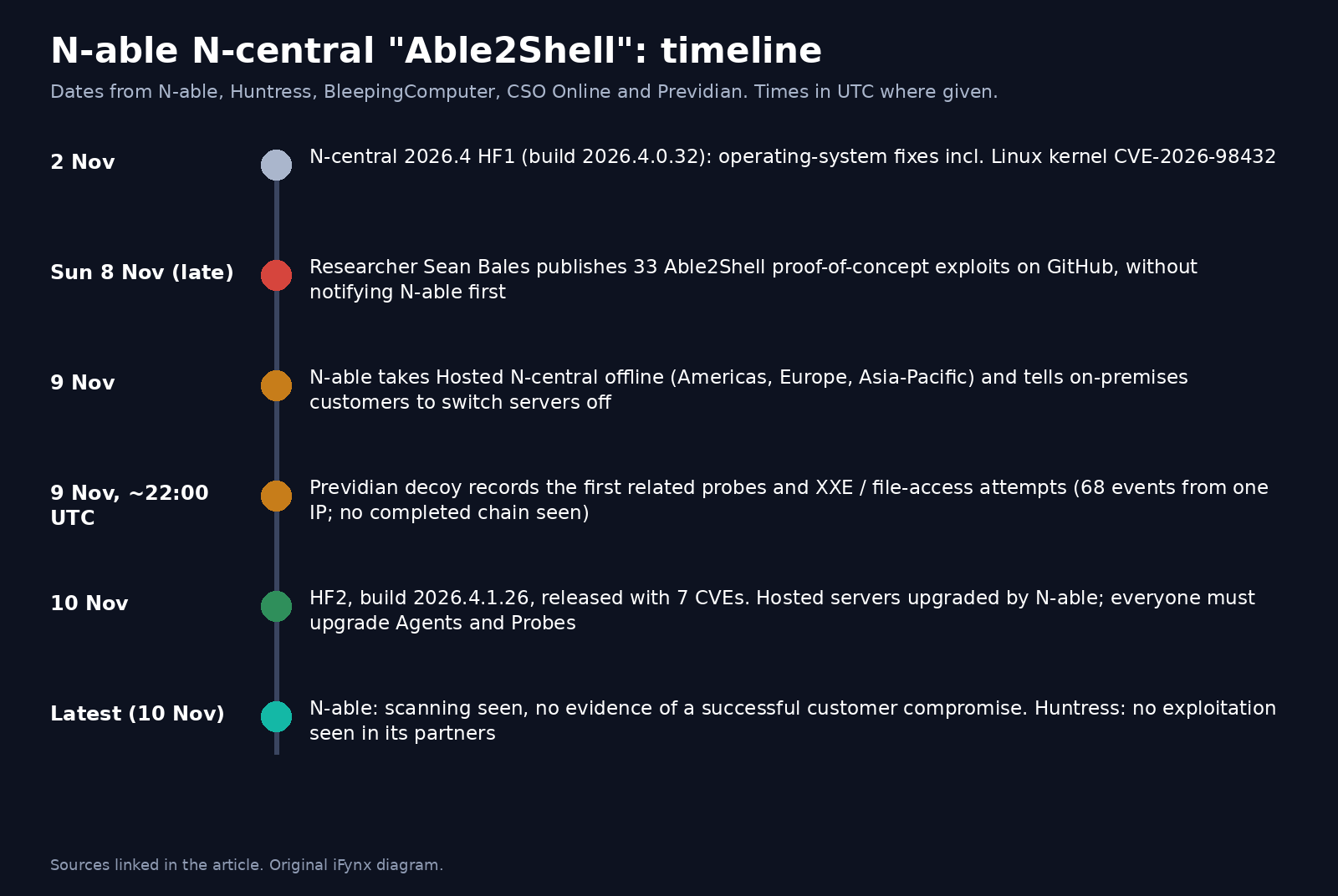
Timeline of the N-central incident
The diagram below puts the official dates in order. Times are in UTC where a source gave one.
Which build fixes Able2Shell, and who has to do what?
N-able’s HF2 release notes, dated 10 November, are the primary source here. The hotfix is a “critical security update” that strengthens authentication and permission checks, removes legacy mobile device management, adds validation to file uploads and log handling, hardens server components and Agent/Probe communication, and updates the server operating system and third-party components. Huntress adds that N-able said all hosted servers were upgraded and brought back online.
| Hosted N-central (N-able’s cloud) | On-premises N-central | |
|---|---|---|
| Server upgrade to 2026.4.1.26 | Done by N-able | You or your MSP, as soon as possible; keep the server offline until it is done (Huntress) |
| Agents and Probes | Must be upgraded by the customer | Must be upgraded by the customer |
| Upgrade order | Agents first, then Probes | Agents first, then Probes |
| Patch Management Engine (PME) | Pushed automatically by N-able | Pushed automatically by N-able |
| Old versions | Not applicable | 2025.4 or newer can go straight to HF2; older must upgrade to a supported version first |
| Remote control | Built-in remote control disabled for now; Take Control works | Same |
| Compromise review | Still review sign-ins, admins, scripts and sessions since 8 Nov | Same, plus server logs and snapshots |
The Agent/Probe change matters. N-able says that if a Probe is upgraded to 2026.4.1.26 before the Agents and PME, those Agents cannot talk to it, and features such as the offline patch cache stop working until they are upgraded. Upgrading Agents first avoids that gap.
One more warning from Huntress: N-able does not always change the version number when it pushes live hotfixes, so check the fix against N-able’s guidance, not only the version string.
Was anyone hacked?
As of N-able’s latest public statements, no. N-able told BleepingComputer on 9 November that it had “not observed active exploitation”, and its later status update, cited by Huntress and CSO, said it had seen “scanning activity associated with the published proof-of-concept code” but no evidence that any customer environment had been successfully exploited. Huntress says it has not seen Able2Shell exploitation in its partners’ environments.
Attackers are looking, though. Previdian says its N-central decoy recorded 68 events from one IP address starting around 22:08 UTC on 9 November, including XXE and sensitive-file access attempts. Previdian stresses that this does not show a completed account takeover or command execution. Treat this as a race: a public exploit, a known fix, and a window in which unpatched servers are easy targets.
There is history behind the urgency. CSO Online notes this is the fourth emergency response for N-central in 15 months, and that an August 2026 N-central authentication bypass was exploited as a zero-day to deploy ransomware on MSP-managed systems. Earlier this month, N-central’s HF1 also shipped operating-system fixes, including the critical Linux kernel CVE-2026-98432 and the Brotli Node2Shell update, which N-able says N-central did not actually use but applied as best practice.
Why one RMM server matters to every client
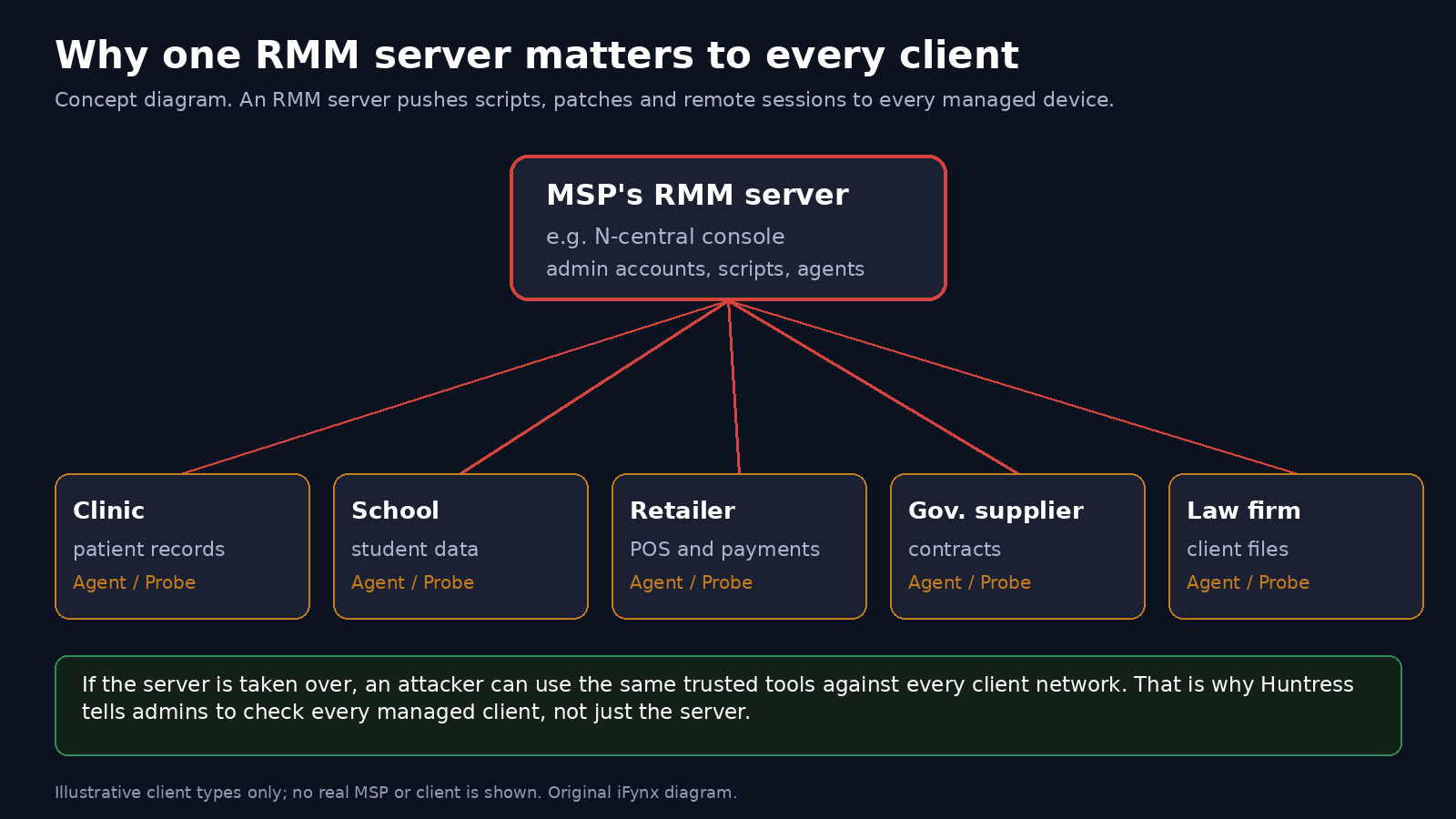
An RMM server is a master key. It can push scripts, install software and open remote sessions on every managed device. If an attacker takes over the server, they can use the MSP’s own trusted tools against every client network. That is why Huntress tells administrators to assess “every client network managed by the server, not just the server itself”, and why past N-central attacks sprayed downstream customers with unauthorised scripts and tools.
The Gulf and Egypt angle: most affected companies are customers, not MSPs
There is no published count of N-central servers in the Gulf or Egypt, and we will not guess one. A typical outsourced-IT setup in the region looks like this: a clinic group in Riyadh, a school in Dubai, a retailer in Cairo or a government supplier in Abu Dhabi outsources desktop support to a local or regional MSP, and the MSP manages everything through one RMM console. The company never logs in to that console and often does not know which product it is. For those companies, the right move this week is not to patch anything themselves. It is to ask the MSP, in writing, five questions:
- Do you use N-able N-central, or any N-able product, to manage our devices?
- Is your server hosted by N-able or on your own premises, and is it on build 2026.4.1.26 or later?
- Have the Agents and Probes on our network been upgraded, Agents first?
- Have you reviewed administrator accounts, scripts and remote sessions created since 8 November, for our environment specifically?
- Is your console reachable from the internet, and is every technician account behind multi-factor authentication?
Keep the answers. If the MSP cannot answer within a day, treat that as a finding in itself.
Saudi Arabia: the NCA’s Essential Cybersecurity Controls (ECC-1:2018) apply to government organisations and to private operators of critical national infrastructure, and the NCA encourages all other organisations to use them. Subdomain 4-1 covers third-party cybersecurity, including managed services: contracts must include communication procedures for cybersecurity incidents (4-1-2-2), IT outsourcing and managed services need a cybersecurity risk assessment before signing or when rules change (4-1-3-1), and managed security operations and monitoring centres must be fully inside the Kingdom (4-1-3-2). An Able2Shell email to your MSP is a natural moment to check those clauses.
Notice duties if personal data was touched: Saudi Arabia’s PDPL Implementing Regulation (Article 24) sets 72 hours to notify SDAIA; Egypt’s Law No. 151 of 2020 (Article 7) sets 72 hours to notify the Personal Data Protection Center; the UAE PDPL (Article 9) requires notice to the UAE Data Office within the period set by its Executive Regulations. Companies in the DIFC or ADGM follow their free zone’s rules. This is a summary, not legal advice.
How to check whether your N-central server was compromised
For MSPs and IT teams that run N-central. Do these checks only on systems you own or manage.
- Preserve first. ThreatDefence, quoted by CSO Online, recommends saving logs and a server snapshot before making changes.
- Review authentication activity from 8 November onward for logins you cannot explain, as Huntress advises.
- List administrator accounts. Look for new ones, especially an enabled “Default Administrator” you did not create, since the XXE chain can create one.
- Review scripts, automation policies and remote-access sessions created since 8 November, across every customer.
- Upgrade the server to 2026.4.1.26, then Agents, then Probes.
- Rotate credentials once restored: administrator and technician accounts, asset-discovery credentials, agent registration tokens and ecosystem agent keys (ThreatDefence via CSO).
- If you find something, bring in incident response and assess every client network the server manages.
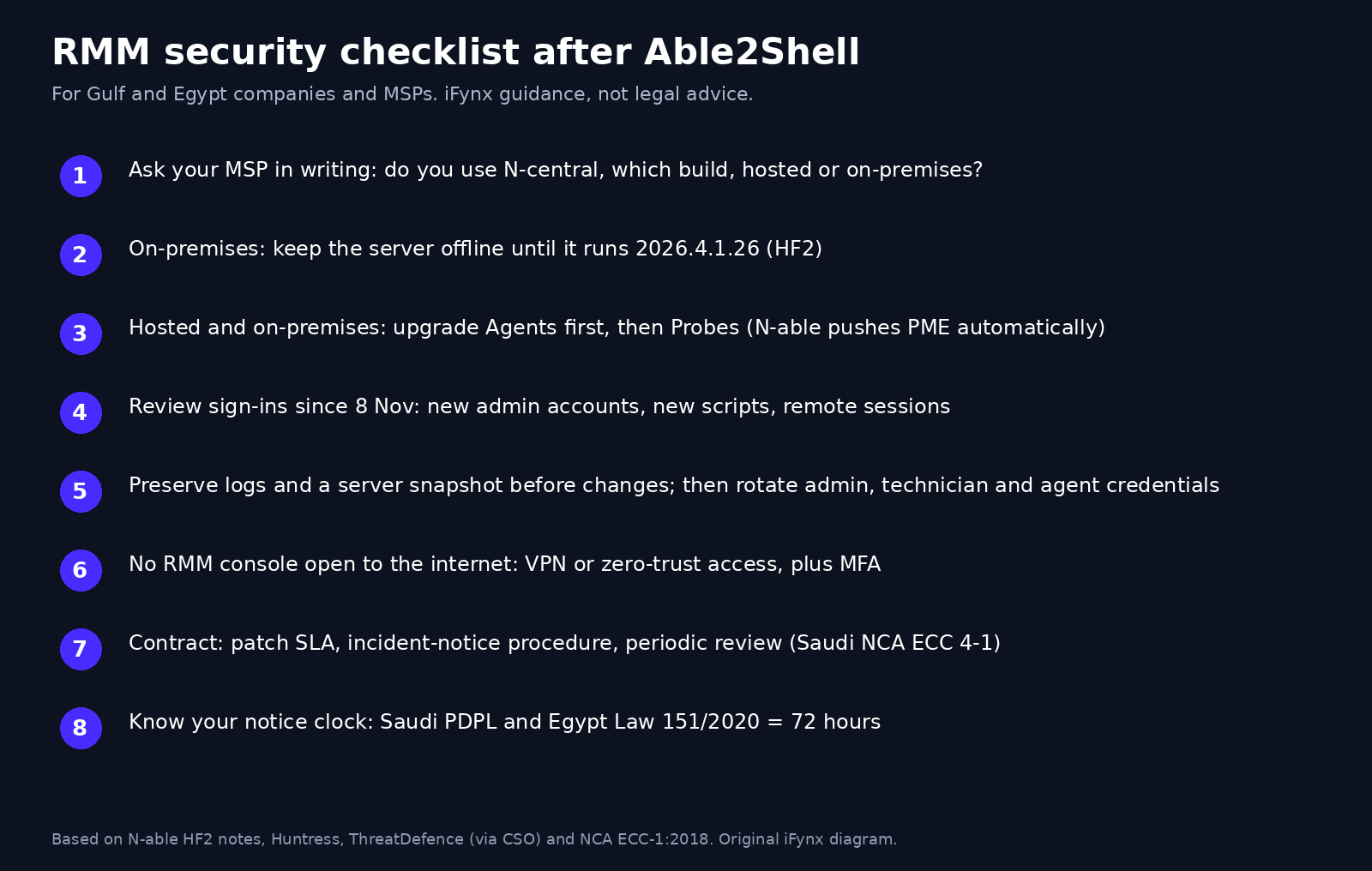
RMM security checklist for Gulf and Egypt companies
Able2Shell will be patched. The weakness it exposed, one console with power over hundreds of networks, will not go away. A short checklist for this week and beyond:
- Know your RMM. Keep a record of which MSP and which RMM tool can reach your devices, including the build number.
- No console on the open internet. Put RMM consoles behind VPN or zero-trust access; CSO’s 1,728 exposed instances show how common this still is.
- MFA and named accounts for every technician; no shared logins; review admins monthly.
- Script and automation control. Require approval for new scripts and alert on mass script runs.
- Patch SLAs in the contract, with an incident-notice clause and named contacts on both sides.
- Log retention long enough to look back at least two weeks, as this incident needed (8 November onward).
- A bilingual incident-notice template ready in Arabic and English, so a clinic or school can tell staff and customers quickly and clearly.
- Practise the offline day. N-able’s shutdown meant no remote support for a day or more. Know how your team works when the RMM is off.
More patch-now guides from iFynx
For other patch-now items this month, see our November 2026 Patch Tuesday and Outlook zero-day guide, the OpenSSH SSHole briefing, our QNAP Plex2Shell recovery guide, and, for the same “delegated access” lesson in AI tools, MCP server security after the Mittwald breach.
iFynx services
How iFynx can help
iFynx designs, builds and maintains web and mobile products for companies in the Gulf, Egypt and Palestine, in Arabic and English. We are not an RMM vendor or an MSP, and we will not touch your N-central console. What we do is keep the software you own patched, monitored and safe to run.
- Software Maintenance: 24/7 monitoring, security patches, dependency updates and SLA-backed support for your web apps, APIs and servers, so a hotfix like HF2 is a planned task, not a panic.
- Quality Assurance: regression testing after emergency patches, so a security update does not break checkout, booking or sign-in.
- API & Backend Engineering: admin consoles built with proper roles, MFA, audit logs and no internet-exposed management pages.
Frequently asked questions
Is N-able N-central safe to use again?
N-able says Hotfix 2 (build 2026.4.1.26) fixes the Able2Shell vulnerabilities and that hosted servers have been upgraded and brought back online. On-premises servers should stay offline until they run 2026.4.1.26. Every customer, hosted or not, must also upgrade Agents and then Probes, and review activity since 8 November.
Which N-central build fixes Able2Shell?
N-central 2026.4 Hotfix 2, build 2026.4.1.26, released on 10 November 2026. It fixes CVE-2026-125883, CVE-2026-125878, CVE-2026-125879, CVE-2026-125880, CVE-2026-125881, CVE-2026-125882 and CVE-2026-91000, and supersedes 2026.4 and HF1. Servers on 2025.4 or newer can upgrade directly; older ones need an intermediate upgrade first.
Do hosted N-central customers need to do anything?
Yes. N-able upgrades hosted servers, but customers must upgrade their own Agents and Probes. N-able recommends Agents first, then Probes, because an upgraded Probe cannot talk to older Agents. Hosted customers should also review administrator accounts, scripts and remote sessions created since 8 November.
Was N-central exploited in the wild?
N-able reports scanning activity linked to the published exploit code but no evidence that any customer environment was successfully exploited, and Huntress has seen no exploitation in its partners. Previdian recorded 68 probing and XXE attempts from one IP against a decoy, without a completed attack chain. That can change, so patch now.
My company uses an MSP. What should we do about the N-able N-central vulnerability?
Ask your MSP in writing whether it uses N-central, whether its server is on build 2026.4.1.26, whether the Agents and Probes on your network were upgraded, and whether it reviewed admin accounts, scripts and sessions since 8 November. In Saudi Arabia, also check the incident-notice and managed-services clauses NCA ECC 4-1 expects.
Sources and update policy
Read on 11 November 2026 (08:55–09:30 Asia/Gaza): N-able, N-central 2026.4 HF2 Release Notes, 10 November 2026 (also HF1 notes, 2 November 2026); Huntress, “N-able Disables Cloud Services Following Disclosure of Able2Shell Exploit Chains”, 9 November 2026, updated 10 November 17:30 ET; BleepingComputer, “N-able takes cloud platform offline after 30+ zero-days published”, 9 November 2026; CSO Online, “N-able N-central gets emergency fix two days after 33 exploits published”, 10 November 2026; Previdian, “N-able N-central Critical Vulnerabilities: What We Know So Far”, updated 10 November 2026; Saudi NCA, Essential Cybersecurity Controls ECC-1:2018. Law texts: UAE Federal Decree-Law No. 45 of 2021, Saudi PDPL Implementing Regulation, Egypt Law No. 151 of 2020. iFynx did not test any N-central system and does not link to the exploit code. The checklist is iFynx guidance, not legal advice. We will update this article if N-able reports confirmed exploitation, ships a further hotfix, or publishes a full advisory.
Related reading
- Linux Kernel Vulnerability CVE-2026-98432: Ubuntu Still Has No Fix, What Is Patched, and How Gulf and Egypt Server Teams Should Mitigate Now
- Outlook Zero-Day CVE-2026-124194: November 2026 Patch Tuesday and What to Patch First in Gulf and Egypt Companies
- OpenSSH SSHole (CVE-2026-123158): CISA Says It Is Exploited, Who Is Affected (Alpine, Docker, OpenWrt) and How to Patch by Nov 12
- QNAP Plex2Shell Warning: Update Plex Media Server, Then Assess Whether Your NAS Needs Recovery
- Workday Outage Cause: How a Disaster-Recovery Test Hit Live Production Data, What Was Affected, and a DR Drill and Payroll Continuity Checklist for Gulf and Egypt Companies
- 64,000 Bitcoin Miners Hijacked: What Happened to 13 EH/s, Is Luxor Commander to Blame, and How to Lock Down Your ASIC Fleet