Fact check · 15 November 2026
No. Nobody has found any evidence of a global cyberattack on 17 November, and nothing official says bank accounts will be wiped or the internet switched off for three months.
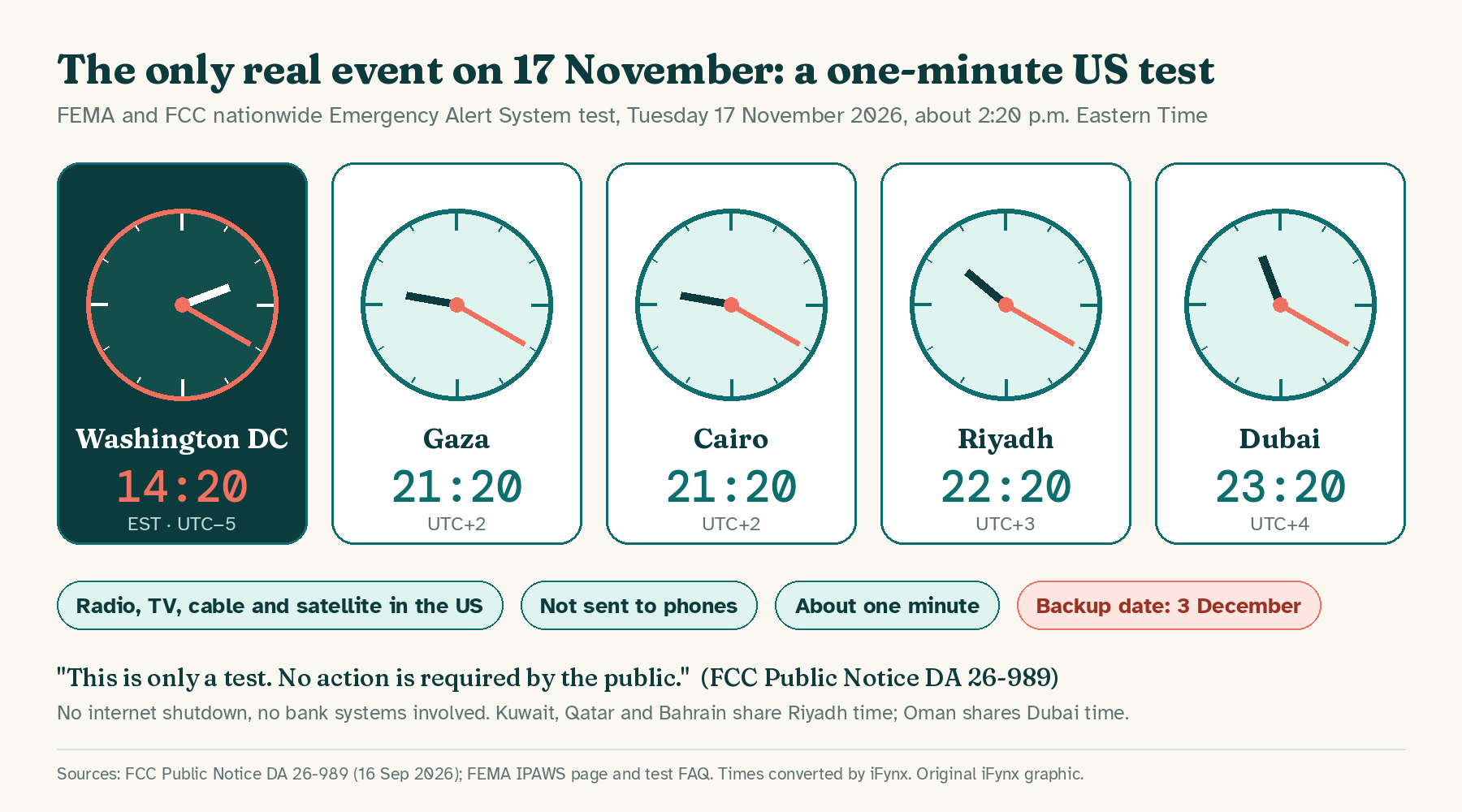
The only real event on that date is a routine US test of the Emergency Alert System, run by FEMA and the FCC at about 2:20 p.m. Eastern Time on Tuesday 17 November. That is 21:20 in Gaza and Cairo, 22:20 in Riyadh and 23:20 in Dubai. It interrupts US radio and TV for about one minute, is not sent to phones, and its message says: “This is only a test. No action is required by the public.” The rumour has been called false or unsupported by Kazakhstan’s emergencies ministry, Ukraine’s Centre for Countering Disinformation and fact-checkers in Austria, France and Russia. The real risk this week is scammers using the fear.


At iFynx we build banking, fintech and mobile apps for companies in the UAE, Saudi Arabia, Egypt and Palestine, so we get asked about stories like this by clients and by our own families. This fact check explains what is really scheduled for 17 November, where the rumour came from, why one hack cannot erase everyone’s money, and what a calm, sensible response looks like for people and for the banks and apps that serve them. We checked the official FCC and FEMA pages and each debunk linked below on 15 November 2026 at about 09:55 Asia/Gaza. We paraphrase the viral posts instead of reproducing them, and we do not name the private accounts sharing them.
Key facts at a glance
- The claim: on 17 November hackers will empty bank accounts worldwide, then the internet will go dark for three months.
- The verdict: false. No bank, attacker or technical detail is named in the posts, and no government or security body has issued such a warning.
- What is real: a FEMA and FCC Emergency Alert System test in the United States, about 2:20 p.m. ET (19:20 UTC) on 17 November, backup date 3 December.
- Who it affects: US radio, TV, cable and satellite audiences, for about one minute. Phones get no alert. Nothing happens to the internet or banks, in the US or anywhere else.
- Gulf and Egypt: as of 09:55 Asia/Gaza on 15 November we found no statement on the rumour from the UAE’s TDRA, Saudi Arabia’s CST, Egypt’s NTRA, Dubai Police, the Central Bank of Egypt or SAMA. Nothing suggests one is needed beyond the usual advice: use official channels only.
- The real risk: fear-based scam messages asking you to “protect” or “move” your money before 17 November.
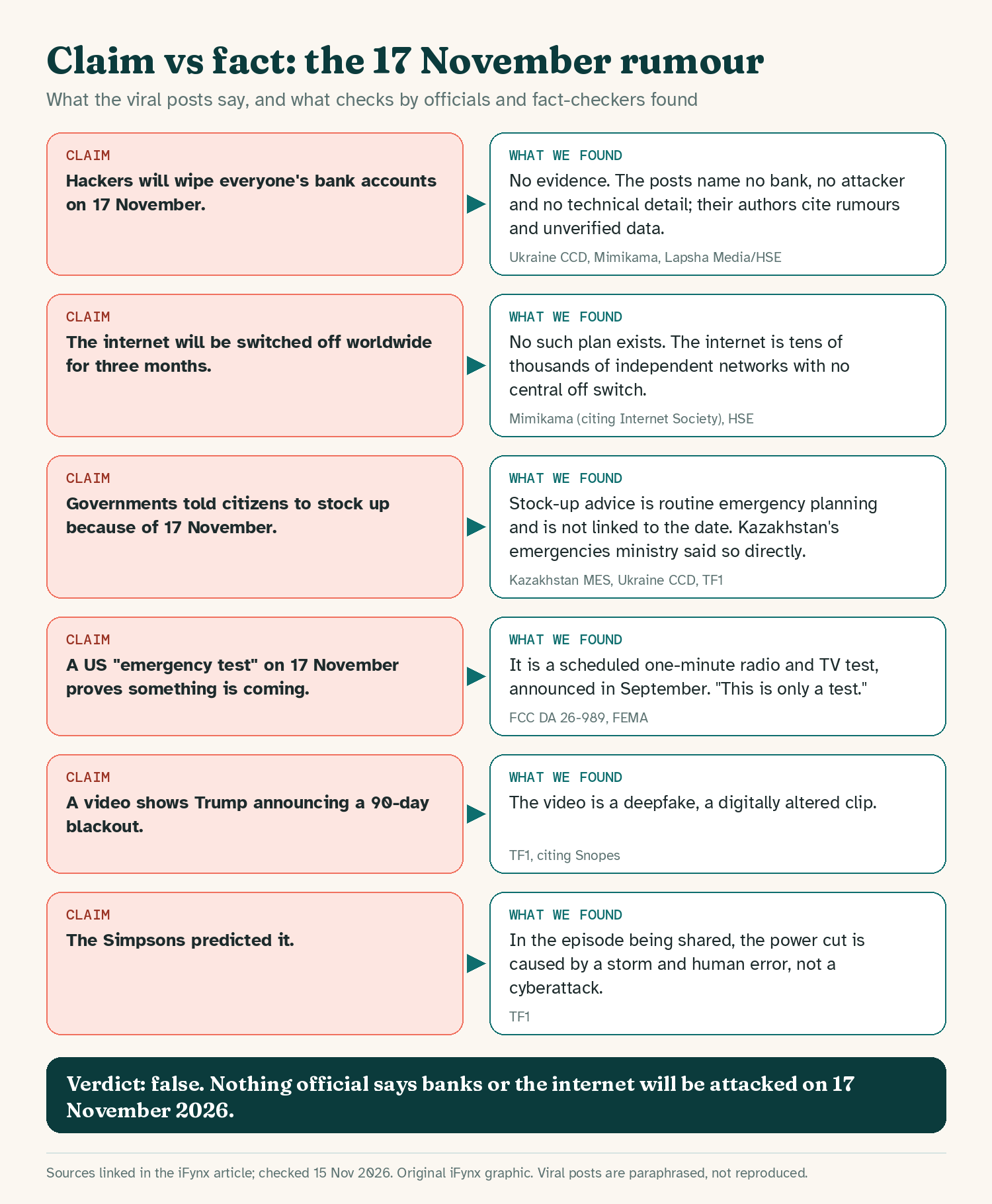
Claim vs fact
The rumour has picked up extra “evidence” as it travelled between languages. Here is each piece next to what officials and fact-checkers found.
What really happens on 17 November
The US Federal Communications Commission announced the test in Public Notice DA 26-989 on 16 September 2026. FEMA, in coordination with the FCC, will send a nationwide test of the Emergency Alert System at 2:20 p.m. Eastern Time on 17 November through its Integrated Public Alert and Warning System. If conditions require it, the test moves to 3 December 2026. The FCC text says the test covers “the United States from 2:20 to 2:50 hours ET”, which is the window stations use to relay it, and ends: “This is only a test. No action is required by the public.”
FEMA’s own alert-system page says radio and television programming “will be briefly interrupted”. FEMA’s test FAQ says the interruption should last about one minute and that Wireless Emergency Alerts will not be part of this year’s test, so phones will not buzz. Wisconsin Emergency Management adds that cable, satellite and wireline video providers will carry it too. US law requires FEMA to test the system at least once every three years; the last nationwide test was in 2023.
In our region the test happens late on Tuesday evening and you will not notice it unless you are watching a US channel live:
| City | Local time on Tuesday 17 November |
|---|---|
| Washington DC (US Eastern) | 14:20 (2:20 p.m.) |
| Gaza, Cairo | 21:20 |
| Riyadh, Kuwait City, Doha, Manama | 22:20 |
| Dubai, Abu Dhabi, Muscat | 23:20 |
Where the rumour came from
Fact-checkers trace the story to X posts from the last days of October 2026. Mimikama examined an English-language post of 31 October that itself called the date a rumour, and a Portuguese version of 1 November whose author said his information came from an unconfirmed source. Lenta.ru, working with the Lapsha Media fact-checking project, also found that the author named no informant, no hacker group and no technical detail. TF1’s fact-checkers found the date first relayed by a US cryptocurrency account, with some crypto accounts telling people to empty their bank accounts and buy crypto.
From there the story spread through Portuguese, Italian, German, French, Russian and Kazakh posts, and on 14 and 15 November it surged in Arabic, by our count of public posts on X. Along the way it collected a deepfake video of President Trump “announcing” a 90-day blackout, a clip from The Simpsons, and screenshots of real government advice to keep emergency supplies. None of these supports the claim.
Who has debunked it
- Kazakhstan’s Ministry of Emergency Situations told Kursiv on 5 November that it “has not issued any official warnings about a possible internet blackout on Nov. 17, massive cyberattacks or the need to urgently stockpile food, water and medical supplies”. It said its standing advice to keep 72 hours of supplies is “unrelated to the circulating reports”.
- Ukraine’s Centre for Countering Disinformation said on 9 November, as reported by LB.ua, that the claim “has no supporting evidence”, that the posts rely on rumours and unverified data, and that the US test “concerns only a test message on radio and television”.
- Mimikama, Austria’s fact-checking organisation, rated the claim “unbelegt” (unsupported) on 10 November and found one post selling “life-saving” products next to the warning.
- TF1 Info in France called the claims false on 14 November and showed the Trump video was a deepfake, as Snopes had found.
- Lapsha Media, a fact-checking project run with Russia’s Higher School of Economics, and Lenta.ru concluded that the “digital apocalypse” has no serious technical basis.
Why one hack cannot wipe everyone’s bank balance
Your balance is not a single number on a single computer. Banks record every account in core banking systems that are copied, in near real time, to backup systems and to second data centres, and they keep transaction histories and backups that let them rebuild a balance if one system fails. Payment networks and central banks hold their own records of money moving between banks. Wiping “everyone’s” money would mean destroying all of those copies, at thousands of independent banks, in every country, at once.
There is a recent real-world example. Lapsha Media and HSE point to a data-centre fire at Yandex in October. Yandex’s fintech head said customers’ balances were not affected, because account records are backed up across several independent sites.
That does not mean banking never breaks. Real outages and attacks happen, and they are usually local, partial and temporary: an app that will not log in for a few hours, a single provider’s data centre, or one company’s systems. Our recent coverage of the Workday outage shows how a failed recovery test took payroll systems down for many companies, and the supermarket cyber attack in Belgium and Sweden shows what real infrastructure attacks look like. The FBI’s warning about the ARTEX AI hacking tool is an example of a real, specific threat: it names the tool, the targets and the fixes. The 17 November posts do none of that.
Can anyone switch off the internet?
No single person, company or government can switch off the whole internet. As Mimikama explains, citing the Internet Society, the internet is tens of thousands of connected networks run by different companies, universities and public bodies, with no central control room. When one network fails, traffic routes around it. Long internet shutdowns do happen, but they are ordered by a government inside its own borders, not switched on worldwide by hackers. Kazakhstan’s emergencies ministry also noted that even when the internet goes down, phone calls to emergency services can still work while mobile networks are up.
The real risk: scams that use the fear
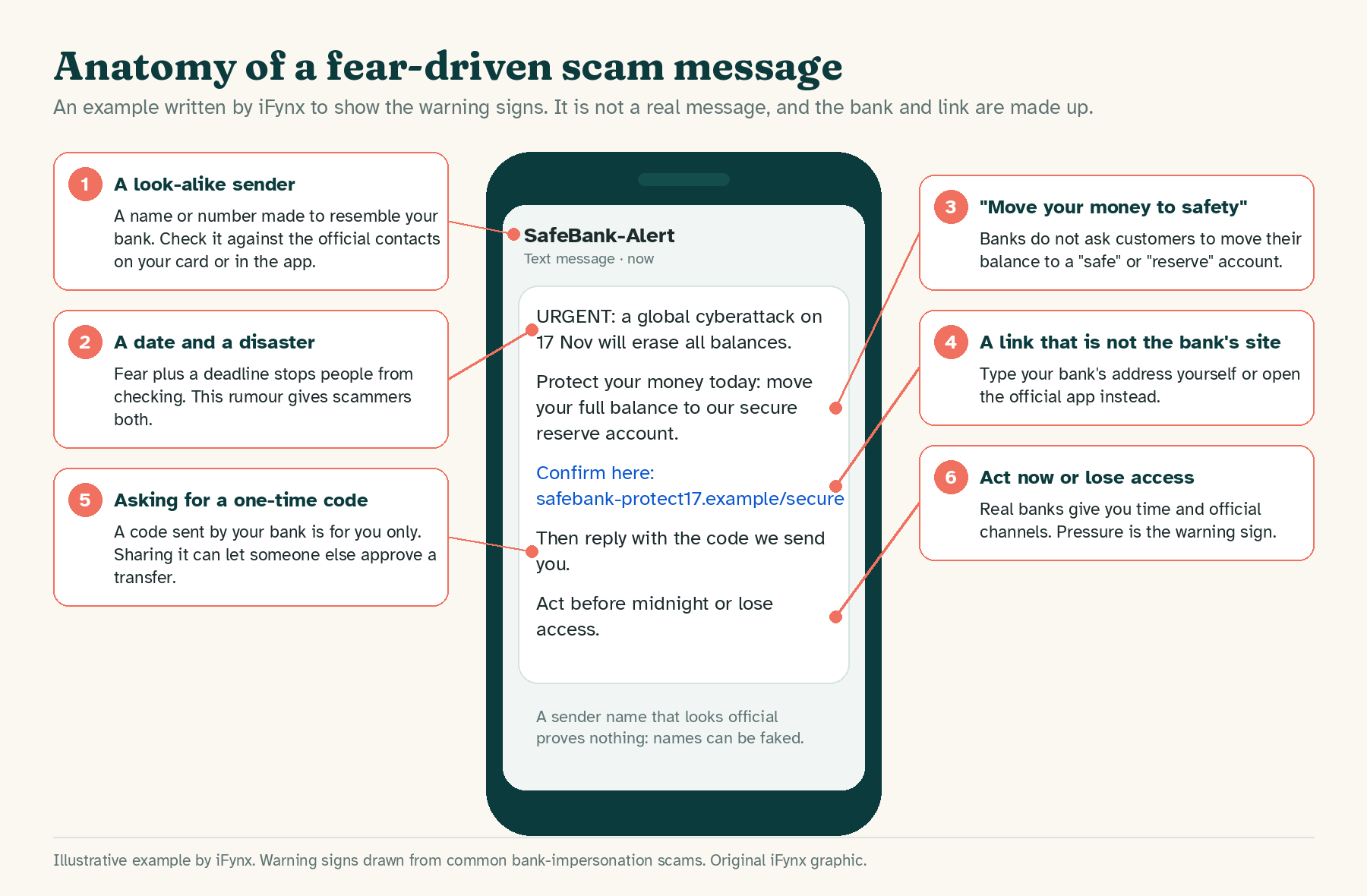
Scammers love a date and a disaster. Expect messages, calls and social media ads in Arabic and English that use 17 November as a reason to act fast. The common patterns:
- “Protect your balance before 17 November”: a text or WhatsApp message that looks like it comes from your bank, with a link to “secure” your account.
- “Move your money to a safe account”: a caller posing as your bank, the police or a regulator who asks you to transfer funds. No real bank asks this.
- “Send us the code”: any request for a one-time password, card PIN or app login.
- “Buy before it’s too late”: survival kits, gold or crypto sold with a countdown. Mimikama documented exactly this kind of fear-selling next to one of the original posts.
- Fake “official” notices: a screenshot made to look like it comes from a central bank, a telecoms regulator or the police.
What to do: do not click, do not share codes, and call your bank on the number printed on your card or shown in its official app. If you were tricked, call your bank immediately to freeze the transfer, then report it. Our guide to UAE online fraud and how banking apps defend against it covers how impersonation scams work and where to report them.
For banks, fintech and telecom teams in the Gulf and Egypt
A viral rumour is a customer-communication problem before it is a security problem. These are practical steps for the next 72 hours:
- Publish a short, calm notice in Arabic and English on your app, website and social accounts: there is no planned attack, your money is safe, and we will never ask you to move funds or share a code.
- Repeat your official channels: the SMS sender ID, the hotline number and the verified social accounts customers should trust.
- Watch for look-alike domains and fake pages using your brand around 17 November, and request takedowns quickly.
- Add friction where scams land: extra checks or a cooling-off period for new beneficiaries, and alerts for unusually large or first-time transfers.
- Brief your call centre and branch staff with one script, so customers hear the same answer everywhere.
- Prepare an honest outage message anyway. If any app has a normal glitch on 17 November, rumours will blame “the attack”. A ready status page and a clear “what is affected, what is not, next update at” message stop that.
- Design for partial failure: show the last known balance with a timestamp when the app cannot reach the server, and explain the error in plain words instead of a blank screen.
A sensible way to be prepared
Keeping a small stock of water, food, medicine, a torch, power banks, copies of important documents and some cash is normal emergency advice in many countries; the European Commission, for example, advised in March 2025 keeping essential supplies for at least 72 hours. Kazakhstan’s ministry stressed that its 72-hour advice is a standard precaution and “does not indicate the existence of any immediate threat”. If it gives you peace of mind, prepare in that spirit, on any day of the year. There is no need to withdraw all your savings, panic-buy or forward warnings to family groups.
How iFynx can help
Calm apps, clear messages
When a rumour spreads, your app should be the calmest voice your customers hear.
iFynx designs, builds and maintains banking, fintech and mobile apps for companies in the Gulf, Egypt and Palestine. We can help you:
- Maintenance & Growth: Software Maintenance: 24/7 monitoring, security patches and ready-to-send incident and status messages in Arabic and English.
- Software Development: Mobile App Development: apps that keep working when the network does not, with offline states, last-known balances and in-app safety banners.
- Software Development: API & Backend Engineering: beneficiary controls, transfer alerts and fraud checks built into your backend.
Frequently asked questions
Will the internet go down on 17 November 2026?
No. No government, internet company or security body has announced any outage or attack for 17 November. The internet is made of tens of thousands of independent networks and has no single off switch. The only scheduled event is a one-minute US radio and TV alert test.
Will bank accounts be wiped? Should I withdraw my cash?
No, and no. There is no evidence of any planned attack on banks. Banks keep copies of account records across several systems and sites, so one hack cannot erase everyone’s balance. Rushing to withdraw savings is not needed, and carrying large amounts of cash brings its own risks.
What is the US Emergency Alert System test, and what time is it in the Gulf and Egypt?
It is a routine nationwide test run by FEMA and the FCC on Tuesday 17 November 2026 at about 2:20 p.m. Eastern Time, with a backup date of 3 December. That is 21:20 in Gaza and Cairo, 22:20 in Riyadh and 23:20 in Dubai. It interrupts US radio and TV for about one minute, is not sent to phones and says: “This is only a test.”
Did The Simpsons predict a 17 November blackout?
No. TF1’s fact-checkers found that in the episode being shared, the power cut is caused by a storm and human error, not a cyberattack. A matching date in a cartoon is not evidence of a real event.
How might scammers use the 17 November rumour?
Expect fake bank messages asking you to “protect” or “move” your money before 17 November, requests for one-time codes, and sales of survival kits or crypto with a countdown. Your bank will never ask you to move your balance to a “safe” account. Call the number on your card or open the official app instead of clicking links.
Sources and update policy
Checked on 15 November 2026 at about 09:55 Asia/Gaza: FCC, Public Notice DA 26-989, 16 September 2026, and the EAS Test Reporting System page (backup date); FEMA, Integrated Public Alert and Warning System and nationwide test FAQ (17 September 2026, via PublicNow); Wisconsin Emergency Management, 10 November 2026; Kursiv (Kazakhstan Ministry of Emergency Situations), 5 November 2026; LB.ua (Ukraine Centre for Countering Disinformation), 9 November 2026; Mimikama, 10 November 2026; TF1 Info, 14 November 2026; Lenta.ru, 3 November 2026; HSE / Lapsha Media, 6 November 2026. Times in the Gulf and Egypt are our conversions from 2:20 p.m. Eastern Standard Time (19:20 UTC). We will add a dated update after the test on the evening of 17 November, or on 18 November, with what actually happened, and sooner if any Gulf or Egyptian authority comments.
Related reading
- UAE Online Fraud: Inside the Dh1 Million Government-Impersonation Scam Dubai Police Reversed, and the Anti-Scam Features UAE Banking Apps Should Ship
- Supermarket Cyber Attack: Fridges and Freezers Hacked in Belgium and Sweden, and the Checklist Gulf and Egypt Retailers Need Tonight
- Old Bitly Links Hijacked: Why Brands' Old Short Links Opened Unrelated Pages, and How to Audit Yours Today