
Goldman Sachs AI ban, in one line: Goldman did not ban AI. Internal guidance updated in October 2026, reported by Bloomberg on 2 November 2026, limits Anthropic’s Claude Code and GitHub’s AI coding tools to engineers and strats; traders and bankers lost access, and staff keep Goldman’s own internal AI assistant. As of 9 November 2026 Goldman had published neither the guidance nor a new statement.
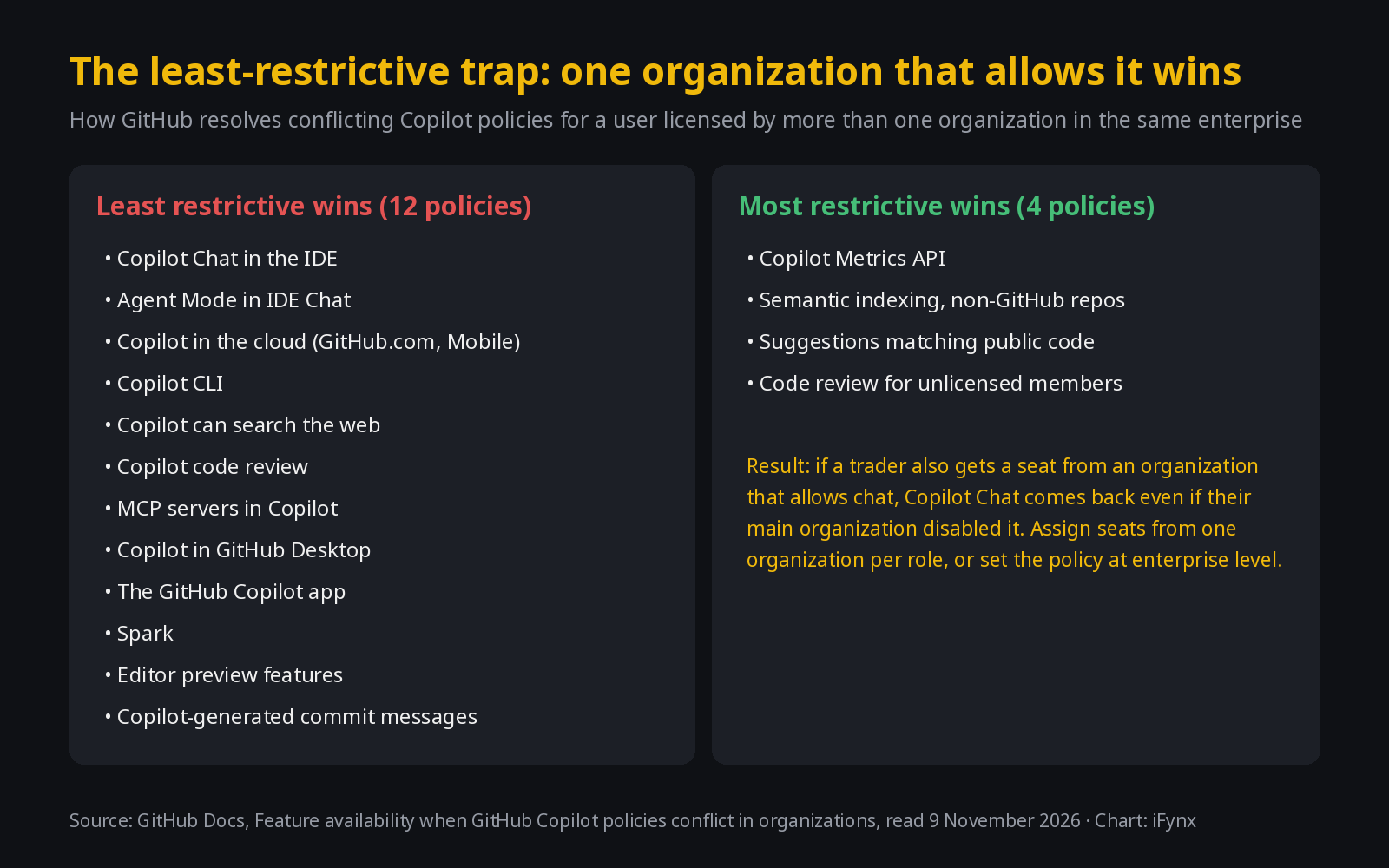
Direct answer: A Copilot Chat restriction, enterprise-wide or by role, is what Goldman Sachs applied in spirit when internal guidance updated in October 2026 (reported by Bloomberg on 2 November 2026, about 15:52 Asia/Gaza) limited Anthropic’s Claude Code and Microsoft’s GitHub coding tools to engineers. Traders and bankers lost access; “strats” are not covered. Goldman has not said which switches it used, but both vendors document them: GitHub Copilot policies and seats in AI controls, and Microsoft’s Integrated Apps block for Copilot Chat, scoped by group. One trap matters most: for 12 of 16 GitHub policies, including Copilot Chat in the IDE, a user with seats from two organizations gets the least restrictive setting. For banks in the UAE, Saudi Arabia and Egypt, the lesson is a role-based restriction under written controls, not a blanket ban. Updated 9 November 2026.
Key facts (re-checked 9 November 2026, 09:15 Asia/Gaza)
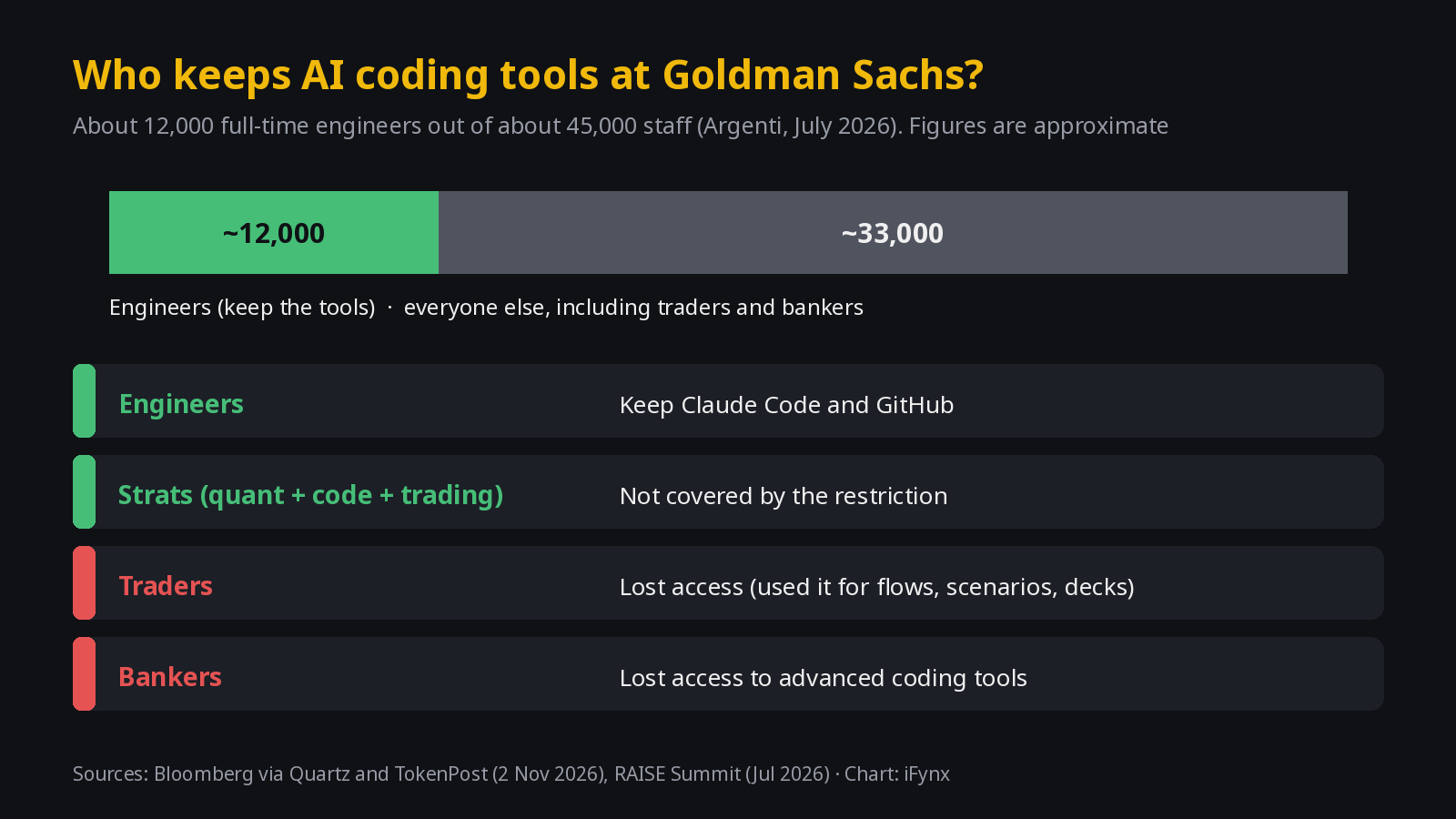
- What changed: internal guidance updated in October 2026 restricts Claude Code and GitHub’s tools to engineers, after a review of productivity and risk (Bloomberg via Quartz, 2 Nov 2026).
- Who lost access: traders and bankers. Traders had used the tools to watch client flows, model market and position changes, and draft text and visuals.
- Who keeps it: engineers (about 12,000 full-time of roughly 45,000 staff, per CIO Marco Argenti in July 2026) and strats.
- Goldman’s statement: spokesperson Nick Carcaterra said the firm put the tools “in the hands of those who are best suited to leverage them for the long term”.
- Not the first cut: Goldman staff in Hong Kong lost Claude access in late April 2026 after a strict reading of the Anthropic contract (Reuters, 29 Apr 2026).
- Still available: Goldman’s own internal AI assistant, which draws on OpenAI, Anthropic and Alphabet models (Bloomberg).
- Not disclosed: the guidance text, the exact list of GitHub products covered, and whether any incident triggered the change.
- Gulf rules in force: CBUAE’s AI guidance note (issued 11 Feb 2026, announced 23 Feb) and SDAIA’s generative AI guidelines (May 2025) both expect role limits, inventories and logging.
- Since 3 November: no new Goldman statement and no published guidance as of 9 November. Fast Company (5 Nov) recapped Bloomberg’s report; India Today (3 Nov) reported that Replit’s CEO posted on X that such restrictions are widespread in finance.
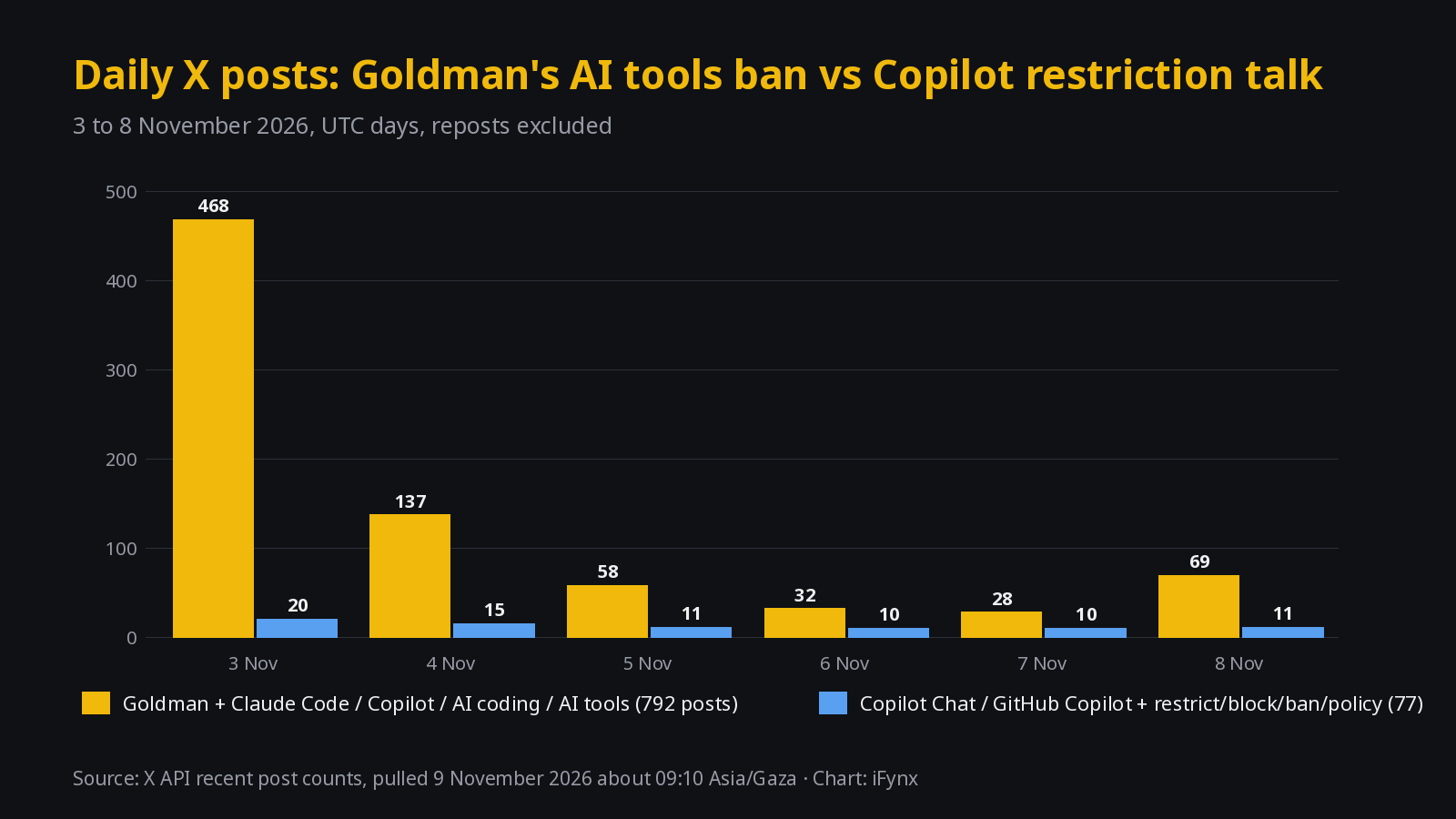
- Interest is fading: X posts matching Goldman plus AI coding terms fell from 468 on 3 November to 28 on 7 November (69 on 8 November), per X API counts.
- How to restrict Copilot Chat: GitHub policies apply per Copilot seat (GitHub Docs); Microsoft lets admins block Copilot Chat for specific users or groups through Integrated Apps (Microsoft Learn).
The Goldman Sachs AI tools ban is a narrower story than the headlines suggest, and a more useful one. Goldman did not drop AI. It took two of the most powerful AI coding tools on the market, Anthropic’s Claude Code and Microsoft’s GitHub tools, away from traders and bankers and left them with its roughly 12,000 engineers. Three months earlier, its technology chief was publicly praising bankers who “vibe coded” their own prototypes.
This article sets out what Bloomberg and other outlets have reported, and marks what Goldman has not confirmed. It then answers the question we hear from banks and fintechs in the UAE, Saudi Arabia and Egypt: should we copy Goldman? Our answer is a role-based access matrix, a regulator mapping for CBUAE, SDAIA and Egypt’s AI charter, and a 10-point AI coding tools policy you can adapt this week.

What did Goldman Sachs restrict, and who is affected?
According to Bloomberg, which saw the guidance, Goldman updated its internal rules in October so that Claude Code and GitHub are available only to engineers. Bloomberg’s Todd Gillespie reported that the change followed a review of the tools’ productivity and risk-management impact. Quartz, Finextra, PYMNTS and TokenPost carried the same details within hours.
The people who lost access are traders and investment bankers. According to the reports, some traders had used the tools to monitor client trading flows, to model how market moves would hit positions, and to draft text and visuals. Some staff were frustrated by the decision. The so-called strats, Goldman’s hybrid of software engineering, quantitative research and trading, are not covered by the restriction.
We make certain AI tools available to our people to determine the best use cases across different parts of the firm. After a period of experimentation where we assess a variety of factors including productivity and risk management, we put them in the hands of those who are best suited to leverage them for the long term.
Nick Carcaterra, Goldman Sachs spokesperson, to Bloomberg, 2 November 2026
What is not confirmed
Goldman has not published the guidance. Reports say “GitHub” without naming products, so it is unconfirmed whether every GitHub Copilot feature, including Copilot Chat, is covered. No security incident has been linked to the change. We will add a dated update if Goldman or Bloomberg publishes more.
Why did Goldman Sachs ban AI coding tools for bankers?
Goldman’s only public explanation is its statement: a period of experimentation, then an assessment of “productivity and risk management”, then access for those “best suited” to use the tools long term. Three threads in the reporting help explain what that likely means, though Goldman has not tied the decision to any one of them.
1. Agentic coding tools are not chatbots
Claude Code runs in a terminal. It can read a whole repository, edit files and run commands. GitHub’s agent features can open pull requests. In the hands of an engineer inside a controlled pipeline, that is a productivity tool. On a trader’s desktop, connected to spreadsheets of client flows, the same tool becomes an unmanaged software factory: code nobody reviews, scripts that touch sensitive data, and outputs that can find their way into client materials. That is a model-risk and data-leak problem before it is a cyber problem.
2. Skills, not just security
In August 2026, partner Chris Churchman, co-chair of the AI working group in Goldman’s global banking and markets division, warned that heavy AI use could weaken junior bankers’ analytical skills (Quartz, citing Bloomberg). A firm that worries analysts will stop building models by hand has a reason to keep the most capable code generators with engineers.
3. Vendor and contract risk
In late April 2026 Goldman staff in Hong Kong lost access to Anthropic’s Claude after the bank took a strict reading of its contract, while Google’s Gemini and OpenAI’s ChatGPT stayed available there (Reuters, citing the FT, 29 April 2026). That episode showed how quickly a vendor term can change who can use what. Narrowing the user base to engineers makes the licence, logging and contract easier to manage.
Goldman Sachs and Claude Code: from vibe coding to engineers only
The reversal is striking because Goldman had been one of the loudest advocates. Speaking at the RAISE Summit in July 2026, chief information officer Marco Argenti described non-technical staff using “vibe coding” to build prototypes and then handing them to engineers to harden. He put the firm at roughly 45,000 employees and about 12,000 full-time engineers, plus thousands of contractors. Summaries of the talk cite a productivity gain of about 20% across engineers; we could not confirm that figure from a primary transcript, so treat it as reported.
Read together, July and October are not a contradiction. Goldman tested broad access, measured it, and concluded that the gains were real for engineers and harder to justify, given the risks, for everyone else. Rivals are taking a different route: JPMorgan said in July it wants staff to match each task to a suitable model rather than default to one tool (Bloomberg). Most banks will land somewhere between the two.
Exclusive: a role-based AI coding tools access matrix
Banks rarely publish this level of detail, so we built the matrix we recommend to clients in the Gulf and Egypt. It follows Goldman’s logic, keeps capable tools where review exists, and replaces a blanket “no” with a safe path for everyone else.
| Role | Agentic coding tools (Claude Code, GitHub Copilot agent) | Chat assistant | Controls |
|---|---|---|---|
| Software engineers | Yes, enterprise plan | Yes | PR review, tests, secret scanning, no direct push, repo allow-list |
| Quant / strats | Yes, on approved repos | Yes | Model-risk sign-off for anything that prices or trades |
| Data and analytics | Limited: notebooks only, no production repos | Yes | Synthetic or masked data; outputs reviewed before reuse |
| Traders and bankers | No (as at Goldman) | Yes, internal assistant | Sandbox with synthetic data; hand prototypes to engineering |
| Operations, compliance, HR | No | Yes, internal assistant | No customer data in prompts; DLP on uploads |
| Contractors and vendors | Only through the bank’s tenant | Bank tenant only | Named accounts, logs kept, access ends with contract |
Why role-based beats a ban
A blanket ban pushes staff to personal accounts and phones, where you have no logs and no contract. Giving each role a tool that matches its review process keeps use visible. That is the practical reading of Goldman’s move, and of the regulators below.
How to set a Copilot Chat restriction in the enterprise (added 9 November 2026)
Goldman has not said how it enforces its rule. Banks that run GitHub Copilot Business or Enterprise, or Microsoft Copilot Chat, do not need to guess: both vendors document the controls. We read GitHub Docs and Microsoft Learn on 9 November 2026. Below is what each control does, and where it falls short. We are not claiming Goldman uses these exact settings.
GitHub Copilot: seats, AI controls and policies
- The seat is the first restriction. GitHub says policies “only apply to users on your Copilot plan”: a user is governed by the enterprise or organization that gives them a Copilot Business or Enterprise licence. No seat from you means none of your policies apply, so remove seats from roles that should not have the tool (GitHub Docs).
- Where the switches are. Enterprise owners open AI controls on the enterprise account. Copilot feature and client policies sit under Copilot, then “Features & clients”; agent policies under Agents; MCP under MCP. Each policy can be enabled, disabled or left to organizations (GitHub Docs).
- Chat without agents. Copilot Chat in the IDE, Agent Mode in IDE Chat, Copilot in the cloud (GitHub.com and GitHub Mobile), Copilot CLI, web search and MCP servers are separate policies. An analytics team can keep chat while agent mode and the CLI stay off.
- Content exclusion is a guardrail, not a wall. Repository admins and owners can stop Copilot reading named files, but GitHub says it “is not a filesystem security boundary” and may not be respected by third-party MCP servers or clients (GitHub Docs). Keep key-management and payment repos out of reach with normal access control.
- Watch for drift. Use the audit log to monitor policy changes, and review who holds enterprise owner or the “Manage enterprise AI controls” permission.
Exclusive: the least-restrictive trap
GitHub’s policy-conflict table lists 16 policies. For a user who gets Copilot seats from more than one organization in the same enterprise, 12 follow the least restrictive organization, including Copilot Chat in the IDE, Agent Mode, Copilot in the cloud and Copilot CLI. Only 4 follow the most restrictive: the Metrics API, semantic indexing of non-GitHub repos, suggestions matching public code, and code review for unlicensed members. So if a trader sits in a markets organization with chat disabled but also gets a seat from an innovation-lab organization that allows it, chat comes back. Across different enterprises, the most restrictive setting usually applies. The fix: set chat and agent policies at enterprise level, or make sure each person gets seats from one organization only, and check seat assignments in the quarterly access review.
Microsoft Copilot Chat: block, scope and limit
- Block by group, not by memo. Blocking Copilot through Integrated Apps in the Microsoft 365 admin center is “a tenant-wide control that you can scope to specific users or groups, including licensed users”. It blocks Copilot in the Copilot app, Teams, Outlook and Copilot Chat on the web (Microsoft Learn).
- Unpinning is not blocking. Microsoft says unpinning does not remove access, and users can still reach m365.cloud.microsoft/chat. Outside the EEA and Switzerland, the pin setting stopped governing the Copilot app on 28 January 2026 (Microsoft Learn).
- Explain the block. Admins can set a custom link that appears on the “Copilot Chat was turned off for your organization” page. Point it to your bilingual AI policy so staff see why, in Arabic and English.
- Web search. The “Allow web search in Copilot” policy in the Cloud Policy service can turn web grounding off for users or groups; the user toggle then appears dimmed (Microsoft Learn).
- Edge and data. The HubsSidebarEnabled policy disables Copilot Chat in Edge entirely (and all sidebar apps); EdgeEntraCopilotPageContext stops it using page or PDF content. Purview DLP can stop items with chosen sensitivity labels being used in responses.
- Personal accounts. Microsoft points admins to Tenant Restrictions v2 to manage whether users can sign in with personal accounts. That is the practical answer to CBUAE’s line about AI models an institution has “no control over”.
The Goldman-style role matrix, mapped to real controls
| Role | GitHub Copilot | Microsoft Copilot Chat |
|---|---|---|
| Software engineers | Business or Enterprise seat; chat, agent mode and CLI on; content exclusion plus repo permissions on key-management code | Allowed; web search per policy |
| Quant / strats | Seat from the engineering organization only; agent mode on approved repos | Allowed; DLP labels on pricing data |
| Data and analytics | Seat with Chat in the IDE on; Agent Mode and CLI off | Allowed; DLP labels |
| Traders and bankers | No seat (as at Goldman); no second seat from a lab organization | Allowed or blocked by group; web search off; custom policy link |
| Operations, compliance, HR | No seat | Allowed with DLP; Edge page context off |
| Contractors and vendors | Named seat through the bank’s enterprise only | Work account only; Tenant Restrictions v2 |
What do CBUAE, SDAIA and Egypt’s AI charter say?
None of the three regimes bans AI coding assistants. All three, in different words, expect what Goldman did: decide who may use which tool, record it, and control the data.
| Requirement | UAE: CBUAE AI guidance note (2026) | Saudi Arabia: SDAIA GenAI guidelines (2025) | Egypt: Charter for Responsible AI (2023) |
|---|---|---|---|
| Status | Non-binding guidance for licensed financial institutions; issued 11 Feb, announced 23 Feb 2026 | Guidelines for government entities (SDAIA-P116E, May 2025); a public version also exists | Non-binding charter from the National Council for AI |
| Who may use tools | Board and senior management accountable for AI use | “Limit the utilization of the generative artificial intelligence tool within the government entity to authorized personnel” | Human oversight and accountability principles |
| Inventory and risk | Inventory of all AI models, including third-party ones, with purpose and risk rating; risk-rate each system (8(d)) | Tools approved via the Data Management Office | Risk assessment across the AI lifecycle (technical guidelines) |
| Data | Privacy-by-design and security-by-design | Do not enter data classified restricted or higher; services may store data for training | Privacy and data-protection guidelines |
| Generated code | Pre-deployment testing; annual independent cyber review | “Verify the accuracy of the generated code before using and executing it” | Robustness and safety guidelines |
| Vendors | Due diligence, audit rights, board or senior-management approval for AI outsourcing; avoid over-reliance on one provider (9(e)) | Detailed records of employee use kept | Transparency on third-party systems |
The CBUAE rulebook text adds one line that matters for coding agents: institutions “should not employ AI models that they have no control over”. A personal Claude or ChatGPT account used by a trader at home is the clearest example of a model the bank does not control. Saudi banks are supervised by SAMA, so SDAIA’s government guidelines are a benchmark, not their rulebook; check SAMA’s own cyber and outsourcing frameworks too.
Limit the utilization of the generative artificial intelligence tool within the government entity to authorized personnel.
SDAIA, Generative AI Guidelines for Government, Appendix 2 checklist (May 2025)
A 10-point AI coding tools policy for banks in the Gulf and Egypt
Use this as a starting draft. Each point notes the guidance it maps to, so your compliance team can trace it.
- Approved tools list. Name every AI coding assistant the bank allows, with version or plan (for example an enterprise tier with no training on your data). Anything not on the list is blocked at the proxy. *Maps to: CBUAE model inventory; SDAIA Data Management Office approval.*
- Role-based access. Grant each tool to identity groups, not individuals: engineers, quant/strats, and a sandbox group for everyone else. Review the groups every quarter. *Maps to: SDAIA “authorised personnel”; Goldman’s October model.*
- Inventory and risk rating. Each tool gets an entry: owner, purpose, data it can see, risk rating. Agentic tools that can run commands rate higher than chat-only tools. *Maps to: CBUAE guidance, section 8(d) and the 2022 Model Management Standards.*
- Data rule in one sentence. For example: “No customer data, no credentials, no data classified restricted or above, in any prompt, file or indexed repository.” Enforce it with DLP and secret scanning. *Maps to: SDAIA data classification; Egypt charter privacy guidelines.*
- Repository scope. Coding agents index code. Keep core banking, payment and key-management repos out of the index unless the tool is self-hosted or contractually isolated.
- Human review before merge or run. Generated code goes through the same pull-request review, tests and static analysis as human code. No agent gets direct push to protected branches. *Maps to: SDAIA “verify the accuracy of the generated code before using and executing it”.*
- Logging. Keep records of who used which tool, when and on which repository. *Maps to: SDAIA “detailed records of employee use of the tool are kept”.*
- Vendor due diligence and contract. Data residency, retention, training opt-out, audit rights, incident notice and, where outsourcing is material, board or senior-management sign-off. *Maps to: CBUAE section 9.*
- Exit plan. Avoid building every workflow around one model vendor. Keep prompts, rules and agent configs portable. Goldman’s Hong Kong episode shows a contract reading can cut access overnight. *Maps to: CBUAE 9(e), over-reliance on one provider.*
- A safe path for non-engineers. Do not just say no. Give traders, analysts and product staff a sandbox with synthetic data, and a route to hand prototypes to engineering. That keeps the productivity Goldman praised in July without the risk it cut in October.
Security box: patch the browser inside your coding agents
One practical risk sits under every AI coding setup: the browser that agents drive. Developers flagged on X on 3 November that Playwright’s latest release bundles a Chromium build (156.0.8078.4) older than Google’s current security fixes; we checked the bundled version on the Playwright releases page, but Microsoft has not issued an advisory, so treat the gap as reported. The CIS advisory 2026-122 (27 October 2026) says Chrome versions before 156.0.8078.73/74 contain multiple vulnerabilities, the most severe of which could allow arbitrary code execution, with no in-the-wild exploitation reported at the time.
- Update Playwright and its browsers as soon as a build with the fixed Chromium ships, and track the bundled version in your inventory.
- Turn on
chromiumSandbox: truein launch options; Playwright’s default is false. - Run browsing agents in a disposable VM or container with no access to production secrets.
- Do not let agents browse untrusted sites from a machine that holds code-signing keys or customer data.
Dated update policy
We will add a dated update if Goldman publishes its guidance, if GitHub product scope is confirmed, or if Playwright ships a patched Chromium. Times are Asia/Gaza (UTC+2) unless marked UTC.
How iFynx can help
If your bank or fintech in the UAE, Saudi Arabia or Egypt wants Copilot and Claude Code in engineers’ hands without pushing bankers onto personal accounts, iFynx can do the groundwork. Our AI Development team builds governed internal assistants grounded in your own data, with guardrails and evaluation, so non-engineers still get a safe tool. Our Software Maintenance team covers monitoring, security patches and dependency updates, and can run the Copilot seat, policy and audit-log reviews described above. Not sure where to start? Try the AI Solution Advisor or book a discovery call.
Frequently asked questions
Why did Goldman Sachs ban AI coding tools for traders and bankers?
Goldman has not published the guidance. A spokesperson, Nick Carcaterra, told Bloomberg that after a period of experimentation the firm assessed “a variety of factors including productivity and risk management” and put the tools “in the hands of those who are best suited to leverage them for the long term”. Bloomberg reported that some staff were frustrated. In August a Goldman partner had also warned that AI could weaken junior bankers’ analytical skills. The exact risk that triggered the October change has not been disclosed.
Does Goldman Sachs still use Claude Code?
Yes, for engineers. The October guidance reported by Bloomberg limits Anthropic’s Claude Code and Microsoft’s GitHub tools to engineers, and the “strats” who combine coding, quantitative research and trading are not covered by the restriction. Goldman also runs its own internal AI assistant, which Bloomberg says draws on models from OpenAI, Anthropic and Alphabet. Separately, Goldman staff in Hong Kong lost Claude access in late April 2026 after a strict reading of the Anthropic contract.
How do you set a Copilot Chat restriction in an enterprise?
In GitHub Copilot Business or Enterprise, remove seats from roles that should not have Copilot, then set the Copilot Chat, Agent Mode, CLI and cloud policies under AI controls at enterprise level. If you delegate to organizations, remember that for most policies a user with seats from two organizations gets the least restrictive setting. In Microsoft 365, block Copilot Chat for specific users or groups through Integrated Apps (unpinning alone does not remove access), turn web search off with the Allow web search in Copilot policy, and add a custom link to your AI policy. Goldman has not said which controls it uses.
Can banks in the UAE and Saudi Arabia use AI coding assistants?
Nothing in the public rules we reviewed bans them. The Central Bank of the UAE’s February 2026 AI guidance note is non-binding but expects board accountability, an inventory of all AI models including third-party ones, a risk rating for each system and due diligence on AI vendors. In Saudi Arabia, SDAIA’s generative AI guidelines for government (May 2025) say tools should be limited to authorised personnel, use should be logged, generated code should be checked before it runs, and restricted data should not be entered. SAMA-regulated banks should also check SAMA’s own rules. This is not legal advice.
What should a bank’s AI coding tools policy include?
At minimum: a list of approved tools and the roles allowed to use each, an inventory entry and risk rating per tool, a rule on what data may be pasted or indexed, human review and testing before generated code is merged or run, logging of use, vendor due diligence and contract terms, an exit plan to avoid dependence on one provider, and a separate safe path for non-engineers who want to prototype. Our 10-point checklist below maps each item to CBUAE, SDAIA and Egyptian guidance.
Did Goldman Sachs ban AI for all employees?
No. Internal guidance updated in October 2026, reported by Bloomberg on 2 November 2026, limits Anthropic’s Claude Code and GitHub’s AI coding tools to engineers and strats. Traders and bankers lost access to those tools, but staff can still use Goldman’s internal AI assistant, which draws on OpenAI, Anthropic and Alphabet models. As of 9 November 2026 Goldman had not published the guidance or made a new statement.
Related reading
- Railway Employee’s AI Agents Probed Rival Cloud Primcloud: What Each Side Says, Why Agent Testing on Competitors Crosses a Line, and an AI-Agent Guardrails Checklist for Gulf and Egypt Teams
- WorkOS breach and ARTEX: an AI agent attack framework, with a defence checklist for Gulf and Egypt banks
- Plugin4Shell and AI agent plugin security: why SHA-pinning failed coding agents
- CBUAE’s AI guidance for banks: explainability UX becomes decision infrastructure
- SDAIA’s national AI risk framework: what Saudi banks need
- SAP UI5 plugins for Claude Code and Copilot: enterprise AX for regulated UI
- Microsoft’s unified Copilot: enterprise AX needs context boundaries
- OpenAI bug bounty now pays up to $172,000: the new reward table
- Claude Code Secrets on GitHub: What Apiiro Found in settings.local.json — A Rotate-First Checklist
Sources
- Bloomberg, Todd Gillespie: Goldman restricts traders and bankers from using some AI tools (2 Nov 2026, 13:52 UTC; paywalled, original report)
- Coverage of the Bloomberg report: Quartz; Finextra; PYMNTS; TokenPost (all 2 Nov 2026)
- Hong Kong Claude restriction: Reuters, citing the Financial Times (29 Apr 2026)
- Marco Argenti at the RAISE Summit (July 2026)
- Central Bank of the UAE: Guidance Note on the Consumer Protection and Responsible Adoption and Use of AI and ML by Licensed Financial Institutions; WAM announcement (23 Feb 2026)
- SDAIA: Generative AI Guidelines for Government (SDAIA-P116E, May 2025)
- Egypt National Council for AI: Egyptian Charter for Responsible AI (2023)
- Security box: CIS advisory 2026-122 (27 Oct 2026); Playwright releases
- Hero photo: Potro, Wikimedia Commons, CC BY-SA 4.0, cropped. In-body photo: Eden, Janine and Jim, Wikimedia Commons, CC BY 2.0. Charts: iFynx, from the sources above, GitHub Docs and X API counts.
- Copilot Chat restriction controls (read 9 Nov 2026): GitHub Docs — Copilot policies, managing enterprise policies, policy conflicts, content exclusion; Microsoft Learn — Manage Copilot Chat, pinning, web search
- Follow-up coverage: Fast Company (5 Nov 2026); India Today (3 Nov 2026)

