Published 3 November 2026, 07:00 Asia/Gaza. Based on OpenAI’s announcement and its Bugcrowd program page.

Quick answer: On 2 November 2026 OpenAI raised its Security Bug Bounty rewards. A critical bug in a core product (ChatGPT, Codex or the API Platform) now pays up to $30,000. Exceptional critical findings remain eligible for up to $100,000, and up to $172,000 with bonuses. New multipliers reward high-quality reports (up to 1.15x), priority campaigns (up to 1.30x) and loyal researchers (+5% to +15%). Reports go through Bugcrowd; jailbreaks and prompt-only safety bypasses stay out of scope. OpenAI also announced a security sprint with outside firm Cathedral.
Key facts
- Bigger ranges: OpenAI says the midpoint of medium, high and critical reward ranges more than quadrupled on average.
- Stacking: quality, campaign and loyalty multipliers multiply together on the base reward.
- Retroactive: unawarded reports get the new ranges; awards in the 30 days before the announcement are topped up if they would have earned more.
- In person: OpenAI’s security team will be at PROMPT2PWN in Oakland on 20 and 21 November.
- Sprint: OpenAI says its last internal sprint put 25% of its product engineers on finding and fixing weaknesses with Codex.
The new reward table, with OpenAI’s own examples
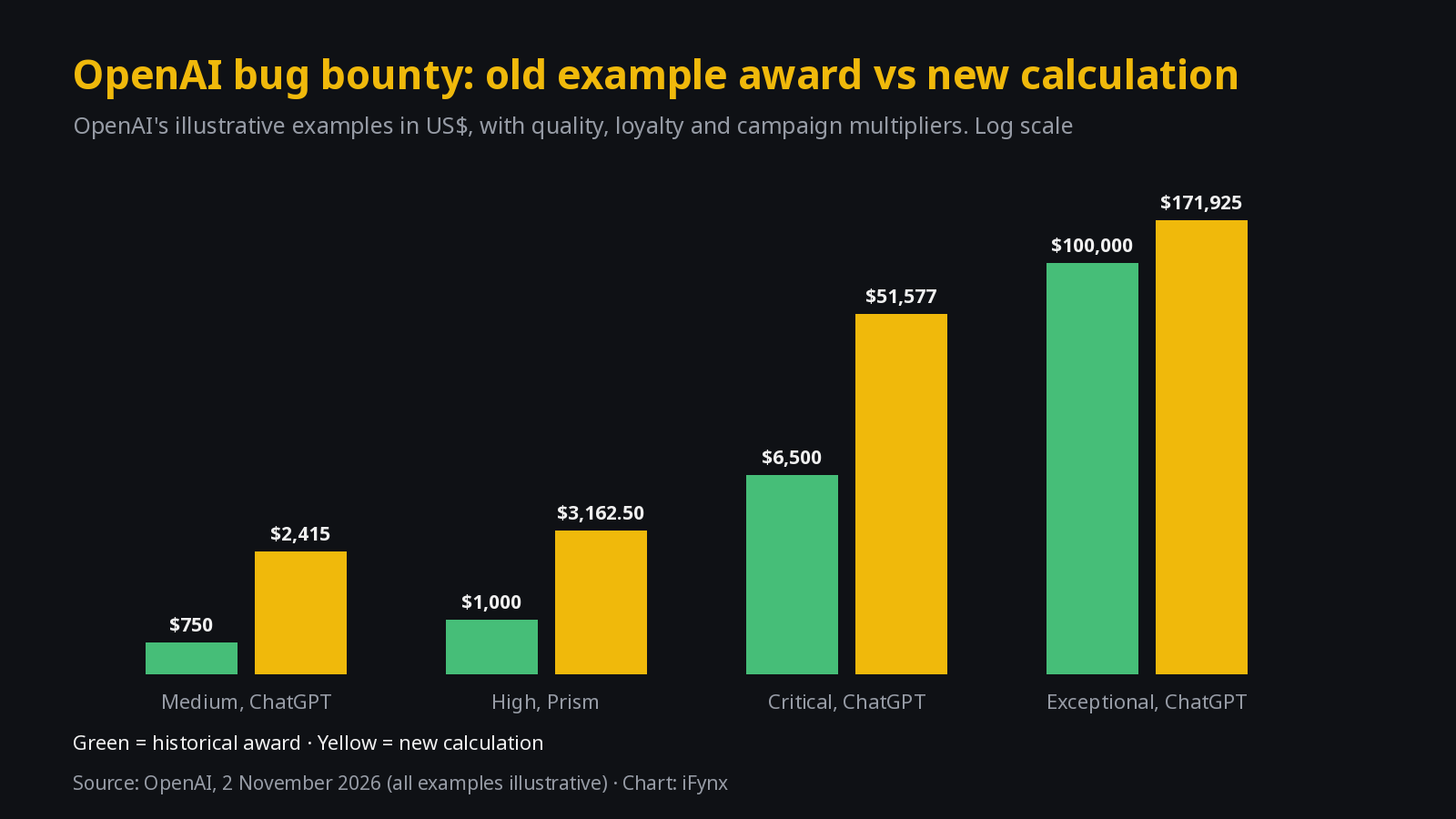
| Example finding | Historical award | New calculation | New reward |
|---|---|---|---|
| Medium, ChatGPT (core): read-only member can upload files to a Project | $750 | $2,000 x 1.15 quality x 1.05 Bronze | $2,415 |
| High, Prism (non-core): IDOR exposing a file in a user’s Project | $1,000 | $2,500 x 1.15 quality x 1.10 Gold | $3,162.50 |
| Critical, ChatGPT (core): one-click account takeover | $6,500 | $30,000 x 1.15 x 1.30 campaign x 1.15 31337 | $51,577 |
| Exceptional, ChatGPT (core): major security-boundary compromise | $100,000 | $100,000 x 1.15 x 1.30 x 1.15 | $171,925 |
OpenAI says all scenarios and historical awards are illustrative. Note one difference: the worked example on the Bugcrowd page uses a $20,000 base for the same one-click takeover, giving $34,385 against an illustrative $6,000, while the blog uses $30,000 and $51,577. The base depends on the target and severity, so check the current table before you estimate.
How the multipliers work
The Bugcrowd program page sets out three bonuses on top of the base reward. A high-quality report can earn up to 1.15x. A finding in a priority campaign can earn up to a further 1.30x. Loyalty adds a percentage of the core award. They stack multiplicatively.
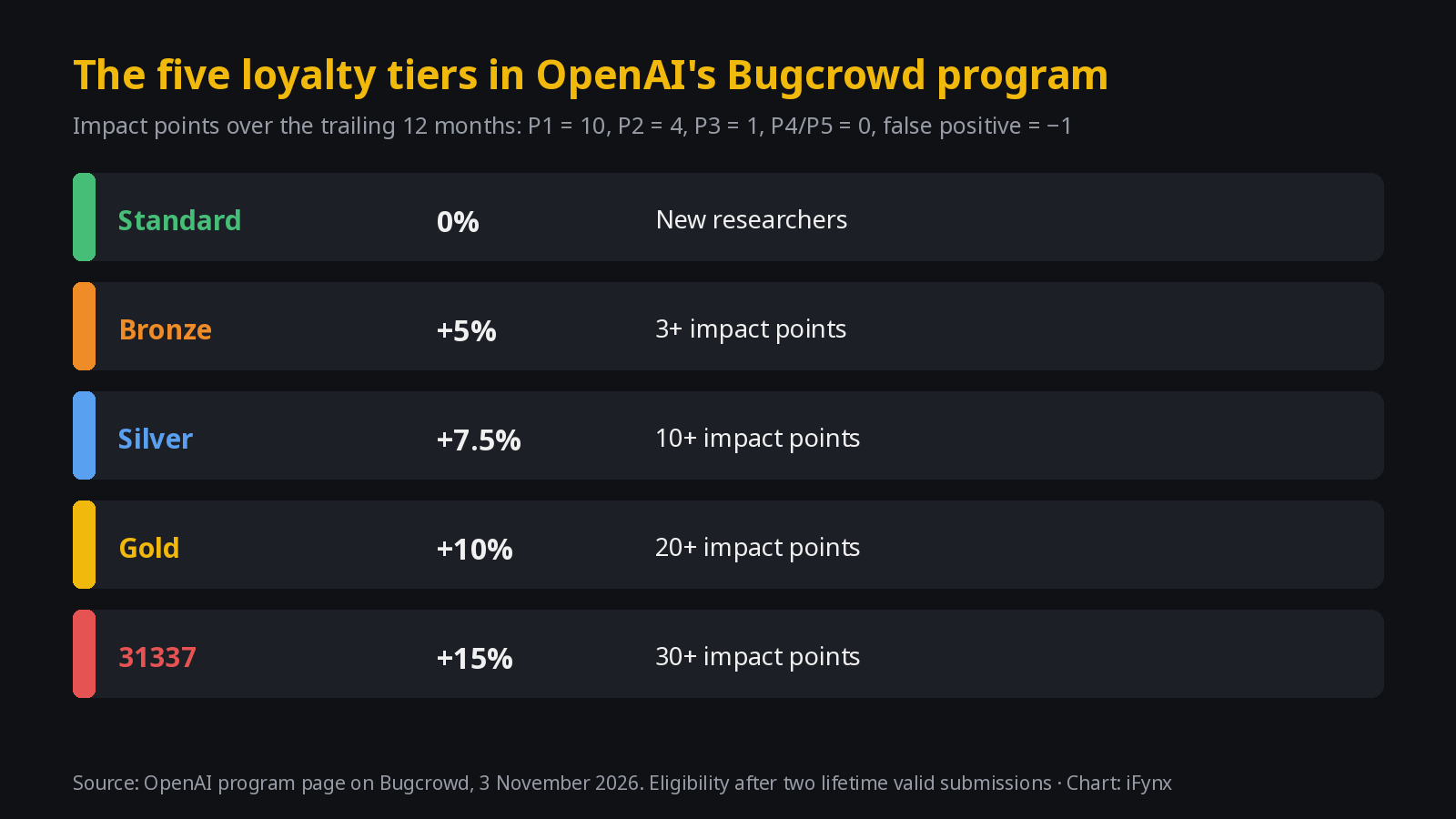
Researchers become eligible for loyalty after two lifetime valid submissions. Tiers are based on impact points over the trailing 12 months: P1 = 10, P2 = 4, P3 = 1, P4 or P5 = 0, and a false positive costs one point.
What is out of scope
The program page opens with a warning: findings limited to model behaviour, including jailbreaks, hallucinations and prompt-based safety bypasses, are out of scope for the Security Bug Bounty. A model-assisted attack can qualify if it exploits a separate flaw in an in-scope OpenAI product or an OpenAI-controlled integration. The page also says disclosure must be unconditional, and that extortion or threats void safe harbour.
Cathedral and the security sprint
In a separate post, OpenAI says its next internal security sprint will bring in Cathedral, whose researchers will use OpenAI’s models alongside OpenAI’s teams to challenge its defences. OpenAI says its last sprint dedicated 25% of product engineers to finding and fixing weaknesses, with Codex used to investigate findings, reproduce vulnerabilities in isolated environments and prepare patches for review. It also says it has committed $1 billion in subsidised access over six months for frontline defenders.
India Today reports that Cathedral was founded by former DOGE staffers and that its AI agents found security gaps in Anthropic’s third-party business systems in under 12 hours. Those claims are India Today’s; OpenAI’s post does not make them, and we have not verified them.
We want OpenAI to be a team you come back to when you find something we’ve missed.
OpenAI, 2 November 2026
Checklist for Arab bug hunters
Egypt, Saudi Arabia, Jordan and Palestine have active bug-hunting communities. The new table rewards the skills that matter most: clean reproduction and clear impact.
- Read the scope first. Model jailbreaks and prompt-only safety bypasses are out of scope. Test only listed targets, with your own accounts.
- Isolate the bug. OpenAI says the quality bonus rewards a reliable proof of concept that isolates the bug, shows when it can be exploited and demonstrates its impact.
- Show impact, not just a payload. Explain what an attacker could read or change, for which users, and under what conditions.
- Never touch other users’ data. Use test accounts; stop as soon as you have proof.
- Disclose unconditionally. The program page says disclosure must be unconditional and that extortion or pressure tactics lose safe-harbour protection.
- Build loyalty. Tiers use impact points over the trailing 12 months (P1 = 10, P2 = 4, P3 = 1); false positives cost a point.
- Watch for priority campaigns on newly launched features, where up to a 1.30x multiplier applies.
- Sort out payouts early. Complete your Bugcrowd profile, identity and tax details before a big award is pending.
Checklist for Gulf and Egypt companies
You do not need a $172,000 ceiling to learn from this. What OpenAI is paying for is fast, clear reports and repeat researchers.
- Publish a security.txt and a vulnerability disclosure policy (VDP). RFC 9116 defines security.txt; it tells researchers where to report and what is in scope.
- Give researchers safe harbour in writing, and name who triages reports and how fast you reply.
- Start with a VDP, then a bounty. Pay only once you can triage and fix within agreed times; a backlog of unpaid reports hurts trust.
- Copy the multiplier idea. Reward clean, reproducible reports and repeat researchers; it cuts triage time.
- Run an internal find-and-fix sprint. OpenAI says its last sprint put 25% of product engineers on finding and fixing weaknesses, using Codex to investigate, reproduce in isolated environments and prepare patches for review.
- Plan for agent-speed attackers. As the WorkOS/ARTEX case shows, attackers now use AI agents; your bounty scope should include sales, support and internal tools, not only the main app.
- Use your national CERT channel too, and know what your regulator expects when a reported bug exposed customer data.
Related: the WorkOS breach and the ARTEX AI attack framework, Linux kernel CVE-2026-98432, AI coding agent plugin security, GPT-6.1 Terra for Arabic teams and the WordPress 7.1.4 security release.
Search interest
Posts on X mentioning OpenAI with “bug bounty” or Cathedral were zero per hour until 02:00 UTC on 3 November, then about 40 in each of the next two hours. Arabic searches on the topic return almost nothing yet.
Status as of 3 November 2026, 07:00 Asia/Gaza.
How iFynx can help
iFynx builds bilingual banking, fintech and SaaS apps for the UAE, Saudi Arabia and Egypt, and can help you set up security.txt, a disclosure policy and a triage process. See our services.
Frequently asked questions
How much does the OpenAI bug bounty pay now?
OpenAI says a critical vulnerability in a core product such as ChatGPT, Codex or the API Platform now earns up to $30,000. Exceptional critical findings on those targets remain eligible for up to $100,000, and up to $172,000 with bonuses. It says the midpoint of medium, high and critical reward ranges has more than quadrupled on average.
Where do I submit a report?
Through OpenAI’s Security Bug Bounty program on Bugcrowd (bugcrowd.com/engagements/openai). Read the policy and scope there before testing.
Are jailbreaks covered?
No. The program page says findings limited to model behaviour, including jailbreaks, hallucinations and prompt-based safety bypasses, are out of scope. A model-assisted attack can qualify if it exploits a separate flaw in an in-scope OpenAI product or OpenAI-controlled integration.
How are the multipliers calculated?
They stack multiplicatively on the base reward: up to 1.15x for a high-quality report, up to 1.30x for a priority campaign, and a loyalty bonus from +5% (Bronze) to +15% (31337). OpenAI’s example: $100,000 x 1.15 x 1.30 x 1.15 = $171,925. All its examples are illustrative.
Will old reports get the new rates?
OpenAI says reports already submitted but not yet awarded will get the new ranges, and for bounties awarded in the 30 days before the announcement it will pay the difference (base award plus loyalty awards) if the finding would have earned more.
What is Cathedral?
A security firm whose researchers will use OpenAI’s models alongside OpenAI’s teams in its next internal security sprint, OpenAI says. India Today reports that Cathedral was founded by former DOGE staffers and that its AI agents found gaps in Anthropic’s third-party business systems in under 12 hours; OpenAI does not say this.
Can researchers in Egypt, Saudi Arabia, the UAE or Palestine take part?
Check eligibility, payout methods and tax forms on Bugcrowd for your country before you start. OpenAI’s pages do not list country restrictions, and we have not verified payout options per country.
Sources
- OpenAI: Rewarding defenders with bigger bug bounties, 2 November 2026
- OpenAI: Preparing our next security sprint to harden OpenAI, 2 November 2026
- OpenAI Security Bug Bounty on Bugcrowd, read 3 November 2026
- India Today, 3 November 2026
- RFC 9116: security.txt
- X post counts: X recent counts API, queried about 05:00 UTC, 3 November 2026
- Cover photo: Tirza van Dijk, Wikimedia Commons.jpg), CC0, cropped. Charts: iFynx.