Direct answer — 8 November 2026: Stop your LNbits server in line with the official team’s warning. Its full-server shutdown request supersedes the earlier instruction to disable only the Paywall extension. The official account has announced security patches are being prepared; our source check did not find a newer official post clearing operators to restart. This is an LNbits software incident, not evidence that Bitcoin or the Lightning Network protocol has been broken.
Key facts and what remains unknown
- The official warning applies to all LNbits users running servers, not just operators who know they enabled Paywall.
- Kevin Ravensberg reports 2,285,545 sats withdrawn from his instance. This is one operator’s self-reported loss, not a global LNbits total.
- Ben Arc’s statement that patches “should” be available within 24–48 hours is an estimate, not a release notification or a safe-restart deadline.
- The public GitHub security advisory page currently shows older 2024 and 2025 entries, not an advisory establishing this incident’s root cause, CVE or fixed build.
- No verified affected-country list, global victim count or official aggregate loss appears in the primary sources checked here. We do not infer one from social-media activity.
From a Paywall precaution to a complete shutdown
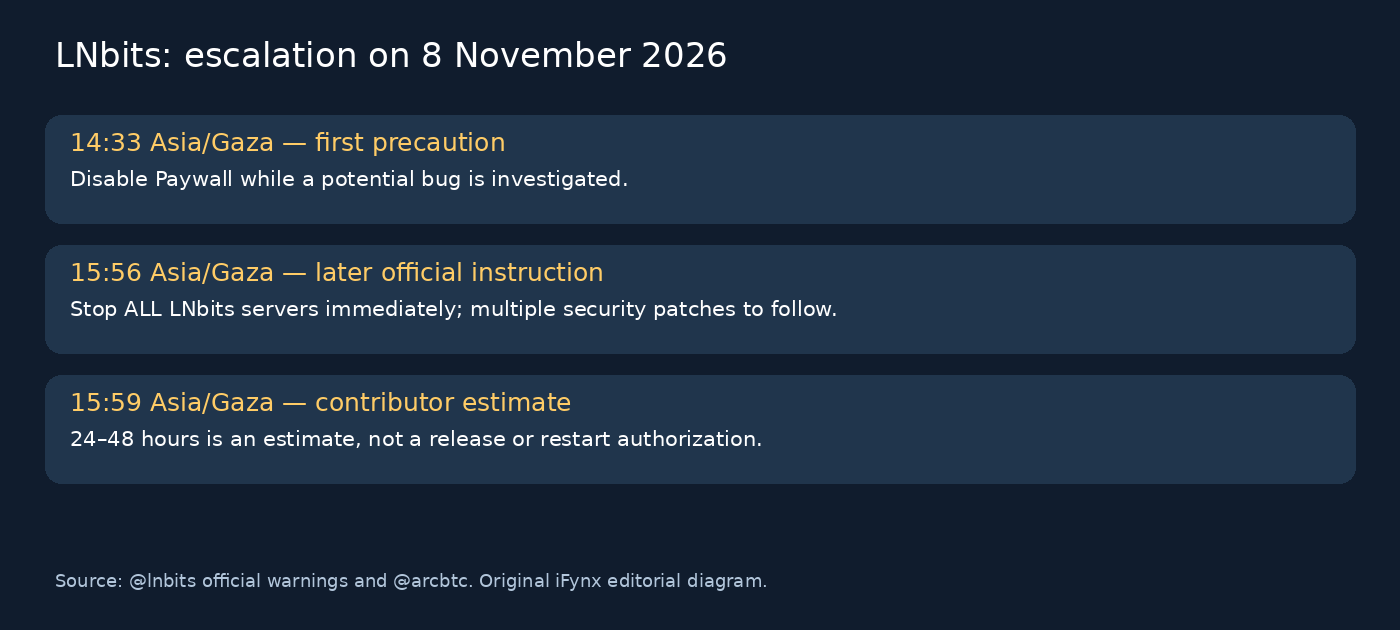
At 14:33 Asia/Gaza on 8 November, the LNbits account asked operators to disable Paywall while it investigated a potential bug. That was the first precaution, not the final scope of the response.
At 15:56 Asia/Gaza, the official account escalated: “All LNbits users should stop their LNbits servers IMMEDIATELY.” It described a wave of attacks and said it had a number of security patches to push. Continuing to run a server after merely disabling one extension does not follow that later instruction. A reverse-proxy maintenance page alone is also not proof the underlying service has stopped.
The distinction matters for a merchant whose payment checkout, donations page or tipping bot depends on the same instance. A narrowly scoped extension workaround can leave the rest of a service running, whereas the vendor’s latest instruction is a complete service pause. This article does not speculate about which component or permission check ultimately caused the attacks.
One operator’s account is evidence, not a worldwide loss tally
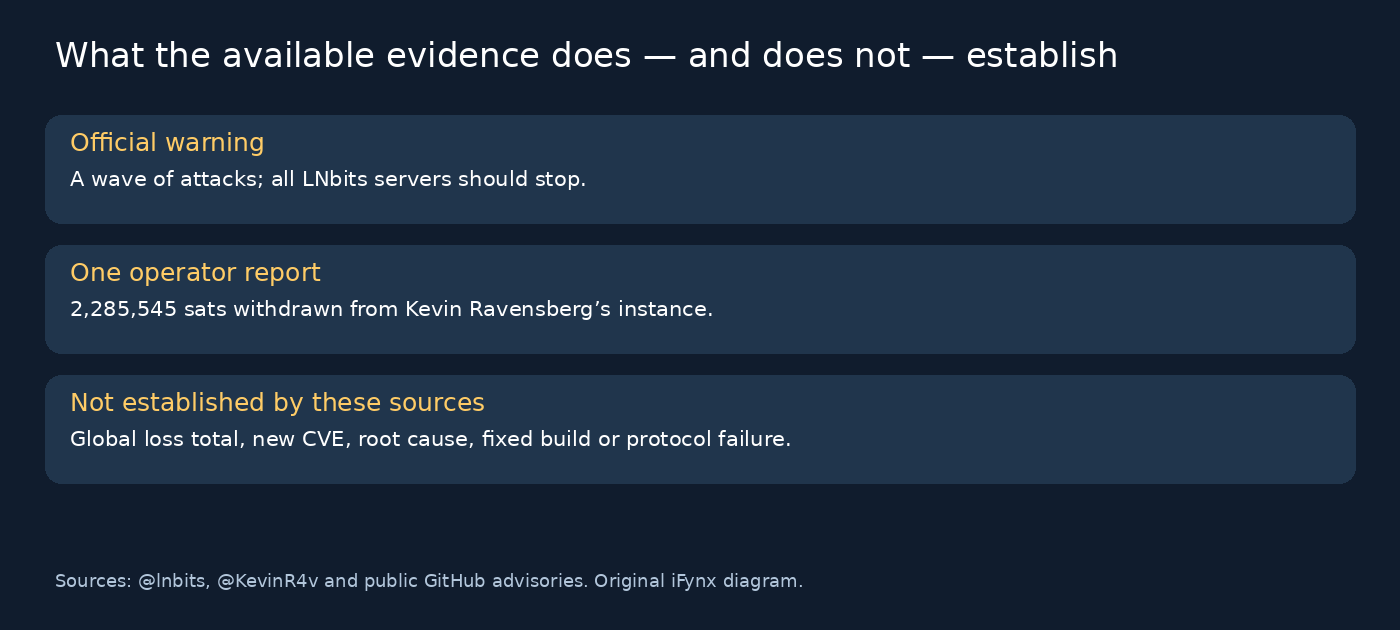
At 17:29 Asia/Gaza, Kevin Ravensberg reported that his LNbits instance had been exploited before the announcement. He said newly created accounts withdrew 2,285,545 sats and put the attack interval at 11:22–16:00 Asia/Gaza. The interval extends beyond the announcement; his post does not establish exactly when he received the warning or completed stopping his service.
He also said BitTipBot users would be made whole by him but could not access funds until LNbits had patched the vulnerabilities. That is the operator’s own commitment to his users, not an LNbits-wide compensation policy, an independently audited ledger or a promise applying to anyone else’s deployment. No dollar conversion is needed to explain the operational impact.
A business investigating its own instance should reconcile its own records rather than copy this figure into an incident report. Unexpected newly created accounts and unfamiliar withdrawals warrant review, but the operator’s description is not a complete or officially published detection rule. An absence of exactly the same pattern does not prove another server was safe.
LNbits software versus Bitcoin and Lightning
LNbits provides an account and application layer around payment infrastructure. A failure in that layer is not, by itself, evidence of a flaw in Bitcoin consensus or the Lightning protocol. Conversely, describing it as an application-layer issue does not make customer balances or connected infrastructure irrelevant: consequences depend on the actual deployment, permissions, integrations and funding arrangements.
Map which business functions rely on the LNbits instance, what backend it uses and who can authorize changes. Do not assume every connected node must be rebuilt, that every Lightning wallet is affected, or that a separate BTCPay installation shares this incident’s vulnerability. Our BTCPay Server report concerns a separate incident; it is useful context for payment-service ownership, not a substitute advisory for LNbits.
What counts as a patch announcement?
Ben Arc’s 15:59 Asia/Gaza post says patches should be merged and available within 24–48 hours. The conditional wording is important. Do not schedule an automatic restart when that interval expires. A merged change, a release package and an explicit vendor restart recommendation are different milestones.
The public LNbits security advisory page displayed an April 2025 SSRF advisory and a June 2024 Eclair-backend advisory during our check. Neither establishes the technical cause of this November incident. We have no basis here for naming a new CVE, claiming a specific fixed version or connecting those older advisories to the current theft report. Operators should follow attributable project updates and verify the precise supported upgrade path once published.
A practical response checklist for Gulf and Egypt merchants
The following is original defensive planning guidance, not an unpublished vendor recovery procedure. A small merchant should assign a named technical owner and a separate person responsible for customer communication, even when the same contractor runs the server and checkout.
- Pause the actual service. Follow the full shutdown instruction and confirm its state through your authorized administration tools. Stop routing new payment attempts into an unavailable dependency. Put a clear Arabic and English maintenance notice on the business-facing checkout without exposing internal server details.
- Preserve evidence before cleanup. Record the installed release, enabled extensions, relevant configuration history and when the service stopped. Preserve existing application, authentication and backend payment records under restricted access. Avoid wiping databases or reinstalling over the only evidence copy.
- Reconcile, do not guess. Compare internal account balances and recorded withdrawals with the payment backend’s records. Separate expected settlements from unexplained activity and state what is still uncertain. Restrict customer data shared with contractors; never publish logs containing tokens or private payment details.
- Map dependent services. Identify shops, creators, APIs and tipping bots using this instance. Arrange an independently assessed alternative checkout only if it does not silently depend on the paused instance. Do not advertise a frozen balance as immediately withdrawable.
- Review identities in the recovery plan. Inventory credentials and integrations that may need revocation or rotation based on the investigation. Coordinate changes so they do not destroy access to preserved evidence. A password reset alone is not proof that a software vulnerability is fixed.
- Wait for verified release guidance. Confirm official announcements and repository provenance, test the documented update in isolation and reconcile balances before restoring production. Treat these as proposed acceptance checks, not as confirmation a safe build is already available.
- Communicate precisely. Tell customers what service is unavailable, what is confirmed, what remains under review and when the next status update will occur. Avoid promising compensation, instant recovery or “no loss” before evidence supports it. Consult appropriate advisers if the facts trigger contractual or local reporting duties; no universal MENA notification deadline is asserted here.
For a regional merchant, Arabic clarity is part of incident handling: distinguish “payments temporarily unavailable” from “funds confirmed lost,” and distinguish a vendor patch estimate from your own restoration commitment. Keep a single approved bilingual status message so customer support does not give contradictory guarantees.
Avoid recovery scams during the waiting period
Use the official project account and repository links below rather than a direct message offering an emergency installer. Do not share wallet secrets, application passwords or server access with someone who claims they can reverse transactions. No legitimate status update requires publishing those credentials. Our Keplr/Web3Auth safety checklist discusses a different incident but the same need to verify recovery claims rather than trust an urgent message.
How iFynx can help
iFynx Software Development includes API & Backend Engineering: secure APIs, data models and infrastructure integrations. Maintenance & Growth lists monitoring, security patches, dependency updates and quality assurance. If this disruption exposes gaps in your product’s dependency inventory, release testing or maintenance ownership, a discovery conversation can define a practical scope. These services are not a claim that iFynx is LNbits’ incident responder, can reverse payments or guarantees recovery of lost funds.
Frequently asked questions
Should I shut down LNbits right now?
Yes. The current official warning asks all operators to stop their LNbits servers immediately. The later full-server warning supersedes the Paywall-only precaution.
Is this a Bitcoin or Lightning protocol hack?
The sources establish an LNbits software incident, not a demonstrated break of Bitcoin or the Lightning Network protocol. Assess the particular application and its dependencies rather than generalizing to every wallet.
Was Paywall the only issue?
That has not been established. Paywall appeared in the initial precaution, but the subsequent instruction covered every LNbits server and referred to multiple security patches.
When is it safe to restart?
There is no verified restart deadline in the sources checked here. Follow official release and recovery guidance; Ben Arc's 24–48-hour estimate is not permission to restart automatically.
How much was stolen in total?
No official global total is established here. The 2,285,545-sat figure is Kevin Ravensberg's self-reported loss for his instance and must not be represented as the total across LNbits.
Sources and update policy
Primary sources are the two official LNbits warnings, Ben Arc’s patch estimate, Kevin Ravensberg’s first-person report and the public GitHub security advisory page linked above. We distinguish those statements from our own defensive planning advice. Update this article when a verified release, technical advisory or changed vendor instruction is published; do not silently turn a forecast into a completed patch. No exploit instructions, proof-of-concept links, invented CVE, root cause or speculative dollar estimate are included.