Direct answer — 9 November 2026: No Binance data breach has been confirmed. A listing signed “ShinyHunters” claims to sell 335,900,000 “lines” of Binance user data, including KYC documents, passwords and private keys, for $900,000. Binance disputes it. In a statement posted by its official Binance Customer Support account on X at 23:39 UTC on 8 November 2026, Binance said the listing “appears likely to be a scam rather than evidence of a Binance systems breach” and that it had found no evidence that its systems, customer KYC data, account credentials, wallet private keys or internal infrastructure information were compromised. Binance says it is still investigating. This claim is separate from the confirmed 29 October hot-wallet hack. You do not need to panic, but you should expect leak-themed phishing and harden your account today.

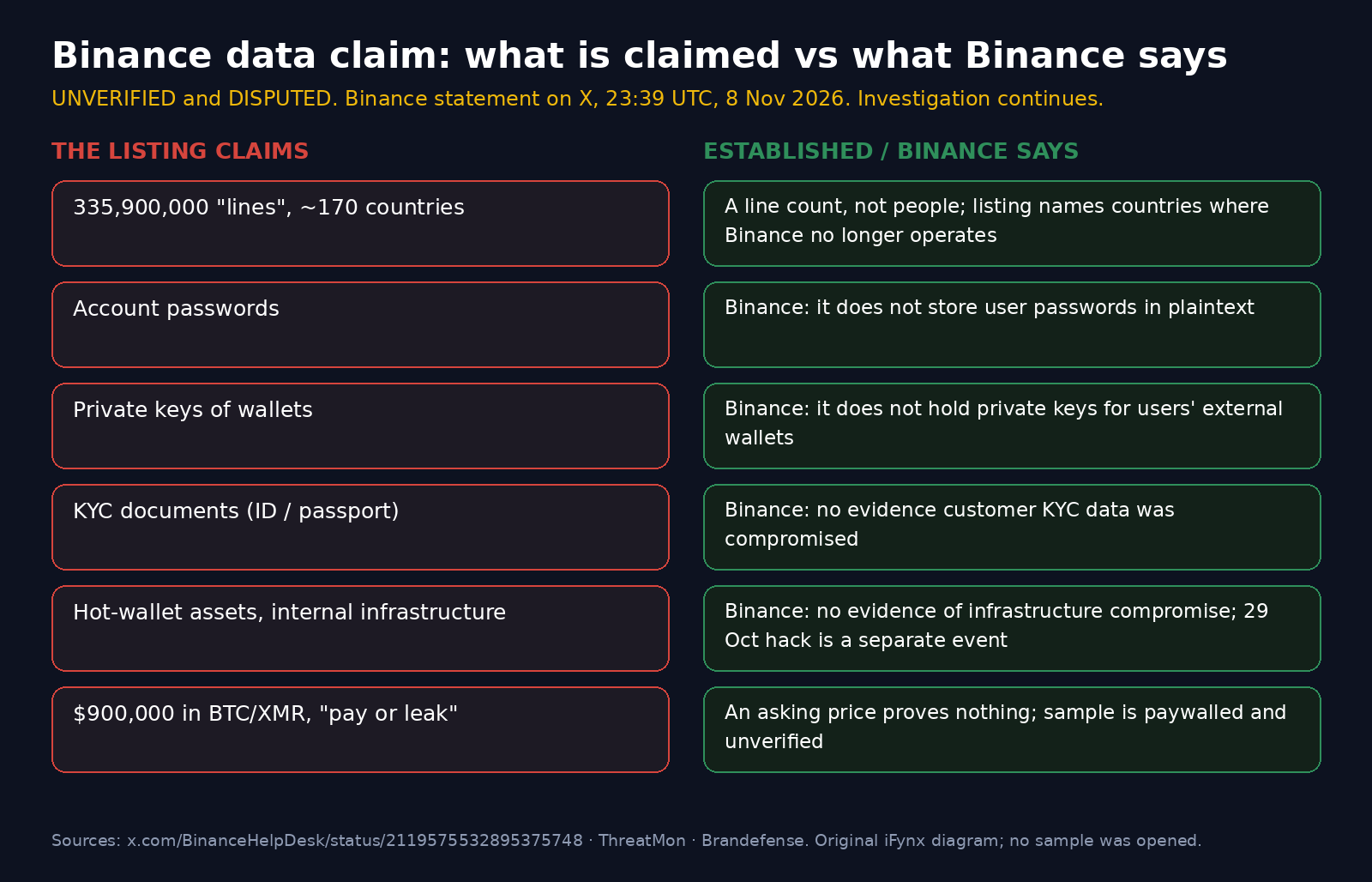
Claimed vs confirmed: the Binance data leak claim at a glance
Everything in the left column comes from the seller’s advertisement as described by ThreatMon and Brandefense. None of it has been independently verified. iFynx has not seen, opened or tested any sample, and we do not link to the listing.
| What the listing claims | What is actually established (9 November 2026) |
|---|---|
| 335,900,000 lines of Binance user data from about 170 countries | A line count, not a count of people. Brandefense notes that duplicates, mixed countries and older lists can inflate a number like this. Binance says the listing names jurisdictions where it no longer operates. |
| Account passwords | Binance says it does not store user passwords in plaintext. Plaintext passwords in a “dump” usually come from users’ own devices or from reused passwords leaked elsewhere. |
| Private keys of wallets | Binance says it does not hold private keys for users’ external wallets. Brandefense calls the private-key offer the least plausible part. |
| KYC documents (ID cards and passports) | Binance says it found no evidence that customer KYC data was compromised in connection with this listing. No proof has been shown publicly. |
| Hot-wallet assets and internal infrastructure details | Binance says it found no evidence of compromise of internal infrastructure information. The confirmed 29 October hot-wallet theft is a different event. |
| Price: $900,000 in BTC or XMR, “pay or leak” | ThreatMon and Brandefense report the asking price (earlier versions asked $500,000). An asking price proves nothing about the data. |
What Binance actually said, and when
The primary source is a reply from @BinanceHelpDesk, the verified Binance Customer Support account, published at 23:39 UTC on 8 November 2026 under a user’s question about the claim. Binance wrote that it is “aware of the claims made on a hacking forum and on X regarding an alleged Binance user data set” and is “actively investigating them”. It listed three reasons the claim is inconsistent with how it handles data: it does not store user passwords in plaintext, it does not hold private keys for users’ external wallets, and the listing references jurisdictions where it no longer operates. It added that “similar past listings have often involved infostealer malware data collected from users’ own devices rather than a breach of Binance systems”, and told users never to share passwords, 2FA codes, seed phrases or private keys.
A Binance spokesperson gave crypto.news the same statement in a report published at 08:34 UTC on 9 November. PANews and The Cryptonomist carry the same points. The claim itself was first widely shared by the threat-intelligence account ThreatMon at 09:20 UTC on 8 November, which said the listing remains unverified and that a sample sits behind a paywall. Earlier, on 3 November, Brandefense had documented four versions of the same advertisement on Telegram between 30 October and 2 November, posted under several account names. Its reading was that the mix of identity documents, wallet keys and server details “look more like recycled data or a scam than one clean extraction”.
Two cautions. First, “ShinyHunters” is the name the seller uses; nobody has shown that this listing comes from the group that used that name in earlier, confirmed incidents. Second, “likely a scam” is Binance’s preliminary assessment while its investigation continues. If Binance or an independent researcher confirms any real exposure, we will update this article with the time and source.
This is not the 29 October hot-wallet hack
The confirmed incident at Binance this autumn was the theft of about $6.3 billion from its hot wallets on 29 October 2026, which Binance’s 3 November incident report traced to compromised employee devices and stolen credentials. Binance says it covered customer losses from its own funds. We covered it, with dated updates, in our Binance hack explainer. The 335 million claim is a different thing: an alleged sale of customer records, which Binance disputes. Scammers will try to blur the two, for example by telling you that “the leak” is why you must “re-verify” your account or claim “compensation”. Binance has not announced any compensation programme for this claim.
How infostealer logs create fake “exchange leaks”
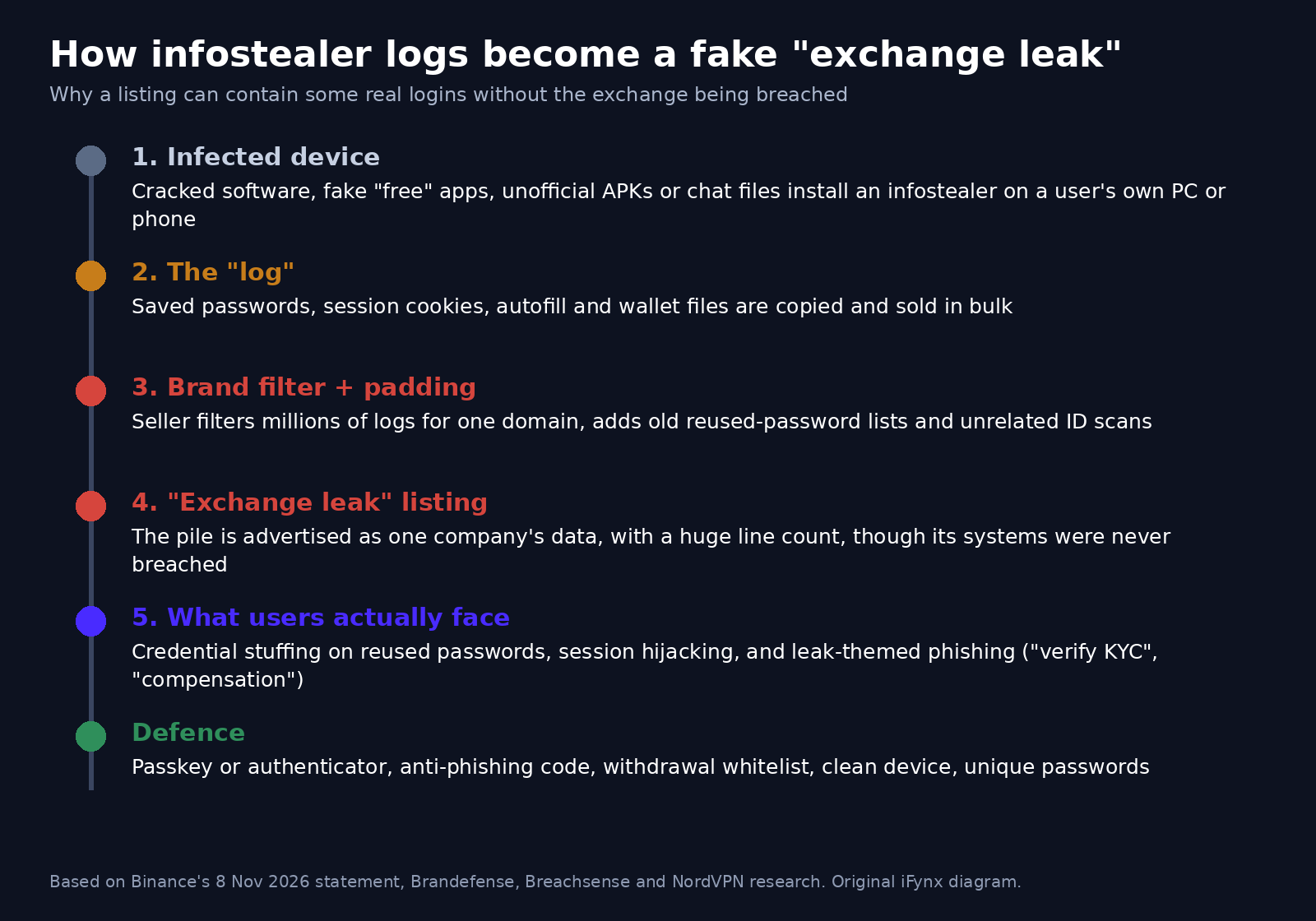
An infostealer is malware that runs on a person’s own computer or phone and copies what the browser and apps have saved: logins and passwords, session cookies, autofill data, crypto wallet files and screenshots. It usually arrives inside cracked software, game cheats, fake “free” versions of paid apps, unofficial APKs, or files sent in chat. The stolen bundle for one machine is called a “log”, and logs are sold in bulk.
The scale is large. Breachsense says the stealer logs it indexed in September 2026 came from 1,176,466 infected machines, with a median of 19 saved credentials each. NordVPN researchers counted more than 52.4 billion stolen cookie records in one year of infostealer data.
Here is how such logs become a headline. A seller filters millions of logs for any line that mentions binance.com, adds old combolists of reused emails and passwords, mixes in unrelated identity scans traded elsewhere, and labels the pile “Binance data”. The result can contain some real Binance logins without Binance’s own systems ever being breached, because the passwords were taken from users’ devices. That is why the advice below focuses on your device and your account, not only on the exchange.
The Arabic phishing wave to expect
A big leak headline is useful to scammers even if the data is fake. Brandefense expects leak-themed phishing, and Binance warned users about it in the same statement. Messages we expect to see in Arabic across SMS, WhatsApp, Telegram and email in the UAE, Saudi Arabia and Egypt include:
- “Your Binance account appeared in the leak. Verify your KYC within 24 hours or it will be frozen.”
- “Binance leak compensation: claim your share by connecting your wallet.”
- A fake “Binance security” caller asking you to read out a 2FA code or to move funds to a “safe wallet”.
- A link to a look-alike login page, or an “official” app file to install outside the app store.
Binance does not need you to do any of this. Check any sender, link or phone number with Binance Verify, open Binance only through the official app or a typed address, and never install an app file sent in a chat.
8-point account hardening checklist
- Use a passkey or an authenticator app, not SMS. Binance supports passkeys for sign-in and 2FA; they resist phishing pages because they only work on the real site.
- Set an anti-phishing code. Once set, Binance’s anti-phishing code appears in every genuine Binance email and SMS. A message without your code is not from Binance.
- Turn on the withdrawal whitelist and the whitelist withdrawal limit. With the withdrawal whitelist, funds can only go to addresses you saved; the limit delays withdrawals to newly added addresses, which gives you time if someone gets in.
- Review devices and active sessions. In your security settings, remove any device you do not recognise and sign out everywhere if in doubt. Stolen session cookies can survive a password change on some services.
- Delete or restrict API keys. Remove keys you no longer use, never enable withdrawals on a trading-bot key, and restrict keys to fixed IP addresses.
- Change reused passwords. If your Binance password, or your email password, is used anywhere else, change it everywhere and use a password manager. Secure the email account first, because it is the reset path for everything.
- Clean the device. If you have installed cracked software, unofficial APKs or “free” paid apps on the computer or phone you trade from, assume it may be infected: update the system, run a reputable scan, and consider a reset before you log in again.
- Watch for identity misuse. If you ever shared an ID document online, watch for unexpected accounts, SIM swap attempts or loan applications in your name. This is a precaution, not a sign that Binance lost your KYC.
For UAE, Saudi and Egypt fintech teams: when a fake leak names your brand
Binance FZE holds an active VASP licence from Dubai’s Virtual Assets Regulatory Authority (VARA register entry, licence VL/24/04/001, read on 9 November 2026), and many wallets, exchanges and neobanks in the region list Binance as a funding route. A loud breach claim against a big brand is also a rehearsal for the day a seller names yours. Two things matter: what you say, and what your login system notices.
Publish a calm “not breached” notice within hours, not days. Binance’s reply works because it states what it checked, lists concrete reasons the claim does not fit, separates the claim from the earlier real incident and gives one safety action. A good notice for your users, in Arabic and English, follows the same shape:
- What we know: “We are aware of a claim that [brand] customer data is for sale. We are investigating. So far we have found no evidence that our systems or customer data were accessed.”
- Why the claim does not fit, in plain facts, without insulting the reporter or the users.
- What users should do: one or two actions, such as setting a passkey, and “we will never ask you for a code or to move funds”.
- Where updates will appear: one official page, with a time on every update. Never put a “check if you are affected” form behind a link in an SMS.
Our Coinbase data breach article covers the harder case, a real vendor incident, and the breach-notice rules in the UAE, Saudi Arabia and Egypt. The Keplr and Web3Auth incident shows why the notice must also name third-party login providers when they are involved.
Spot credential stuffing from infostealer logs. When logs that include your domain are sold, the attack you will actually see is automated login attempts with real email and password pairs. Signals worth alerting on:
- A rise in failed logins spread across many accounts, each tried once or twice, often from rotating residential or data-centre IP ranges.
- Successful logins with the correct password from a new device, followed within minutes by a 2FA change, a new withdrawal address, an email change or an API key creation.
- Sessions that suddenly appear from a new country or network with no fresh login, a sign of a replayed session cookie.
- Many logins with identical device fingerprints or user agents across unrelated accounts.
Defences that work without hurting real users: check new and changed passwords against known-breached password lists using a privacy-preserving lookup; rate-limit per account and per network, not only per IP; require step-up verification on a new device; hold withdrawals to newly added addresses for 24 to 48 hours; bind sessions to device signals and revoke them on any security change; and make passkeys the default for new sign-ups.
How iFynx can help
iFynx Software Development builds secure web and mobile products, including sign-in, passkey and 2FA flows, step-up verification and withdrawal-address controls for fintech and crypto apps. Maintenance & Growth keeps those products monitored and patched after launch, including login-anomaly alerts and a ready-to-publish incident or “not breached” notice page in Arabic and English. If a breach claim, real or fake, would catch your team unprepared, book a free 30-minute discovery call. iFynx is not affiliated with Binance and cannot check or recover Binance accounts.
Frequently asked questions
Was Binance hacked again, and is the 335 million leak real?
No new Binance breach has been confirmed. A seller using the name ShinyHunters claims to have 335.9 million lines of Binance user data. Binance said on 8 November 2026 that the listing appears likely to be a scam and that it found no evidence its systems or customer data were compromised; its investigation continues. Treat the claim as unverified and disputed.
Is my Binance KYC data, such as my passport or ID, leaked?
There is no public evidence that it is. Binance says it found no evidence that customer KYC data was compromised in connection with this listing, and no independent researcher has confirmed the sample. As a precaution, watch for identity misuse and ignore any message asking you to re-submit KYC through a link.
Is this linked to the 29 October Binance hot-wallet hack?
No. The 29 October theft of about $6.3 billion from Binance hot wallets is a confirmed, separate incident that Binance traced to compromised employee devices. The 335 million claim is an alleged sale of customer records that Binance disputes.
What is infostealer malware and how does it produce exchange leaks?
An infostealer is malware on a user’s own device that copies saved passwords, session cookies and wallet files. Sellers filter millions of these logs for one brand, add old leaked password lists, and advertise the result as that company’s leak, even though the company’s own systems were not breached.
Should I change my Binance password and 2FA, and how do I spot leak compensation phishing?
Change your password if you reuse it anywhere, switch to a passkey or authenticator app, set an anti-phishing code and turn on the withdrawal whitelist. Binance has announced no compensation for this claim, so any message offering leak compensation, asking for a 2FA code or asking you to connect a wallet is phishing.
Sources and update policy
Primary source: Binance Customer Support’s statement on X, published 23:39 UTC on 8 November 2026. Claim details: ThreatMon on X (09:20 UTC, 8 November) and Brandefense (3 November). Coverage: crypto.news, PANews and The Cryptonomist (9 November). Security settings: Binance support pages linked above. Licence: VARA public register. Infostealer figures: Breachsense and NordVPN. We do not link to the forum, Telegram advertisements or any sample. We will update this article, with the time, if Binance completes its investigation or an independent party confirms or rules out real data.
Related reading
- Binance Hack: What We Know About the $6.3 Billion Theft, When Withdrawals Return, and What Users and Fintech Teams in the UAE, Saudi Arabia and Egypt Should Do
- Coinbase Data Breach via Amplitude: What Leaked, What Didn't, and the Analytics SDK Checklist for Gulf and Egypt Apps
- Keplr Wallet Hack: Web3Auth Incident Hits Some Google and Apple Login Accounts — What Users Should Do Now
- Coinbase Opens a Sign-Up Page for AI Trading Agents as Its $2M Champions Cup Starts 4 November: How Coinbase for Agents Works, What the Rules Say, and an Agent Safety Checklist for Gulf and Egypt Traders and Fintechs
- Crédit Mutuel Arkéa Crypto Hack: What We Know About the Alleged $133M Theft, and 10 Exchange-Account Controls for Gulf and Egypt Banks
- Saudi PDPL Compliance in 2026: A Product Checklist, the Draft Localisation and Breach Rules (Comments Close 5 November), and SDAIA's Sandbox
- Fireworks AI Data Breach: What Was Exposed (Secrets, Datasets, Model Weights), What LLMjacking Is, and What AI Teams in the Gulf and Egypt Should Rotate Now
- iOS worse_query Vulnerability: Binance Warns Crypto Users. Update to iOS 27.2.1 and Protect Your Seed Phrase