Direct answer — 10 November 2026: Fireworks AI published an update on its October 2026 security incident dated 9 November 2026. This is a follow-up to the 9 October bulletin, not a separate, unrelated case: Fireworks is disclosing a second path inside the same October investigation. The 9 November update says that after the first finding — unauthorized use of internal credentials and access to secrets stored for evaluation jobs — the company later found impact to account and billing information and, for a limited set of accounts, to secrets, datasets and incomplete model weights. Payment card numbers, Fireworks says, are not stored and were not impacted. It has not detected impact to Inference, the Training SDK or Nexus, which are zero data retention by default; those findings are “based on our investigation to date,” and the investigation is ongoing. Fireworks does not say that customer prompts or inference traffic were leaked. If you have not received a notice, Fireworks’ earlier bulletin said it had not identified your account as affected so far.
Update, 14 November 2026, 13:22 Asia/Gaza: Cursor says its breach started with a key exposed at Fireworks
In a 13 November update, Cursor said its October security incident began when an attacker obtained an access key Cursor had issued to Fireworks; Cursor says the key was “exposed by Fireworks”. The attacker used it to copy a read-only bucket of Cursor coding agent traces (mostly from 2025, from sessions not in Privacy Mode). A few traces contained unredacted credentials (less than 0.01% of Cursor customers had API credentials exposed), which led the attacker to some of Cursor’s SaaS tools and, on 29 October, to tampered copies of Anthropic’s Claude Code extension (2.1.312 and 2.1.313) on Cursor’s extension marketplace cache, which at most 5,000 users potentially received. Cursor has moved all inference off Fireworks. This is Cursor’s account; Fireworks’ bulletins, last updated 9 November, do not name Cursor. Full details and a checklist for dev teams: Cursor security breach: how a key exposed at Fireworks AI led to a malicious Claude Code extension.
Separately, Uber told US state attorneys general on 10 November that a service provider’s compromised internal credentials were used on 7 October to access Uber driver data, including driver’s licence images, name, address, date of birth and licence number (Uber notice to the Iowa Attorney General, covering about 2,999 Iowa residents). The notice does not name the provider; an Uber spokesperson told TechCrunch it is Fireworks. Uber has not published a total number of affected drivers.

Startups and agencies in the Gulf and Egypt that iFynx sees building Arabic chatbots, RAG systems and fine-tunes on hosted inference should treat this as a rotate-first incident. The same class of mistake — secrets sitting in evaluation jobs — showed up in our Claude Code secrets checklist. Rotate Fireworks API keys and any third-party credentials stored as secrets at the issuer, not only by deleting the stored copy.
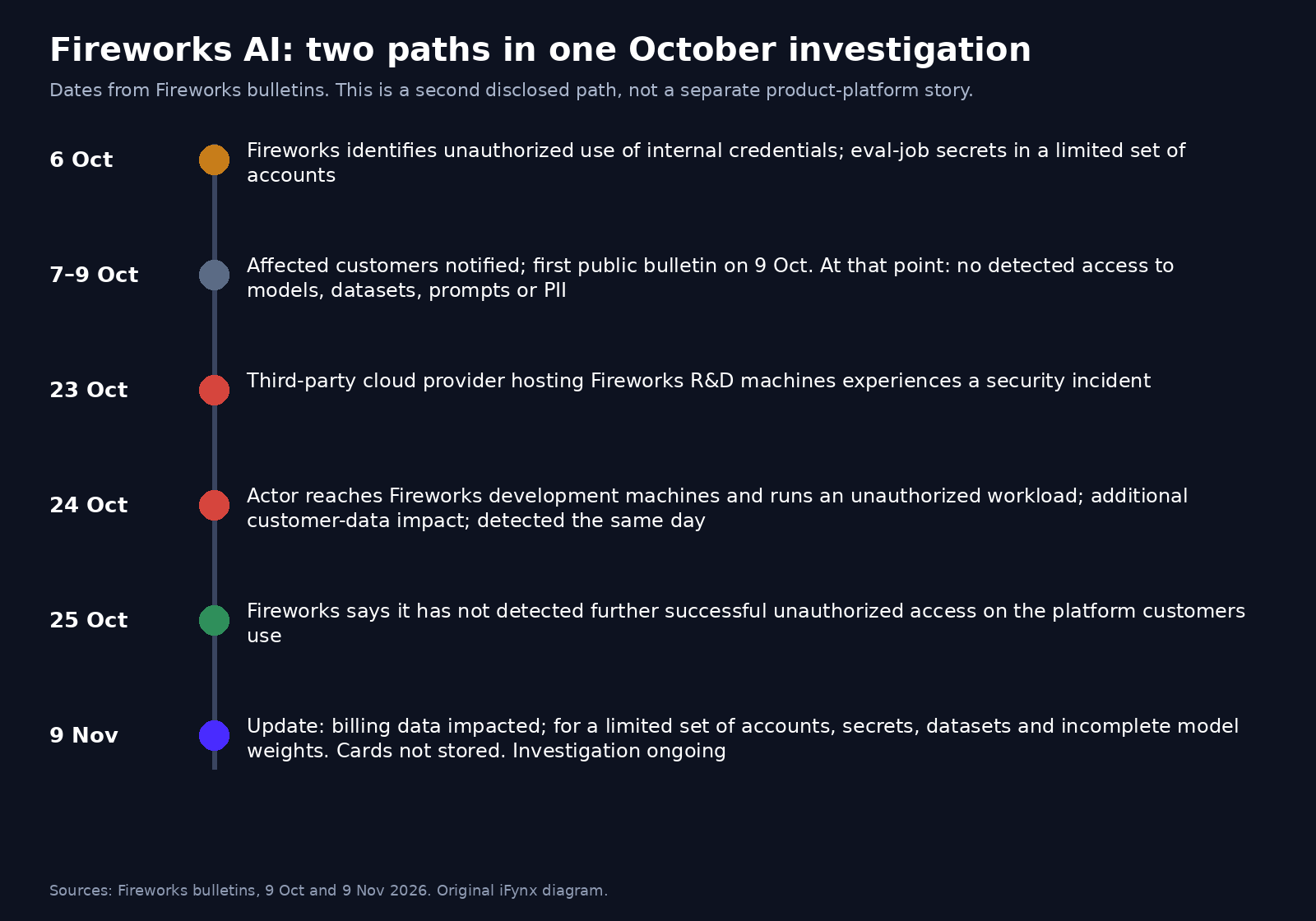
Two paths in one October investigation
On 6 October 2026, according to the first bulletin (last updated 10 October 2026, 11:16 PDT), Fireworks “identified a security incident involving unauthorized use of internal Fireworks credentials.” An unauthorized third party “accessed environment variables used in evaluation jobs in a limited number of customer accounts.” At that point, Fireworks said it had not detected evidence of unauthorized access to customer models, datasets, training data, personal information, or inference traffic (including prompts and outputs) within its security perimeter. It began notifying affected customers on 7 October and published the bulletin on 9 October.
The 9 November update adds a further path. “A third-party cloud provider that hosted Fireworks R&D machines experienced a security incident on October 23. On October 24, the unauthorized third party used it to reach Fireworks development machines and then run an unauthorized workload that led to additional customer data impact. We detected this activity on the same day, and followed our incident response processes to take immediate remediation measures and close known critical vulnerabilities. As of October 25, we have not detected further evidence of successful unauthorized access by the threat actor on the Fireworks platform customers use.”
That is why headlines calling this a “second hack in weeks” need care. It is a second disclosed incident path in the same October investigation, after a third-party cloud provider was breached, not a second, fully separate product-platform compromise described as complete in the first bulletin. Fireworks says it notified law enforcement and brought in Palo Alto Networks Unit 42 for forensics.
What Fireworks says was involved — and what it does not say
The 9 November update lists these categories of information in the affected internal application:
- Resource metadata, such as Fireworks resource identifiers, display names, descriptions and creation time.
- Billing information, such as billing and shipping addresses, invoice and payment history, account balance and credit usage. “Payment card numbers are not stored by Fireworks and were not impacted.”
- “Model weights and datasets, for certain customers, a subset of incomplete model weights and datasets were accessed.”
The same update also says that, after the first bulletin, Fireworks “discovered impacts to account and billing information. For a limited set of accounts, we also discovered impact to secrets, datasets, and incomplete models.” It is notifying customers whose data was impacted, with details and recommended actions. Contact is via the incident notification email or security-notice@fireworks.ai.
Fireworks is explicit about what it has not found so far: “We have not detected any impact to Inference, Training SDK and Nexus, which are all zero data retention (ZDR) by default. These findings are based on our investigation to date. Our investigation is ongoing and may reveal additional information.” That is not the same as a proof that prompts were never exposed, and it is also not a statement that customer prompts were disclosed. We are not saying they were.
As a containment step, Fireworks has “disabled self-serve dataset uploads and downloads used by Batch Inference and dataset-based training while we investigate this incident. Training SDK remains available with ZDR, i.e. no training data stored at rest, and Fireworks Lab-based training operates in an isolated environment with additional network and storage protection.”
LLMjacking, as Fireworks and Google describe it
Fireworks writes: “The evidence indicates links to a cybercriminal threat actor group, which is financially motivated and aimed at selling tokens from unauthorized access to Large Language Models (LLMs) to illicit routing gateways, known as ‘LLMJacking’.” It points to the 2 November 2026 Google Threat Intelligence Group and Mandiant post on the rise of LLMJacking.
That Google post describes Mandiant incidents in 2026 in which attackers hijacked enterprise access to LLMs across cloud and model providers. Unlike cryptojacking, it says, LLMJacking “can generate large spikes in fraudulent cloud charges in a matter of hours,” with some incidents exceeding $100,000 in a single day and cumulative charges at some organisations reaching $1 million before access was revoked. GTIG also describes “LLM Mixers” — illicit routing gateways that proxy and resell unauthorized LLM access. The practical defence for a customer is the same one Fireworks already told affected accounts in October: rotate keys at the issuer, watch the bill, and do not leave production cloud credentials sitting as provider secrets. Our WorkOS / ARTEX agent-attack write-up covers a related lesson about agent tooling and keys.
Customer-churn rumours, and who Fireworks says it is helping
A Benzinga item dated 9 November 2026, bylined as coming from The Information, reports, “according to two people with knowledge of the breach,” that Fireworks had in the last week told some large customers, including Harvey, of “a recent, more serious hack.” It then says, according to one of those people, that “some of Fireworks’ customers, who spend millions of dollars on its services per year, are considering switching to other providers.” That switching claim is an anonymous source. It is not a statement from Fireworks, and we are not reporting it as a fact.
Bloomberg Law, in a 9 November 2026 piece, quotes a Fireworks spokesperson as saying the company is “actively working with our customers to manage the incident, including Notion, Cursor and others.” Notion and Cursor are named there as customers being helped, not as customers who have left. Bloomberg also notes that Fireworks lists Harvey, Notion and Cursor among customers on its website. As with any disputed leak claim, the rule in our Binance 335-million-record claim explainer still holds: attribute the source, and do not upgrade a rumour to a confirmed outcome.
The third-party pattern is familiar from the Coinbase / Amplitude vendor breach: a compromise at a vendor or a vendor’s vendor can expose customer data even when the product your users touch is described as unaffected so far.
Side box — 10 November 2026: NEAR AI also reported unauthorized access
Dated note, 10 November 2026, Asia/Gaza: secondary reports (including CryptoBriefing, PANews and TechFlow) said NEAR AI had posted that it detected unauthorized access to internal systems, paused NEAR AI Cloud inference as a precaution, and stated that customer prompts and inference run in hardware-isolated trusted execution environments (TEEs). Those reports also said NEAR Protocol and other NEAR services were not affected, and that a full incident report was still to come. Later on 10 November, some of the same outlets said NEAR AI posted that Cloud was back online after vulnerabilities were patched and affected credentials were rotated. When we checked NEAR AI’s own blog on 10 November 2026, we did not find a dedicated official incident report. Treat the pause, the TEE claim and any restoration as NEAR AI’s statements as relayed by those outlets, not as an independent finding, and watch for the promised report. This is context for “AI inference providers under attack,” not a second Fireworks incident.
What Gulf and Egypt AI teams should do now
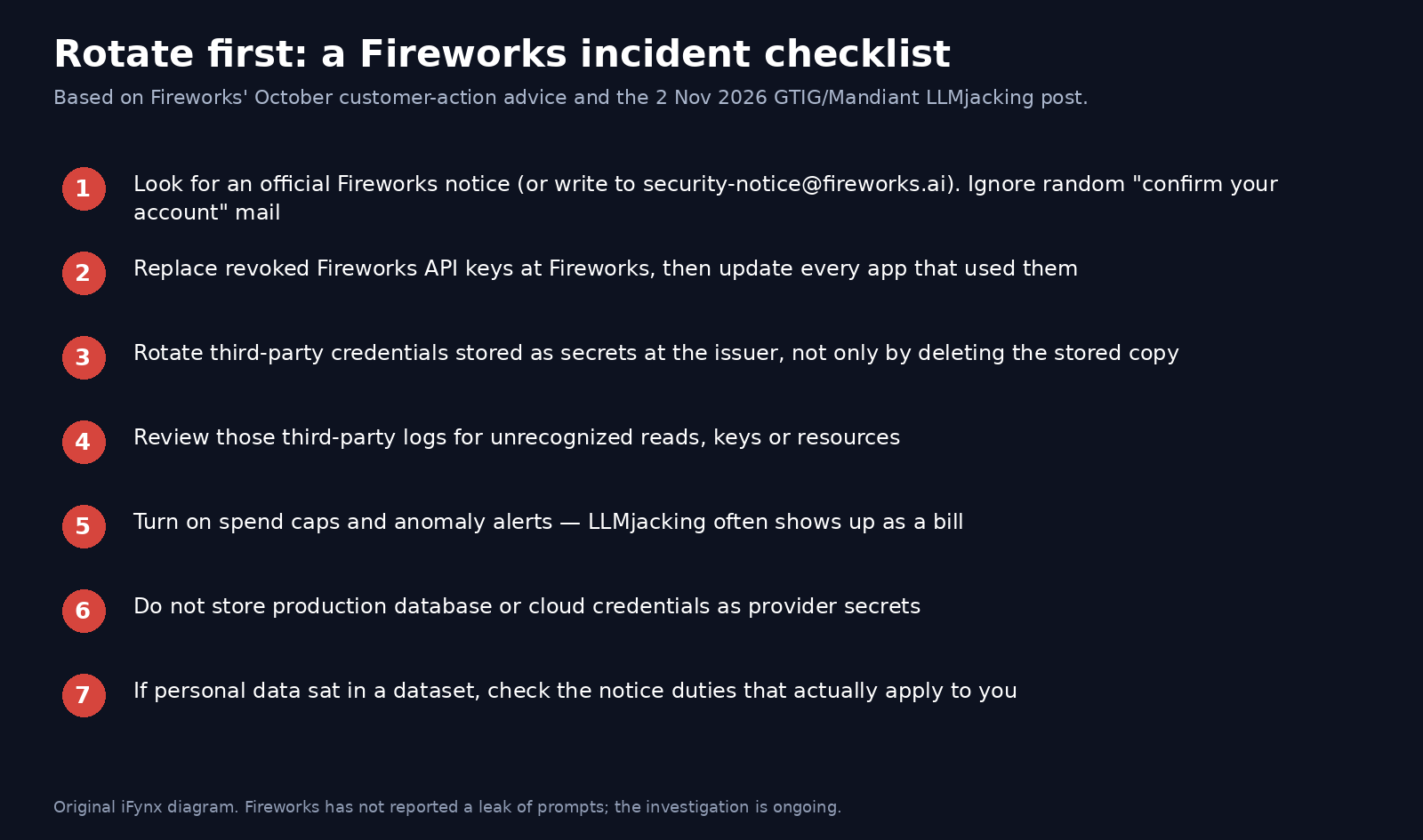
- Look for a Fireworks incident email. If you have not received one, Fireworks’ October bulletin said your account had not been identified as affected based on the investigation at that time; that can change, so keep watching official channels. Do not trust a random “confirm your account” message; the official contact is the notification thread or security-notice@fireworks.ai.
- If you are notified, replace revoked Fireworks API keys at Fireworks, then update every app that used them.
- Rotate third-party credentials that were stored as Fireworks secrets *at the issuer* (cloud, database, Git, Slack, payment, and so on). Removing the stored secret is not enough. This is the same rotate-first rule as in our Claude Code secrets guide.
- Review activity on those third-party providers for unrecognized reads, keys or resources, and send Fireworks any names or IDs you do not recognize.
- Turn on spend caps and anomaly alerts on every AI-provider key. LLMjacking often shows up as a sudden bill.
- Do not store production database or cloud credentials as secrets on an inference or evaluation platform.
- Ask current and future vendors a short questionnaire: which third-party clouds host R&D machines, is inference ZDR by default, and what is the breach-notice SLA?
- If personal data sat in a fine-tune or evaluation dataset, check whether a notice duty applies under the privacy laws that actually cover you. Our Saudi PDPL product checklist is a starting point for the Saudi regime; this article does not give legal advice and does not quote statute text we have not re-verified today.
Separately, on 9 November 2026 OpenAI published a research-infrastructure kill switch. Our Control Room explainer covers that system; it is not ChatGPT or the public API, and it is not connected to this Fireworks incident. Both are useful reading for teams that run agents and hosted inference.
How iFynx can help
iFynx AI & Data covers AI Development and AI Agents & Automations: secure integrations with hosted models, key management and a vendor checklist. Maintenance & Growth covers credential rotation and monitoring after launch. If a Fireworks or other inference-provider notice has landed on your desk in the Gulf or Egypt, book a free 30-minute discovery call. iFynx is not affiliated with Fireworks AI and cannot check whether your account was affected.
Frequently asked questions
Was my Fireworks account affected, and how do I know?
Fireworks says it is notifying customers whose data was impacted. The October bulletin said that if you had not received a notice, Fireworks had not identified your account as affected based on the investigation to date, and that this could change. Use the official notification email or security-notice@fireworks.ai, not a third-party form.
Which keys must I rotate?
Fireworks’ October advice to affected customers was to replace revoked Fireworks API keys and to rotate third-party credentials identified in the notice with the providers that issued them, then update applications and stored secrets. Deleting a stored secret alone does not invalidate the underlying credential.
Were prompts or inference traffic exposed?
Fireworks says it has not detected impact to Inference, the Training SDK or Nexus, which are zero data retention by default, based on the investigation so far, which is still ongoing. It does not say customer prompts were disclosed, and we are not saying they were.
What is LLMjacking, and how do I stop stolen keys being resold?
Fireworks links the actor to a financially motivated group that sells unauthorized LLM access to illicit routing gateways, a pattern Google GTIG and Mandiant described on 2 November 2026. Practical controls are: inventory keys, rotate them at the issuer, scope keys per environment, set spend caps and alerts, and never store production credentials as provider secrets.
Should I switch inference providers, and were payment cards exposed?
Whether to switch is a vendor-risk decision, not a fact we can settle from anonymous sources. Benzinga, citing one unnamed person, said some large customers were considering a switch; Fireworks’ spokesperson, quoted by Bloomberg, named Notion and Cursor as customers it is helping to manage the incident. Fireworks says payment card numbers are not stored and were not impacted.
Sources and update policy
Primary sources: Fireworks, “Update on October 2026 security incident,” last updated 9 November 2026, and the earlier “Fireworks October 2026 security incident” bulletin, last updated 10 October 2026. Secondary: GTIG/Mandiant on LLMJacking, 2 November 2026; Benzinga / The Information and Bloomberg Law, 9 November 2026. Customer-churn claims are attributed to anonymous sources. We do not describe exploit steps. We will update this article, with the time, if Fireworks narrows or widens the data categories, or if it reports an impact on inference or prompts.
Related reading
- Claude Code Secrets on GitHub: What Apiiro Found in settings.local.json — A Rotate-First Checklist
- Coinbase Data Breach via Amplitude: What Leaked, What Didn't, and the Analytics SDK Checklist for Gulf and Egypt Apps
- Binance Data Breach Claim: What ShinyHunters Says, Why Binance Calls It a Scam, and What Gulf and Egypt Users Should Do Now
- MCP Server Security After the Mittwald Breach: What Happened, Why AI-Assistant Connectors Are Now an Attack Surface, and a Lock-Down Checklist for Gulf and Egypt Teams
- wfx-loot GitHub Actions Malware: How Hijacked Accounts Stole CI Secrets From Thousands of Repositories, and the CI/CD Secret Checklist for Gulf and Egypt Teams