Direct answer — 10 November 2026: Muse Ember (muse-ember-1.0) is the smallest and cheapest model in Meta’s Muse family, launched on 9 November 2026 for the repetitive work inside AI agents: tool calls, routing, extraction and long-document parsing. On the Meta Model API pricing page it costs $0.10 per million input tokens, $0.004 per million cached input tokens and $0.50 per million output tokens, with a 1,048,576-token context window and up to 524,288 output tokens. The catch: once a request has more than 200K input tokens (cached tokens and previous_response_id history included), the whole request is billed at $0.30 / $0.012 / $1.50. Ember runs in Standard mode only, so Meta says your content is not used to train its models. Meta claims Ember beats Claude Haiku 5.5 and GPT-6 Luna on intelligence per dollar; that is Meta’s own benchmark claim, and the three models actually share the same $0.10 / $0.50 base list price.


This iFynx briefing is for product and engineering teams in Saudi Arabia, the UAE, Egypt and the wider region who run, or plan to run, AI agents on Arabic documents and conversations. Everything below comes from pages we read on 10 November 2026: Meta’s launch post and developer docs, Anthropic’s and OpenAI’s own model pages for the competitor prices, and Google Cloud’s model card. Where a number is Meta’s claim rather than an independent measurement, we say so. The cost tables are our own arithmetic on published list prices, using workload sizes we chose as examples; they are not quotes or measured bills.
Key facts (checked 10 November 2026, before publishing)
- What: Muse Ember, Meta’s smallest and most efficient Muse model, model ID
muse-ember-1.0. Meta positions it as the “executor”: a bigger model (Muse Wonder or Muse Spark) plans, Ember handles the volume. - Launched: 9 November 2026, on the Meta Model API and in Muse Code. Meta’s post adds that Muse Ember, Muse Spark and Muse Wonder are now on Google Cloud and Oracle Cloud.
- Price (up to 200K input tokens): $0.10 input, $0.004 cached input, $0.50 output, per million tokens.
- Price (over 200K input tokens): $0.30 input, $0.012 cached input, $1.50 output, applied to the whole request.
- Limits: 1,048,576-token context, 524,288 max output tokens; 3,000 requests and 4,000,000 tokens per minute per team.
- Inputs: text, image, video, audio and PDF; output is text. Endpoints: Responses, Chat Completions and Messages.
- Data: Standard mode only; no cheaper Contributor-mode variant, so your content is not used for training.
- Benchmarks: Meta reports Ember matches Claude Haiku 5.5’s best Artificial Analysis Index score at about a third of the cost per task. Meta’s claim; Arabic was not reported.
What is Meta Muse Ember?
Meta introduced Muse Ember as “our smallest and most efficient model designed for complex reasoning execution and the work agents repeat all day”. In practice that means the many small, structured steps an agent takes: reading a file, calling a tool, classifying a ticket, pulling fields out of an invoice, summarising one long PDF. The Muse Ember developer page lists four jobs: sub-agent tasks, tool calls inside a bigger workflow, routing requests to the right handler, and running the same task over thousands of images, files or records in parallel.
It is not meant to be your only model. Meta’s own advice is to run Muse Wonder or Muse Spark on the main loop to plan and reason, and to hand the repeated subtasks to Ember. For “hard single-shot coding problems, knowledge-heavy questions, or visual coding”, Meta points you back to Spark or Wonder. Ember is also the first model Meta says it trained using Muse Wonder Full, its largest internal model.
A practical detail for developers: Ember accepts the same request body as Muse Spark, and the API speaks three formats, the Responses and Chat Completions endpoints familiar from OpenAI’s SDK and the Messages endpoint used by Anthropic’s. For many teams, trying Ember is a base-URL and model-ID change, not a rewrite. Reasoning effort runs from minimal to max, and the default is max, which matters for cost, as we explain below.
If you followed our earlier coverage of Meta Muse’s secure VM for agents, Meta Muse and agentic commerce and Shopify’s Muse Shop Pay checkout, Ember is the piece that makes those agent experiences cheap enough to run at scale.
Muse Ember pricing: the numbers and the 200K trap
Here is the full Muse Ember price list from Meta’s pricing page, per million tokens:
| Usage | Up to 200K input tokens | Over 200K input tokens |
|---|---|---|
| Input | $0.10 | $0.30 |
| Cached input | $0.004 | $0.012 |
| Output | $0.50 | $1.50 |
Three rules on the same page decide what you actually pay:
- The tier is set per request, by total input. Cached tokens count towards the 200K. A request that is 150K cached plus 60K fresh is over the line.
- Stored conversations count too. If a request continues a conversation with
previous_response_id, Meta says its input “includes that conversation”. A chatty agent that keeps one long thread will cross 200K without anyone noticing. - Over the line, everything is billed at the higher rate, “in full, not only for the tokens past 200K”. Your invoice lists the two tiers separately, so you can see it afterwards, but by then the money is spent.
The jump is sharp. One request with 199,000 input tokens and 5,000 output tokens costs about $0.022. The same request with 210,000 input tokens costs about $0.071, more than three times as much for 5% more input. Meta’s Wonder and Spark models have no long-context premium; Ember does.
Two more line items: web search grounding adds $2.50 per 1,000 searches on top of tokens, and rate limits are 3,000 requests and 4,000,000 tokens per minute per team, shared by every API key in the team.
Muse Ember vs Claude Haiku 5.5 vs GPT-6 Luna: specs and list prices
All three are “small, fast” models for high-volume agent work. We took each competitor price only from its vendor’s own page: Anthropic’s Claude Haiku 5.5 model page and OpenAI’s GPT-6 Luna model page.
| Muse Ember (Meta) | Claude Haiku 5.5 (Anthropic) | GPT-6 Luna (OpenAI) | |
|---|---|---|---|
| Base input / output, per M tokens | $0.10 / $0.50 | $0.10 / $0.50 | $0.10 / $0.50 |
| Cached input (read), per M | $0.004 | $0.01 | $0.01 |
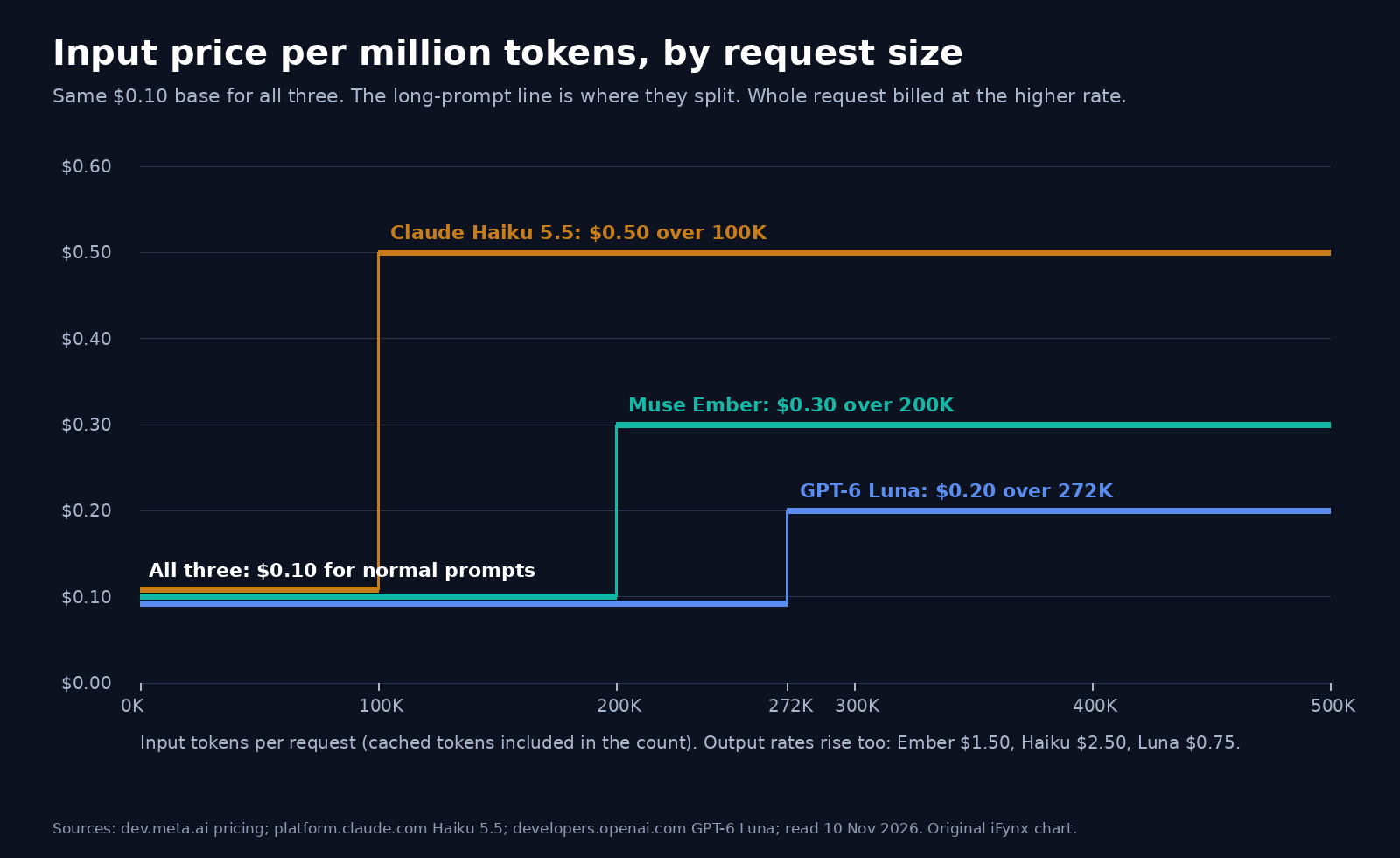
| Long-prompt threshold | Over 200K input | Over 100K prompt | Over 272K input |
| Long-prompt rates, per M | $0.30 / $1.50 (3x) | $0.50 / $2.50 (5x) | $0.20 / $0.75 (2x input, 1.5x output) |
| Context / max output | 1,048,576 / 524,288 | 1M / 128K | 1,050,000 (922,000 max input) / 128,000 |
| Inputs | Text, image, video, audio, PDF | Text, images | Text, image |
| Batch discount | Not listed for Ember | 50% | 50% (Batch and Flex) |
The surprising line is the first one: all three charge exactly $0.10 per million input tokens and $0.50 per million output tokens for normal-length prompts. So Meta’s “cheaper” story is not about the sticker price. It is about how many tokens and steps each model burns to finish a task, plus a cheaper cache and a higher long-prompt threshold than Haiku. Each vendor also counts tokens differently: Anthropic notes its current tokenizer counts the same text as roughly 30% more tokens than Claude Haiku 4.5 did, and Arabic text can tokenise very differently from English across vendors. Same price per token does not mean same price per Arabic invoice.
What Meta’s benchmarks claim, and what they do not
According to Meta’s launch post, Muse Ember “delivers more intelligence per dollar than Claude Haiku 5.5 or GPT-6 Luna at any reasoning setting”. The numbers Meta publishes, from the Artificial Analysis Intelligence Index v5 dated 9 November 2026:
- Muse Ember (max effort): score 35.8 at $0.136 per task.
- Claude Haiku 5.5 (best setting): score 36.2 at $0.411 per task, so Ember matches it at about a third of the cost, in Meta’s words.
- GPT-6 Luna (best setting shown): score 27.8 at $0.152 per task.
- Agent tasks: Meta reports AutomationBench-AA 37.8% for Ember vs 13.9% for Haiku 5.5 and 20.2% for Luna, and Terminal-Bench 4.0 40.9% vs 39.2% and 16.4%.
- Where Ember loses: on FrontierCode 2.0-AA (mergeable engineering tasks) Haiku 5.5 scores 34.9% against Ember’s 27.2%, by Meta’s own table.
Treat these as vendor claims. Several of the scores are “Meta internal evaluation” (Agents’ Last Exam, OSWorld 2.1, PerceptionBench, and the Personal Superintelligence Index, which Meta built itself). Meta’s chart note also says Ember’s cost per task is an estimate at the proposed pricing. And none of the published results is an Arabic test. Partner quotes are encouraging: Cloudflare’s CTO says Ember ran “up to 30% faster at the tail” in its testing, and You.com reports a p95 latency of 2.2 seconds on its coding quests. But a benchmark on English coding tasks does not tell you how Ember reads a scanned Arabic tax invoice.
What Arabic agent workloads cost: under and over 200K
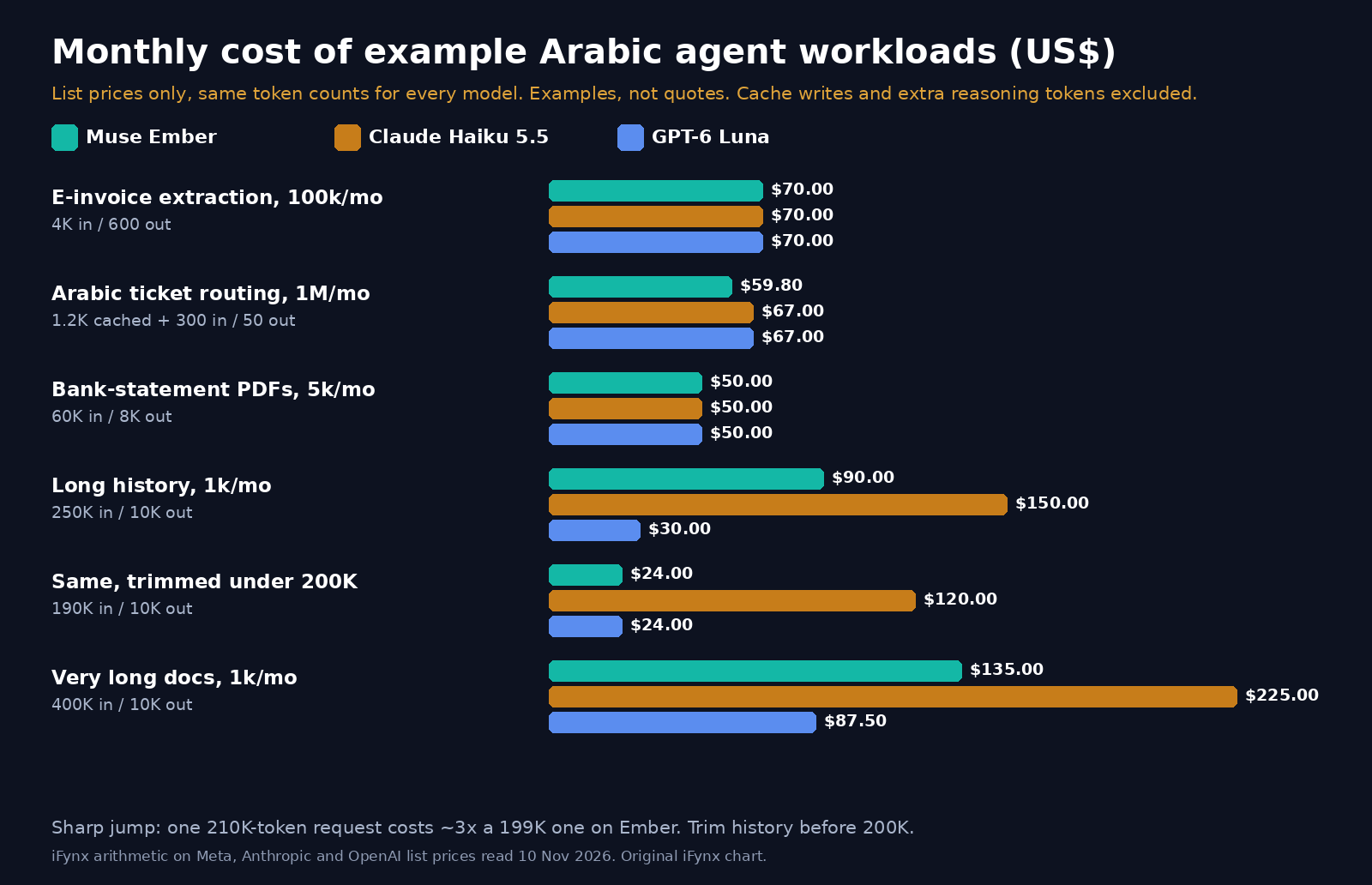
To make the price rules concrete, we priced six example workloads that we see often in Gulf and Egypt projects. Token counts are our assumptions, identical for all three models so that only the price rules differ. Prices are standard API list prices in US dollars per month, before tax, reasoning tokens beyond those listed, web search, and Anthropic or OpenAI cache-write charges.
| Example workload (per month) | Tokens per request | Muse Ember | Claude Haiku 5.5 | GPT-6 Luna |
|---|---|---|---|---|
| E-invoice field extraction (ZATCA / UAE), 100,000 invoices | 4,000 in / 600 out | $70.00 | $70.00 | $70.00 |
| Arabic support-ticket routing, 1,000,000 tickets, cached system prompt | 1,200 cached + 300 in / 50 out | $59.80 | $67.00 | $67.00 |
| Bank-statement PDF parsing, 5,000 statements | 60,000 in / 8,000 out | $50.00 | $50.00 | $50.00 |
| Six-month statement bundle or long agent history, 1,000 requests | 250,000 in / 10,000 out | $90.00 | $150.00 | $30.00 |
| Same job, history trimmed below 200K, 1,000 requests | 190,000 in / 10,000 out | $24.00 | $120.00 | $24.00 |
| Very long document set, 1,000 requests | 400,000 in / 10,000 out | $135.00 | $225.00 | $87.50 |
What the table shows:
- Short, repetitive tasks cost the same at list price. For invoices and statements the difference between the three will come from tokens per task, retries and accuracy, not from the price sheet. Test on your own documents.
- Ember wins when you reuse a long, cached prompt. Its $0.004 cached rate is less than half the $0.01 of Haiku 5.5 and Luna, which is why routing with a large cached Arabic system prompt is cheapest on Ember.
- Between 100K and 200K, Ember and Luna tie and Haiku costs five times as much, because Haiku’s long-prompt rates start at 100K.
- Between 200K and 272K, Luna is cheapest. Ember has switched to its 3x rate; Luna has not yet reached its threshold.
- Trimming history is the biggest saving. Cutting the long-history job from 250K to 190K input tokens takes Ember’s bill from $90 to $24.
For reference, the Saudi riyal and UAE dirham are pegged to the dollar (about SAR 3.75 and AED 3.67 per dollar), so $70 a month is roughly SAR 262 or AED 257.
Planner plus executor: Muse Wonder or Spark plans, Ember executes
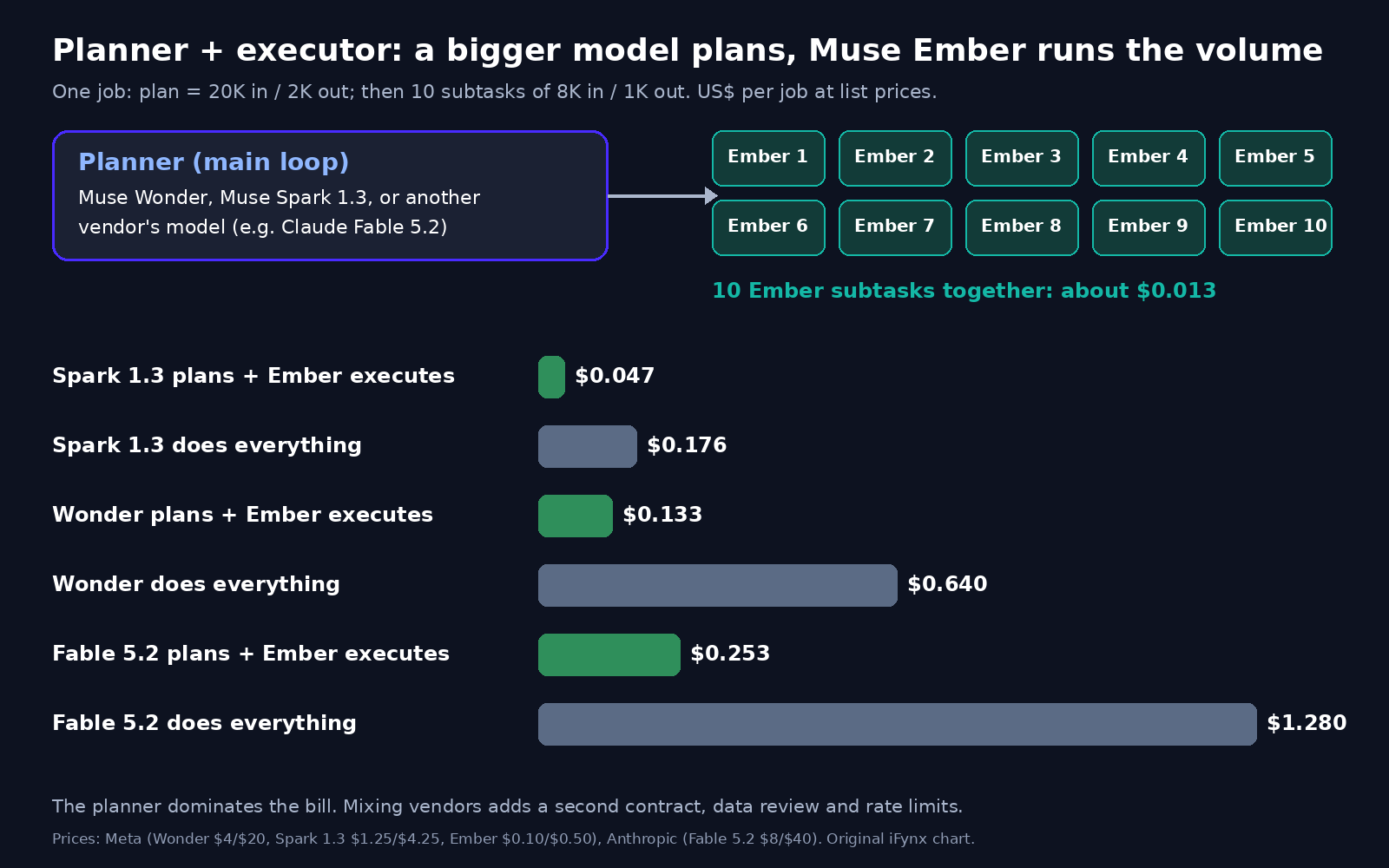
Meta’s recommended pattern, a larger model on the main loop and Ember on the subtasks, changes the maths far more than the choice between small models. Take one agent job that needs a 20,000-token planning step with 2,000 tokens of output, then ten subtasks of 8,000 input and 1,000 output tokens each. At list prices:
| Who plans, who executes | Cost per job |
|---|---|
| Muse Spark 1.3 plans ($1.25 / $4.25), Ember runs 10 subtasks | about $0.047 |
| Muse Spark 1.3 does everything | about $0.176 |
| Muse Wonder plans ($4 / $20), Ember runs 10 subtasks | about $0.133 |
| Muse Wonder does everything | about $0.640 |
| Claude Fable 5.2 plans ($8 / $40), Ember runs 10 subtasks | about $0.253 |
| Claude Fable 5.2 does everything | about $1.280 |
The ten Ember subtasks cost about $0.013 together. The planner dominates the bill, so the real decision is which planner you need, and how often it is called. Because Ember speaks the Messages and Chat Completions formats, you can, technically, put it under a non-Meta planner such as Claude Fable 5.2 or under OpenAI’s models (our GPT-6 Sol and Luna coverage). That adds a second vendor contract, a second data-processing review and a second set of rate limits, so do it only when the saving is clear. The same logic applies to how you price your own agent product; see our guide to AaaS vs SaaS pricing.
Data, residency and PDPL: what to check before you send Arabic customer data
Standard mode is a real plus: Meta’s pricing page says that in Standard mode “your content is not used to train Meta models”, and Ember has no Contributor-mode variant at all. But “not used for training” is not the same as “processed in your country”. Check these points:
- Where processing happens. We did not find a processing region named in Meta’s Model API docs. On Google Cloud, the Muse Ember 1.0 model card lists it as Preview, on the global endpoint only, with text and image inputs, and Google notes that endpoints do not guarantee in-region ML processing. Google’s Dammam and Doha regions do not change that for Ember today.
- Retention. Zero Data Retention is available only for qualified accounts, through Meta’s sales team, and “ZDR support may vary by model”. Under ZDR, stateful requests that reference an earlier response, background requests, file uploads and web search are switched off. Flagged content can be kept for up to two years even with ZDR.
- Country access. Meta’s geographic use policy lists restricted territories including Iraq, Libya, Syria and Somalia. You may not serve end users there through the API. Gulf states and Egypt are not on the list.
- The law that applies to you. UAE federal PDPL allows transfers abroad under Articles 22 and 23, as summarised by the US International Trade Administration; DIFC and ADGM have their own regimes. Saudi Arabia’s Regulation on Personal Data Transfer outside the Kingdom requires a risk assessment for certain transfers. Egypt’s Law 151 of 2020 has cross-border transfer rules in its 2025 executive regulations. This is a checklist, not legal advice.
- Tools the agent can reach. A cheap executor that calls many tools widens your attack surface; lock down connectors as in our MCP server security checklist.
Before you switch: an Arabic test checklist
- Build a test set of 100 to 300 real, anonymised items: Arabic and mixed Arabic-English invoices, Gulf and Egyptian dialect tickets, scanned bank statements.
- Run the same set on Ember, Haiku 5.5 and Luna, and record accuracy,
usagetokens (input, cached, output) and latency per item, not only the price per token. - Set reasoning effort on purpose. Ember defaults to
max; routing and field extraction often work at a lower setting with far fewer output tokens. - Check right-to-left output: numbers, dates, Hijri and Gregorian formats, VAT numbers and IBANs must come back exactly, in structured output.
- Add an alert when any request passes 180K input tokens, and summarise or trim history before it reaches 200K.
- Watch
cached_tokensin responses so you know your long system prompt is actually being served from cache. - Use exponential backoff on HTTP 429 and read the
x-ratelimit-remaining-*headers; limits are per team, not per key. - Keep a fallback model configured, and log which model answered each request for audits.
How iFynx can help
iFynx designs, builds and maintains AI agents and automations for companies in the Gulf, Egypt and Palestine, with Arabic and English from day one. Through our AI Agents & Automations service we wire the right model into your workflow, whether that is Muse Ember as a cheap executor under a stronger planner or a different model where your tests say so, and we keep humans in the loop where judgement matters. Our AI Development team runs the Arabic benchmark on your own invoices, tickets and statements, sets up guardrails and evaluation, and models your monthly bill under each provider’s tiers. Data Engineering handles the document pipelines and data-residency design behind it. A good first step is a free 30-minute discovery call: contact us with one workflow and its monthly volume.
Frequently asked questions
What is Meta Muse Ember and how much does it cost?
Muse Ember (muse-ember-1.0) is Meta’s smallest and most efficient Muse model, launched on 9 November 2026 for high-volume agent work such as tool calls, routing and extraction. On the Meta Model API it costs $0.10 per million input tokens, $0.004 per million cached input tokens and $0.50 per million output tokens for requests up to 200K input tokens.
Is Muse Ember cheaper than Claude Haiku 5.5 and GPT-6 Luna?
Not per token at normal prompt lengths: all three list $0.10 input and $0.50 output per million tokens. Ember has a cheaper cache read ($0.004 vs $0.01) and a higher long-prompt threshold than Haiku 5.5 (200K vs 100K), while GPT-6 Luna stays at its base price until 272K. Meta claims Ember needs about a third of Haiku’s cost per benchmark task; that is Meta’s claim.
What is the Muse Ember 200K long-context price?
If a request has more than 200K input tokens, counting cached tokens and any conversation history pulled in with previous_response_id, Meta bills the whole request at $0.30 input, $0.012 cached input and $1.50 output per million tokens, three times the normal rate. Trim or summarise history to stay under 200K.
Does Meta train on my data when I use Muse Ember?
Meta says that in Standard mode your content is not used to train Meta models, and Muse Ember is available in Standard mode only, with no Contributor-mode variant. Not being used for training is different from data residency: check where requests are processed and retained, and whether you need Zero Data Retention, before sending personal data.
Can I use Muse Ember with the OpenAI or Anthropic SDK?
Meta lists Responses, Chat Completions and Messages endpoints for Muse Ember, and says it accepts the same request body as Muse Spark, so many existing OpenAI-style or Anthropic-style clients only need a new base URL, API key and the model ID muse-ember-1.0. Test tool calling and structured output before switching production traffic.
Sources and update policy
Read on 10 November 2026: Meta, Introducing Muse Ember (9 November 2026); Muse Ember developer docs; Meta Model API pricing and rate limits; Meta Zero Data Retention help page; Meta Model API geographic use policy; Google Cloud Muse Ember 1.0 model card and endpoint locations; Anthropic, Claude Haiku 5.5; OpenAI, GPT-6 Luna. Benchmark figures are Meta’s, citing Artificial Analysis Intelligence Index v5 and Meta internal evaluations. Cost tables are iFynx arithmetic on list prices for example workloads, not quotes. Vendors change prices often; we will update this article when a listed price or term changes.
Related reading
- Meta Muse Secure VM vs Confidential VM: How Muse's Isolated Agent Computer Works, and What Product Teams Should Copy
- Meta’s Muse vs Amazon & Six Banks’ Agentic Commerce Rules: Payment UX Needs Agent Identity
- Claude Fable 5.2 vs Opus 5.5: Price, Speed, Mythos 5.2 Access and When Gulf and Egypt Dev Teams Should Switch
- OpenAI GPT-6 Sol & Luna: Enterprise Coding Agents Compete on Cost, Clarity, Alignment