Direct answer — 11 November 2026: Grok Build apps were exposed because most of them were published with access set to “Anyone with the link”, and their “random” links were findable. In research published on 10 November, the security firm Claroc says it tried 43,551 Grok app addresses under grok.me. Of the 37,571 still online, 35,578 (94.7%) opened for anyone with no sign-in. Only 1,993 (5.3%) returned an HTTP 401 error, the response of an app set to “Only you” or “Invited users”. Each Grok app gets its own hostname, and Claroc and Ars Technica explain that passive DNS services record those names, so an unguessable link did not stay hidden. Claroc found 24 open apps built by SpaceXSI and X staff, which were taken down after the reports. SpaceXSI says Grok apps are private until their creator chooses to share one, and that employee accounts start set to “Only you”. If you build on Grok, switch every app holding internal data to “Only you” or “Invited users” today.


This iFynx briefing is for companies in Saudi Arabia, the UAE, Egypt and the wider region whose staff use AI app builders such as Grok Build, Lovable, Bolt or Replit to make internal dashboards, rosters and customer lists. We read Claroc’s report and the Ars Technica article again shortly before publishing (03:58–04:30 Asia/Gaza, 11 November). Every figure below is Claroc’s, as published by Claroc or reported by Ars. We do not name any affected organisation, give any app address, or explain how to find other people’s apps.
Key facts (checked 11 November 2026, before publishing)
- Who found it: Claroc Research, in a report it calls “GhostShares 2”, dated 10 November 2026. Ars Technica’s Dan Goodin reported it the same day.
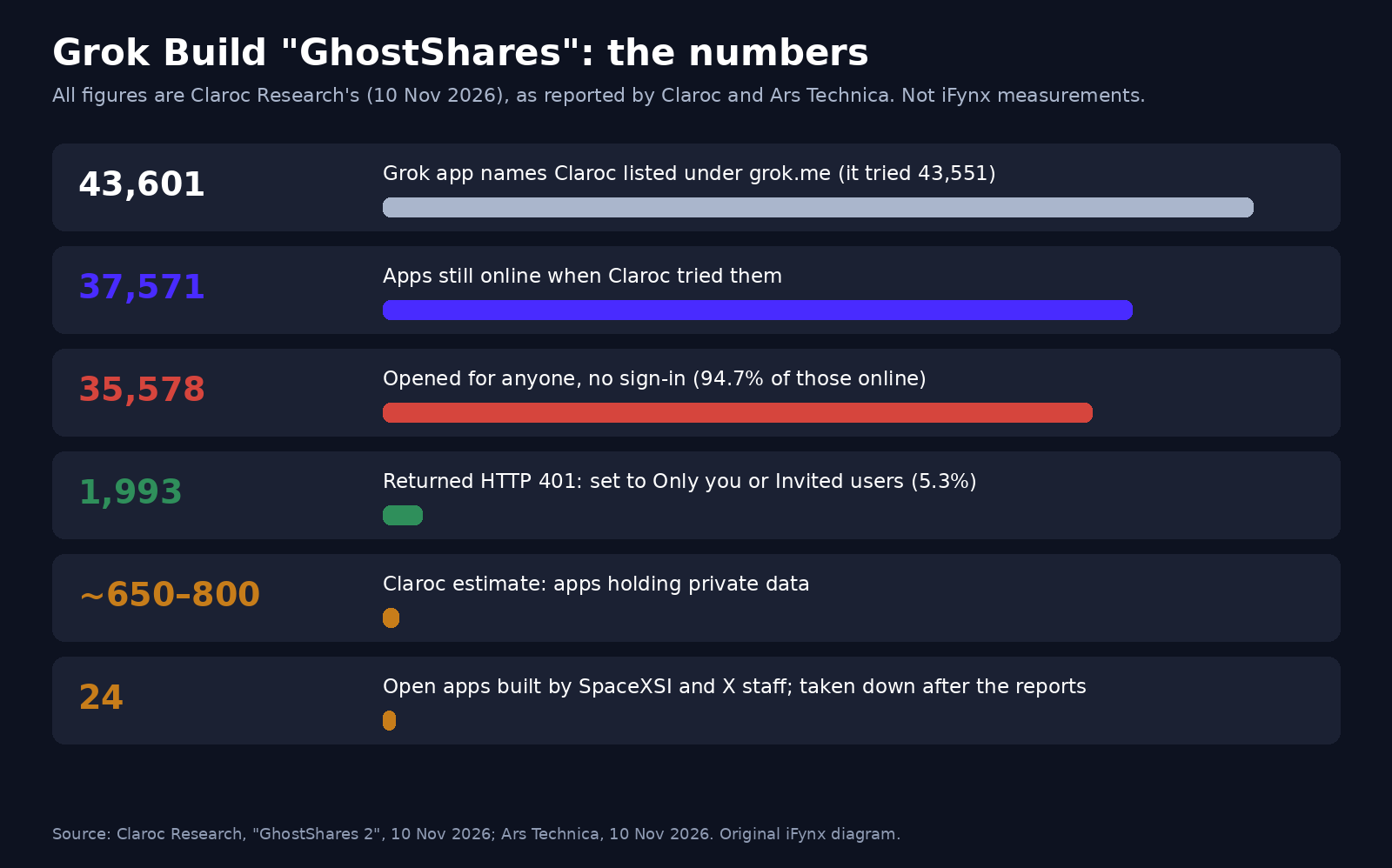
- The scale, per Claroc: 43,601 Grok app names listed under grok.me; 43,551 tried; 37,571 online; 35,578 (94.7%) opened with no sign-in; 1,993 (5.3%) returned HTTP 401.
- The default, per Claroc: in the paid account Claroc used, the publish step offered “Anyone with the link”, “Invited users” and “Only you”, with “Anyone with the link” already selected.
- The sign-in gap, per Claroc: in a team app Grok built for Claroc, “Continue with Google” let any Google account read, edit and delete records. Claroc tested this only on its own app.
- What was inside: most open apps were games, landing pages and calculators. Claroc estimates about 1 in 10 held sensitive material and roughly 2% held material it rates high or critical, about 650 to 800 apps with private data in total.
- SpaceXSI’s own apps: 24 open apps built by SpaceXSI and X staff, including a confidential onboarding plan, a sales territory map of 594 accounts and advertising proposals. Ars reports they were taken down within hours of its questions.
- Other organisations: Claroc says 30 other identifiable organisations had internal data in open apps: 26 with more than 1,000 employees, six in the Fortune 500, 18 in the US and 12 in 11 other countries. Claroc names none, and neither do we.
- What SpaceXSI says: Grok apps are private until the creator chooses to share; employee accounts are set to “Only you” by default. Claroc says its tests showed a different default for ordinary accounts.
- Pattern: the second AI app-builder data exposure in eight days, after the Lovable case we covered on 3 November.
What did Claroc find in Grok Build apps?
Grok Build is the mode of SpaceXSI’s Grok assistant (SpaceXSI is the company formerly called xAI) where you describe an app in a chat and Grok writes it. When you publish, the app goes live at its own address under grok.me. Claroc says it opened the first page of each app once, from the public internet, signed in to nothing, “the way anyone would in an incognito window”. It says it did not sign in, submit forms, call server functions or use any password or key it saw.
The headline numbers come from that pass. Of 37,571 apps still online, 35,578 opened for anyone. Most were harmless. Claroc estimates that about one in ten held internal business data or personal data, and that roughly 2% were serious enough to rate high or critical. Among the cases it confirmed by hand, Claroc lists, by kind only:
- a hospital group’s staff event app with a searchable roster of more than 3,500 employees;
- an intensive care briefing for a single patient, with labs, imaging and ventilator status;
- a cruise ship’s galley inspection checklist listing crew members by full name and employee ID;
- a fire department’s live shift board with names, badge numbers and duty hours;
- a trucking firm’s driver-recruiting list of more than a thousand people with legal names and personal emails;
- a contractor’s staff timesheet whose browser code held 18 accounts with plain-text passwords, admins included.
Claroc also found 24 open apps built by SpaceXSI and X staff. It lists a confidential onboarding plan for a new enterprise sales hire, a sales territory map of 594 strategic accounts, eight advertising proposals and media plans (one, marked confidential, to a US federal agency), live advertiser account boards and campaign reports. Only one SpaceXSI or X app it found asked for a password. Ars reports that SpaceXSI began removing the 24 links within hours of its questions, and that they then returned “app not found”. Claroc says the apps of other Grok users stayed online.
Grok Build by the numbers
The chart below shows Claroc’s figures side by side. They are Claroc’s measurements, not ours.
Why an “unguessable” link was not private
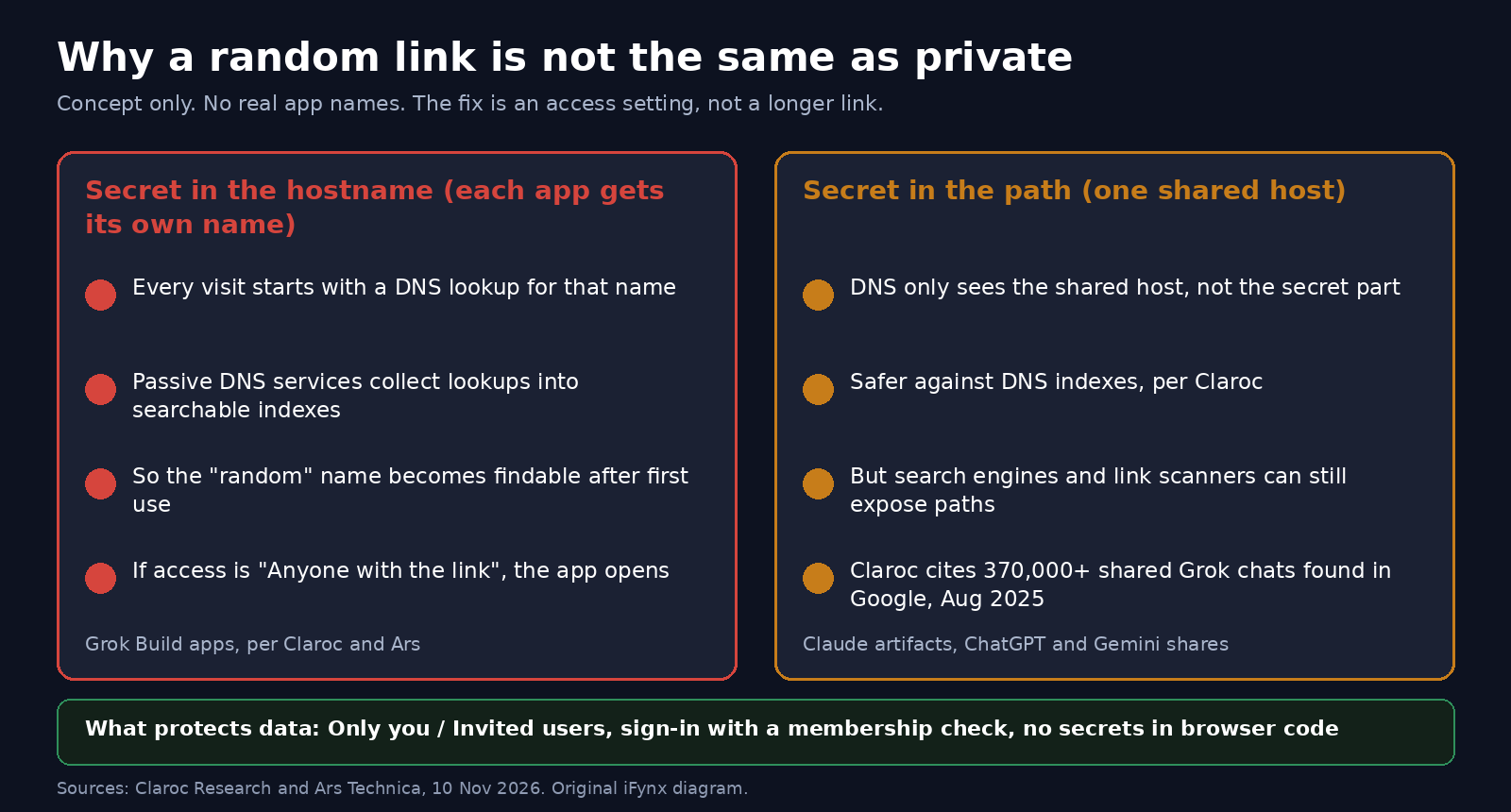
Grok proposes app names made of random words, and Ars notes that a three-word phrase carries roughly 38 bits of entropy, billions of combinations. Guessing one is impractical. The problem, as both Claroc and Ars describe it, is where the randomness sits. On Grok the random part is the hostname itself. Every time someone opens an app, their device asks a DNS resolver where that name lives. Passive DNS services collect those lookups into commercial indexes. So the first time the intended people use a link, Claroc says, “the name lands in a commercial index”. Nobody needs to guess it.
Shared chats on Claude, ChatGPT and Gemini put the secret part in the path after one shared host, so DNS never sees it. Claroc is careful to add that a path is not private either. It recalls that in August 2025 more than 370,000 shared Grok conversations turned up in Google search because search engines could index them. Link scanners in email and chat tools can expose paths too. Claroc lists Grok, ChatGPT, Lovable, Replit, Base44, Google AI Studio and Meta’s Muse as giving each published app its own hostname, and says v0 and Bolt deploy to hostnames too.
The lesson for any team is simple: a long link is not access control. The only thing that protects data is an access setting that refuses strangers, plus a sign-in that checks who belongs.
What SpaceXSI says, and what Claroc’s tests showed
SpaceXSI’s position, as Claroc reports it from SpaceXSI’s answers to a reporter, is that Grok apps are private until their creator chooses to share one. SpaceXSI says publishing takes several steps (click Publish, pick an address, choose between “Only you” and “Anyone with the link”, accept a legal disclaimer and click Publish again), and that employee accounts are set to “Only you” by default. Ars quotes a representative of Cursor, which Ars describes as the AI coding service SpaceXSI recently acquired, saying Grok Build “apps are private by default and nothing goes public unless the creator chooses to share it”.
Claroc agrees that nothing goes public before the builder clicks Publish. Its finding is about the access step that follows: in the paid account it used, “Anyone with the link” was already selected. Ars writes that Claroc’s tests “contradict the representative’s statement”. Claroc also points out that the “Only you” default SpaceXSI uses for employees did not keep SpaceXSI’s own data in, since its staff still had 24 open apps.
Claroc built two test apps with made-up data. A contact list got a database and no sign-in, so a stranger could add a row. A customer list “for my company’s sales team of 4 people” got “Continue with Google” and “Continue with X” buttons, but, Claroc says, the code added whoever signed in to the team before checking membership. An uninvited Google account could see, change and delete records. Claroc stresses it proved this only on its own apps. With “Only you” switched on, its first app returned 401 to a stranger. So Grok has the right settings. Claroc’s point is that they are not the default for ordinary users and nothing prompts the builder to use them.
Is this the same as the Lovable exposure?
It is the same pattern with a different mechanism. In the Lovable apps data exposure we covered on 3 November, researchers found readable records because database access rules were misconfigured. In the Grok case the main problem was the publish default plus findable hostnames, with a sign-in gap on top. Both show the same thing: AI app builders make it easy for a non-engineer to put real data behind a public address in minutes, and the tool’s defaults decide whether anyone checks who can read it.
Claroc’s own words: “AI app builders turned publishing into a few clicks, and the default answer to who can see it is everyone.” For a wider view of how coding agents become an attack surface, see our pieces on agent plugin security and MCP server security, and on the guardrails AI agents need from our Railway AI agents case. If you are choosing between coding agents, our note on Grok 4.7 for coding covers the model side; this incident is about the publishing side.
How to check whether your own Grok app is public
Do this only for apps you or your company own. Do not open, probe or sign in to anyone else’s app.
- Open each app’s publish or share settings in Grok and look at the access setting. Anything holding internal, customer, patient or staff data should say “Only you” or “Invited users”, never “Anyone with the link”.
- Test your own link from outside. Open it in a private window, signed out, or from a personal phone. A stranger should get an error page, not your data. Claroc says a correctly set app answers HTTP 401.
- Test sign-in from outside the team. If a Google or X account that was never invited gets in, the app needs a real list of who may use it.
- Look for secrets in the code the browser downloads. Search the app’s script files for names, emails, passwords and API keys. If you find any, remove them and change those passwords and keys at the source.
- Unpublish what nobody owns. Claroc says unpublishing takes a grok.me app offline within seconds.
- Assume an app that was open was read. If it held personal data, treat it as a possible breach and follow the next section.
If your data was in an exposed app: notice duties in the UAE, Saudi Arabia and Egypt
Claroc says it is contacting affected organisations itself where it can find a security contact. Do not wait for that email. If your company published an open app that held personal data, take it down, record what it held and since when it was public, change any exposed passwords or keys, and get legal advice on notification. The rules differ by country, and we kept to what the law texts say:
- UAE (Federal Decree-Law No. 45 of 2021, the PDPL): Article 9 requires the controller, on becoming aware of a breach that would prejudice the privacy, confidentiality and security of personal data, to notify the UAE Data Office and to inform affected people, within the period and procedures set by the Executive Regulations. Law text. Companies in the DIFC or ADGM follow those free zones’ own data-protection rules instead.
- Saudi Arabia (PDPL and its Implementing Regulation): Article 24 requires the controller to notify SDAIA within 72 hours of becoming aware of a breach that may harm personal data or data subjects, and to notify affected people without undue delay. SDAIA regulation.
- Egypt (Law No. 151 of 2020): Article 7 requires the controller or processor to notify the Personal Data Protection Center within 72 hours (immediately where national security is concerned), and to notify the data subject within three days of notifying the Center. Law text (ILO NATLEX).
Health data usually carries extra sector rules, and regulated firms may have separate incident-reporting duties to their own regulator. This is a summary, not legal advice. The clock in Saudi Arabia and Egypt is short, so decide quickly whether a notice is needed. Our Coinbase data breach guide has practical notes on writing a clear breach notice for users.
AI app builder security checklist for Gulf and Egypt teams
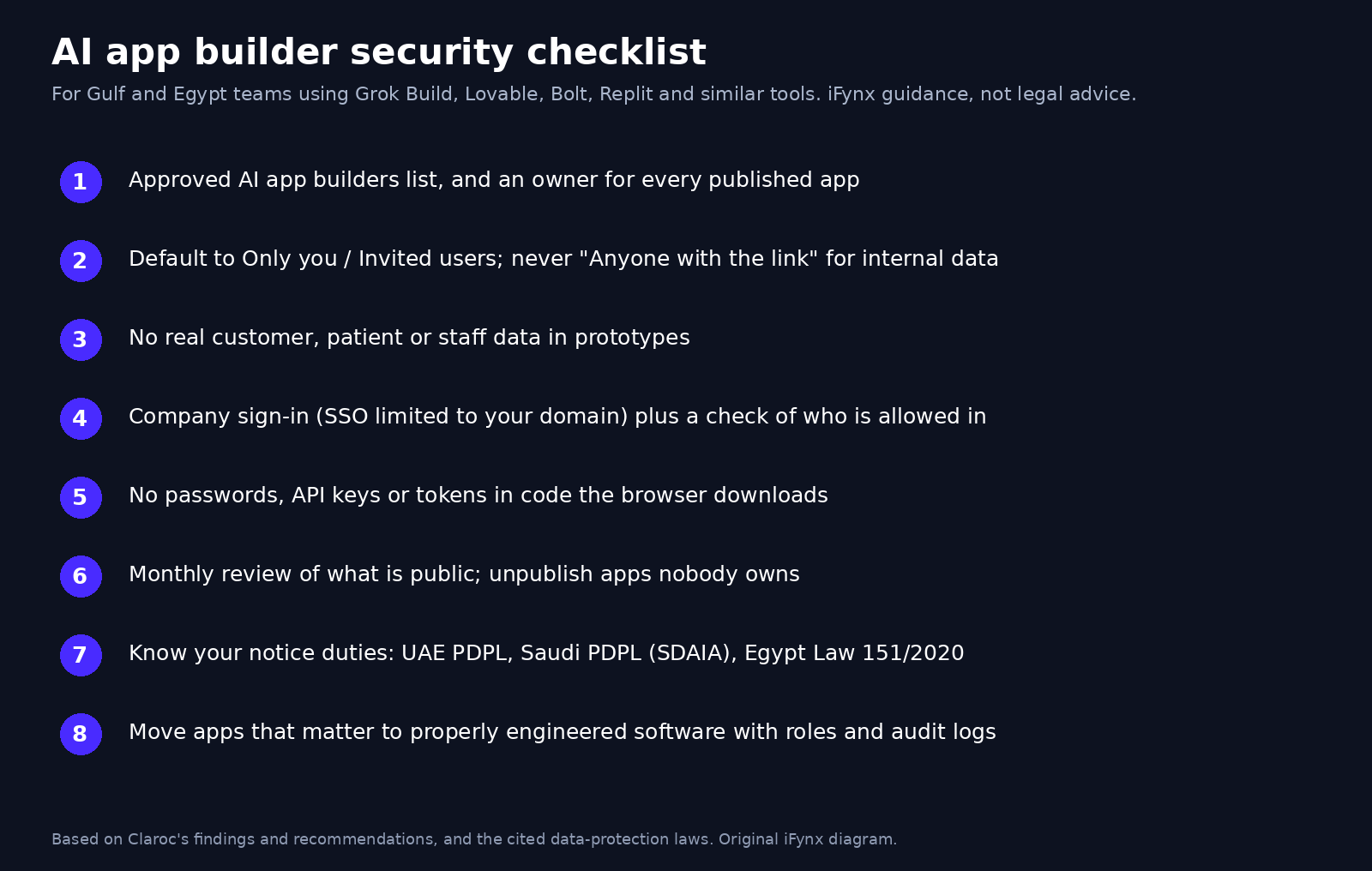
Hospitals, logistics firms, government contractors and SMEs across the Gulf and Egypt now let staff build internal tools with AI. Claroc notes that these builders “need no admin rollout and no company account”, so IT often does not know the apps exist. Our checklist, built on Claroc’s findings and recommendations:
- Keep an approved-tools list of AI app builders and require a named owner for every published app.
- Make private the default. Use “Only you” or “Invited users” for anything internal. Treat “Anyone with the link” as publishing to the internet.
- Keep real customer, patient and employee data out of prototypes. Use made-up data until the app has passed a review.
- Use real sign-in. Company SSO limited to your own domain, plus a check of who is on the team after sign-in, not “any Google account”.
- Never put secrets in browser code. Passwords, API keys and tokens belong on a server, not in script files every visitor downloads.
- Prefer path-based share links on a shared host when you build sharing yourself, and add link expiry. Remember that paths can still be indexed, so access control comes first.
- Audit what is public every month, and unpublish apps nobody owns. Apps drift: Claroc warns that an app “harmless yesterday” can hold customer records after the next prompt.
- Know your notice duties under the UAE PDPL, Saudi PDPL and Egypt’s Law 151/2020 before an incident, and check where the builder stores your data.
- Know when to graduate. When an app handles real customers, patients, money or staff records, move it to properly engineered software with roles, audit logs and monitoring.
A company policy for vibe-coded internal apps
A one-page policy covers most of the risk. It should say which AI builders staff may use and with which company account; which data classes are banned from prototypes (health, ID numbers, payment data, passwords); who must approve before anything is published; that every published app needs an owner, an expiry date and a private access setting; and how staff report an app that was open by mistake, with no blame for reporting quickly. Pair it with a short training note showing the Grok, Lovable and Replit sharing screens, because the risky choice is usually one click.
How iFynx can help
iFynx designs, builds and maintains web and mobile products for companies in the Gulf, Egypt and Palestine, in Arabic and English. Many teams now arrive with a working AI-built prototype. Our MVP Development and API & Backend Engineering teams turn vibe-coded prototypes into production apps with company sign-in, roles, server-side secrets and audit logs, without losing what already works. Our Product Design team designs sharing and permission screens where private is the default and users can see who has access before anything goes live. Through Software Maintenance and Quality Assurance in our Maintenance & Growth service, we review the access settings of your existing apps, test sign-in from outside, look for secrets in client code, and set up monitoring. Contact us for a free 30-minute review of your AI-built apps.
Frequently asked questions
Is Grok Build safe for company data?
It can be, but not with the setting Claroc found pre-selected. Claroc says that in its paid account the publish step proposed “Anyone with the link”, and 94.7% of the online apps it tried opened with no sign-in. SpaceXSI says apps are private until shared and employee accounts start as “Only you”. Use “Only you” or “Invited users”, real sign-in with a membership check, and no real personal data in prototypes.
How do I check if my Grok app is public?
Open the app’s publish or share settings in Grok and check the access setting. It should say “Only you” or “Invited users” for anything internal. Then open your own link in a private, signed-out window: a stranger should get an error page, not your data. Also try signing in with an account that was never invited. Only test apps you own.
Why isn’t an unguessable link private?
Because the random part of a Grok app link is its hostname, and every visit triggers a DNS lookup that passive DNS services record in searchable indexes, according to Claroc and Ars Technica. Links in the path avoid DNS, but search engines and link scanners can still expose them. Real privacy comes from an access setting that refuses strangers, not from a long link.
What should my company do if our data was in an exposed Grok app?
Take the app down or set it to “Only you”, record what it held and how long it was public, change any exposed passwords and keys, and assume it was read. Then check notice duties: Saudi Arabia’s PDPL regulation sets 72 hours to notify SDAIA, Egypt’s Law 151/2020 sets 72 hours to notify the Center, and the UAE PDPL requires notice to the Data Office. Get legal advice.
Is the Grok Build exposure the same as the Lovable exposure?
It is the same pattern, not the same bug. In the Lovable case, researchers found records readable because database access rules were misconfigured. In the Grok case, Claroc points to a publish default of “Anyone with the link” plus per-app hostnames that passive DNS made findable, and a sign-in gap in a team app it built. Both show that AI app builders need private defaults.
Sources and update policy
Read on 11 November 2026 (03:58–04:30 Asia/Gaza): Claroc Research, “GhostShares 2: Grok Apps Exposed xAI’s Business Secrets and People’s Private Data”, 10 November 2026; Ars Technica, “Grok Build coding agent leaks oodles of confidential info, some belonging to SpaceXSI”, 10 November 2026; also covered by Unite.AI and MLQ.ai. Law texts: UAE Federal Decree-Law No. 45 of 2021, Saudi PDPL Implementing Regulation, Egypt Law No. 151 of 2020. All counts and estimates are Claroc’s. iFynx did not access any Grok app. The checklist is iFynx guidance, not legal advice. We will update this article if SpaceXSI changes the publish default, says it will notify app owners, or Claroc publishes new findings.
Related reading
- Lovable Apps Left Passports, Payments and 200,000 Chats Open: What Crissy Field Found in 159,041 Projects, Why Supabase RLS Is the Weak Spot, and a Pre-Launch Checklist for Gulf and Egypt Builders
- MCP Server Security After the Mittwald Breach: What Happened, Why AI-Assistant Connectors Are Now an Attack Surface, and a Lock-Down Checklist for Gulf and Egypt Teams
- Plugin4Shell: AI Coding Agents Need Supply-Chain UX, Not Just Smarter Models
- Grok 4.7 at Unchanged Price: Coding Agents Compete on Harness Fit