Update, 11 November 2026, 04:07 Asia/Gaza
Related: the Grok Build "GhostShares" exposure (10 November 2026), the second AI app-builder data exposure in eight days: see Grok Build Apps Exposed: Why 35,000 AI-Built Apps Were Open to Anyone, and the AI App Builder Security Checklist for Gulf and Egypt Teams.
Published 3 November 2026, 12:49 Asia/Gaza. Based on Crissy Field’s research report and press coverage; we will add dated updates.
Quick answer: German security firm Crissy Field says it analysed 159,041 projects built with the AI app maker Lovable and found many where personal and confidential data could be read without logging in. On 7,403 sites it found readable records containing email addresses, and among the worst cases were more than 1,000 identity document records with passport numbers, over 80,000 forum profiles, more than 200,000 chat messages and ticket sales with payment information. The cause, it says, is access-control misconfiguration in the apps’ Supabase databases, not a hack. It could not establish whether the data was misused.
Key facts
- Who found it: Crissy Field GmbH, a Hamburg application security firm, working with German business daily Handelsblatt, which published the story on 2 November 2026.
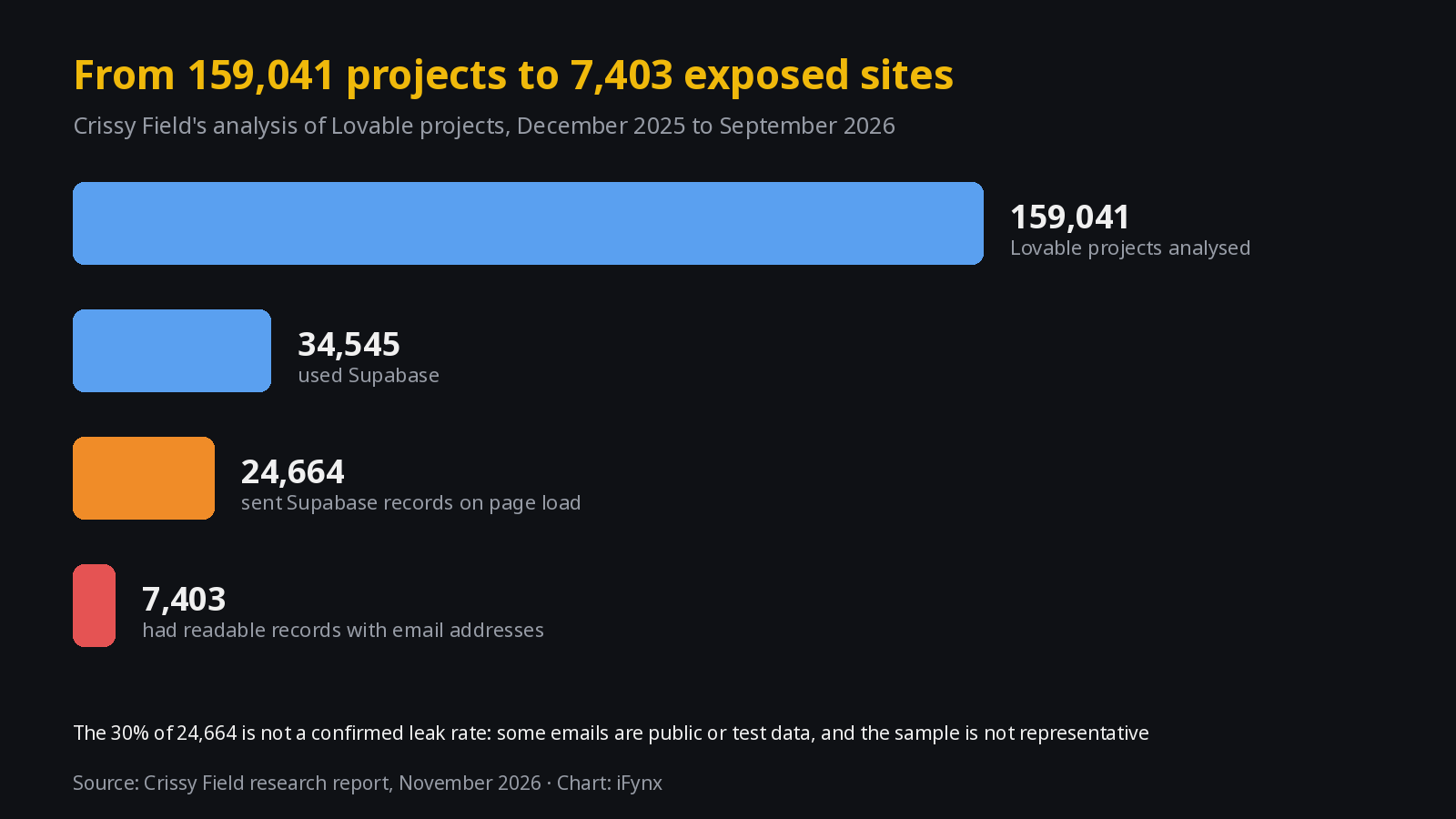
- The sample: 159,041 Lovable projects from Common Crawl, December 2025 to September 2026. 34,545 used Supabase.
- The exposure: 24,664 sites sent Supabase records on page load. With further read-only requests, records with email addresses turned up in 10,560 tables across 7,403 of them (30%).
- The caveat: Crissy Field says 30% is not a confirmed leak rate, and its sample is not representative of all Lovable apps.
- Lovable’s response: according to India Today, citing Handelsblatt, Lovable said the problem is widespread across the industry and its terms make customers responsible for their apps and data.
- What is not public: Crissy Field is not publishing how to access the data, and it has not named the affected apps. Neither do we.
What was exposed
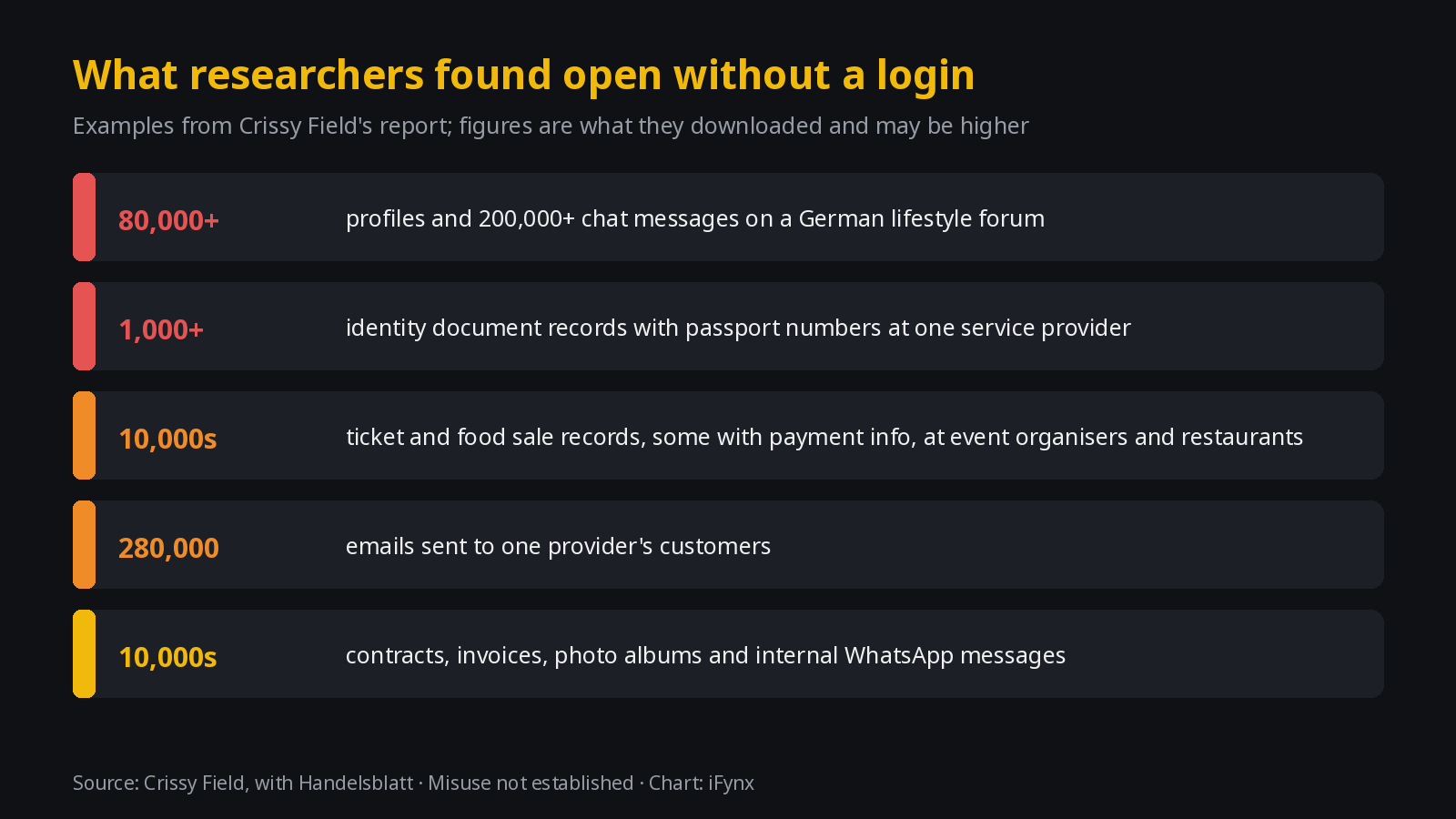
Crissy Field says it downloaded only parts of the datasets, so the real numbers may be higher. The examples in its report include:
- A German lifestyle forum with more than 80,000 profiles (full names, email addresses, dates of birth, gender) and over 200,000 chat messages.
- Event organisers and restaurants with tens of thousands of ticket and food sale records, including email addresses, phone numbers, postal addresses, payment information and ticket codes.
- A property management company exposing AI-generated summaries of internal emails about tenants, owners and business partners.
- A service provider exposing more than 1,000 identity document records, with passport numbers, expiry dates and nationalities.
- Tens of thousands of contracts, invoices, personal photo albums and internal WhatsApp messages, and in one case 280,000 emails sent to a provider’s customers.
An easy-to-use development platform does not remove the need for an expert review of access permissions before an application handles confidential data.
Crissy Field research report, November 2026
Why Supabase RLS is the weak spot
Lovable apps usually talk to their Supabase database straight from the browser, using a public key that is built into the page on purpose. That is safe only if every table has Row Level Security switched on, with a policy that says who may read which rows. Supabase’s own guide is blunt: “Enable RLS on every table in an exposed schema.” When it is missing or too loose, anyone who opens the site can read more than the page shows.
Crissy Field makes a further point: because Lovable apps follow recurring patterns, an approach that works against one app may work against others with little extra effort. And people without a technical background find these flaws harder to spot. This is the same lesson as with AI coding agents in general: the tool writes code fast, but nobody has checked the permissions.
For teams in the Gulf and Egypt using AI builders to launch fintech, travel, events or government-facing services quickly, this matters. Identity documents and payment data are exactly what these apps collect. Banks are already setting limits on AI coding tools, as with Goldman Sachs’ policy, and data that leaks through a supplier hurts customers just as much, as the Coinbase and Amplitude case showed.
Pre-launch checklist for Lovable and Supabase apps
- Turn on Row Level Security (RLS) for every table that holds anything about a person or a business, and write a policy for each one. Supabase’s RLS guide says a table in an exposed schema without RLS “is readable and writable by any role with a grant on it”.
- Treat the public (anon or publishable) key as public. It ships inside your page by design. It is not a password. Supabase’s API keys guide describes which keys are safe in a browser and which must stay on the server.
- Never put the service-role or secret key in front-end code, in a Lovable prompt or in a public repo. If it was ever exposed, rotate it now.
- Test as a stranger. Open your published app in a private window without logging in and check what loads. Then create two test accounts and confirm that account B cannot see account A’s records.
- Run the built-in checks before you publish. Lovable’s security documentation describes security scans that run before publishing and on demand, which check database access rules, and Supabase has a Security Advisor. Fix every critical finding. Crissy Field says automated checks are not a substitute for a professional review.
- Keep sensitive files out of public tables and buckets. Passports, IDs, contracts and invoices belong in private storage with per-user access.
- Collect less. If your waiting list only needs an email, do not ask for a passport number or a date of birth.
- Re-check after every big change. A new table or a new feature can quietly reopen access. Crissy Field recommends repeating the review after significant changes.
- Know your data protection law. The UAE (Federal Decree-Law 45 of 2021), Saudi Arabia (Personal Data Protection Law) and Egypt (Law 151 of 2020) all set duties for protecting personal data. “An AI built it” is not a defence. Ask your lawyer what applies to you.
- Get an expert review before real customer data goes in, especially for fintech, health, travel or anything with identity documents.
If you think your app is affected
Switch on RLS and add policies now, rotate any secret key that was ever in the front end, check your Supabase logs for unusual reads, and talk to a lawyer about whether you must notify users or a regulator. Do not try to test other people’s apps; use their published security contact or bug bounty program instead.
Search interest
The story spread on X overnight. The International Cyber Digest post about it passed 100,000 views by 10:45 UTC on 3 November, and posts appeared in English, German, Chinese and Turkish. We found almost no Arabic coverage.
Related: Railway’s AI agents and Primcloud, AI coding agent plugin security, the WorkOS breach and ARTEX and the Coinbase and Amplitude breach checklist.
Status as of 3 November 2026, 12:49 Asia/Gaza.
How iFynx can help
iFynx builds and reviews bilingual banking, fintech and SaaS apps for the UAE, Saudi Arabia and Egypt, including database access policies, auth and pre-launch security reviews for apps first built with AI tools. See our services.
Frequently asked questions
What did Crissy Field find in Lovable apps?
German security firm Crissy Field analysed 159,041 Lovable projects found in Common Crawl data from December 2025 to September 2026. 34,545 used Supabase, 24,664 sent Supabase records when the page loaded, and with further read-only requests the researchers found records containing email addresses in 10,560 tables across 7,403 of those sites (30%).
Was Lovable itself hacked?
No hack of Lovable’s own systems has been reported. The researchers describe access-control misconfigurations in apps built on the platform, mainly around the Supabase database, which let data be read without logging in.
Was the exposed data misused?
Crissy Field says it could not establish whether any of it had been misused. It also says the 30% figure is not a confirmed leak rate, because some email addresses are public or test data and the sample is not representative of all Lovable apps.
What did Lovable say?
According to India Today, citing Handelsblatt, Lovable said the problem was not limited to its platform and was widespread across the industry, and its terms place responsibility for apps and data handling on customers.
What is Supabase Row Level Security?
Row Level Security is a PostgreSQL feature that Supabase uses to decide which rows each user can read or change. Without RLS and a policy on a table, the public key that ships with the app may be enough to read it.
How do I check my Lovable app?
Run Lovable’s security scan and Supabase’s Security Advisor, confirm RLS is on for every table with personal data, open the published app logged out, and test with two accounts that one cannot see the other’s data. Before real customer data goes in, get a professional review.
Sources
- Crissy Field: Lovable research report, November 2026
- Handelsblatt, Lina Knees, 2 November 2026 (German)
- India Today, 3 November 2026
- International Cyber Digest on X, 23:21 UTC, 2 November 2026
- Supabase docs: Row Level Security, API keys, Security Advisor; Lovable security overview
- Cover photo: Marc Mueller, Wikimedia Commons.jpg), CC0, cropped. Charts: iFynx.
Related reading
- GitBook Breach by AI Agents: What Was Exposed (Git Sync Secrets, API and Integration Tokens, Assistant Questions), What to Rotate Now, and a Docs-Platform Security Checklist for Gulf and Egypt Crypto, Fintech and SaaS Teams
- Coinbase Opens a Sign-Up Page for AI Trading Agents as Its $2M Champions Cup Starts 4 November: How Coinbase for Agents Works, What the Rules Say, and an Agent Safety Checklist for Gulf and Egypt Traders and Fintechs