Direct answer — 14 November 2026: On 13 November the FBI published FLASH-20261113-001 (TLP:CLEAR) about ARTEX, an open-source AI agent framework for penetration testing that criminals and other threat actors have used since at least August 2026 to automate intrusions “at machine speed”, from reconnaissance to data theft. The FBI says some intrusions went from first targeting to privileged access in under three hours, that the GitHub repository was taken down in October but forks, archived copies and a commercial “ARTEX PRO” still circulate, and that more than 1,600 ARTEX consoles were publicly exposed in early November. Its advice is defensive and practical: find every internet-facing app (especially the forgotten ones), take admin and backup interfaces off the internet, tighten app permissions, review Microsoft 365 tenants that ever had the affected ConnectWise apps, and preserve logs. The FLASH does not name any victim in the Gulf or Egypt.

The iFynx team builds and maintains portals, mobile backends and internal tools for banks, fintechs and SaaS companies in the UAE, Saudi Arabia, Egypt and Palestine, which are exactly the “peripheral” systems the FBI says ARTEX is best at finding. This briefing is built differently from a news recap: first the five things to do today, then the timeline, then a decision tree for Microsoft 365 admins, and finally a 10-step checklist with an owner for every step. We re-read the FBI PDF on the evening of 14 November (Asia/Gaza) and use only what it states; the few extra details from The Record’s report are labelled as such. We do not publish attack steps, exploit code or indicator lists to block blindly.
If you only have five minutes
- Ask one question in your next stand-up: “Who owns each of our internet-facing apps, including partner portals, mobile APIs and old staff tools?” Anything without an owner goes to the top of the list.
- Check whether ConnectWise apps were ever installed or authorised in your Microsoft 365 tenant. Search by application ID, not by display name, as the FBI advises.
- Take admin, backup and deployment consoles off the public internet today, or put them behind a VPN or zero-trust gateway.
- Preserve logs before you change anything: Microsoft Entra sign-in and audit records, Purview Audit, SIEM data, from at least 1 October 2026.
- Do not panic-block the FBI’s indicator list. The FBI itself says some indicators, such as IP addresses, may not be indicative of a compromise on their own. Investigate first.
Key facts (from the FBI FLASH, checked before publishing)
| Question | What the FBI says |
|---|---|
| What is ARTEX? | An open-source, LLM-driven, multi-agent penetration testing platform written in Go. It turns goals written in plain language into commands run by AI agents, with minimal human input after the objective is set. |
| Which models? | It has no model of its own and plugs into external ones, including Anthropic Claude, OpenAI GPT, DeepSeek, GLM, Grok and Kimi. In attacker-controlled instances, Chinese models were most common, with DeepSeek Flash family models dominating. |
| Since when? | Released on GitHub in July 2026 by a developer called “Autumn-27”; used by malicious actors since at least August 2026. |
| Who is targeted? | Organisations globally in financial services, government, technology, defence, semiconductors, energy, healthcare, manufacturing, telecommunications and legal. |
| How fast? | Some intrusions went from initial targeting to privileged access in under three hours. |
| Notable campaigns | Financially motivated attacks on South Korean financial institutions, with personal data of about 67,000 people exfiltrated; a supply chain compromise of ConnectWise Cloud Backup customers that gave access to more than 2,250 downstream tenants. |
| Is it still out there? | The developer made the repository unavailable on 8 October 2026, but forks, localised variants, archived copies and a commercial ARTEX PRO keep it available. More than 1,600 publicly exposed ARTEX consoles were found in early November. |
| Indicators | IP addresses, a domain and behavioural signs. The FBI asks organisations to vet them before blocking, because cloud IP addresses can be reassigned to harmless services. |
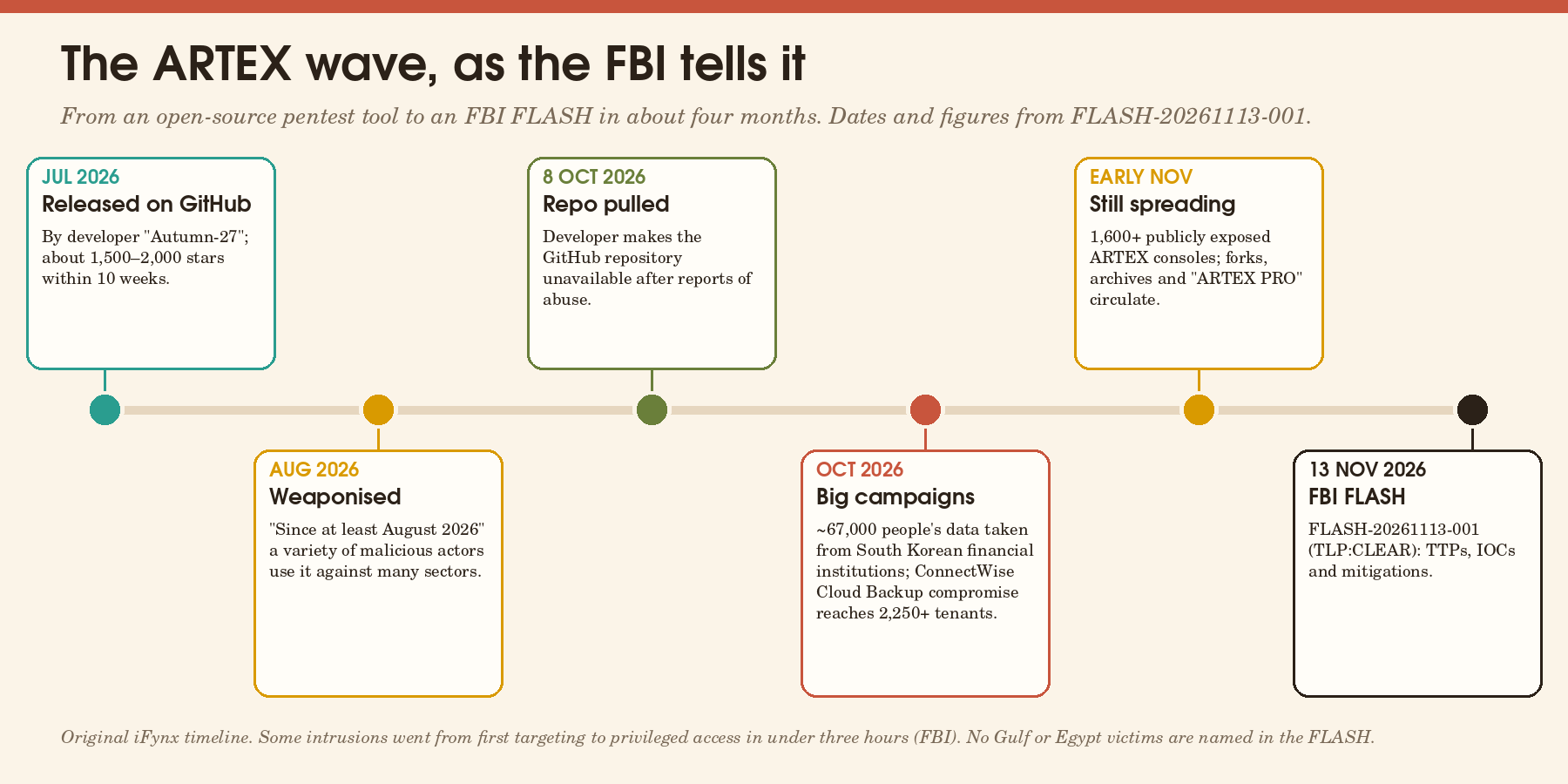
The ARTEX timeline, from GitHub to FBI FLASH
ARTEX did not start as malware. According to the FBI, it was published on GitHub in July 2026 by a developer using the name “Autumn-27”, who said it was meant for authorised security testing within defined scopes. It became popular quickly, reaching an estimated 1,500 to 2,000 GitHub stars within 10 weeks.
By August 2026, the FBI says, “a variety of malicious cyber actors” were already using it. October brought the campaigns that put ARTEX in the headlines: the attacks on South Korean financial institutions and the ConnectWise Cloud Backup supply chain compromise, which Microsoft researchers documented on 21 October (the FLASH cites that research). On 8 October the developer made the repository unavailable after reports of abuse. It did not matter much: the FBI says the framework “continues to proliferate” through forks, local variants, archives and ARTEX PRO, and Censys research cited in the FLASH counted more than 1,600 exposed ARTEX consoles in early November, with the real number “likely significantly higher”. On 13 November the FBI turned all of this into a FLASH alert.
We first wrote about ARTEX when identity company WorkOS said an AI-assisted framework was used against one of its internal sales tools; that WorkOS breach and ARTEX explainer now carries a dated update pointing here.
What makes ARTEX different, in plain language
Traditional intrusions need skilled people to chain many small steps: find a forgotten server, test a login page, try a stolen password, move to the next machine. ARTEX hands those steps to AI agents. The FBI lists five reasons that matters:
- Many targets at once. Small groups can run several intrusion campaigns in parallel, at a scale they could not manage before.
- The overlooked systems. ARTEX “excels” at finding peripheral systems that get less security attention than the flagship app: partner and supplier portals, mobile backends, employee apps, sales-support systems, legacy services, third-party integrations and apps built by different business units.
- Supply chains. Agents can map trust relationships between organisations and use a weaker vendor, CI/CD pipeline or software provider as the way in. The FBI mentions a case of modified iOS app distribution infrastructure reached through exposed cloud credentials.
- Lower skill needed. Attackers with minimal expertise can run complex operations.
- Less time to react. ARTEX is noisy and may trigger alerts, but it moves so fast that defenders have little time to coordinate before the attacker reaches the goal.
The FLASH maps observed activity across the whole attack lifecycle. At a high level, it includes mapping the permissions of stolen cloud credentials, exploiting common web flaws (such as SQL injection, SSRF, XXE and missing authentication on web APIs), finding administrator passwords hardcoded in JavaScript bundles, using stolen VPN configurations, planting web shells, adding credentials to existing OAuth apps, attacking Active Directory and reading data in bulk from databases, storage and mailboxes. None of that is new. What is new is the speed and the fact that one operator can point it at many organisations at once.
Where ARTEX hits: the systems nobody owns
Here is how the FBI’s list of favourite targets looks inside a typical bank, fintech or SaaS company in our region. This is iFynx’s mapping for planning, not a list of known victims.
| FBI’s “peripheral system” | What it often is in the Gulf and Egypt | First question to ask |
|---|---|---|
| Partner and supplier portals | Merchant onboarding portals, agent and broker portals, supplier invoice portals | Does every partner account have MFA, and do we alert on bulk lookups? |
| Mobile backends | The API behind the banking, wallet or delivery app | Is authorisation checked on the server for every record, not only in the app? |
| Employee applications | HR, leave, expense and payroll tools, often built quickly by an agency | Is it on the public internet at all? Does it need to be? |
| Sales-support systems | CRM add-ons, quoting tools, call-summary tools (the WorkOS case) | Which customer data can a sales login export? |
| Legacy services | An old version of the website, a forgotten test server, a retired app’s API | Is it still running, and who patches it? |
| Third-party integrations | Payment gateway callbacks, KYC providers, SMS and email services, ERP connectors | Which keys does each integration hold, and when were they last rotated? |
| Apps built by other business units | Marketing microsites, campaign landing pages with forms, internal dashboards | Is it in the central inventory and the security scan? |
Microsoft 365 and ConnectWise: what admins should check
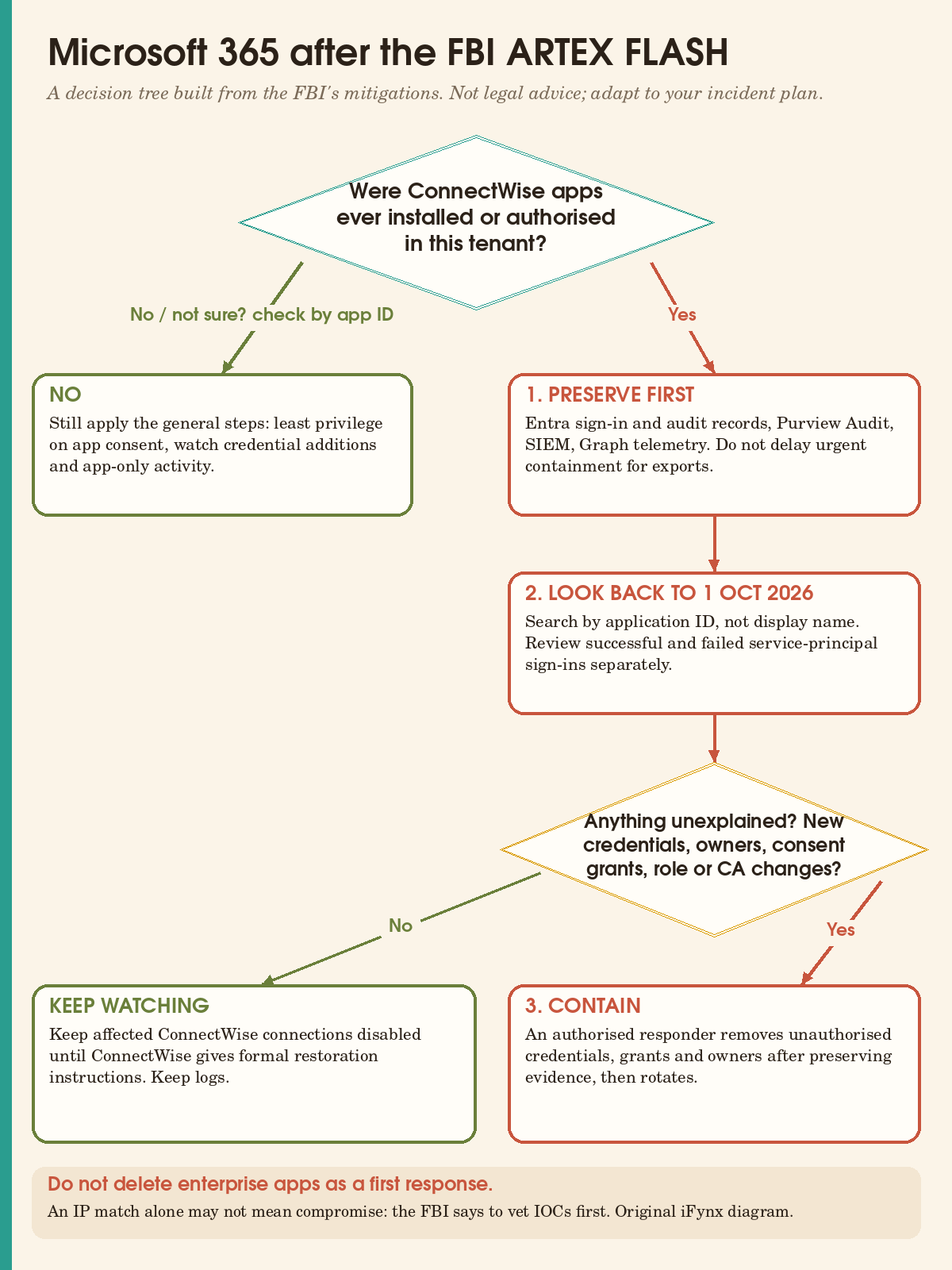
The FLASH spends a lot of space on the ConnectWise Cloud Backup supply chain compromise, because it reached more than 2,250 downstream tenants. Many small and mid-sized companies in the UAE, Saudi Arabia and Egypt are run by managed service providers who use tools like this, so it is worth checking even if you have never heard of ConnectWise: your IT provider may have connected it. The FBI’s steps, in order:
- Review every Microsoft 365 tenant where affected ConnectWise applications are or were installed or authorised, even if the integration is no longer used. Search by application ID rather than display name.
- Preserve Entra sign-in and audit records, Purview Audit records, SIEM data and any Graph telemetry first, but do not delay urgent containment while waiting for exports.
- Review activity from at least 1 October 2026. Look at successful and failed service-principal sign-ins separately, and investigate unfamiliar sources, not only the published IP addresses.
- In Entra audit records, look for new credentials on applications or service principals, new applications, owners, app-role assignments, consent grants, privileged role assignments and changes to users, groups, authentication methods or Conditional Access.
- If suspicious activity is confirmed, an appropriately authorised responder should remove the unauthorised credentials, grants, owners and identities after preserving evidence, then rotate credentials.
- Keep affected ConnectWise connections disabled until ConnectWise provides formal restoration instructions, and do not delete enterprise applications as a first response.
Do the FBI’s IOCs mean you are compromised?
Not on their own. This is the part of the FLASH most likely to be misread. The FBI lists IP addresses, a domain and behavioural indicators, and then says clearly that organisations should investigate or vet indicators before acting, for example before blocking. Infrastructure on cloud platforms gets new IP addresses all the time, so an address that was malicious during the campaign may now belong to a harmless service. In the FBI’s words, some indicators, “particularly those of a nondeterministic or ephemeral nature (such as filenames or IP addresses), may not be indicative of a compromise.”
That is why we do not reproduce the indicator list here; use the FBI PDF directly and feed it to your security team or SIEM as a lead, not a verdict. The behavioural signs are more useful for most teams:
- unexpected outbound calls from servers to LLM APIs (the FBI names api.anthropic.com, api.deepseek.com, open.bigmodel.cn and api.x.ai), investigated alongside other suspicious activity, not alone;
- high-frequency automated requests with sequential enumeration against login or search endpoints;
- outbound transfers of structured data such as names, phone numbers and financial information to unknown destinations;
- unexpected .aspx or .jsp files in web application paths;
- signs of self-hosted LLM gateways or resellers you did not install, and AI API billing anomalies.
The 10-step checklist for Gulf and Egypt banks, fintechs and SaaS teams
Every step below comes from the FBI’s recommendations. The owner column is our suggestion for a typical company in the region; adjust it to your team.
| # | Step | Suggested owner |
|---|---|---|
| 1 | Inventory every internet-facing app, including partner portals, mobile backends, employee apps, legacy services, third-party integrations and apps built by other units | CTO or head of IT, with each business unit |
| 2 | Restrict cloud admin, network device management, Kudu/SCM publishing, hypervisors and backup platforms to trusted networks, private connectivity or dedicated admin paths; disable basic publishing authentication where it is not needed | Infrastructure or DevOps lead |
| 3 | Require an architecture review before any workload or management interface gets a public IP; move enterprise apps behind zero-trust access where feasible | Security architect |
| 4 | Apply least privilege to multi-tenant app permissions and consent grants | Microsoft 365 or identity admin |
| 5 | Monitor credential additions, privilege assignments and unusual app-only activity, especially on highly privileged apps | SOC or managed security provider |
| 6 | Run the Microsoft 365 and ConnectWise review above (application ID, from 1 October 2026, sign-ins and Entra audit) | Identity admin with your MSP |
| 7 | Put guardrails on high-impact APIs and portals: rate limits, recipient and transaction thresholds, alerts on sequential lookups and unusually many records per session, server-side authorisation, and only the fields each screen needs | Backend and product teams |
| 8 | Stop showing stack traces, SQL errors, internal paths and framework details to unauthenticated users; keep them in internal logs | Development teams |
| 9 | Scan configs, environment variables, infrastructure-as-code, deployment scripts, CI/CD pipelines, container images and databases for embedded secrets, continuously, and rotate anything exposed | DevSecOps |
| 10 | Prepare evidence and response: keep sign-in, audit and SIEM logs, vet IOCs before blocking, and agree who may remove credentials and when (after evidence is preserved) | CISO and incident response lead |
Two related lessons from our recent coverage fit here. The Cursor incident showed how secrets inside agent traces and vendor keys can open a path into a company, which is step 9. And the MCP server security and agent plugin security cases show that the AI tools your own teams use also need least privilege, which is step 4.
How this fits regional rules
Banks, fintechs and their suppliers in the region already work under cybersecurity rules from regulators such as the Saudi Central Bank (SAMA), Saudi Arabia’s National Cybersecurity Authority, the Central Bank of the UAE, and Egypt’s Central Bank and Financial Regulatory Authority. Asset inventories, access control, logging and third-party risk management are common themes in those regimes. The FBI’s ten steps give your compliance team concrete evidence for exactly those themes, but we are not mapping clause numbers here; check the text that applies to your licence with your compliance team. If you find a compromise, report it to your national cybersecurity authority or CERT and your sector regulator as your rules require; the FLASH’s own reporting channels (FBI field offices and IC3) are aimed at the United States.
What the FLASH does not say
- It does not name victims in the Gulf, Egypt or the wider Middle East. We do not claim any.
- It does not say every ARTEX user is one group. It describes “a variety of malicious cyber actors”.
- It does not give a total number of victims worldwide.
The Record adds context from outside the FLASH: it reports that ARTEX was also implicated in attacks on Japanese financial institutions, that Microsoft linked the ConnectWise attack to Chinese state-backed actors, and that Amazon published research the same day describing credential theft to access AI models, where stolen keys paid for the LLM inference behind further attacks. That pattern is close to the LLMjacking we described in our Fireworks AI breach explainer. The Record also gives August as the release month; we follow the FBI’s July 2026.
How iFynx can help
Close the gaps ARTEX looks for
Find your forgotten apps before an AI agent does.
iFynx designs, builds and maintains web and mobile products for banks, fintechs and SaaS companies in the Gulf, Egypt and Palestine. After this FBI FLASH, we can help you work through the checklist quickly:
- Maintenance & Growth: Software Maintenance and Quality Assurance: an inventory of your internet-facing apps and APIs, patching, secret scanning, rate limits and monitoring for the systems we maintain.
- Software Development: API & Backend Engineering: server-side authorisation, minimal API responses, safe error handling and admin interfaces moved off the public internet.
- AI & Data: AI Agents & Automations: if you build your own AI agents, we design them with least-privilege keys, spend caps, logging and a stop switch, so they cannot be turned against you.
Book a free 30-minute review of your partner portals, mobile backends and admin interfaces.
Frequently asked questions
What did the FBI say about ARTEX?
In FLASH-20261113-001, dated 13 November 2026, the FBI says ARTEX is an open-source, LLM-driven agentic penetration testing framework that threat actors have used since at least August 2026 to automate intrusions from reconnaissance to data exfiltration, against organisations in finance, government, technology and other sectors. Some intrusions reached privileged access in under three hours. The FLASH lists tactics, indicators and mitigations.
Is ARTEX still available after the GitHub repository was removed?
Yes. The FBI says the developer made the repository unavailable on 8 October 2026, but the framework keeps spreading through community forks, localised variants, archived copies and a commercial version called ARTEX PRO. Researchers found more than 1,600 publicly exposed ARTEX consoles in early November, and the FBI says total deployments are likely significantly higher.
Are banks or companies in the Gulf or Egypt named as victims?
No. The FLASH says ARTEX campaigns target organisations globally and names South Korean financial institutions and ConnectWise Cloud Backup customers, but it does not name any victim in the Gulf, Egypt or the wider Middle East. The systems it says ARTEX favours, such as partner portals, mobile backends and employee apps, are common in the region, so the mitigations still apply.
How do I check my Microsoft 365 tenant for the ConnectWise-related activity?
Find out whether affected ConnectWise applications were ever installed or authorised in the tenant, searching by application ID rather than display name. Preserve Entra sign-in and audit logs and Purview Audit records, review activity from at least 1 October 2026, check successful and failed service-principal sign-ins separately, and look for new app credentials, owners, consent grants and role changes. Do not delete enterprise apps as a first response.
Do the FBI’s IOCs mean I’m compromised?
Not by themselves. The FBI asks organisations to vet indicators before acting on them, because cloud IP addresses can be reassigned to harmless services, and it says some indicators, such as filenames or IP addresses, may not be indicative of a compromise. Treat a match as a lead and confirm it with other evidence, such as unusual sign-ins, new credentials or unexpected data transfers.
Sources and update policy
Read on 14 November 2026 (evening, Asia/Gaza): FBI, FLASH-20261113-001, “Threat Overview of ARTEX Autonomous Penetration Testing Framework”, 13 November 2026, TLP:CLEAR. The FLASH cites research by Akamai, Microsoft, Google Threat Intelligence Group and Mandiant, Censys, CrowdStrike, Zscaler, CERT-EU and Check Point; figures in this article are the FBI’s as stated in the FLASH. Additional context: The Record, “FBI flash alert says Artex tool automating cyberattacks at ‘machine speed'”, 13 November 2026. Earlier iFynx coverage: WorkOS breach and ARTEX. The owner column, the regional mapping table and the checklists are iFynx guidance, not legal advice. We will update this article if the FBI, ConnectWise, Microsoft or a regional authority publishes new information.
Related reading
- MCP Server Security After the Mittwald Breach: What Happened, Why AI-Assistant Connectors Are Now an Attack Surface, and a Lock-Down Checklist for Gulf and Egypt Teams
- Cursor Security Breach: How a Key Exposed at Fireworks AI Led to a Malicious Claude Code Extension, and What Dev Teams Should Check Now
- Plugin4Shell: AI Coding Agents Need Supply-Chain UX, Not Just Smarter Models
- Workday Outage Cause: How a Disaster-Recovery Test Hit Live Production Data, What Was Affected, and a DR Drill and Payroll Continuity Checklist for Gulf and Egypt Companies
- Google Finds exploit_agent, an AI Pipeline That Turns Security Patches Into Exploits With No Human in the Loop: Why Patch Windows Now Shrink to Hours, and a Checklist for Gulf and Egypt Web Teams