GOOGLE GTIG + MANDIANT · AI THREAT TRACKER · CHECKED 21:55 ASIA/GAZA, 16 NOV 2026
Google’s threat intelligence team says that, for the first time, it has seen attackers use AI to find and exploit flaws with no human in the loop. On an exposed staging server it found exploit_agent, a multi-agent framework that compares web software before and after security patches, drafts exploits and runs them automatically.
For anyone running WordPress or a web app, the message is simple: the gap between a fix being published and an attack using it is shrinking. The report shows the framework inspecting code from the popular Spectra WordPress plugin, version 2.19.25, but does not say that a flaw there was exploited. Treat critical, internet-facing patches as same-day work.
At iFynx we build and maintain WordPress sites, web apps and APIs for companies in the Gulf and Egypt, so we read Google’s report for one question: how fast do our clients now need to patch? This article sticks to what Google Threat Intelligence Group (GTIG) and Mandiant published on 16 November 2026, and to what the press reported from it, attributed as such. It gives no exploit steps. It follows our coverage of the FBI’s ARTEX warning, the AI attack framework GTIG also names in this report.
The patch-to-exploit clock
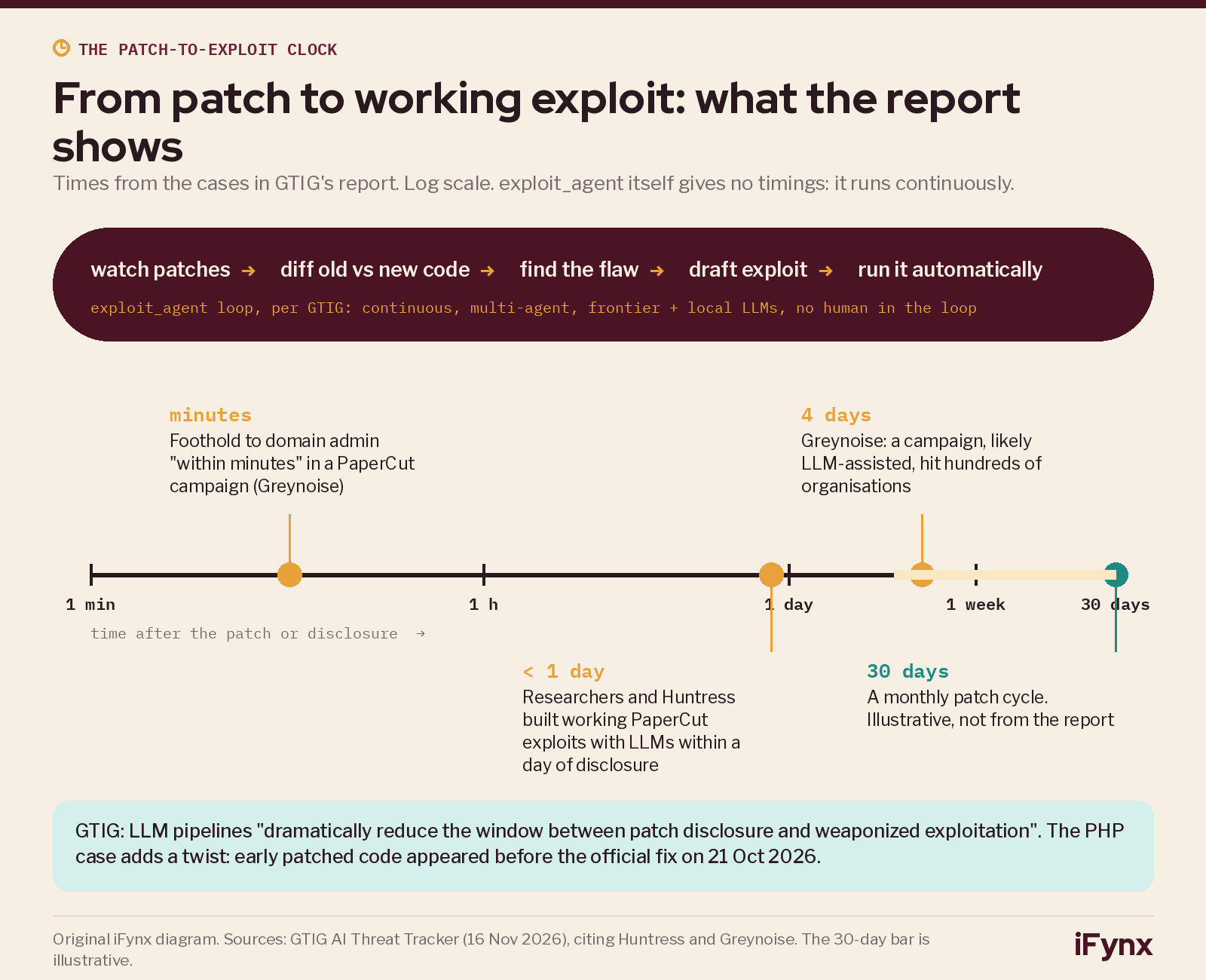
For years the comfortable assumption was that after a security update you had days or weeks before attackers caught up, because someone had to read the patch, understand the bug and write an exploit by hand. GTIG’s report says language models are now doing that work. In its words, LLM pipelines can “dramatically reduce the window between patch disclosure and weaponized exploitation”, and attackers find it efficient to focus on known, patched bugs because the patch itself tells them where to look.
The cases in the report show how short the clock has become. In late August 2026, attackers used two PaperCut print-server flaws as zero-days. After disclosure, researchers and the security company Huntress built working exploits with LLMs within a day. Greynoise, as cited by GTIG, reported a campaign four days after disclosure in which an actor likely used LLMs to build exploits and hit hundreds of organisations, going from a first foothold to domain administrator “within minutes”. In the PHP case (CVE-2026-109618 and CVE-2026-109619), early patched code and a proof-of-concept video appeared before the official fix on 21 October 2026, so attackers could compare versions before many teams could even patch. We covered that PHP update here.
What Google found: exploit_agent
| What | What the report says |
|---|---|
| Name | exploit_agent, a “multi-agent vulnerability research and weaponization framework” |
| Where it was found | An exposed staging server, identified by GTIG |
| How it works | Continuous differential analysis of “popular web application software”: compares code before and after patch announcements, finds likely flaws, drafts exploits and runs them “without human intervention” |
| Models | Integrates with multiple frontier and local LLMs |
| Also on the server | Data taken from victims, plus scripts for internal reconnaissance, brute-forcing, installing webshells and removing other attackers’ webshells |
| Targets | Victim telemetry suggests interest in French media, entertainment and education websites |
| Operator | Not named. A configuration file carried Russian-language comments; The Register describes a “suspected Russian-speaking operator” |
GTIG calls this the first time it has seen threat actors “using LLM frameworks to fully automate vulnerability discovery and exploitation without a human in the loop”. The phrase that matters for defenders is “continuous differential analysis”: the tool is not waiting for a public exploit. It watches for patches, and each patch becomes a lead.
GTIG also adds a caveat. These frameworks currently “trade stealth for velocity”: they generate noisy traffic and leave code-level traces, so good logging and monitoring still catch them. BleepingComputer reports that GTIG expects unsophisticated attacks needing “little to no human interaction” within about three months, and “sophisticated, fully autonomous” agentic attacks within about six.
The WordPress plugin in Google’s report: what it shows, and what it does not
Figure 4 of the report shows the framework “inspecting access control implementations” in the Spectra (Ultimate Addons for Gutenberg) WordPress plugin, version 2.19.25, specifically a permission check on the plugin’s popup REST route. That is all the report says about it. It does not say a vulnerability was confirmed, whether it was exploited, or which sites were hit.
What we can add from the public record: WordPress.org now lists the plugin as Spectra Legacy, with more than a million active installs, and its current version is 2.20.6, released on 3 November 2026. Its changelog lists several security fixes since 2.19.25, credited to Wordfence, Patchstack and an independent researcher. We cannot tell from public sources whether any of them relates to the code in Google’s figure, so we do not claim a link.
IF YOU RUN SPECTRA
Update to the latest version from WordPress.org (2.20.6 when we checked), confirm auto-updates are on or patched on a schedule, and remove the plugin if you no longer use its blocks. That is good practice for any plugin. It is not a claim that Spectra is under attack.
Patch in hours: a 72-hour ladder for Gulf and Egypt web teams
Much of the web in Saudi Arabia, the UAE and Egypt, from agency-built company sites to school, media and government-adjacent portals, runs on WordPress with a long tail of plugins. Those are exactly the “popular web application software” that a tool like exploit_agent can watch. Here is the ladder we now recommend for internet-facing systems:
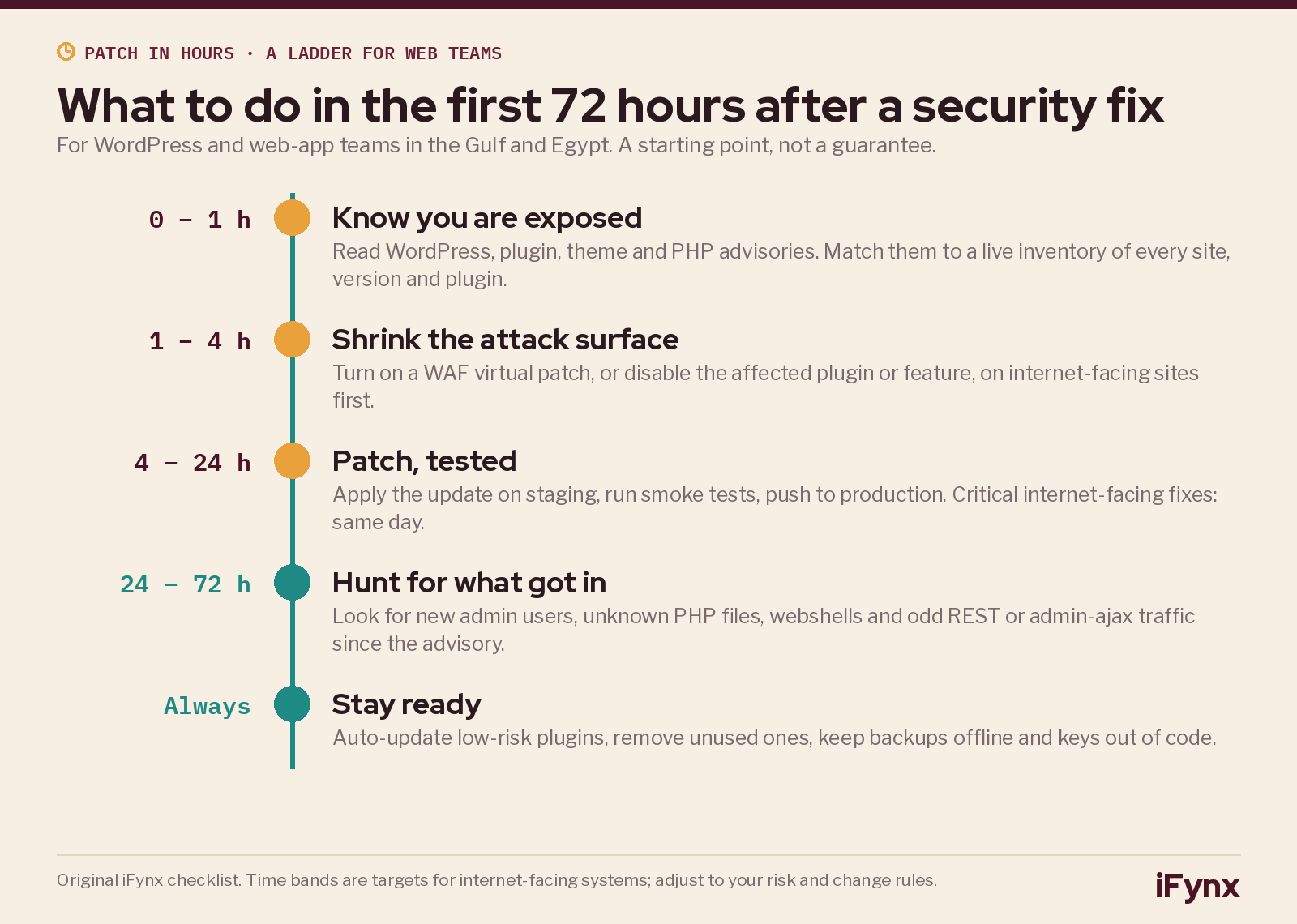
- Hour 0 to 1: know you are exposed. Keep a live inventory of every site, its WordPress and PHP versions, and every plugin and theme with its version. Subscribe to WordPress core, plugin and PHP security feeds, and match each advisory against the inventory the same hour it lands. Our WordPress 7.1.4 checklist shows how.
- Hour 1 to 4: shrink the attack surface. If you cannot patch at once, turn on a virtual patch in your WAF, block the affected route, or disable the plugin feature on public sites first.
- Hour 4 to 24: patch, tested. Push the update through staging with smoke tests, then to production. Agree in advance that critical fixes on internet-facing systems are same-day changes, so nobody waits for the weekly window.
- Hour 24 to 72: hunt for what got in. The exploit_agent server held scripts for webshells and brute-forcing. Look for new administrator accounts, unknown PHP files in uploads and plugin folders, changed core files, and unusual REST API or admin-ajax requests since the advisory.
- Always: stay ready. Turn on auto-updates for low-risk plugins, delete unused plugins and themes, keep tested offline backups, and keep secrets out of code and CI. The wfx-loot CI secret theft shows why.
- Know who you report to. Have contacts ready for your national CERT and regulator: Saudi Arabia’s National Cybersecurity Authority, the UAE Cyber Security Council and aeCERT, and Egypt’s EG-CERT, plus any sector regulator such as your central bank. Check your own reporting obligations with counsel.
The rest of the report: agent frameworks, stolen AI keys and the Middle East
exploit_agent is one part of a broader quarter. GTIG says attackers are using open-source agentic pentesting frameworks in live intrusions: ARTEX, which we covered in the WorkOS breach, plus CAIRN and PentAGI, with experimentation seen with CyberStrikeAI and HexStrike AI.
It also describes “LLMJacking”: criminals stealing AI API credentials and cloud resources, then reselling access through “LLM Mixers”, underground storefronts that spread traffic across many victims’ keys. Advertised prices ranged from $0.10 to $25 per million tokens. If your product calls an AI API, a leaked key is now a sellable asset, as the Fireworks AI breach showed.
Two items touch the region directly. GTIG says it continues to see CALANQUE ION, which it describes as an Iranian government-backed actor previously tracked as APT42, use LLMs including Gemini for reconnaissance and targeted social engineering. And in August 2026 it investigated a platform built with the Gemini API and other AI tools to target public sentiment on regional political topics, “primarily across Europe and the Middle East”. For Gulf and Egypt organisations, that means more convincing phishing and fake personas in Arabic as well as English.
How iFynx can help
Attackers now read your patches as fast as you do. We help companies in the Gulf and Egypt close that gap:
- Patch pipelines that run in hours. Our Web Development team sets up plugin inventories, staging, automated smoke tests and same-day release paths for WordPress and custom web apps.
- Hardened APIs and back ends. Through API & Backend Engineering we review REST routes and permission checks, add WAF rules and logging, and clean up after an incident.
- Safe AI integration. Our AI Agents & Automations team keeps model API keys in a vault, scopes and rotates them, and alerts on unusual usage, so your keys do not end up in an LLM Mixer.
Want a 72-hour patch plan for your sites? Talk to the iFynx team.
Frequently asked questions
What is exploit_agent, and who found it?
It is a multi-agent AI framework that Google Threat Intelligence Group found on an exposed staging server and described in its AI Threat Tracker report of 16 November 2026. It compares web software before and after security patches, works out what was fixed, drafts exploits and runs them automatically. GTIG did not name the operator; the configuration carried Russian-language comments, and victims appeared to be French media, entertainment and education websites.
Can AI really turn a security patch into an exploit on its own?
According to GTIG, yes: it says this is the first time it has seen attackers fully automate vulnerability discovery and exploitation without a human in the loop. GTIG also notes these tools are currently noisy and leave traces, and that many AI-generated exploits shared online do not work. The practical effect is that the safe period after a patch is much shorter.
Which WordPress plugin was in Google’s report, and should I update it?
The report shows the framework inspecting access-control code in Spectra (Ultimate Addons for Gutenberg), version 2.19.25. It does not say a flaw was confirmed or exploited. WordPress.org lists the current version as 2.20.6, released on 3 November 2026, with several security fixes since 2.19.25. If you use it, update to the latest version, as you should with any plugin.
How fast should we patch now?
For critical fixes on internet-facing systems, aim for the same day, ideally within hours, with a WAF virtual patch or a disabled feature as a stopgap. Less exposed systems can follow your normal cycle. The cases in Google’s report include working exploits within a day of disclosure and a mass campaign within four days.
What is LLMJacking, and how do I protect my AI API keys?
LLMJacking is the theft of AI service credentials or cloud resources so others can use your models at your cost. GTIG says stolen access is resold through “LLM Mixers”. Keep keys in a secrets manager, never in code or front ends, scope them to the minimum, set spending limits and alerts, and rotate them on any suspicion.
Sources and update policy
Primary: GTIG AI Threat Tracker: Agentic Threat Activity Crosses a Significant Threshold (Google Cloud blog, 16 Nov 2026, by Aurora Blum, Kelli Vanderlee, Jess Xia and David Mainor), re-checked at 21:55 Asia/Gaza; Google’s summary on The Keyword; and the plugin’s WordPress.org page for its current version and changelog. Press: BleepingComputer, The Register and SiliconANGLE.
We will update this article if Google, the plugin’s developer or a security firm publishes more detail on exploit_agent or the code it analysed. This is general information, not legal advice.
Related reading
- FBI ARTEX Warning (FLASH-20261113-001): What the FBI Says About the AI Agent Hacking Tool, Its Mitigations, and a 10-Step Checklist for Gulf and Egypt Banks, Fintechs and SaaS Teams
- WordPress 7.1.4 Security Release: 22 Vulnerabilities Fixed, the Upgrade-Window RCE, and the Update Checklist for Gulf and Egypt Sites