Direct answer — 15 November 2026: On 14 November an attacker drained about 55.2 million KAVA, worth roughly $3.76 million at the pre-attack price, from Kava Lend, the lending app on the Kava blockchain. According to on-chain analysis by The Block and Bitquery, the attacker used Kava Lend’s almost-empty market for BUSD, a stablecoin Paxos stopped minting in 2023, to make the protocol believe a small BUSD deposit was worth over a billion dollars, then borrowed nearly all the KAVA in the pool against it. Most of the coins were bridged to BNB Chain and sold for about $2.1 million. Kava itself has confirmed only that this was “not an infinite mint”, that the event is “isolated and contained within Kava Lend”, that partner exchanges paused deposits and withdrawals, and that it paused the Axelar bridge. Kava has not yet published a loss figure, a root cause or a reimbursement plan.

The iFynx team builds ledgers, wallet backends and fintech apps for companies in the UAE, Saudi Arabia, Egypt and Palestine, so we read this incident as engineers: what broke, why an unused feature became the way in, and what any team that keeps balances should check this week. We start with what Kava has actually said, then answer the question users are asking (is my KAVA safe?), then explain the mechanism at a high level, follow the money, and end with a “dead market” checklist. We re-checked Kava’s official X account and website before publishing (03:55 Asia/Gaza, 15 November). On-chain figures are third-party analysis and are labelled as such. We do not publish reproduction steps, and we do not name or guess who is behind the wallets.
Key facts: what Kava confirmed vs what on-chain analysts found
| Question | Kava (official X posts) | Third-party on-chain analysis |
|---|---|---|
| What happened? | “Unexpected behavior originating from a dApp within the Kava ecosystem” (11:28 UTC, 14 Nov). | Kava Lend’s KAVA pool was emptied in about 98 minutes, from 04:04 to 05:42 UTC (Bitquery). |
| Infinite mint? | “This is not an infinite mint. The event is isolated and contained within Kava Lend.” | Consistent: the coins came out of the lending pool, which fell from about 55.3M KAVA to almost nothing (Bitquery, The Block). |
| How much? | No official figure yet. | About 55.2M KAVA borrowed, roughly $3.76M at $0.068 (The Block); about $2.09M raised when most of it was sold (The Block, Bitquery). |
| Root cause | Not published. “We will share a complete incident report as soon as it is ready.” | A near-empty BUSD market and an interest calculation that only guarded against a supply of exactly zero (The Block, Bitquery, citing Kava’s public code). |
| Bridges and exchanges | Partner exchanges paused deposits and withdrawals as a precaution; the Axelar bridge was paused (14:05 UTC). | The coins left through Kava’s LayerZero bridge, not Axelar (The Block). Upbit, Bithumb and Coinone paused transfers (reported by Crypto Briefing, via Bitquery). |
| Reimbursement | No statement yet. | Bitquery says the pool still owes lenders about 55.2M KAVA and held almost none when it checked. |
Is my KAVA safe?
It depends on where your coins are. These are the facts so far; this is not investment advice.
- KAVA in your own wallet or on an exchange: Kava says the event is contained within Kava Lend and that no coins were minted. Bitquery’s analysis also says the attack took no coins from wallets or exchange balances. The coins lost value because of the sale: The Block put the drop at about 39% in 24 hours when it published.
- KAVA lent through Kava Lend: this is where the loss sits. Bitquery says the pool owes its lenders about 55.2 million KAVA and held almost none when it read the chain on 14 November, so withdrawals cannot be paid in full for now. Kava has not said how or whether lenders will be made whole.
- Moving coins between chains or exchanges: some exchanges, including Upbit, Bithumb and Coinone, paused KAVA transfers, and Kava paused the Axelar bridge. Wait for official notices from your exchange and from Kava before moving funds, and ignore anyone in your DMs offering “recovery” or “refund” help.
How the attack worked, in plain language
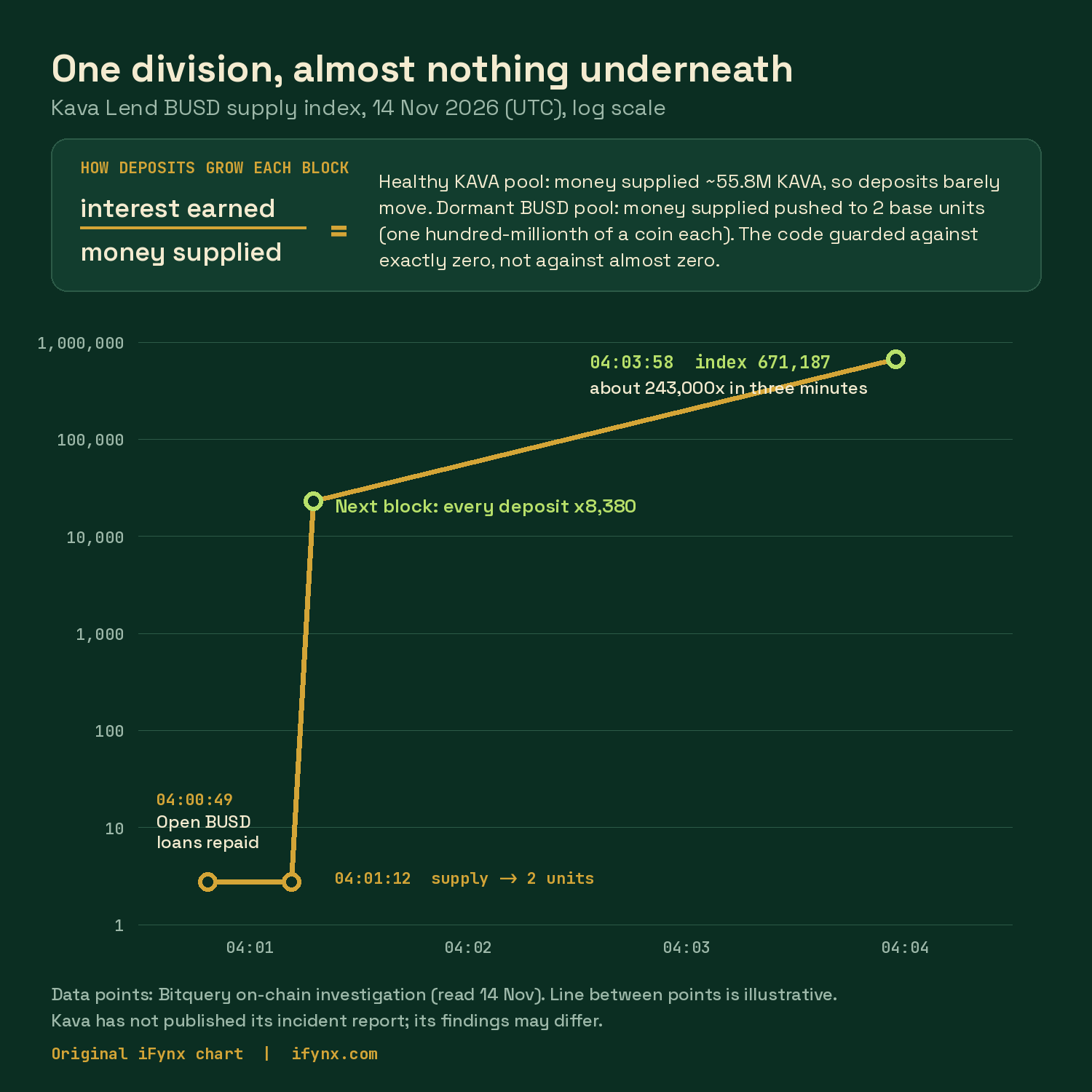
Kava Lend works like most lending apps. Lenders put coins into a shared pool and earn interest; borrowers lock up collateral and take coins out. Each market keeps a supply index: when the index rises, every deposit in that market is worth more. Each block, the protocol adds new interest by dividing the interest earned by the money supplied to the market.
In a busy market, that division gives a tiny number and deposits grow slowly. The BUSD market was not busy. BUSD is an old Binance-branded stablecoin that Paxos stopped minting in February 2023, and Kava Lend’s BUSD market had been left switched on with almost no cash in it. Bitquery says that just before the attack the market owed lenders 440,145 BUSD while holding only 0.003 BUSD in cash, so its books no longer added up.
According to The Block and Bitquery, the attacker pushed the market’s money-supplied figure down to a minute positive number. Kava’s public code skips the division only when that figure is exactly zero, so the protocol kept dividing by almost nothing. Within about three minutes, the BUSD supply index rose roughly 243,000-fold, and a BUSD deposit the attacker had placed earlier was suddenly counted as about 1.25 billion BUSD of collateral (Bitquery puts it at 1.26 billion). The attacker then borrowed KAVA against that inflated collateral 127 times, using a second wallet and the liquidation process to get around Kava Lend’s cap on KAVA borrowing. The Block says the wallets had been testing the BUSD market since 8 November.
Where the coins went
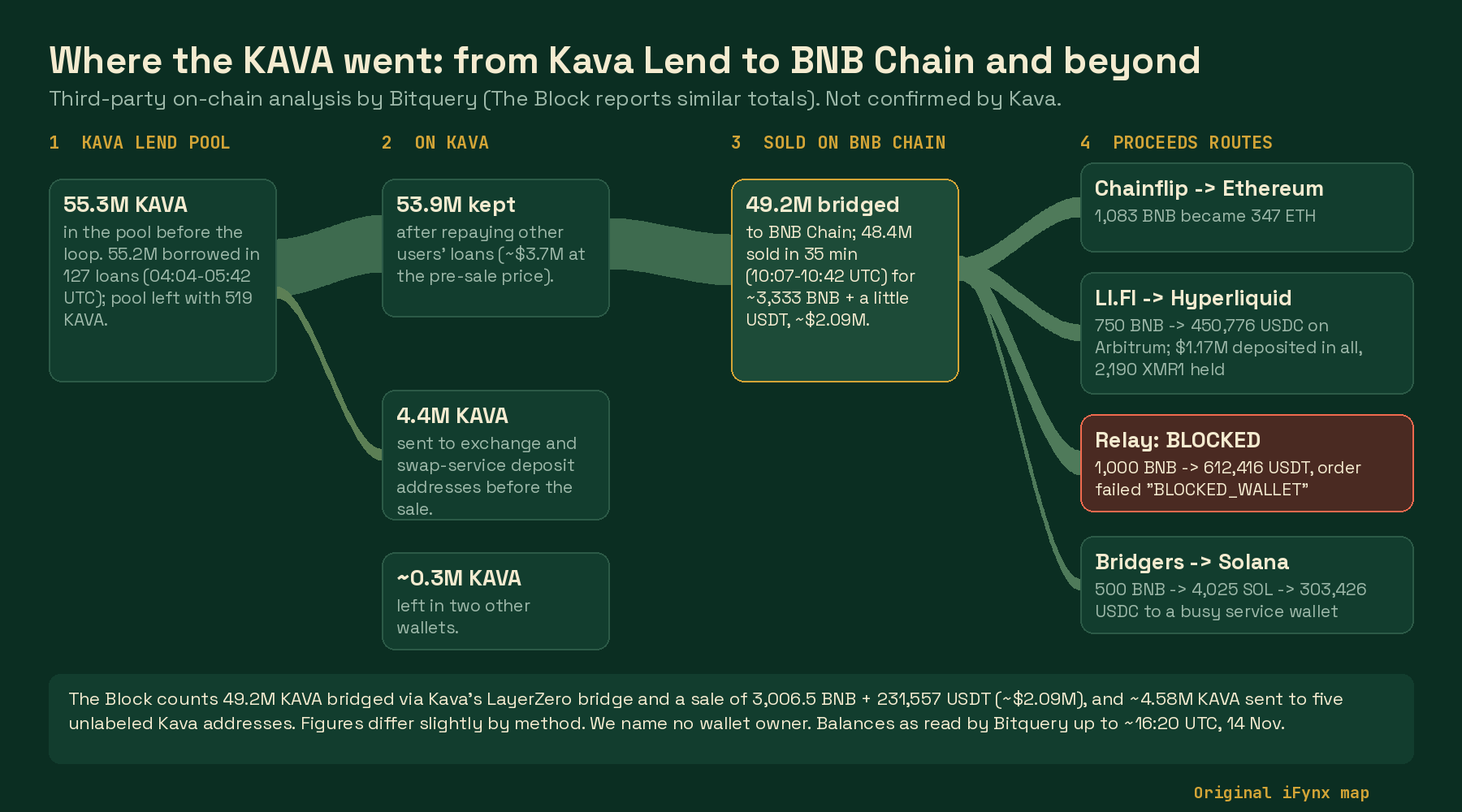
Bitquery followed the money across five chains. The map below summarises its findings; The Block’s totals are close but not identical, because the two count slightly differently.
- On Kava: the two wallets kept about 53.9 million KAVA after repaying other users’ loans. About 4.4 million KAVA went to exchange and swap-service deposit addresses before the sale (Bitquery). The Block separately counts about 4.58 million KAVA sent to five unlabeled addresses.
- To BNB Chain: about 49.2 million KAVA crossed Kava’s LayerZero bridge. Most of it was sold within about 35 minutes, for about 3,006.5 BNB and 231,557 USDT according to The Block, or about 3,333 BNB and a little USDT according to Bitquery, roughly $2.09 million either way.
- After the sale: Bitquery says the BNB left BNB Chain by four routes. The largest share ended up on Hyperliquid, where eight accounts bought a Monero-named token. One route was stopped: the Relay bridge blocked 612,416 USDT, about 29% of the proceeds, with the reason “BLOCKED_WALLET”.
We describe wallets only by what they did. We do not name or guess who controls them.
Why dead markets become attack surface
Nothing about this exploit needed a brand-new trick. It needed a feature nobody was watching. A market for a stablecoin that stopped being minted years earlier, with almost no cash and old reserves on the books, sat inside a live protocol next to a pool holding millions of dollars of KAVA. Bitquery puts the lesson simply: close dead markets, or limit how far an index can move in one block.
The same pattern shows up far outside crypto. A loyalty-points balance nobody reconciles, a legacy wallet currency still enabled in a neobank app, an interest rule for a product that was “retired” but never switched off: each one is still code that can change real balances. The quieter a feature is, the less likely anyone notices when its numbers stop adding up.
The dead-market checklist for Gulf and Egypt fintech, exchange and wallet teams
- List every market, asset and balance type that is still enabled, including ones with no new users. Each one gets an owner.
- Sunset deprecated assets in stages: stop new deposits and borrows first, move to withdraw-only, then remove the code path.
- Set minimum-liquidity floors. If a market’s supply falls below a safe level, freeze interest accrual and borrowing there instead of dividing by a tiny number.
- Guard against “almost zero”, not just zero. Any rate, index or ratio with a denominator needs a sensible lower bound and a test for edge values.
- Cap how far an index can move per block or per hour, and halt the market automatically when the cap is hit.
- Monitor invariants per market: assets on hand plus loans should cover what is owed to depositors. Alert when they diverge.
- Make borrow caps hold under liquidation loops. Test whether repaying or liquidating a position lets someone reopen room under a cap faster than intended.
- Watch collateral that comes from a dormant market. Very large collateral values from a near-empty market should trigger review before a large loan.
- Prepare exchange-side pauses: have a tested switch to stop deposits and withdrawals of a token whose network or app reports an incident, plus a clear notice for users.
- Write user messages before you need them, in Arabic and English: what is affected, what is not, what users should do and when the next update comes.
For exchanges and wallets in the region
Exchanges and wallet providers in the Gulf and Egypt that list or custody third-party tokens are exposed to incidents like this even when their own systems are fine. Teams licensed by, or applying to, regulators such as Dubai’s VARA or ADGM in Abu Dhabi should treat token-network incidents as part of operational risk: keep a written playbook for pausing a single asset, decide in advance who approves the pause, and log the decision. We are not quoting any specific rule here; check the wording that applies to your licence with your compliance team.
A short user notice, in both languages, can look like this:
English: We have temporarily paused [token] deposits and withdrawals while the [network/app] team investigates an incident. Balances held with us are not affected as far as we know. Trading [is / is not] available. We will update you by [time]. We will never ask for your password or seed phrase.
العربية: أوقفنا مؤقتًا إيداع وسحب [العملة] بينما يحقق فريق [الشبكة/التطبيق] في حادثة. حسب علمنا، لم تتأثر الأرصدة المحفوظة لدينا. التداول [متاح / غير متاح]. سنوافيكم بالمستجدات قبل [الوقت]. لن نطلب منكم أبدًا كلمة المرور أو العبارة السرية.
Is KAVA halal or haram?
Many Arabic searches about this incident ask «عملة kava حلال ام حرام». iFynx does not issue religious rulings. Scholars and fatwa bodies hold different views on cryptocurrencies in general, so please ask a qualified scholar or the fatwa authority you follow. The facts that may help that conversation: KAVA is the native coin of the Kava blockchain, and Kava Lend, the app that was exploited, is a lending service where borrowers pay interest that is passed on to lenders. Holding a coin and lending it through an interest-paying app are different activities, and the risks of this incident sit mainly with Kava Lend’s lenders.
For related reading, see how a front-end hijack hit users in our Across Protocol hack briefing, what wallet operators did after the LNbits hack, the login lessons from the Keplr wallet incident, how a legacy product leaked data in the Gnosis Pay breach, and the withdrawal questions in our Binance hack coverage.
How iFynx can help
Retire what you no longer use
Your quietest feature can be your biggest risk.
iFynx builds and maintains fintech, wallet and ledger software for companies in the Gulf, Egypt and Palestine. After the Kava Lend exploit, we can help you:
- Software Development: API & Backend Engineering: review interest, balance and collateral logic for edge cases such as near-zero denominators, and add hard limits on how fast an index can move.
- Maintenance & Growth: Software Maintenance: find and retire dormant markets, assets and features safely, and set up invariant monitoring and alerts.
- Quality Assurance: test edge values, liquidation loops and pause switches before attackers do.
Frequently asked questions
What happened to Kava Lend?
On 14 November 2026 an attacker borrowed about 55.2 million KAVA from Kava Lend, the lending app on the Kava blockchain, in about 98 minutes, according to on-chain analysis by The Block and Bitquery. Kava confirmed the event was contained within Kava Lend and said it will publish a full incident report.
Was it an infinite mint?
No. Kava said “This is not an infinite mint.” On-chain analysis agrees: the coins came out of Kava Lend’s existing pool of deposits rather than being newly created.
How much was taken?
Kava has not published a figure. The Block estimates about 55.2 million KAVA, roughly $3.76 million at the pre-attack price of $0.068. Most of it was sold on BNB Chain for about $2.09 million, and Bitquery says the Relay bridge blocked 612,416 USDT of the proceeds.
Will Kava Lend users be reimbursed?
Kava has not said. Its last update, on 14 November, said a complete incident report would follow. Bitquery’s analysis says the pool owes lenders about 55.2 million KAVA and held almost none when checked.
Why are dormant markets dangerous?
A market nobody uses can drift into a state the code was never tested for, such as almost no cash and old reserves on the books. In Kava Lend’s case, analysts say a near-empty BUSD market let an interest calculation divide by almost nothing. Freezing or removing dead markets, and capping how fast an index can move, closes that door.
Sources and update policy
Checked on 15 November 2026 (03:55 Asia/Gaza): Kava official X posts of 14 November at 11:28 UTC, 12:01 UTC and 14:05 UTC, the latest at the time of checking; The Block, Kava Lend loses roughly $3.8 million to hack, 14 November 2026; Bitquery, Kava hack investigation, on-chain figures read up to about 16:20 UTC on 14 November; The Defiant, Kava Lend exploit report; PANews, analysis summary, 15 November 2026. On-chain figures are third-party analysis, not confirmed by Kava, and Kava’s own report may describe the cause differently. This article is not investment, legal or religious advice. We will update it when Kava publishes its incident report or a reimbursement plan.
Related reading
- Across Protocol Hack: How a Registrar Social-Engineering Attack Turned across.to Into a Wallet Drainer, and the Domain Hijacking Checklist Gulf and Egypt Crypto Apps Need
- LNbits Hack: Team Urges All Operators to Stop Servers After Attacks
- Trezor CryptoBilis Implant: What Trezor Confirmed About Tampered Safe 5 Wallets, What Firmware 2.13.1 Fixes, and How to Buy a Hardware Wallet Safely in the Gulf and Egypt