Direct answer — 11 November 2026: The Across Protocol hack was a domain hijacking, not a smart-contract exploit. In its own post on X, Across says that at about 18:45 UTC on 10 November “a social engineering attack on @Namecheap (our domain registrar) gave a bad actor control of the Across domain”. For a short time, across.to served a phishing site. Across says it was alerted within 15 minutes, SEAL911 flagged the site to major wallets, and Cloudflare pulled the domain’s DNS records, so the fake site is offline. According to Across, no API users or third-party integrations were affected, and people who used the real frontend before the attack are safe. Users who visited across.to in that window should revoke the approvals they granted that day on revoke.cash and DM Across on X. Across says “all affected users will be made whole”. Those services later returned: Across said at 01:16 UTC on 11 November that it is “fully restored, and all systems are operational”.
Update, 11 November 2026, 03:16 Asia/Gaza
Across said in a post on X at 01:16 UTC (03:16 Asia/Gaza) that it is “fully restored, and all systems are operational”: across.to is back under its control, and all Across systems are working normally. It thanked Namecheap founder @synth for responding on X, helping secure the account and opening an investigation. In a follow-up at 02:26 UTC, Across said integrators were not affected and all services are fully restored. Affected users should still DM Across on X; Across says they will be made whole. Users who visited across.to during the attack window should still revoke approvals granted that day on revoke.cash. Across also said that if a phishing warning still appears in a wallet or browser, it should clear soon.


This iFynx briefing is for crypto exchanges, wallets, bridges, fintechs and banks in Saudi Arabia, the UAE, Egypt and the wider region. Every one of them depends on a domain name and on one account at a registrar, and that account is the part attackers went after here. We read Across’s posts on X shortly before publishing (01:00–01:30 Asia/Gaza, 11 November), along with Cointelegraph, TechFlow and PANews coverage and the public reports on last month’s Name.com hijacks. Each claim below is credited to its source. Loss figures posted by individual users are unconfirmed and labelled that way. We give no attack steps.
Key facts (checked 11 November 2026, before publishing)
- What happened, per Across: a social-engineering attack on its registrar, Namecheap, at about 18:45 UTC on 10 November (21:45 Riyadh, 22:45 Dubai, 20:45 Cairo) gave an attacker control of across.to. The domain then served a phishing (“malware”) site.
- First warning: Across’s alert at 19:05 UTC: “Do NOT visit the app, connect your wallet, or sign any transaction or approval there until further notice.”
- Containment, per Across: alerted within 15 minutes; SEAL911 marked across.to as phishing with major wallets; Cloudflare marked the domain as at risk and later pulled its DNS records. The phishing site is no longer available.
- Not affected, per Across: third-party integrations, API users, and anyone who used the real frontend before the attack. Across has not reported any smart-contract compromise.
- Restored, per Across (11 November, 01:16 UTC): Across said it is “fully restored, and all systems are operational”, across.to is back under its control, and all systems are working normally. In a follow-up at 02:26 UTC it said integrators were not affected and all services are fully restored. At 22:13 UTC on 10 November, Across had said its frontend and API would stay down and that Namecheap “has been unresponsive”; that account was later superseded. When we first checked Namecheap’s X account, it had posted nothing about Across.
- Victims: DM Across on X with transaction details; “all affected users will be made whole”. Revoke approvals granted on 10 November.
- Losses: Across has not published a figure. User claims on X (for example 9,000 USDC; 7,053 USDT0 on Plasma; 25 ETH) are unverified.
- Second registrar-level DeFi attack in about ten days: on 30–31 October, 12 DeFi sites registered at Name.com served the Step Drainer kit (Blockaid, via The Block).
What happened to Across Protocol and across.to?
Across is a cross-chain bridge: users connect a wallet on across.to and move tokens between networks. At 19:05 UTC on 10 November, its account on X posted a short alert telling users not to visit the app, connect a wallet or sign anything there. About three hours later, at 22:13 UTC (00:14 Asia/Gaza on 11 November), Across explained the cause. In its words, “a social engineering attack on @Namecheap (our domain registrar) gave a bad actor control of the Across domain.”
Across says its team was alerted within 15 minutes and “immediately worked to shut the site down”. SEAL911, a volunteer security emergency group, marked across.to as a phishing site with major wallets. Cloudflare “worked with us to mark the domain as at risk, and later pulled the site’s DNS records.” By the time of that post, Across said, the domain was fully down and the phishing site was gone.
Across adds: “In the brief period before Cloudflare fully blocked the malware site, some users who visited across.(to) may have been affected.” It also says: “Across’s domain was fully locked down with best-in-class security practices; this unauthorized takeover should not have been possible,” and promises a post-mortem “on how this domain takeover was possible”. Across has not said what form the social engineering took or which registrar controls were in place. We will not guess.
One more line mattered at the time for anyone running a business on a domain. In its 22:13 UTC post on 10 November, Across said: “Despite our best efforts, @Namecheap has been unresponsive, and we have not been able to properly secure the domain to bring Across’s services back up.” That was Across’s account then, and it has since been superseded. At 01:16 UTC on 11 November, Across thanked Namecheap founder @synth for responding on X, helping secure the account and opening an investigation. At the time we first checked (around 23:10 UTC on 10 November), Namecheap’s X account had posted nothing about the incident, and we have still not found a public statement from Namecheap itself.
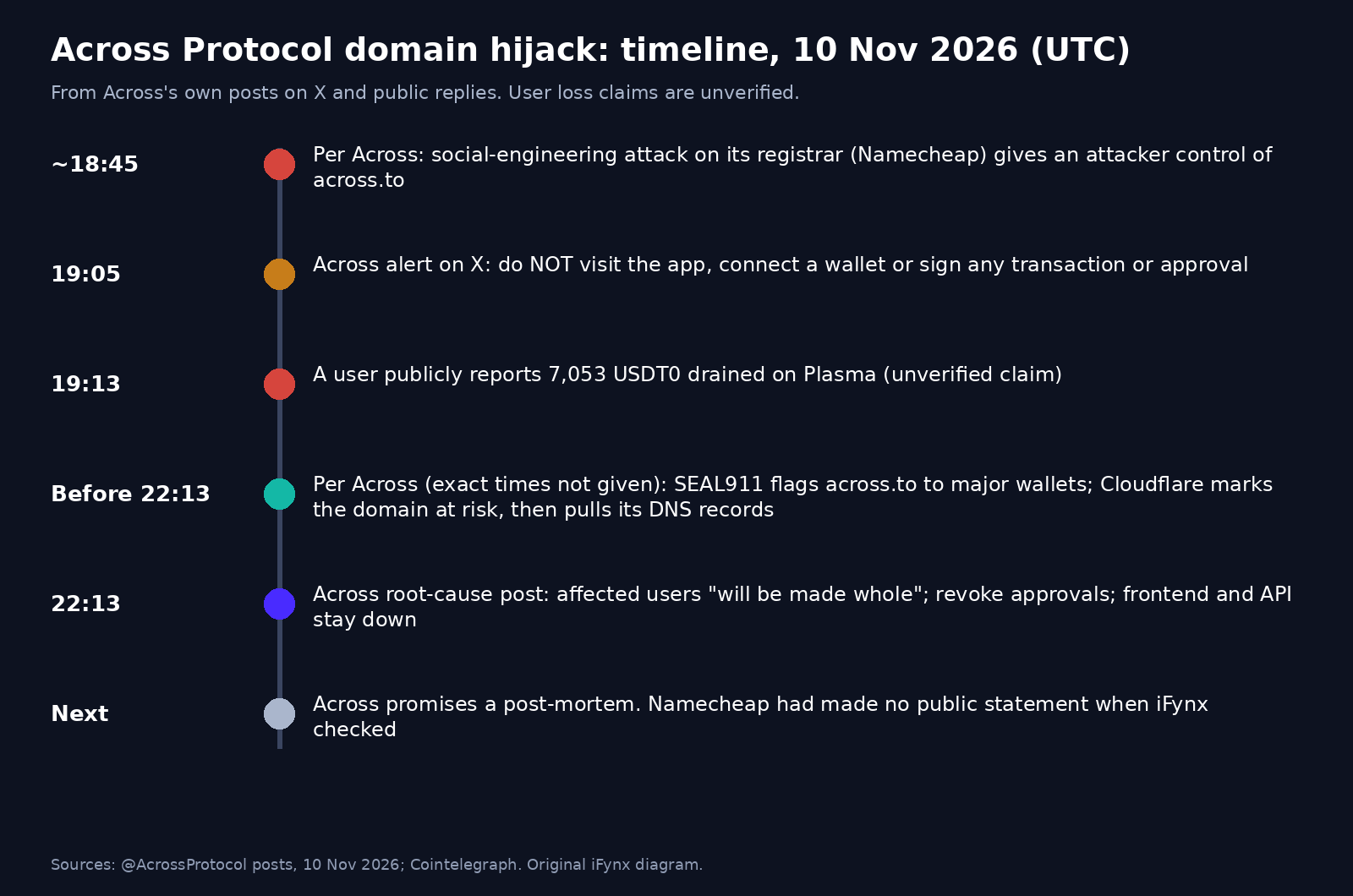
Timeline: what Across says happened
Times are UTC, on 10 and 11 November 2026. They come from Across’s posts and from public replies to them.
- ~18:45 — per Across, the social-engineering attack on Namecheap gives an attacker control of across.to.
- 19:05 — Across’s first alert: do not visit the app, connect a wallet or sign.
- 19:13–19:14 — one user publicly reports seven transfers of 7,053.46 USDT0 out of their wallet on Plasma (unverified).
- 19:30–21:40 — Across replies to users who report losses, asking for transaction details and moving to DMs.
- 22:13 — Across’s root-cause thread: registrar social engineering, SEAL911 and Cloudflare containment, compensation promise, frontend and API kept down.
- 11 November, 01:16 — Across says it is “fully restored, and all systems are operational”; across.to is back under its control; it thanks Namecheap founder @synth for responding on X, helping secure the account and opening an investigation.
- 11 November, 02:26 — Across says integrators were not affected and all services are fully restored.
What was and was not affected
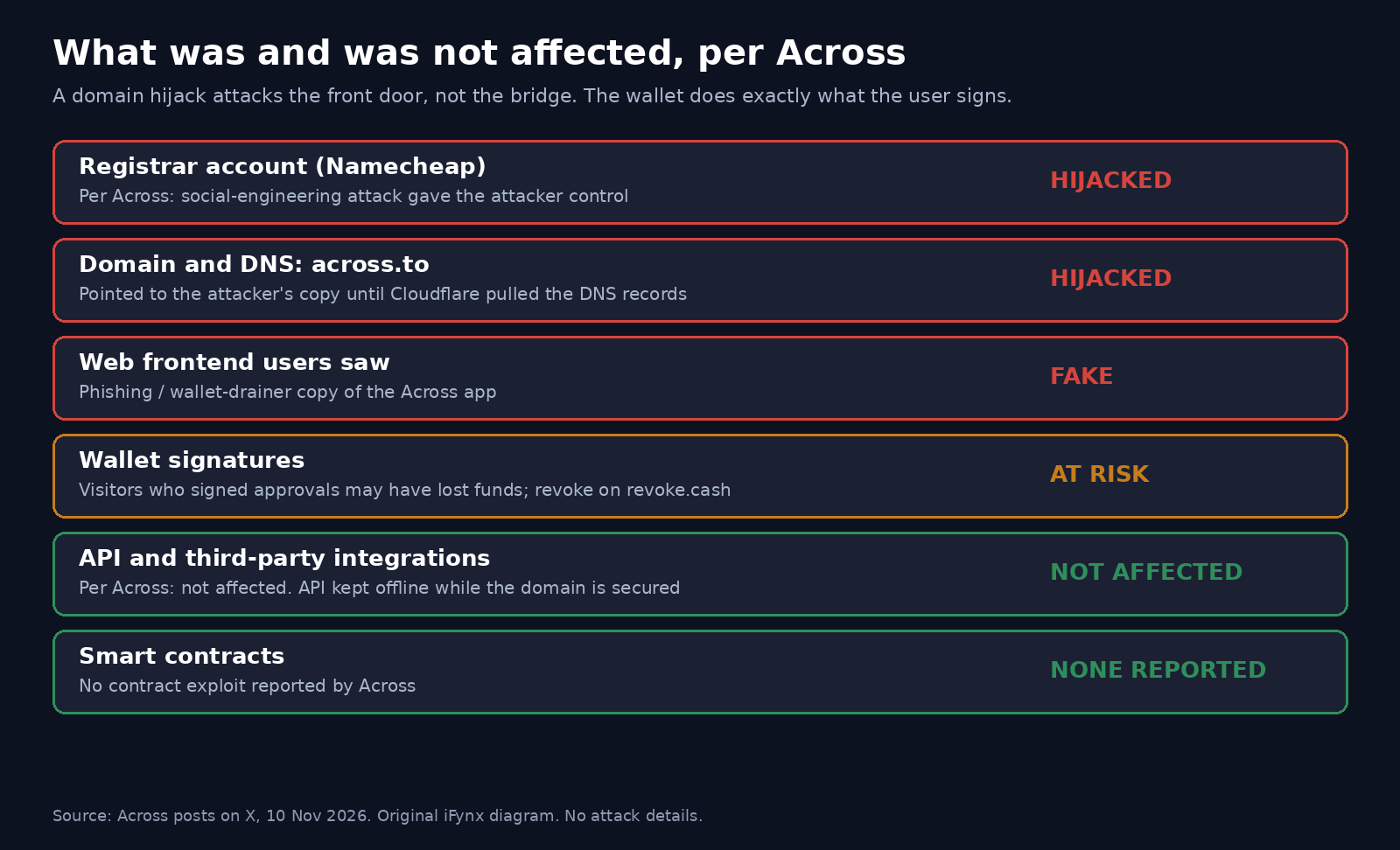
According to Across, the attack lived at the domain layer. The attacker controlled where across.to pointed, so the “Across” page a visitor loaded was the attacker’s copy. A wallet drainer like this does not need to break a bridge contract. It asks the visitor to sign an approval or a transfer that hands tokens to the attacker, and the wallet then does exactly what was signed. The AInvest analysis of the first alert put it this way: the risk was “the front door, not the bridge”.
What Across says was not affected: “No third-party integrations or API users were affected,” and “Users who previously visited the Across frontend (before this attack) or used our API or a 3rd party integration are NOT affected and are completely safe.” The API was taken offline as a precaution while the domain was being secured, not as a sign that the API was abused. Across later said, at 01:16 UTC on 11 November, that all systems are operational and, at 02:26 UTC, that all services are fully restored.
About the losses. Across has not published a total, and nor will we. On X, one user said 9,000 USDC was drained, another reported 7,053 USDT0 on Plasma, and a third claimed 25 ETH. Cointelegraph said it had not independently verified those reports, and we have not either. Aggregate totals circulating on social media are unconfirmed.
I connected my wallet to across.to on 10 November. What now?
Across’s own advice comes first: if you visited across.to “in the last few hours” around the attack and think you were affected, DM @AcrossProtocol on X with your transaction details, and go to revoke.cash “with the wallet you used to connect and revoke any permissions granted today”. On top of that, iFynx suggests these steps:
- Stop signing. Do not use across.to again until Across says on its verified account that the domain is safe.
- Revoke approvals you granted on 10 November, on every chain you used, with the same wallet. Revoking stops future pulls. It does not undo a transfer that already happened.
- Move what is left to a fresh wallet if you signed anything you do not recognise (an approval, a “permit” signature or a batch transaction). Some signatures can be used later, so a fresh wallet is the safer choice.
- Write down the evidence: wallet address, chain, transaction hashes and the time you visited. Across asks for these.
- Beware of “support” scams. Fake Across support accounts, “refund” links and “recovery” services follow incidents like this. Only use the verified @AcrossProtocol account. No real support team needs your seed phrase.
- Tell your exchange if stolen funds may reach it. Exchanges in the region can sometimes flag deposits from known attacker addresses.
Mobile wallet users: the same rules apply. If your phone is also behind on updates, see our guide to the iOS worse_query vulnerability, which Binance flagged to iPhone crypto users.
Why bookmarks and the padlock did not help
A bookmark saves a name, not a server. When the attacker controls the domain, the saved link still resolves to the attacker’s server, so the bookmark opens the fake site. The padlock does not help either. Whoever controls a domain can usually get a valid TLS certificate for it, because certificate authorities check control of the domain, not who the “real” owner is. The address bar read across.to because it really was across.to.
So domain hijacking is different from the scams most users are trained to spot:
| Attack | What the attacker controls | Does the URL look right? | Main defence |
|---|---|---|---|
| Domain hijacking (this case) | The real domain, via the registrar account or registry | Yes, it is the real name | Registry lock, registrar account security, monitoring |
| DNS hijack at the DNS provider | The DNS records, but not the registration | Yes | DNS provider MFA, change alerts, DNSSEC |
| DNS cache poisoning | Answers cached by a resolver | Yes, for affected users | DNSSEC validation, patched resolvers |
| Typosquatting / look-alike domain | A different, similar name | Almost (one letter off) | Bookmarks, wallet warnings, takedowns |
That is why the defence has to sit with the company, not the user. Wallet warnings (SEAL911’s role here) and fast takedowns limit the damage. Only the domain owner can make the takeover itself harder.
Ten days earlier: the Name.com Step Drainer wave
This is the second registrar-level attack on DeFi frontends in about ten days. On the night of 30–31 October, 12 DeFi websites registered at Name.com, including Kintsu, Flap, Pickle Finance and Origami Finance, served copies loaded with a drainer kit sold as “Step Drainer”, according to Blockaid via The Block. On the day, The Block traced about $138,000 to three EVM wallets. Its count left out Solana and Aptos. Bitquery later counted $202,386 taken from 32 wallets on six chains and noted that “every drain we traced used a victim’s own signature”. Bitquery found the sites used four different DNS providers. The registrar was the one thing they shared. How the records were changed in that case has not been publicly established.
Two different registrars, two different attacks, and the same lesson: the weakest link of a well-audited protocol can be an ordinary web account. We saw the same pattern with the Keplr wallet incident, where the trouble came from a login provider, not the chain.
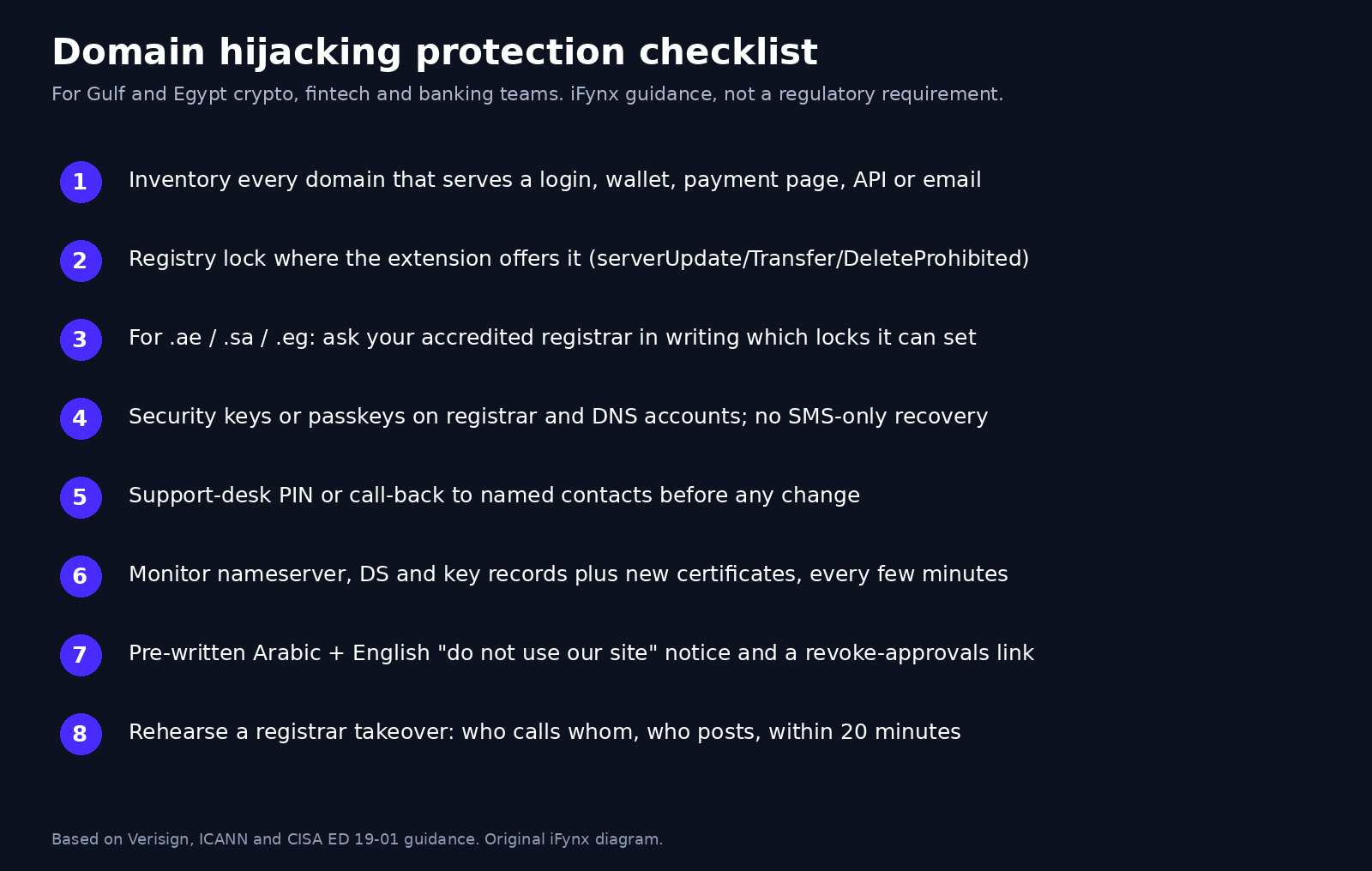
Domain hijacking protection checklist for Gulf and Egypt crypto and fintech teams
Exchanges, wallets and payment apps regulated by VARA, the DFSA, ADGM’s FSRA, SAMA, the CBUAE or Egypt’s FRA and CBE all publish their login and signing pages on a domain. We would treat the registrar account as a production system, with the same controls as your cloud console. Our checklist:
- Inventory your critical domains. List the main site, the app and login domains, payment pages, API hostnames and the email domain. For each one, note the registrar, the account that holds it, and the people who can change it.
- Use registry lock where the extension offers it. A registry lock puts server-level statuses (serverUpdateProhibited, serverTransferProhibited, serverDeleteProhibited) on the domain at the registry. Changes then need an out-of-band check between your registrar and the registry. A stolen password is not enough. Verisign offers this for .com and .net and explains how to check the status in Whois. ICANN explains each status code.
- For .ae, .sa and .eg, ask your accredited registrar in writing what locks it can set. We found no public registry-lock product from the UAE’s .aeDA or Saudi Arabia’s SaudiNIC, and no public lock documentation for .eg. At a minimum, turn on the client transfer, update and delete locks your registrar supports.
- Protect the contact email. The .aeDA FAQ says the domain password recovery service sends the password to your registered email address. SaudiNIC’s transfer procedure asks the administrative contact to approve a transfer. It also lets a transfer go through if the losing registrar does not respond within five days. Use a monitored role mailbox, ideally on a different domain, and keep the contact details current.
- Use phishing-resistant MFA on the registrar and DNS accounts. That means security keys or passkeys, not SMS. CISA’s Emergency Directive 19-01 on DNS tampering recommends exactly this for accounts that can change DNS. Remove former staff and agencies.
- Close the support-desk path. Across names social engineering at the registrar. Ask your registrar whether it can require an account PIN or passphrase, or a call-back to named contacts, before any change. Get that rule confirmed in writing.
- Know what DNSSEC and CAA do and do not do. DNSSEC protects answers from tampering in transit, and CAA limits which certificate authorities may issue for your name. Both help against some attacks. Neither stops someone who controls the registrar account and can change the nameservers, which is why item 2 comes first.
- Monitor from the outside. Alert on any change to nameservers, DS records or key A/AAAA/CNAME records, and on registrar security emails. Watch Certificate Transparency logs for new certificates on your domains. Check every few minutes, not daily.
- Prepare the “do not use our site” notice now, in Arabic and English. Across’s first alert went out about 20 minutes after the takeover. Write yours in advance, agree who can post it, and plan how it reaches users: X, Telegram, email, push notifications and an in-app banner.
- Design signing screens that show the spender. Show which contract will receive an approval and for how much, in plain Arabic and English. Prefer exact-amount approvals to unlimited ones. Keep a revoke page or a revoke.cash link in your help centre.
- Do not let the API share the frontend’s fate. Across took its API down while the domain was at risk. Put critical API hostnames under the same locks and monitoring, and consider a separate domain for them.
- Rehearse it. Run a one-hour drill: the registrar account is taken over at 23:00 on a Thursday. Who calls the registrar, Cloudflare or your DNS provider, and the wallet-warning groups? Who posts the notice? Where is the list of approvals to tell users to revoke?
If you hold a licence, check what your incident-reporting rules say about a hijacked customer-facing domain. Users who lose money to a fake copy of your site will see it as your incident, whatever the root cause.
What this means for exchanges, banks and users in the region
For users in the UAE, Saudi Arabia and Egypt, the simple rule is that a protocol’s warning on its verified accounts outranks the address bar. If a project says “do not sign”, even the real domain may not be safe. For product teams, the costs of a hijack (lost funds, compensation, days of downtime, a regulator asking questions) far exceed the cost of a registry lock and a few security keys. Custody failures still dominate the headlines, as our coverage of the Binance hack and the Mercado Bitcoin hack shows. But domains, logins and email are now a common way in, as with the exploited Outlook zero-day patched this week and the MCP server security problems we covered last week.
How iFynx can help
iFynx builds and maintains web and mobile products for crypto, fintech and other regulated companies in the Gulf, Egypt and Palestine, in Arabic and English. Through Software Maintenance in our Maintenance & Growth service, we can audit your domains, registrar and DNS accounts. We then set up locks, phishing-resistant MFA and outside-in monitoring, and write the incident runbook and the bilingual “do not use our site” notice. Our Quality Assurance team tests signing flows and incident banners before you need them. If you are building a wallet, bridge or payment app, our Product Design and API & Backend Engineering teams design signing screens that show the spender and amount clearly, and keep critical APIs separate from your marketing domain. Contact us for a free 30-minute review of your domain setup.
Frequently asked questions
Was Across Protocol hacked, or just its website?
According to Across, its domain was hijacked. A social-engineering attack on its registrar, Namecheap, gave an attacker control of across.to, and the domain briefly served a phishing site. Across has not reported any smart-contract exploit. It says API users, third-party integrations and people who used the real site before the attack were not affected.
I connected my wallet to across.to on 10 November. What should I do?
Stop signing, and revoke the approvals you granted that day on revoke.cash with the same wallet, as Across advises. DM the verified @AcrossProtocol account on X with your transaction details. If you signed anything you do not recognise, move your remaining funds to a fresh wallet. Across says all affected users will be made whole. Ignore anyone offering paid “recovery”.
What is domain hijacking, and how is it different from DNS poisoning or typosquatting?
Domain hijacking means taking control of the real domain, usually through the registrar account, so the genuine name points to the attacker. DNS cache poisoning tricks resolvers into caching false answers. Typosquatting uses a different, look-alike name. In a hijack the address is correct, which is why bookmarks and the padlock do not protect users.
How do I protect my company’s domain from hijacking?
Use registry lock where your extension offers it, and turn on registrar transfer and update locks. Protect the registrar and DNS accounts with security keys, and require a PIN or call-back for support-desk changes. Keep the contact email secure and current. Monitor nameserver and record changes from outside, and have an Arabic and English incident notice ready.
Will Across refund users who lost funds?
Across says “all affected users will be made whole” and asks affected users to DM it on X with transaction details. It has not published a total loss figure or the details of how compensation will work. Across later said it is fully restored and all systems are operational, and it has promised a post-mortem.
Sources and update policy
Read on 10–11 November 2026 (first before 01:30 Asia/Gaza, then re-checked around 07:00 Asia/Gaza): Across’s posts on X, the first alert, the root-cause post, the follow-up on revoking approvals, the 01:16 UTC restoration post and the 02:26 UTC integrators follow-up; Cointelegraph via TradingView; TechFlow; PANews; The Block and Bitquery on the Name.com hijacks; Verisign Registry Lock status; ICANN EPP status codes; CISA ED 19-01; the .aeDA FAQ and SaudiNIC transfer procedure. Namecheap itself had made no public statement when we first checked, and we have still not found one. Loss amounts posted by individual users are unverified. The checklist is iFynx guidance, not a regulatory requirement. We will update this article when Across publishes its post-mortem, Namecheap comments, or a verified loss figure appears.
Related reading
- Keplr Wallet Hack: Web3Auth Incident Hits Some Google and Apple Login Accounts — What Users Should Do Now
- iOS worse_query Vulnerability: Binance Warns Crypto Users. Update to iOS 27.2.1 and Protect Your Seed Phrase
- Outlook Zero-Day CVE-2026-124194: November 2026 Patch Tuesday and What to Patch First in Gulf and Egypt Companies
- Mercado Bitcoin Hack: Brazil's Largest Crypto Exchange Halts Withdrawals After a Reported $40M Drain. Is Your Money Safe on an Exchange in the UAE, Saudi Arabia or Egypt?
- Kava Lend Exploit Explained: How a Dormant BUSD Market Let an Attacker Borrow 55.2M KAVA, What Kava Has Confirmed, and the Dead-Market Checklist for DeFi and Fintech Teams
- Old Bitly Links Hijacked: Why Brands' Old Short Links Opened Unrelated Pages, and How to Audit Yours Today