Breach explainer · 15 November 2026
Coinone was not hacked directly. Its customer-support contractor, MetaM, was. Personal details that customers gave in Coinone chat or phone support may have been taken, including, for some people, passwords, resident registration numbers and bank account numbers.
Coinone, a South Korean crypto exchange, says an outside attacker got into MetaM’s server at around 04:00 Korea time on 12 November (21:00 on 11 November in Gaza). It says its own account, trading and wallet systems run separately and show no sign of a direct break-in, and that every login still needs an OTP or KakaoTalk confirmation. Only customers who have used Coinone’s support are affected. Neither company has said how many people are affected, or which other MetaM clients were hit.

At iFynx we build exchanges, wallets, banking apps and the support tools behind them for companies in the UAE, Saudi Arabia, Egypt and Palestine. This breach matters well beyond Korea, because it did not start in the exchange’s core systems. It started in the support desk, where customers type their most sensitive details to get help. Below: what Coinone and MetaM have confirmed, what is still unknown, what Coinone users should do today, and a support-desk data checklist for exchanges and fintechs in the Gulf and Egypt. We re-checked Coinone’s notice, Yonhap’s report on MetaM’s notice, Chosunbiz, SBS and Korean security press on 15 November 2026 at about 13:00 Asia/Gaza. We describe no attack technique, because none has been published and the investigation is ongoing.
Key facts: known and not yet known
| Confirmed by Coinone or MetaM | Not disclosed yet |
|---|---|
| Who was breached: MetaM (메타엠), the outside firm running Coinone’s customer support. Coinone’s notice says MetaM’s server was accessed. | How many people: no victim count from Coinone or MetaM. |
| When: about 04:00 KST on 12 November. Coinone learned of it at about 09:20 KST the same day. | Other MetaM clients: MetaM says only some of its clients were affected and that it has notified them, but it has not named them. |
| What: details customers gave in chat or phone support, up to 11 kinds of data. The exact items differ by person. | How and when it really started: under investigation. MetaM says some services saw abnormal access even before 12 November. |
| Not hit, per Coinone: member accounts, trading and crypto wallets, which run separately. No sign of direct intrusion so far. | Misuse: no reports of theft from accounts so far. Coinone warns of phishing and voice-phishing. |
| Reported to: KISA, the Personal Information Protection Commission and the Financial Supervisory Service. | Lookup tool: Coinone says it is preparing a service so each customer can see their own exposed items. |
How the breach unfolded
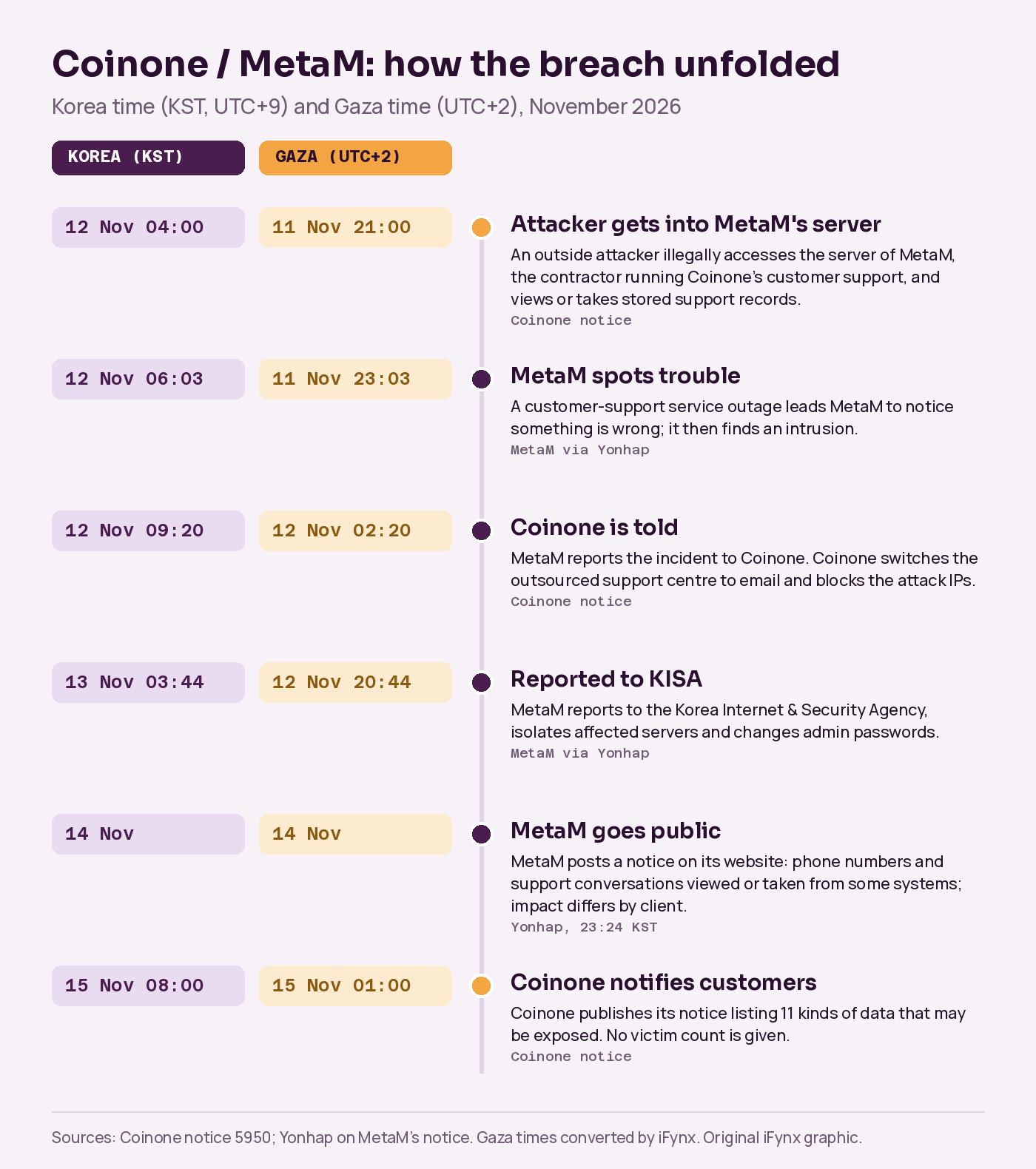
The timeline comes from two notices. Coinone gives the time of the intrusion and when it was told. MetaM’s own notice, reported by Yonhap, gives the time it noticed a problem and when it reported to KISA.
- 12 Nov, about 04:00 KST (11 Nov, 21:00 Gaza): an outside attacker illegally accesses MetaM’s server and views or takes stored support records, according to Coinone.
- 12 Nov, 06:03 KST (11 Nov, 23:03 Gaza): a customer-support service outage makes MetaM notice that something is wrong. It then finds an intrusion.
- 12 Nov, about 09:20 KST (12 Nov, 02:20 Gaza): MetaM reports the incident to Coinone. Coinone blocks the attack IPs and access to the support centre, and switches outsourced support to email only.
- 13 Nov, 03:44 KST (12 Nov, 20:44 Gaza): MetaM reports to KISA. It isolates affected servers, separates its development network, limits some client connections and changes admin passwords.
- 14 Nov: MetaM posts a notice saying phone numbers and support conversations were viewed or taken from some of its systems. Yonhap reported it at 23:24 KST (16:24 Gaza).
- 15 Nov, 08:00 KST (15 Nov, 01:00 Gaza): Coinone publishes its customer notice.
One caveat on the start time. According to DailySecu’s report on MetaM’s notice, MetaM says some of its services saw abnormal access and lookups even before 12 November. The first intrusion time, the route in and the total scale are all still under investigation, so 04:00 on 12 November is the confirmed access time, not necessarily the start.
What may have leaked, and what was not touched
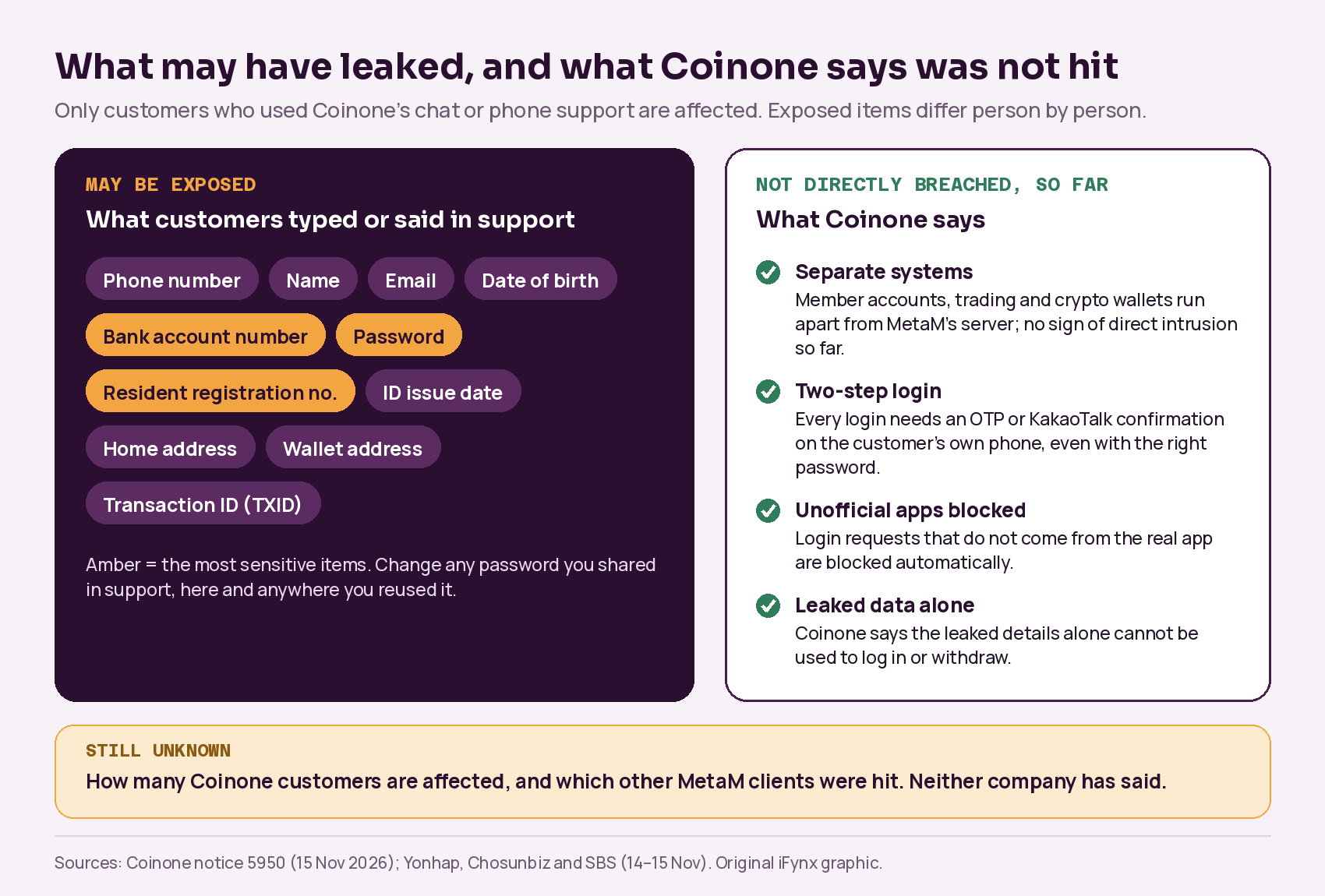
Coinone lists every item that may have been exposed: the phone number used for support, name, email, date of birth, bank account number, password, resident registration number, ID issue date, home address, wallet address and transaction ID (TXID). It stresses that this is the full list of what *might* have leaked. People shared different things in different conversations, so each person’s exposure is different. Customers who never contacted support are not affected.
The passwords are the uncomfortable part. They are in the list because some customers typed or read out their password during a support conversation, and it was then stored with the transcript. That is exactly the kind of data a support desk should never hold.
Can someone take my coins with this data?
According to Coinone, not with the leaked details alone. It says every login needs a second step, an OTP or a KakaoTalk confirmation on the customer’s own phone, even when the password is right. Login requests that do not come from the official app are blocked automatically. Coinone says its account, trading and wallet systems are separate from MetaM’s server, with no sign so far that they were breached.
The bigger risk is people, not systems. Someone who knows your name, phone number, ID number and what you asked support about can make a very convincing call or message. Coinone’s notice warns specifically about voice-phishing, phishing emails, spam texts and identity theft. It also says that calls or messages mentioning your past support conversation may be impersonation.
What Coinone users should do now
These steps come from Coinone’s notice, plus standard advice for any exposed identity data:
- Change any password you ever shared in support. Change it on Coinone and on every other site where you used the same password.
- Never give a password, OTP or verification code to anyone. Coinone says it will never ask for these by phone, text or email, and will never ask you to withdraw crypto or change a wallet address.
- Treat “we’re calling about your support ticket” as a red flag. Hang up and contact Coinone through the official app.
- Check your withdrawal address book in the app (Deposits/Withdrawals > address book). Use the account lock feature if anything looks wrong.
- Don’t open links or attachments in unexpected texts or emails, even if they quote your details correctly.
- Watch for Coinone’s lookup service, then check which of your items were exposed. If your resident registration number or bank account was among them, watch for identity misuse.
- Know your rights in Korea. Coinone’s notice says customers who suffer losses can claim damages, or statutory damages of up to 3 million won without proving the exact loss, under the Personal Information Protection Act and the Credit Information Act.
If you hold crypto through any exchange, in the Gulf, Egypt or anywhere else, the general lesson is simple: never type a password or recovery phrase into a support chat. A real support agent does not need them. If you move larger amounts to self-custody, our guide on how to buy a hardware wallet safely covers the checks that matter. Our explainer on government impersonation scams and banking-app defences in the UAE shows how callers use leaked details to sound official.
Why support chats became the weak point
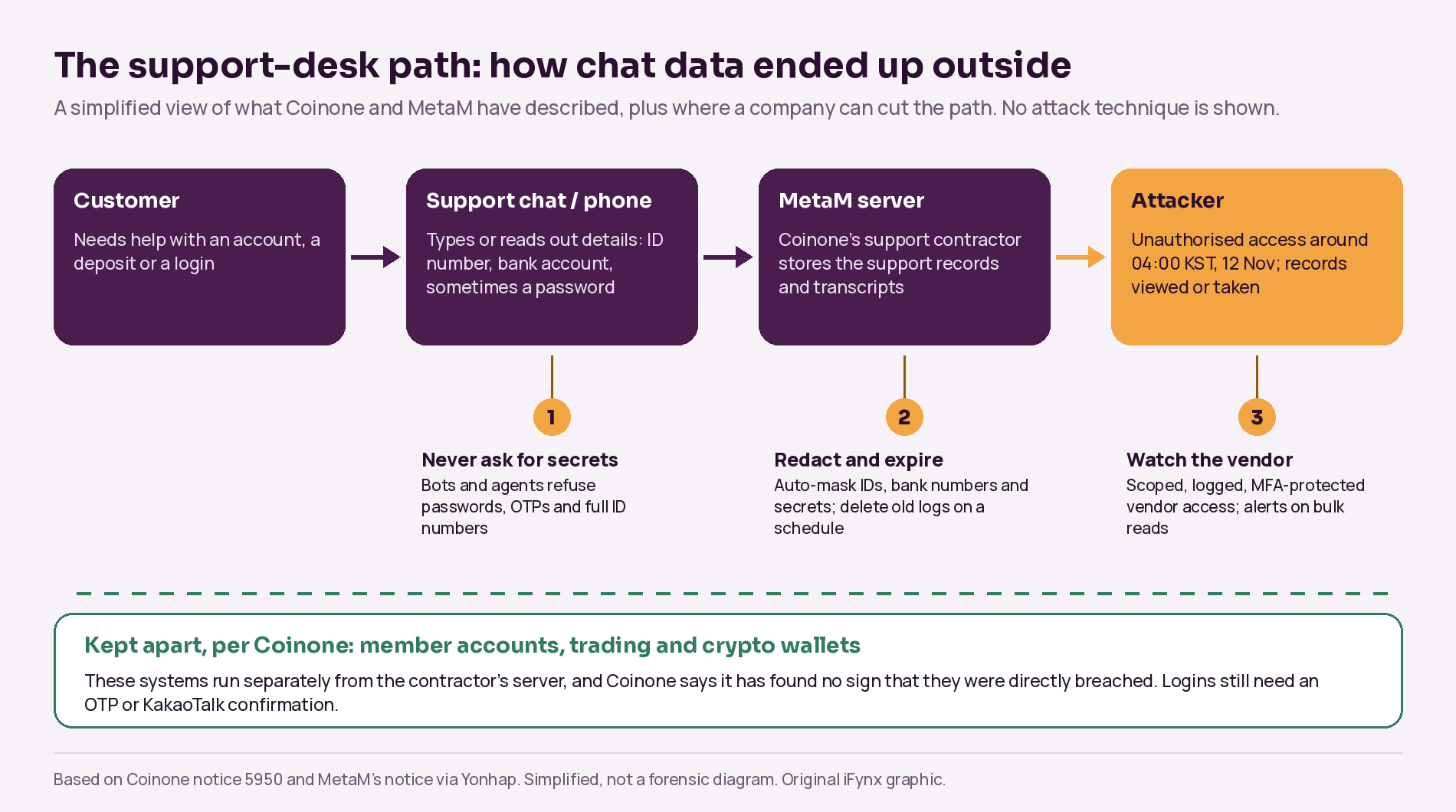
Exchanges spend heavily on protecting wallets and logins, but the support desk sits outside that perimeter and still collects sensitive data all day. Customers paste ID numbers to prove who they are, bank details to chase a deposit, and sometimes a password because they are locked out and stressed. If transcripts are stored in full, kept for years and reachable by an outside contractor’s systems, the support desk becomes the easiest copy of customer identity data to steal.
This is not the first time. In May 2025, Coinbase told the US SEC that criminals had paid “multiple contractors or employees working in support roles outside the United States” to collect customer data from its internal systems. Coinbase said passwords and private keys were not involved, and estimated costs of about $180 million to $400 million. Its filing with the Maine Attorney General put the number of affected customers at 69,461. The method was different from Coinone’s: bribed insiders there, a server intrusion here. The weak point was the same, though: the support layer. We covered a different Coinbase exposure, through a third-party analytics tool, in our Coinbase data breach and analytics SDK checklist. The Gnosis Pay legacy card breach showed the same pattern with old systems nobody was watching. And Coinone was in our coverage just yesterday as one of the Korean exchanges that paused KAVA transfers after the Kava Lend exploit.
Egypt’s support desks and Gulf brands
This story is close to home for our region. Egypt is one of the region’s biggest outsourcing hubs, and much of the Arabic customer support for Gulf companies is answered from Cairo and Alexandria. According to ITIDA, Egypt’s IT industry development agency, the country’s offshoring sector counts 252 companies across 282 delivery centres, employing more than 195,000 specialists. When Alshaya Group opened its Cairo talent centre, ITIDA said it serves 16 markets across the Middle East and North Africa, including contact centre work.
None of this means Egyptian contact centres are less secure. MetaM is a Korean company, and according to Green Economy Daily it has said it ran contact centres for about 200 client companies. One provider can hold the support history of hundreds of brands. It means that a Gulf exchange or fintech’s customer data often sits in a partner’s tools, in another country and under another company’s security. When you outsource the conversation, the data travels with it. Your contract, access controls and retention rules have to go with it too.
The support-desk data checklist for Gulf and Egypt exchanges and fintechs
- Map where support data lives: the chat widget, ticketing system, call recordings, email inbox, the vendor’s own servers and any backups. You cannot protect a copy you do not know exists.
- Refuse secrets by design: bots and agents should block passwords, OTPs and recovery phrases, detect them automatically and warn the customer before they are sent.
- Redact at the point of entry: mask Emirates ID, Saudi national ID or Iqama, Egyptian national ID numbers, IBANs and card numbers in transcripts and recordings, so full values are never stored.
- Verify identity in the app, not in the chat: send an in-app confirmation instead of asking for documents or ID numbers in the conversation.
- Set short retention: delete or anonymise transcripts on a fixed schedule, and keep vendors to the same rule.
- Lock down vendor access: single sign-on with MFA, one named account per agent, IP or device restrictions, no bulk export, and only the fields each role needs.
- Alert on bulk reads: log every transcript view and export, and alert when an account or server reads far more records than normal.
- Keep support away from money: support tools must never change withdrawal addresses or approve withdrawals. Address changes need in-app confirmation and a cooling-off period.
- Put it in the contract: breach notice from the vendor within hours, a list of sub-processors, data location, audit rights and deletion at the end of the contract.
- Rehearse the breach notice: a bilingual Arabic and English notice template, a self-service “was I affected?” lookup and an agent script for the scam calls that follow.
- Plan for insiders: monitoring, background checks and limited data views for agents. The Coinbase case shows a bribe can work where a hack would fail.
Breach notification clocks in the UAE, Saudi Arabia and Egypt
If a support vendor leaks your customers’ data, the legal clock usually starts when you become aware. In outline (this is not legal advice):
| Country | Law | Notify the regulator | Notify customers |
|---|---|---|---|
| Saudi Arabia | PDPL Implementing Regulation, Article 24 | SDAIA within 72 hours of becoming aware, if the breach may cause harm | Without undue delay, if it may cause harm |
| Egypt | Law No. 151 of 2020, Article 7 | The Personal Data Protection Centre within 72 hours | Within three days of notifying the Centre |
| UAE | Federal Decree-Law No. 45 of 2021, Article 9 | The UAE Data Office (the “Bureau” in the law) on becoming aware, within the period set by the Executive Regulations | Within the period set by the Executive Regulations |
The UAE law also says a processor, such as an outsourced support vendor, must tell the controller as soon as it becomes aware of a breach. Free zones such as DIFC and ADGM have their own data protection laws, and sector regulators such as central banks may add their own reporting rules. Check with counsel which apply to you.
How iFynx can help
Support desks that don’t leak
Your support desk shouldn’t hold a better copy of your customers’ identities than your vault does.
iFynx designs, builds and maintains exchanges, wallets, fintech apps and the support tooling around them for companies in the Gulf, Egypt and Palestine. We can help you:
- Software Development: API & Backend Engineering: automatic redaction of IDs, IBANs and secrets in chat pipelines, scoped vendor APIs, audit logs and bulk-read alerts.
- Software Development: Web Development: in-app identity checks and secure support widgets that refuse passwords and OTPs before they are sent.
- Maintenance & Growth: Software Maintenance: retention jobs, access reviews, patching and a ready bilingual breach-notice and lookup flow.
- Maintenance & Growth: Quality Assurance: tests that prove secrets are masked and that support tools cannot touch withdrawals.
Frequently asked questions
What happened in the Coinone data breach?
An outside attacker got into the server of MetaM, the contractor running Coinone’s customer support, at around 04:00 Korea time on 12 November 2026. Coinone says support records were viewed or taken, including details customers gave in chat or phone support. Coinone was told the same morning and published its notice on 15 November.
Can hackers log in or withdraw my crypto with the leaked data?
Coinone says no, not with the leaked details alone. Every login needs an OTP or KakaoTalk confirmation, unofficial apps are blocked, and its account and wallet systems are separate from the contractor’s server. The real risk is scam calls and messages that use your details to sound genuine.
How do I know if I was affected?
Only customers who used Coinone’s chat or phone support are affected, and exposed items differ by person. Coinone says it will tell customers through separate notices or a lookup service it is preparing. If you ever shared a password in support, change it now on Coinone and anywhere you reused it.
Who is MetaM, and were other companies affected?
MetaM is a Korean customer-support outsourcing company. It has said it ran contact centres for about 200 client companies. It says only some clients were affected and it has notified them, but it has not named them. Neither company has given a victim count.
What should exchanges in the Gulf and Egypt learn from this?
Treat the support desk as part of your security perimeter. Refuse passwords and OTPs in chat, mask ID and bank numbers, keep transcripts briefly, give vendors minimal and logged access, and keep support tools away from withdrawals. Know your clocks: 72 hours in Saudi Arabia and Egypt.
Sources and update policy
Checked on 15 November 2026 at about 13:00 Asia/Gaza: Coinone, notice on the personal data leak (Korean, posted 08:00 KST 15 November); Yonhap, report on MetaM’s notice (Korean, 14 November); Chosunbiz, Contractor hack exposes Coinone customer data; SBS, Coinone customer personal info leaked due to third-party vendor hack; DailySecu, MetaM support system hack (Korean); Green Economy Daily, MetaM hack and other clients (Korean). Coinbase precedent: Coinbase Form 8-K, 14 May 2025 and the Maine Attorney General breach filing. Laws: Saudi PDPL Implementing Regulation (SDAIA), Egypt Law No. 151 of 2020 (ILO NATLEX translation), UAE Federal Decree-Law No. 45 of 2021. Egypt outsourcing: ITIDA, outsourcing sector overview and Alshaya Cairo centre. Gaza times converted by iFynx.
We will update this article when Coinone or MetaM gives a victim count, names other affected clients, opens the lookup service or publishes the cause. We do not publish attack techniques.
Related reading
- Coinbase Data Breach via Amplitude: What Leaked, What Didn't, and the Analytics SDK Checklist for Gulf and Egypt Apps
- Gnosis Pay Breach: Legacy Crypto Card Data Exposed, Funds Unaffected — User and Fintech Protection Checklist
- 64,000 Bitcoin Miners Hijacked: What Happened to 13 EH/s, Is Luxor Commander to Blame, and How to Lock Down Your ASIC Fleet
- SBI Data Breach: What the FIR Says About the Hack at SBI's Global IT Centre, and What Customers and Gulf NRIs Should Do Now