Correction 17 Nov 2026, 20:05 Asia/Gaza: an earlier version said we found no SBI notice to affected customers. That was wrong. In an advisory on 23 October 2026, also posted on SBI’s official X account, SBI said it had individually informed all customers whose data was identified, by email and WhatsApp (report). If you got no such message, SBI has not identified your record, but the impersonation advice below still applies. We have corrected the article.

At iFynx we build and maintain loan, onboarding and KYC software for banks and fintechs in the UAE, Saudi Arabia, Egypt and Palestine. This case shows how much damage one store of application forms can do. Below: what to do now if you bank with SBI, including from the Gulf; what the different numbers mean; the timeline; how to spot an impersonation call; and a checklist for securing loan and KYC document stores. We re-checked SBI’s filing, its official X account and the Indian press reports on 15 November 2026 at about 19:05 Asia/Gaza (17:05 UTC). We include no dark-web links or leaked data.
What to do now if you bank with SBI
- Treat any “SBI” call, SMS, WhatsApp or email as suspect, even if it knows your name, date of birth, branch or loan application. Hang up and call back on a number you look up yourself.
- Never share an OTP, PIN, password or card CVV, and never install an app or share your screen because a caller asks. SBI says it never asks for these by call, SMS or email.
- Check the sender. SBI says its emails come only from @sbi.co.in and its SMS headers are SBIINB, SBIPSG or SBICRD, not 10-digit mobile numbers.
- Turn on transaction alerts in YONO or internet banking and review recent activity. Report anything you did not make at once.
- Report scams to report.phishing@sbi.co.in and to India’s cybercrime portal, cybercrime.gov.in, or helpline 1930 from an Indian number. If you are in the UAE, also see our guide to UAE online fraud and how to report it.
- If you applied for a loan or opened an account recently, assume a copy of your form could be in criminal hands. Watch for new loans or SIM swaps in your name.
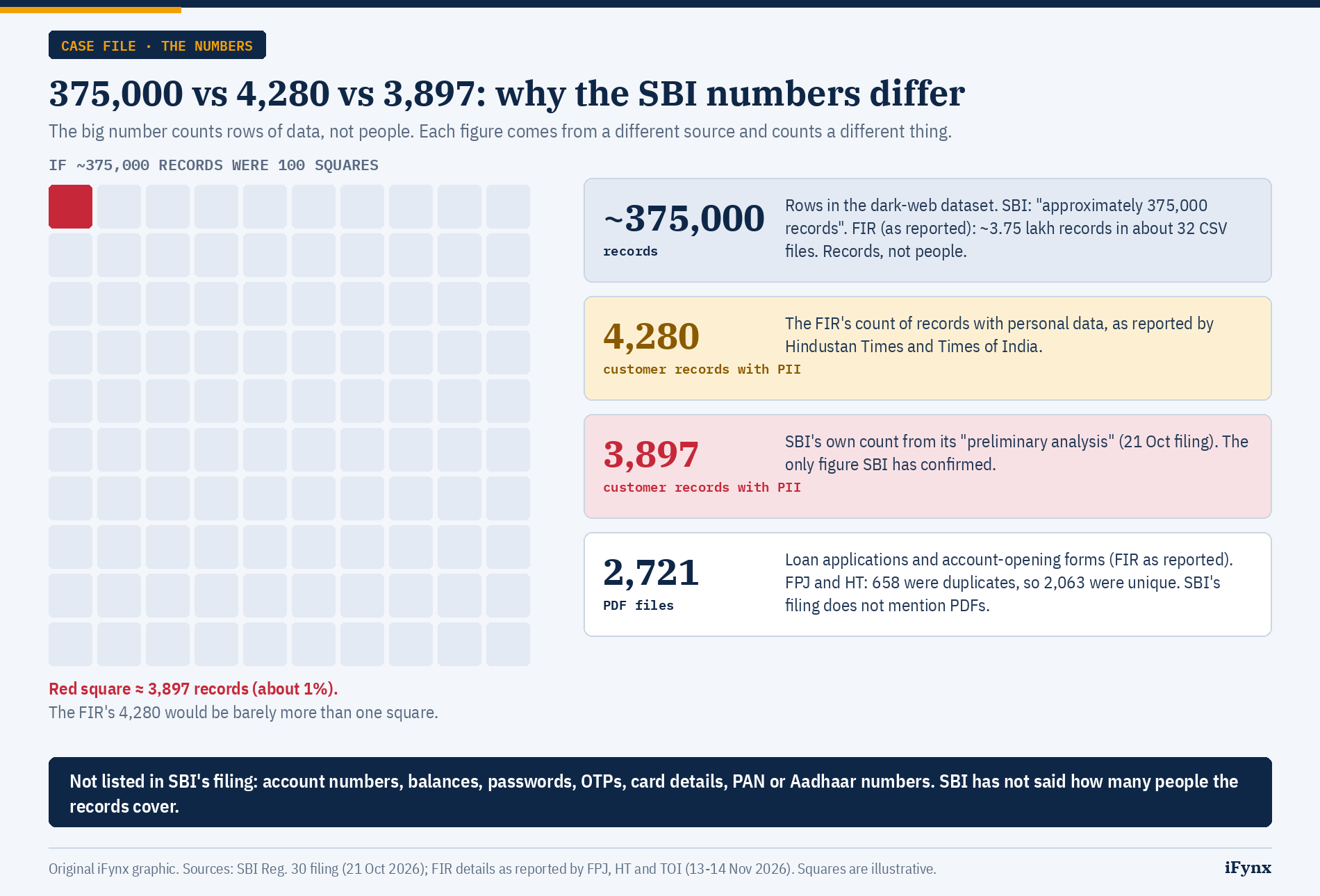
The numbers explained: 375,000, 4,280 and 3,897
Headlines say “3.75 lakh customers”. That is not what the sources say. Each figure counts something different:
Key facts
| Figure | Source | What it counts |
|---|---|---|
| ~375,000 (3.75 lakh) | SBI filing; FIR as reported | Records (rows of data) in the dark-web set, in about 32 CSV files. Not people. |
| 4,280 | FIR, as reported by Hindustan Times and Times of India | Customer records with personally identifiable information (PII) |
| 3,897 | SBI’s Reg. 30 filing, 21 Oct 2026 | Customer records with PII found in SBI’s “preliminary analysis”. The only figure SBI has confirmed. |
| 2,721 | FIR, as reported by FPJ and HT | PDF files, including loan applications and account-opening forms; 658 were duplicates. SBI’s filing does not mention them. |
| Unknown | None | How many people are affected, and whether they have been told |
The 3,897 records are about 1% of the 375,000. SBI has not said whether they belong to 3,897 different people, or what the rest of the set contains.
From intrusion to FIR: the timeline
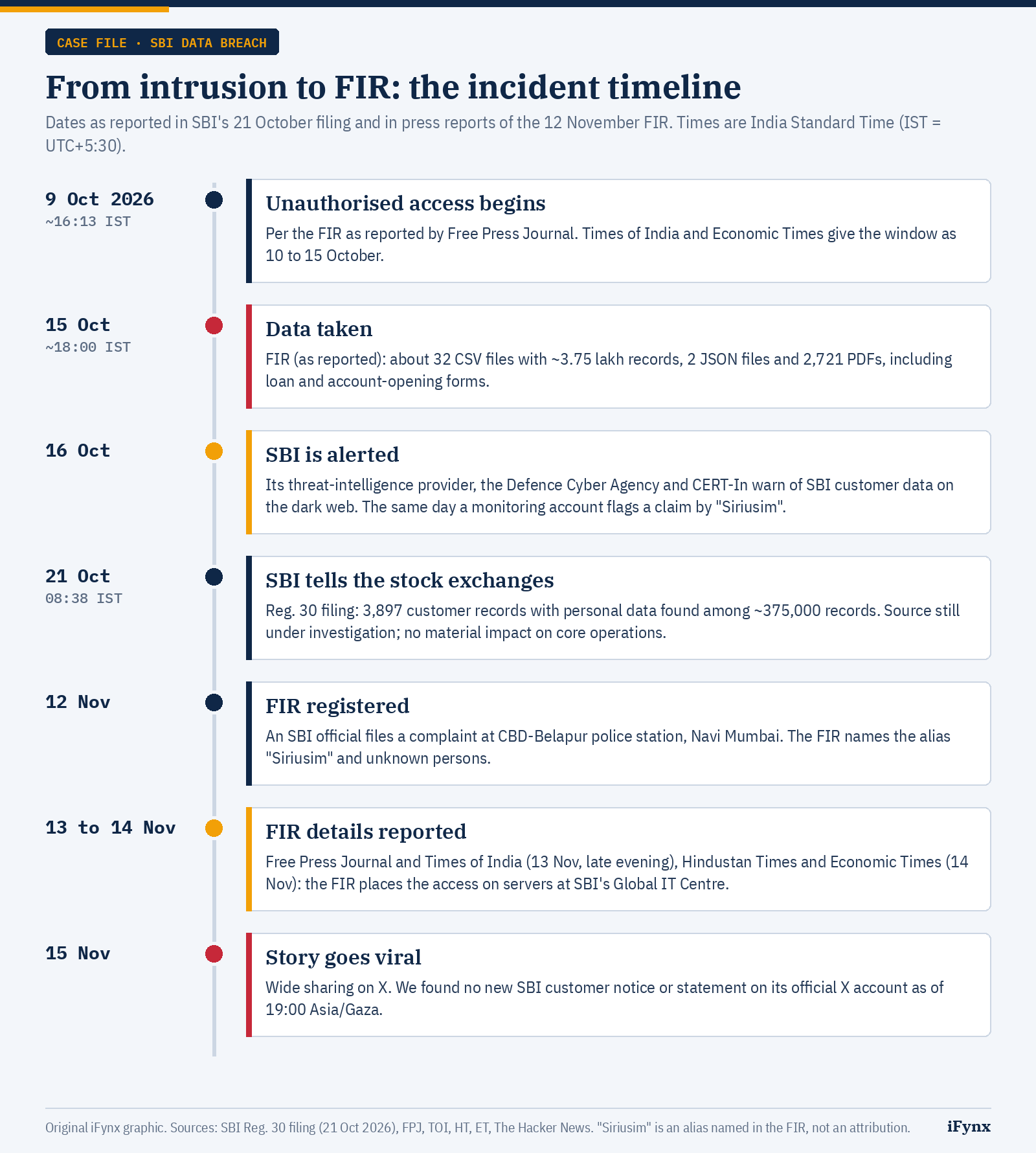
- 9 October, about 16:13 IST: unauthorised access to the Global IT Centre server begins, according to the FIR as reported by Free Press Journal. Times of India and Economic Times give the window as 10 to 15 October.
- 15 October, about 18:00 IST: data is taken. FPJ reports it came from two applications, UNO 2.0 and RAAS.
- 16 October: SBI is alerted by its threat-intelligence provider, India’s Defence Cyber Agency and CERT-In. The same day, a monitoring account on X flags a claim by a group calling itself “Siriusim”, according to the Internet Freedom Foundation and The Hacker News.
- 21 October: SBI files a Regulation 30 disclosure with BSE and NSE. It says it activated its incident response and hired an independent CERT-In-empanelled agency to investigate.
- 12 November: an SBI official registers an FIR at CBD-Belapur police station. Police invoked theft and conspiracy sections of India’s criminal code and sections of the IT Act.
- 13 to 14 November: FPJ and Times of India (late on 13 November), then Hindustan Times and Economic Times on 14 November, report the FIR. It places the access on SBI’s own servers, which the October filing had left open.
- 15 November: the story spreads widely on X. SBI’s official X account had posted nothing about it as of 19:05 Asia/Gaza.
What was exposed, and what was not listed
SBI’s filing says the exposed data “reportedly included” registered mobile numbers, dates of birth, names, gender, email addresses, residential addresses, branch and CIF identifiers, lead IDs, and metadata linked to loan and lead records.
The FIR, as reported, adds loan application records and account-opening forms in PDF files. Free Press Journal, which examined a few sample records posted with the listing, reported that they carried KYC fields. That covers only a handful of records and is not confirmed by SBI.
Not in SBI’s list: account numbers, balances, passwords, OTPs, card details, or PAN and Aadhaar numbers. That does not prove they are absent from the PDFs, and the Internet Freedom Foundation has asked SBI to say whether KYC documents such as Aadhaar, PAN or passport copies were exposed.
Who is “Siriusim”? Only an alias. The FIR names “an individual or hacker group operating under the alias ‘Siriusim'” along with unknown persons. No one has been publicly identified, and we make no attribution beyond that.
How to spot an SBI impersonation call or message
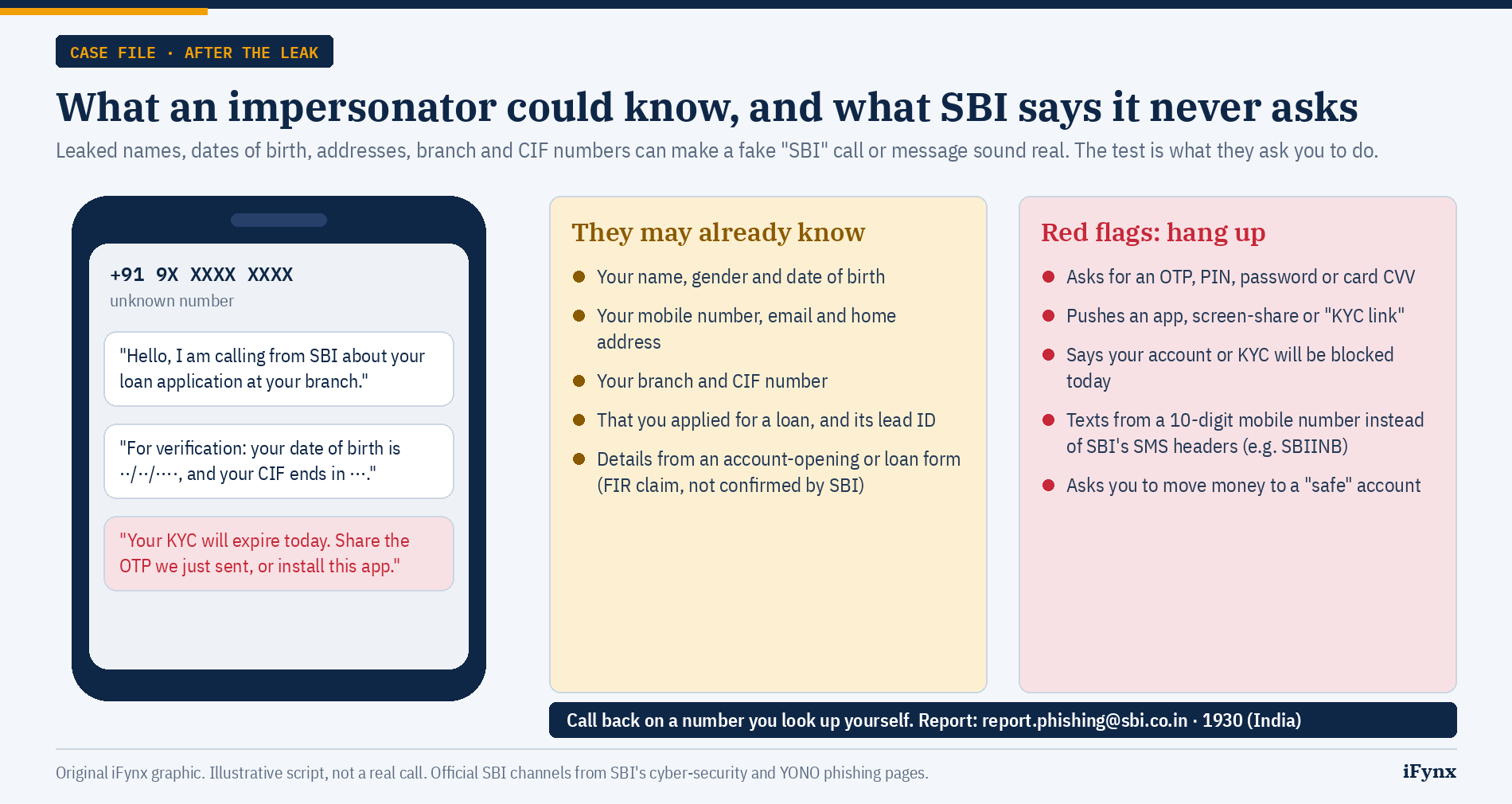
With a name, date of birth, branch and CIF number, a fraudster can sound exactly like a bank officer. The tell is not what they know, but what they ask for.
- Hang up if they ask for an OTP, PIN, password, CVV, a screen-share, an app install or a “KYC update” link.
- Hang up if they rush you: “your account will be blocked today” is a classic pressure line.
- Hang up if they ask you to move money to a “safe” or “verification” account.
- Call back on a number from SBI’s website or the back of your card, never one the caller gives you.
If you have already shared details or clicked a link, SBI’s own guidance is to call customer care, lock access through YONO or internet banking and report at once. SBI’s phishing page lists +91 80 2659 9990 among its helpline numbers, which can be dialled from abroad.
Gulf NRIs: what this means for you
The FIR concerns servers at SBI’s Global IT Centre in India. No report says SBI’s overseas branches or their systems were involved. The data described is the kind collected for loan leads and account opening in India, so the people most exposed are customers of SBI in India. That includes many non-resident Indians (NRIs) living in the Gulf who keep SBI accounts or loans at home.
SBI’s own pages show its Gulf presence: a DIFC branch in Dubai, regulated by the DFSA and focused on trade and corporate banking; a wholesale bank and a retail branch in Bahrain; and a Muscat branch in Oman listed on its NRI remittance page. SBI’s 2019-20 annual report says it closed its Jeddah branch in Saudi Arabia.
For NRIs, the practical risks are:
- Scams to your Indian mobile number, often over WhatsApp, citing your branch, loan application or CIF number.
- Fake “NRI KYC” or “NRE account freeze” messages that push you to a link or an app.
- Fraud in your name in India, such as new loan applications, if copies of KYC documents were in the PDFs.
The advice is the same as above. Remember that 1930 is an Indian helpline: from the Gulf, use cybercrime.gov.in, report.phishing@sbi.co.in and SBI’s internationally reachable helpline. Also report local scam calls to the police in your country of residence.
Is SBI safe? What SBI, the police and experts say
- SBI: the incident “does not have any material impact” on its core business operations, financial performance or business continuity (21 October filing). That statement is about the bank’s business, not about customer risk.
- Police: a senior police inspector told Times of India that bank officials said they had removed the data from the dark web and “ensured that it had not been misused”.
- Experts: cyber lawyer Prashant Mali told Times of India that hackers might still have sold the data, and that SBI customers “need to be extra vigilant” about phishing.
- Customer notice: SBI said on 23 October that it had individually informed all customers whose data was identified, by email and WhatsApp. India’s DPDP Act breach-notice duties take effect on 13 May 2027, according to IFF.
Your deposits are not reported to be at risk from this incident. Banks cannot simply be “wiped”, as we explained in our 17 November rumour fact check. The risk is social engineering.
Checklist: securing loan and KYC document stores at Gulf and Egypt banks and fintechs
Loan-origination and lead-management apps collect ID copies, salary slips and application forms. Many leads never become customers, but their documents stay. This is the same lesson as the Coinone support-contractor breach and the Coinbase analytics leak: sensitive data piles up where nobody is watching.
| Control | Why it matters | What to do |
|---|---|---|
| Data minimisation | Every extra field is extra exposure | Collect only what the product needs; do not keep full ID scans when a verified flag will do |
| Short retention for unconverted leads | Lead data is the bulk of most leaks | Auto-delete documents from leads that do not convert within a set period |
| Encrypt and tokenise document stores | A copied file should be useless | Encrypt PDFs and images at rest with per-tenant keys; tokenise ID numbers in databases |
| Least-privilege service accounts | One account should not read everything | Scope app and integration accounts to the records they need; no shared admin logins |
| Egress and bulk-export alerts | Theft looks like a big export | Alert on bulk CSV, JSON or PDF downloads and unusual outbound volume from loan and KYC systems |
| Segment lead and loan apps | Front-office tools are easier to reach | Keep lead and loan tools apart from core banking; restrict admin access to managed devices |
| Dark-web and brand monitoring | You may hear about a leak from outsiders first | Monitor for your brand, sample records and staff credentials; rehearse what you do in the first hour |
| Breach-notice clocks | Deadlines start when you become aware | Saudi PDPL: notify SDAIA within 72 hours. Egypt Law 151 of 2020: notify the Data Protection Centre within 72 hours and affected people within 3 working days. UAE federal PDPL: the deadline awaits executive regulations; DIFC requires notice “as soon as practicable”. Confirm with counsel |
| Customer-notice UX in Arabic and English | Silence fuels scams | Prepare SMS, email and in-app notices and a “check if I am affected” page before you need them |
| Anti-impersonation banner | Scammers move fast after a leak | Show an in-app banner listing what you will never ask for, and a one-tap way to report a call |
How iFynx can help
For more on breaches in payment and crypto services, see our explainer on the Gnosis Pay breach.
Frequently asked questions
Was SBI really hacked?
SBI confirmed “an incident involving the loss of certain data” in a 21 October 2026 stock-exchange filing. A police FIR filed by an SBI official on 12 November says unknown persons accessed servers at SBI’s Global IT Centre between 9 and 15 October and stole files. SBI says core operations were not affected.
What data was stolen in the SBI breach?
SBI’s filing lists names, mobile numbers, dates of birth, gender, email and home addresses, branch and CIF identifiers, lead IDs and loan-lead metadata. The FIR, as reported, adds 2,721 PDFs including loan applications and account-opening forms. The filing does not list account numbers, passwords, OTPs or card details.
Were 3.75 lakh SBI customers affected?
No source says that. About 375,000 is the number of records in the leaked set, not people. SBI found 3,897 customer records with personal data in its preliminary analysis, and the FIR reportedly counts 4,280. SBI has not said how many people are affected.
Is my money in SBI safe?
No reports say money was taken from accounts in this incident, and SBI says its core operations were not affected. The main risk is fraud: callers or messages that use your real details to get an OTP, PIN or payment. Never share these, and call SBI back on a number you look up yourself.
How do I know if my SBI data was leaked?
SBI has not announced a lookup tool, but on 23 October it said it had individually informed every customer whose data was identified, by email and WhatsApp. If you applied for an SBI loan or opened an account recently, act as if your details may be exposed: watch for impersonation, enable alerts and report suspicious contacts to report.phishing@sbi.co.in.
Sources and update policy
Checked on 15 November 2026 at about 19:05 Asia/Gaza (17:05 UTC): SBI’s Regulation 30 filing of 21 October 2026; SBI’s official X account (no breach-related post found since 16 October); Times of India, Economic Times, Hindustan Times, 14 Nov and Free Press Journal on the FIR; Hindustan Times, 21 Oct (Internet Freedom Foundation comments); The Hacker News; SBI’s cyber-security page and phishing guide; SBI’s Gulf pages for DIFC, Bahrain and foreign branches, and its 2019-20 international operations report; breach-notice rules from Compliance Colleague’s Gulf notification table and an English translation of Egypt’s PDPL. FIR details are as reported by the press; we have not seen the FIR itself. Gaza and UTC times converted by iFynx.
We will update this article if SBI publishes a customer notice, a lookup tool or the investigation’s findings, or if police name a suspect. We do not link to leaked data or describe attack techniques.
Related reading
- Coinone Data Breach: A Support Contractor Hack Exposed What Users Typed Into Support Chats — What to Do Now, and the Support-Desk Data Checklist for Gulf and Egypt Exchanges
- UAE Online Fraud: Inside the Dh1 Million Government-Impersonation Scam Dubai Police Reversed, and the Anti-Scam Features UAE Banking Apps Should Ship