Link status · 16 Nov 2026 · sources checked 03:55 Asia/Gaza
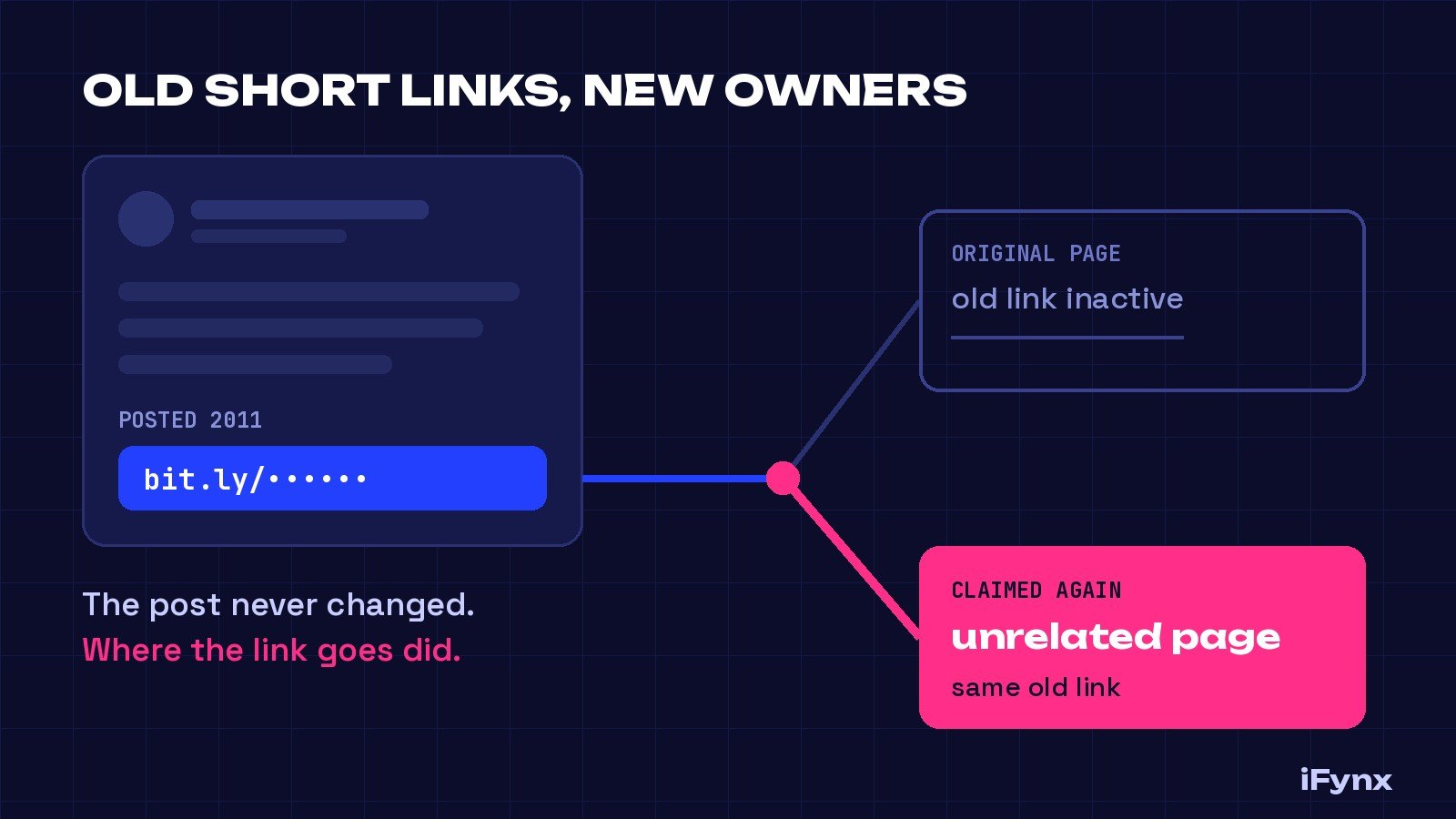
Old bit.ly short links inside 2009 to 2014 posts from Burger King, McDonald’s, Donald Trump’s account and others were registered again by someone else on 14 and 15 November 2026 and pointed at unrelated pages, some of them deeply offensive.
Bitly confirmed an issue at 19:13 UTC on 15 November (21:13 Asia/Gaza) that “allowed bad actors to repurpose certain old, inactive links”. It says it has suspended the accounts involved and is disabling the affected links. The brands’ X accounts were not hacked: nothing was posted from them. What changed was where their old short links led. Bitly has not said how many links were affected or exactly how they were claimed.
At iFynx we build web and mobile products for banks, retailers and public-facing services in the UAE, Saudi Arabia, Egypt and Palestine, and almost all of them send links: in SMS, WhatsApp, email, PDFs and printed QR codes. This story is a warning for every one of them. Below: what happened, how an old short link can change owners, what an independent audit found, how to check whether a bit.ly link is safe before you tap it, and a five-step audit for your own old links. We re-checked Bitly’s X account, its help centre and the news reports on 16 November 2026 at about 03:55 Asia/Gaza (01:55 UTC). We do not link to any hijacked destination.
Before you tap a bit.ly link
- Preview it. Add a plus sign (+) to the end of a bit.ly address. Bitly shows the destination and the date the link was created, without sending you there.
- Compare the dates. If the link was created long after the post, email or document it sits in, it is not the original link.
- Do not trust a link because the account is famous or verified. The account owner may no longer control where it goes.
- Never sign in, pay or connect a crypto wallet on a page you reached through an old short link. Type the address yourself instead.
What happened, in order
All times are from Bitly’s public link pages as reported by Ransomnews, from X, and from the news reports linked below. Asia/Gaza is UTC+2.
| When (UTC) | Asia/Gaza | What happened |
|---|---|---|
| 14 Nov, 23:52 | 15 Nov, 01:52 | Earliest change Ransomnews found: a link in a 2013 post from Donald Trump’s account is registered again and pointed at a games page. |
| 15 Nov, 05:14 | 07:14 | The bit.ly link in a 7 June 2011 McDonald’s post is registered again and pointed at Wikipedia’s article on the 11 September 2001 attacks. |
| 15 Nov, 05:32 | 07:32 | The bit.ly link in a 24 July 2011 Burger King restaurant-locator post is registered again and pointed at Wikipedia’s list of Nazi concentration camps. A post quoting it passes 2 million views within hours. |
| 15 Nov, 07:49 to 09:57 | 09:49 to 11:57 | More links in old posts from Donald Trump’s account are re-registered, pointing at a game profile, videos and a Wikipedia article. |
| 15 Nov, 19:13 | 21:13 | Bitly confirms an issue, suspends the accounts involved and starts disabling the affected links. |
| by 19:22 | by 21:22 | The Burger King and McDonald’s links show Bitly’s “Link Deactivated” page, according to Ransomnews. |
| 15 Nov, evening | 15 Nov, night | CNN reports similar redirects in old posts from Bill Gates, Justin Trudeau and Mike Pence, and Ransomnews adds that CNN also named the FBI and the US Department of Defense. |
The offensive destinations were Wikipedia pages: a list of Nazi concentration camps, a page on Adolf Hitler and the article on the September 11 attacks, attached to cheerful fast-food posts. Others led to games, joke videos and a vulgar audio clip. We describe them here so readers understand the harm; we do not reproduce or link the hijacked links.
How an old short link changed owners
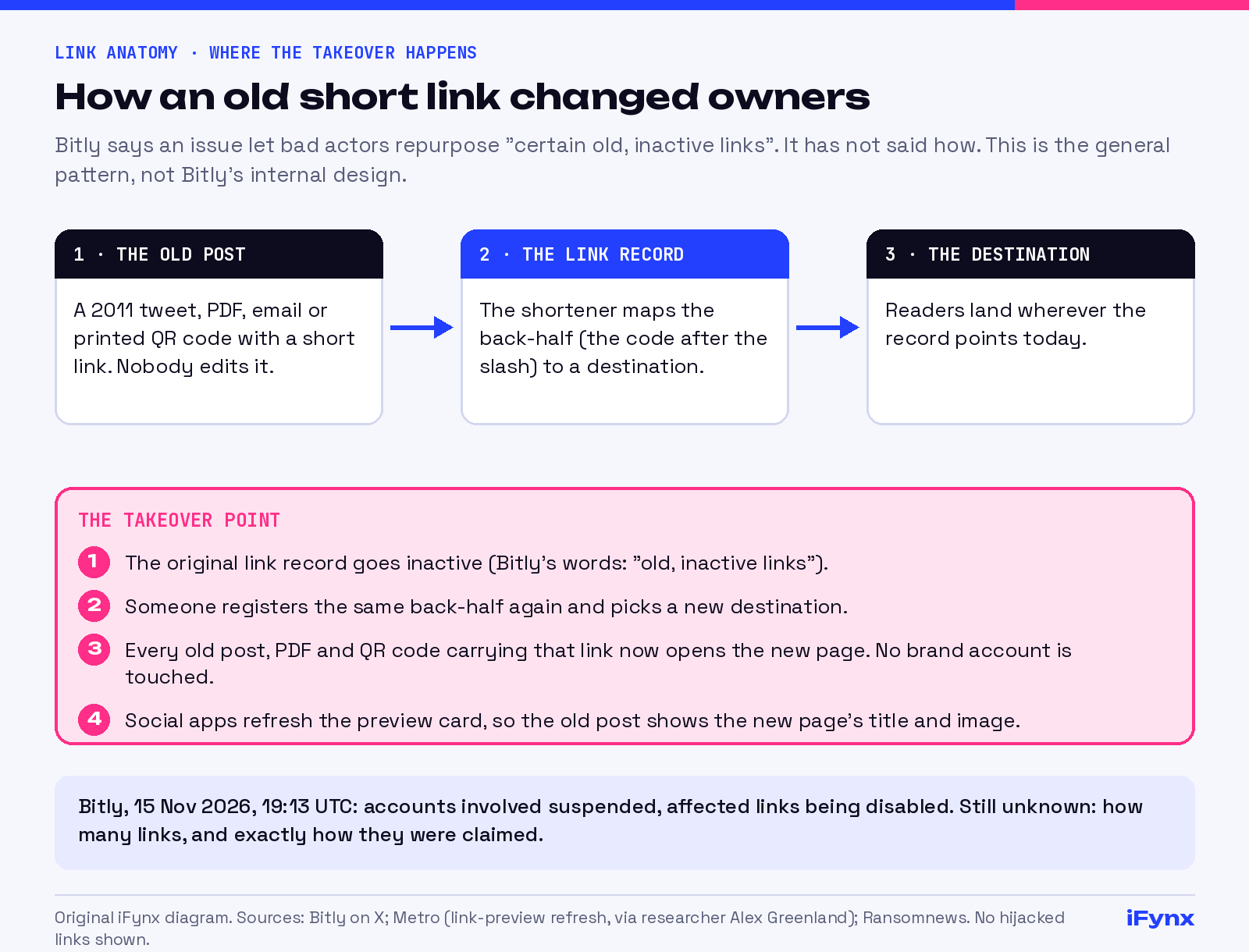
A short link has two parts: the shortener’s domain (bit.ly) and the “back-half”, the code after the slash. The shortener keeps a record that maps each back-half to a destination. The post, email or QR code that carries the link never changes. Only the record decides where a reader lands.
If that record can be claimed again, whoever claims it controls every old post, PDF and printed code that carries the link. No password is stolen and no brand account is touched, so the brand sees nothing wrong until someone complains. Social networks make it worse: as security researcher Alex Greenland told Metro, X fetches the final destination to build the link preview, so an old post can suddenly display the new page’s title and image.
Bitly’s own help page says bit.ly back-halves “cannot be re-used — whether they’re automatically-generated or custom back-halves”. The creation dates collected this weekend do not fit that statement. Bitly’s post confirms an issue with “certain old, inactive links” but does not explain the mechanism. Ransomnews reports that a similar link-claiming bug was reported and fixed in February 2025; that earlier fix is reported, not confirmed by Bitly in this incident.
Was Bitly hacked, or were the brands hacked?
Neither claim is supported by the sources. Bitly describes “an issue that allowed bad actors to repurpose certain old, inactive links”, not a breach of its systems, and has not said more. Burger King, McDonald’s and the other accounts did not post anything new: the posts were years old and unchanged. A Burger King spokesperson told Metro “this is of course not the original link of the post and it has been deleted”, and told CNN the company had “no part in the links being redirected”.
That distinction matters for any brand. You can lose control of what your post does without anyone logging into your account. Account security (two-factor login, access reviews) is necessary, but it would not have stopped this.
What the independent audit found
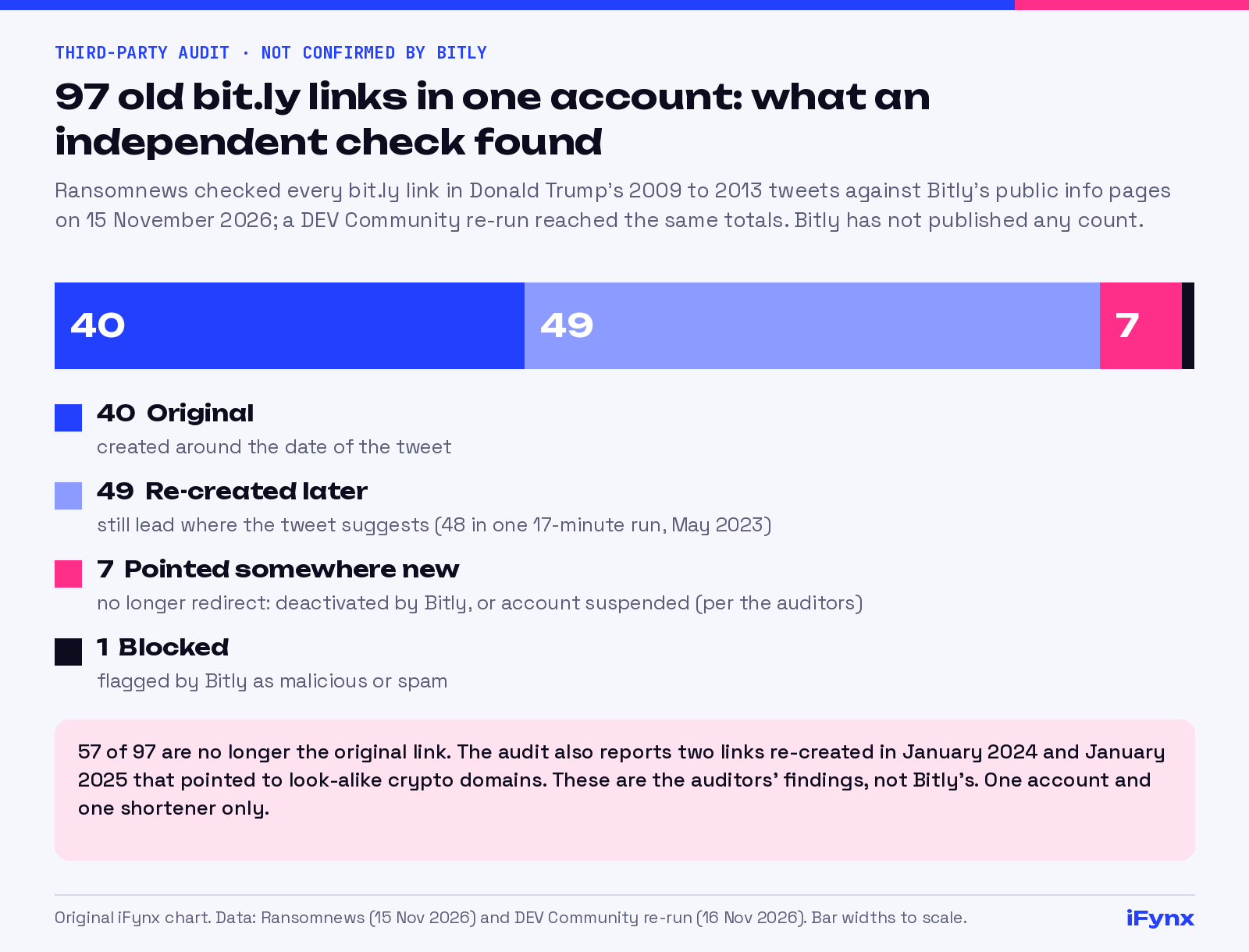
The best numbers so far come from outside Bitly. Ransomnews took every bit.ly link from the tweets of Donald Trump’s account between 2009 and 2013 in a public archive, 97 links in all, and checked each one against Bitly’s public information pages on 15 November. A DEV Community re-run on 15 and 16 November reached the same totals. We use this account only because a full public archive exists; the point is technical, not political.
- 40 links were original, created around the date of the tweet.
- 49 were created again years later but still lead where the tweets suggest. 48 of them were made within 17 minutes on 26 May 2023, by someone unknown.
- 7 pointed somewhere the tweets never did. By the evening of 15 November they no longer redirected.
- 1 is blocked by Bitly as malicious or spam.
So 57 of 97 links are no longer the originals. The audit also reports two links, re-created in January 2024 and January 2025, that pointed at domains copying the names of crypto services. These are third-party findings; Bitly has not confirmed any count. The DEV Community author also found one re-created link whose destination, a retired news-video page, now forwards to a memecoin page one hop later. The lesson: checking the short link is not enough. The destination can change too.
Why this matters for Gulf and Egypt brands, banks and SMS campaigns
Many banks, telcos, retailers and government services in the UAE, Saudi Arabia and Egypt send short links by SMS, WhatsApp and email, and print QR codes on packaging, menus, posters and invoices that stay in circulation for years. Customers in the region are already targeted by fraud messages that rely on links; our guide to UAE online fraud shows how convincing impersonation scams can be.
A hijacked link inside a real, old message from your brand is a gift to a scammer, because it carries your name and your history. The 15 November destinations were mostly pranks. The same move could send customers to a fake login page or a fake payment form. The same thinking applies to domains: in the Across Protocol case, control of a domain was enough to turn a trusted address against its users.
Three practical consequences for teams in the region:
- Public shorteners are a dependency. If you use bit.ly or any shared short domain, your links depend on the shortener’s records and your account staying active. Bitly’s help page says links on your own custom domain keep working after account deletion only “as long as your previous domain’s DNS settings still point to Bitly’s IP addresses”. Own the domain, and know who renews it.
- Tell customers what your links look like. Publish the domains and sender IDs you use and say, plainly, which kinds of links you never send. That is anti-phishing design, not just policy.
- Printed codes last longest. A QR code on a shop window or a product box cannot be edited. Point it at a domain you control, never at a link you might lose.
Audit your old short links this week
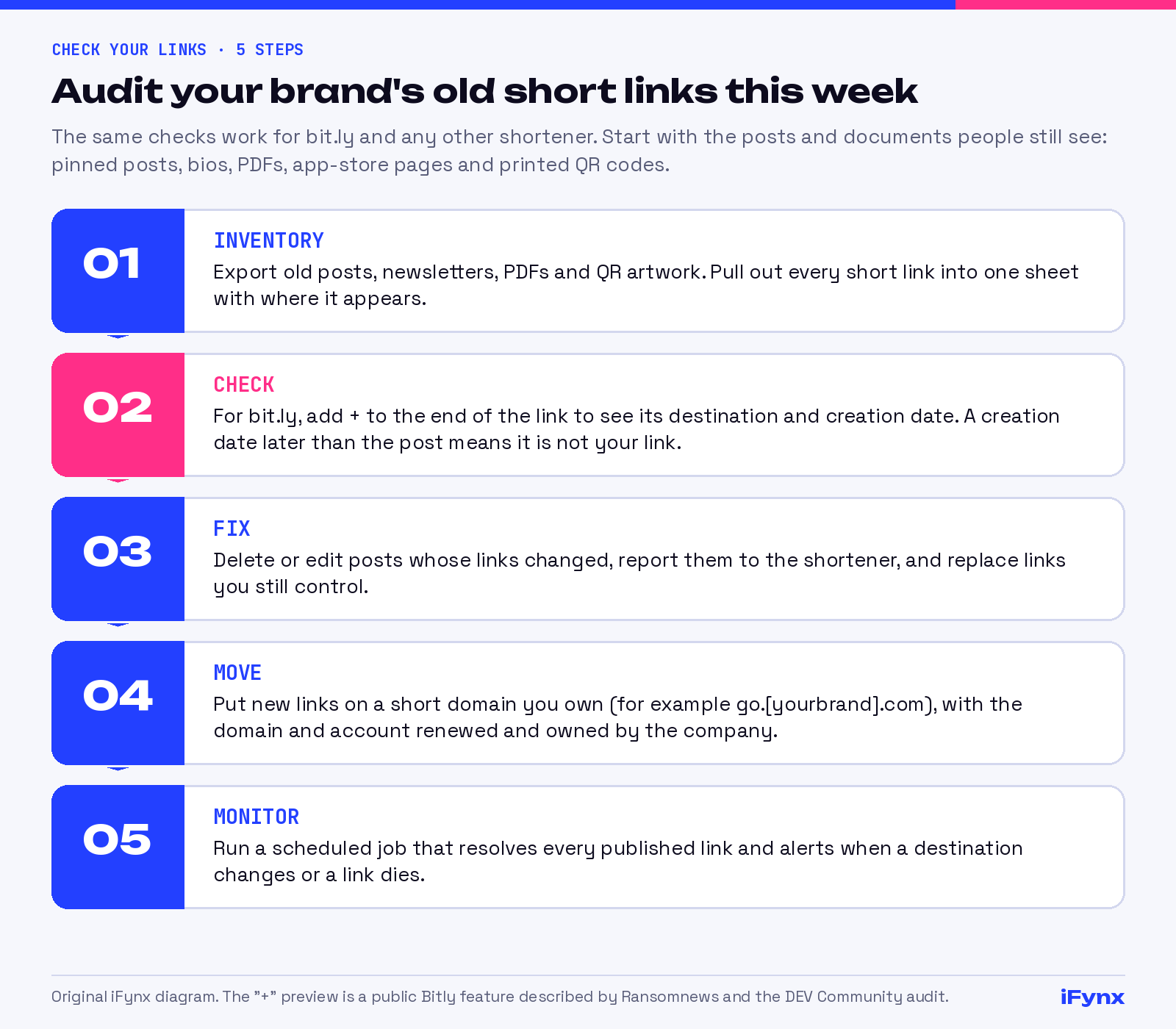
Start with what people still see: pinned posts, profile bios, app-store descriptions, PDFs on your site, and QR codes in print.
- Inventory. Export old posts from each social account, plus newsletters, PDFs and QR artwork. Put every short link in one sheet with where it appears and who owns it.
- Check. For bit.ly links, add + to the end to see the destination and creation date. A creation date later than the post means it is not your link. For other shorteners, follow the redirect with a tool that reads headers without opening the page.
- Fix. Delete or edit posts whose links changed, report them to the shortener, and replace any link you still control with one on your own domain.
- Move. Use a short domain you own, such as go.[yourbrand].com, registered to the company, on auto-renew, with registrar lock on, and with more than one person able to manage it.
- Monitor. Run a scheduled job that resolves every published link and alerts you when a destination changes, a redirect chain grows, or a link dies.
For app teams: links that open your app
Banks and retailers in the region often use links that should open the app directly, for example from an SMS. Do not route those through a third-party shortener. Use verified Android App Links and Apple Universal Links on your own domain, so the operating system checks that the domain belongs to your app before opening it. Keep the verification files under change control and monitor them like any other production asset.
How iFynx can help
We help Gulf and Egypt teams make sure every link they send still belongs to them.
- Link inventory and monitoring. Our Web Development and API & Backend Engineering teams build a branded short-link service on your own domain, plus a scheduled job that resolves every published link and alerts on change.
- Verified deep links. Through Mobile App Development, we set up Android App Links and Apple Universal Links so SMS and email links open your app safely, with no third-party redirect in the middle.
- Anti-phishing message design. Our UX/UI Design team designs bilingual Arabic and English SMS, email and in-app messages that tell customers which links and sender IDs are really yours.
Want a quick audit of your old links? Talk to iFynx, part of our Software Development and Design services.
Frequently asked questions
Was Bitly hacked?
Bitly has not described a hack. On 15 November 2026 it said it had identified an issue that allowed bad actors to repurpose certain old, inactive links, suspended the accounts involved and began disabling the affected links. It has not said how many links were affected or how they were claimed.
Were Burger King’s and McDonald’s accounts hacked?
No. Nothing was posted from their accounts. Short links inside posts from 2011 were registered again by someone else on 15 November 2026, so the old posts began opening unrelated pages. Burger King said the redirected link was not the original and that it was deleting altered posts.
Are Bitly links safe to click now?
Most bit.ly links still lead where their creators intended, but an old link in an old post is not guaranteed. Add a plus sign to the end of a bit.ly link to see where it goes and when it was created before you open it, and never sign in or pay on a page reached through an old short link.
Do Bitly links expire, and can an old short link be taken over?
Bitly says its links do not expire and that bit.ly back-halves cannot be re-used. This weekend showed that certain old, inactive links could be repurposed, and Bitly confirmed the issue. An independent audit found that 57 of 97 old links in one account were no longer the originals; Bitly has not confirmed that figure.
How do I check my company’s old bit.ly links?
Export old posts, newsletters, PDFs and QR artwork, list every short link, add a plus sign to each bit.ly link and compare its creation date with the date of the post. Delete or fix posts whose links changed, report them to Bitly, and move new links to a short domain your company owns and monitors.
Sources and update policy
Bitly’s statement on X, 15 November 2026, 19:13 UTC; Bitly Help Center, what happens to links after an account is deleted (read 16 November 2026); Ransomnews (timeline, link pages, 97-link audit); DEV Community audit re-run; Metro (Burger King statement, link-preview explanation); New York Post; CNN via KRDO; Headlinne; X news story; Android and Apple developer documentation on App Links and Universal Links. Bitly had posted no further statement on X when we checked at about 03:55 Asia/Gaza on 16 November. Times converted to Asia/Gaza by iFynx.
We will update this article if Bitly publishes a count of affected links, explains how they were claimed, or confirms a fix. We do not publish hijacked links or methods for claiming links.
Related reading
- Across Protocol Hack: How a Registrar Social-Engineering Attack Turned across.to Into a Wallet Drainer, and the Domain Hijacking Checklist Gulf and Egypt Crypto Apps Need
- No, There Is No Global Cyberattack on 17 November: What Really Happens That Day, Why Banks Can't Be Wiped, and the Scams to Watch in the Gulf and Egypt
- Telegram Blocked in Jordan: What Stopped Working and How Jordanian Businesses Should Move Their Channels, Bots and Customers