SUSPECTED DRAIN · CAUSE NOT CONFIRMED · CHECKED 18:55 ASIA/GAZA, 16 NOV 2026
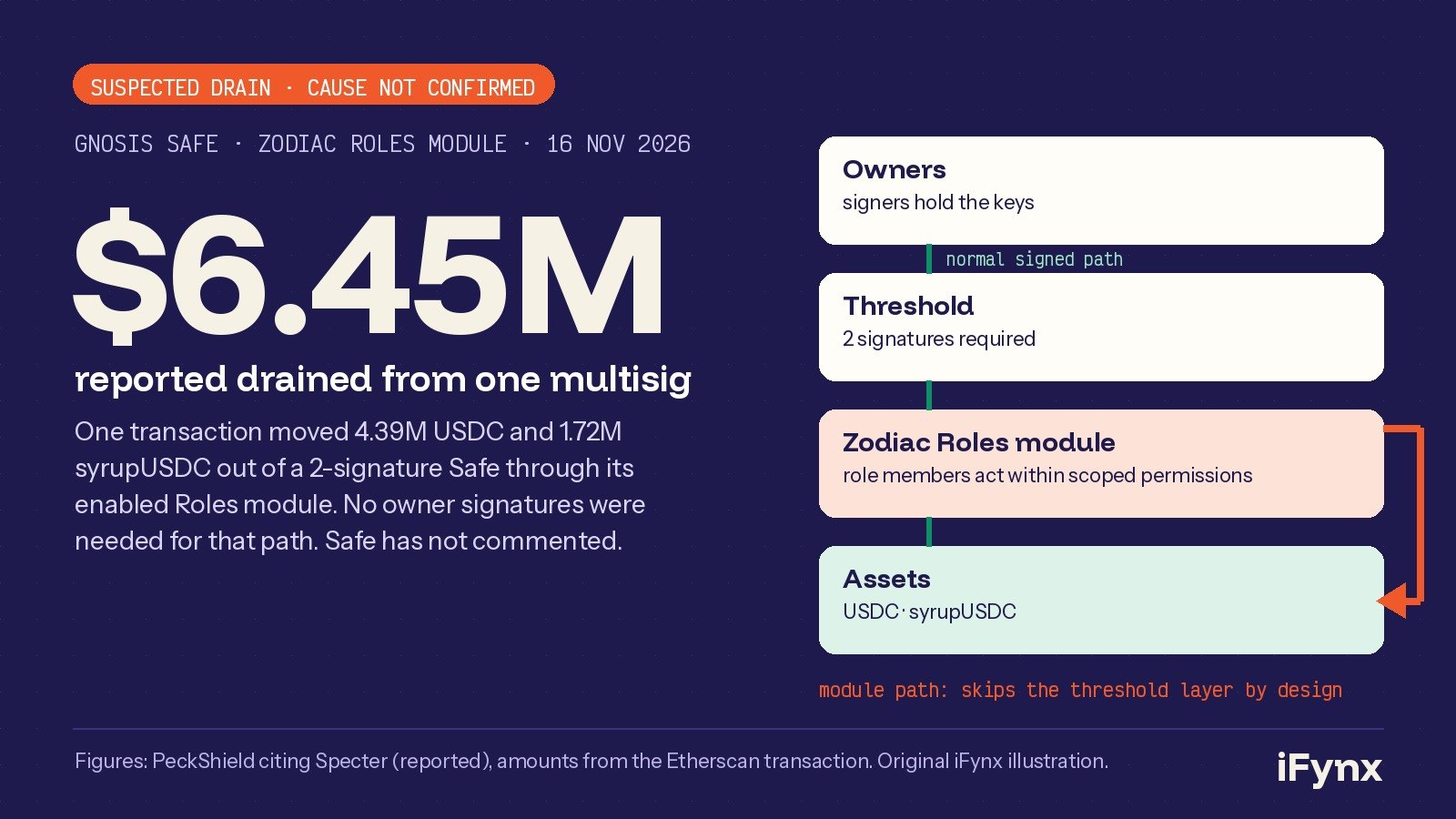
About $6.45 million was reportedly drained from a single Gnosis Safe multisig on Monday 16 November 2026. The on-chain record shows the funds left through the wallet’s Zodiac Roles module, a permission add-on, rather than through a transaction signed by the Safe’s owners.
One Ethereum transaction at 11:35 UTC (13:35 Asia/Gaza) moved 4,387,188.43 USDC and 1,717,918.96 syrupUSDC out of the Safe. Security firm PeckShield, citing on-chain analyst Specter, flagged it at 14:46 UTC and said the Safe “may have been compromised”.
Safe, Gnosis Guild (which maintains Zodiac) and Maple (which issues syrupUSDC) had not commented when we checked. Whether a role key was stolen, a permission was set too wide, or something else happened is not known. Nothing public shows a bug in Safe or Zodiac.
At iFynx we build treasury, custody and payments back ends for companies in the Gulf and Egypt, and many of those teams hold funds in Safe multisigs, so we read this incident for what it means for the people who set wallet permissions. This article uses only what can be checked: the transaction itself, Safe’s and Zodiac’s documentation, and what named analysts have reported, labelled as reports. It names no victim, gives no exploit steps and offers no price or trading advice. It comes on the same day as the Lighter leaked-API-key drain, and the lesson rhymes: the signers are not the only keys. API keys and modules are keys too.
What is verified, and what is only reported
| Claim | Status | Basis |
|---|---|---|
| A Gnosis Safe paid out 4,387,188.43 USDC and 1,717,918.96 syrupUSDC to one address in one transaction at 11:35:23 UTC | Verified on-chain | Etherscan and Blockscout, read by iFynx |
The call went through the Safe’s Zodiac Roles module (execTransactionWithRole), not a signed multisig transaction |
Verified on-chain | Transaction input; the Safe emitted ExecutionFromModuleSuccess for the Roles contract |
| The Safe needs 2 owner signatures for normal transactions, and the Roles contract is still enabled as a module | Verified on-chain | Public contract reads at 18:55 Asia/Gaza |
| Total loss of about $6.45M | Reported | PeckShield citing Specter; Etherscan prices put the two amounts at about $6.4M |
| The attacker used the wallet’s existing Roles permissions | Reported | Specter, as reported by BeInCrypto; The Defiant cites an analyst on “a gap in its delegated trading permissions” |
| About $813K bought XMR on Hyperliquid; about $1.2M went into XMR | Reported | PeckShield ($813K); Specter via BeInCrypto ($1.2M) |
| Who owns the Safe, and how the role key was obtained | Not known | No statement from the owner, Safe, Gnosis Guild or Maple |
Safe anatomy: how a module can move funds without the multisig
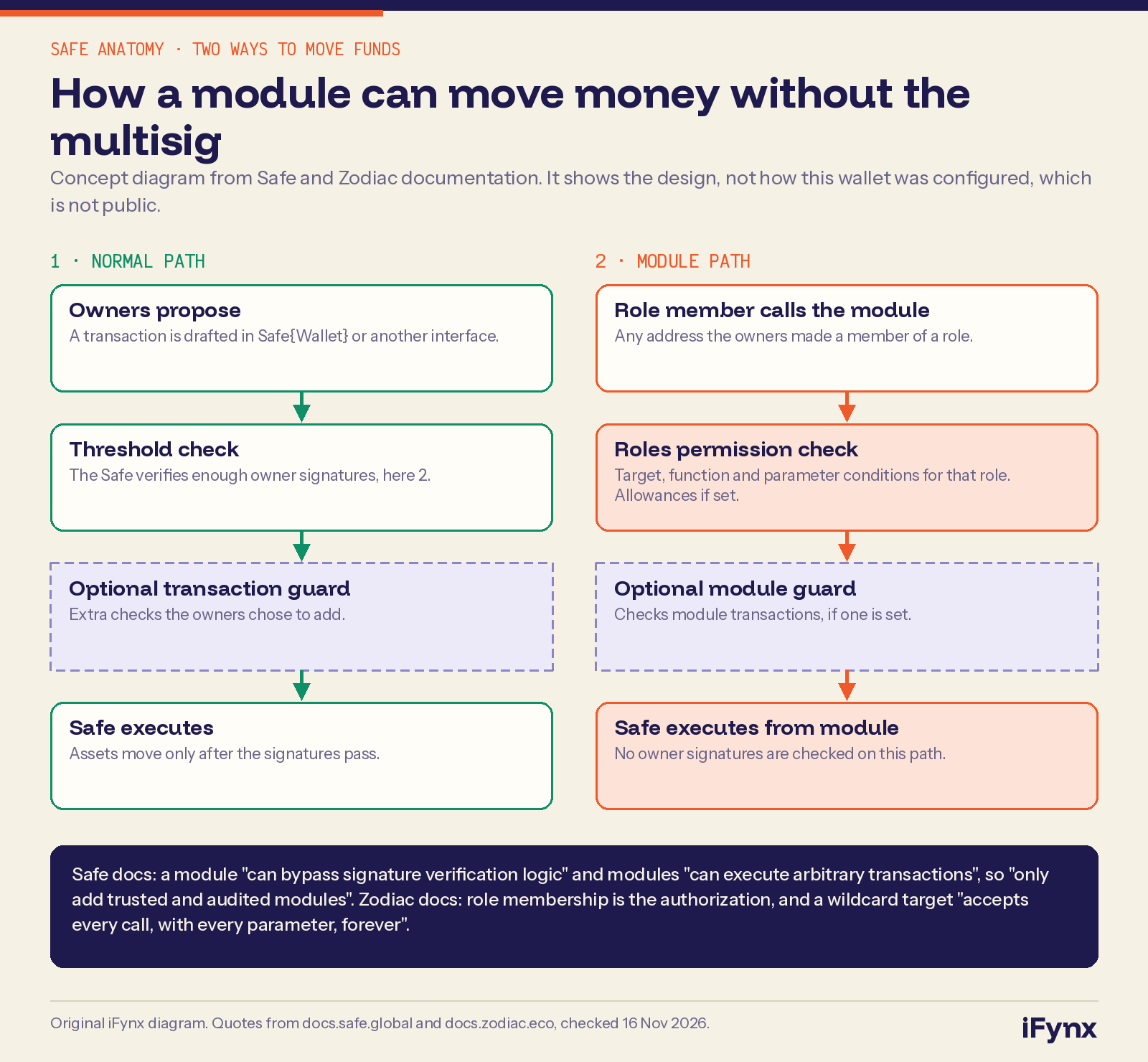
A Safe is a smart-contract wallet. In the normal path, owners propose a transaction and the Safe executes it only after enough owners have signed, here two. Modules are a second, deliberate path. Safe’s documentation says a module “can bypass signature verification logic to execute transactions through a Safe Smart Account”, and its modules page warns that modules “can execute arbitrary transactions” and that teams should “only add trusted and audited modules”. Owners must approve, at the Safe’s threshold, before any module is enabled.
The Zodiac Roles Modifier is a widely used module of this kind, maintained by Gnosis Guild. It lets the owners create roles, assign them to addresses, and scope what each role may call. Its contract reference states that “role membership is the authorization for execution”. Its permission guide is blunt: a wildcarded target “accepts every call, with every parameter, forever — until you revoke it”, an unconditioned token approve “is as powerful as transfer“, and a delegate call “can drain all assets and change the owners”. Its conditions guide adds that when several permissions cover the same function, the merge “widens access”.
That is the design, and it is useful: it lets a trading desk or a bot act within limits without waking two signers for every swap. It also means a role is only as safe as its scope and the key that holds it. How this particular Safe’s roles were configured is not public, and we do not guess.
One transaction, read on-chain
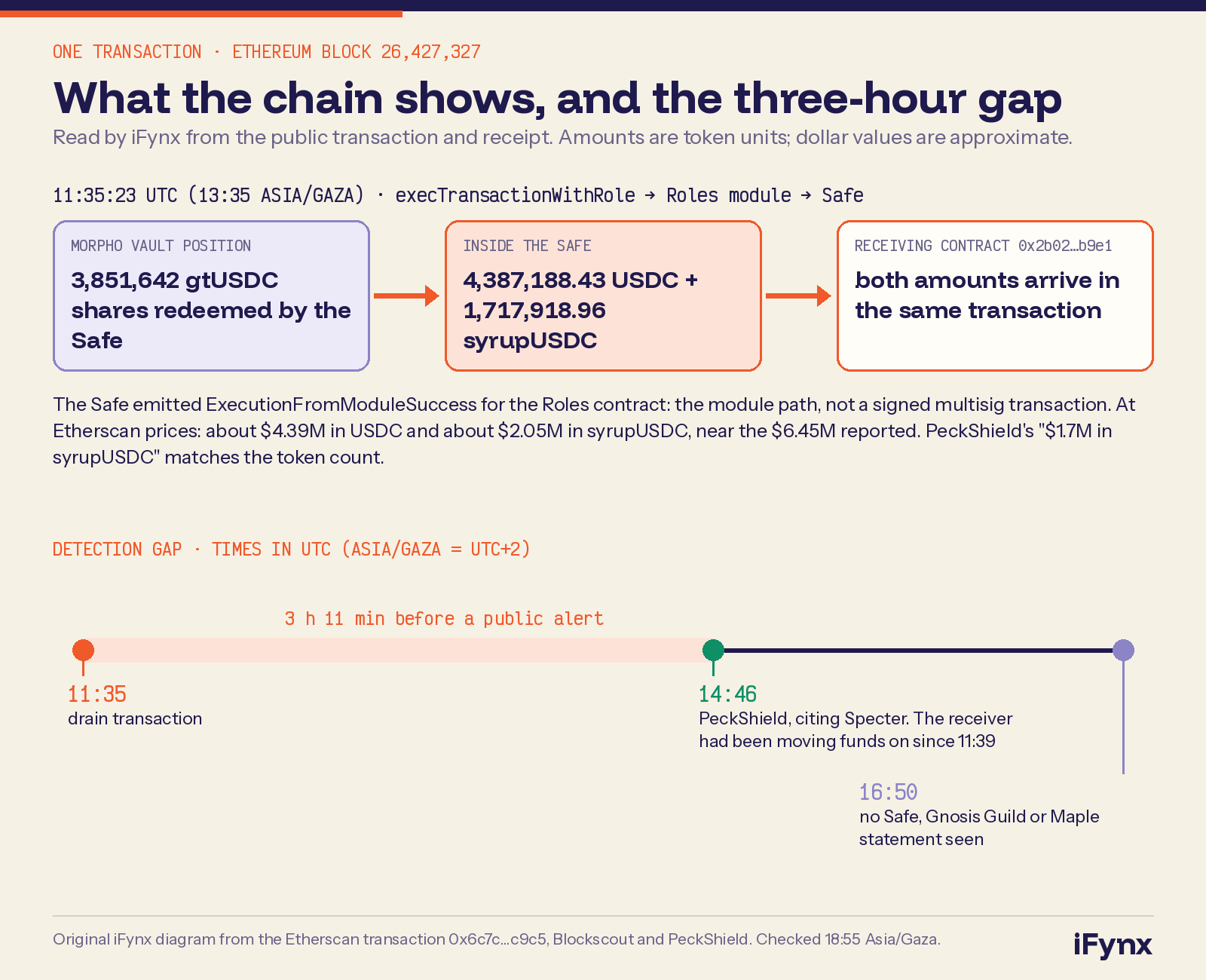
We read the transaction and its receipt directly. A regular Ethereum account called execTransactionWithRole on the Roles contract at 11:35:23 UTC in block 26,427,327. Inside that single call, the Safe redeemed 3,851,642 shares of a Morpho USDC vault for 4,387,188.43 USDC, then sent that USDC and 1,717,918.96 syrupUSDC to a contract at 0x2b02…b9e1. The Safe logged a successful module execution for the Roles contract, which is the module path, not a signed multisig transaction.
At Etherscan’s prices the USDC was worth about $4.39 million and the syrupUSDC about $2.05 million, close to the $6.45 million reported. PeckShield’s “$1.7M in syrupUSDC” matches the token count rather than the dollar value. The receiving contract began moving funds on within minutes, from about 11:39 UTC, and its ETH balance was close to zero when we checked at 18:55 Asia/Gaza. The syrupUSDC tokens were simply transferred out of the Safe; nothing in the transaction points to a fault in syrupUSDC or in Morpho.
The time gap is the lesson for operators. The transaction happened at 13:35 Asia/Gaza; the first public alert came at 16:46, 3 hours and 11 minutes later. Whoever owned this Safe either did not see module activity in real time or could not stop it in time.
What Safe, Gnosis Guild, Maple and analysts have said
Safe. As of 18:55 Asia/Gaza, Safe’s X account had posted nothing about the incident. Its only posts around the time of the alert were reposts of unrelated material.
Gnosis Guild and Maple. Gnosis Guild, which maintains Zodiac, and Maple, which issues syrupUSDC, had also not commented. We will add their statements if they publish them.
Analysts and media. PeckShield said, citing Specter, that “a Gnosis Safe may have been compromised, resulting in $6.45M being drained”, and that the attacker “has spent ~$813K to buy $XMR on Hyperliquid”. BeInCrypto reported that the drain exploited permissions in the wallet’s Zodiac Roles module, and reported Specter as saying about $1.2 million went into Monero through a swap service, which Specter named on X. The Defiant wrote that “an analyst traced the drain to a gap in its delegated trading permissions”. Some posts on X claim the same attacker was behind today’s Lighter incident because both used Monero routes. No analyst has shown evidence for that, so we do not repeat it as fact.
Is this a Safe hack? Nothing public says so. The transaction used a module the owners had enabled, through a role the owners had created. This incident is also separate from the Gnosis Pay card-data breach we covered earlier, which involved a different product.
WATCH FOR FAKE “SAFE SECURITY” MESSAGES
- Incidents like this bring fake “urgent migration”, “revoke now” and “Safe support” links. Safe and Gnosis Guild publish from their verified accounts and their own domains.
- Never sign a transaction or message from a link you were sent to “fix” your Safe. Open the Safe app yourself.
- Changing modules needs your owners’ signatures. Plan the change, check the exact module address, and have a second owner verify it.
A module-permission audit checklist for Gulf and Egypt custodians
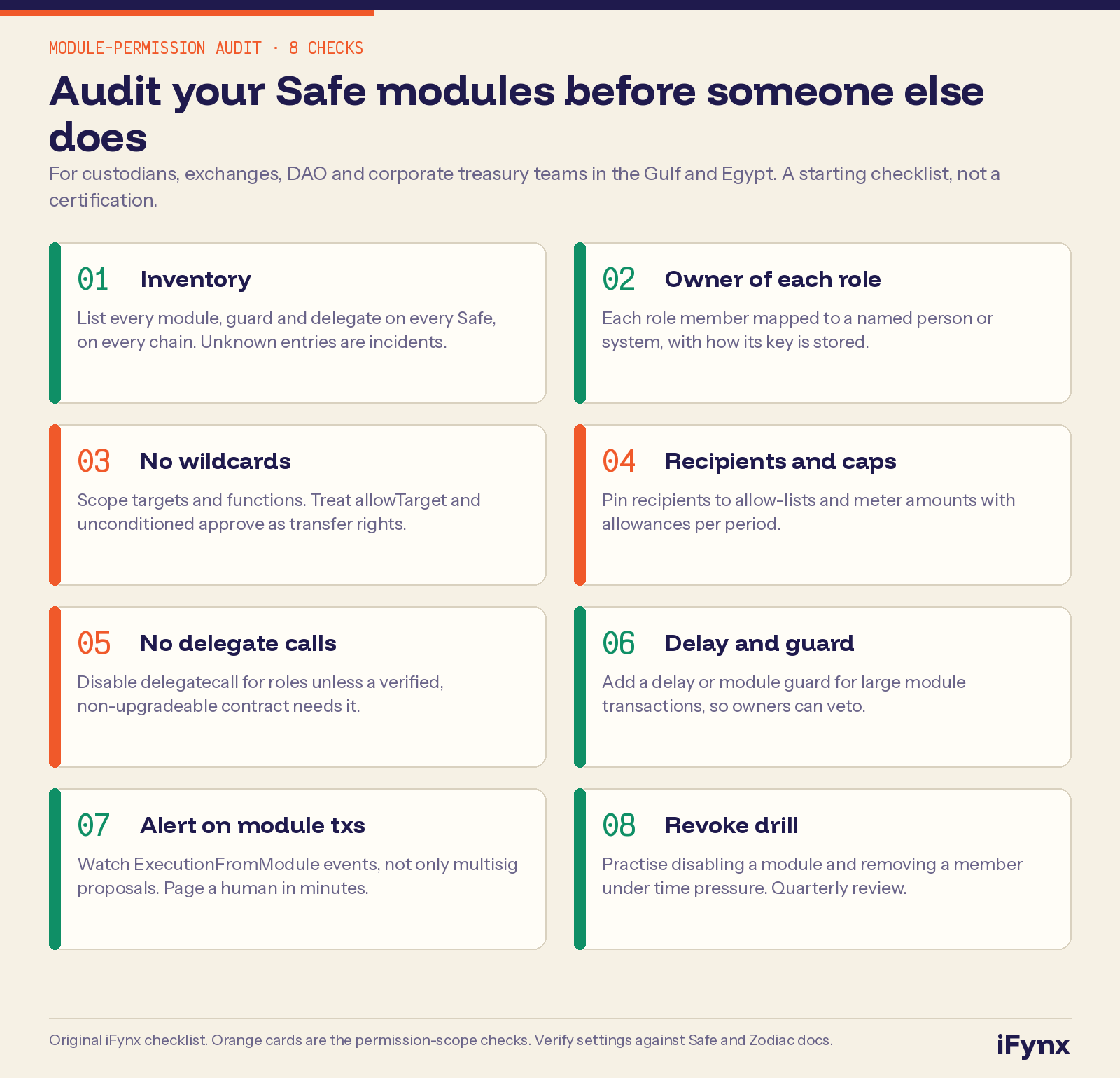
Crypto custodians, exchanges and brokers licensed in Dubai, Abu Dhabi, Saudi Arabia or Egypt, plus DAO and corporate treasury teams across the region, often run Safe multisigs with modules for automation. Whatever caused this incident, these eight checks reduce what one role key can do. Our Kava Lend, Across Protocol and Keplr explainers cover the neighbouring risks: forgotten markets, hijacked front ends and login providers.
- Inventory every module, guard and delegate on every Safe, on every chain, from the Safe app’s settings and from the chain itself. Anything nobody can explain is an incident until proven otherwise.
- Map each role member to a named person or system, and record where its key lives and who can use it. Hot keys on servers need the same care as signer keys.
- Remove wildcards. Replace
allowTargetwith scoped functions, and treat unconditionedapproveas a transfer right. - Pin recipients and cap amounts. Restrict where funds can go with allow-lists, and meter amounts with allowances per period, so one call cannot empty the wallet.
- Turn off delegate calls for roles unless a verified, non-upgradeable contract truly needs them.
- Add a delay or a module guard for large module transactions, so owners have time to veto.
- Alert on module transactions, not only on multisig proposals. Watch the Safe’s module-execution events and page a person within minutes.
- Practise the revoke drill. Rehearse disabling a module and removing a role member under time pressure, and review every role at least quarterly as part of treasury procedures.
If a module is abused: the first hour
Decide these steps before you need them. Have pre-agreed owners ready to disable the module or remove the role member; that change needs the normal multisig threshold, so on-call signers matter. Contact stablecoin issuers and the protocols where funds sit, and give them the transaction hash quickly. Share addresses with security firms and the exchanges that might receive the funds. Tell clients and regulators early and plainly, in Arabic and English, what is affected and what is not.
How iFynx can help
We help custodians, exchanges and treasury teams in the Gulf and Egypt make sure every key, signer, API key or module, can do only what it should, and that someone notices within minutes when it does something else.
- Permission models and custody back ends. Our Software Development team designs least-privilege role scopes, allowances, delays and approval flows for treasury operations.
- Transaction monitoring that reaches a person. Through our API & Backend Engineering service, we build watchers for module executions, large outflows and new recipients, with alerts routed to on-call signers.
- Signing and permission-review screens people understand. Our Design team designs bilingual Arabic and English approval and permission-review interfaces, so signers can see what a role can actually do before they approve it.
Want a review of your Safe modules and treasury controls? Talk to iFynx.
Frequently asked questions
Was Gnosis Safe hacked?
Nothing public says so. On 16 November 2026 one Safe multisig paid out about $6.45 million, as PeckShield and Specter reported. The transaction went through a Zodiac Roles module the owners had enabled, not through owner signatures. Safe and Gnosis Guild had not commented when we checked, and no bug in Safe or Zodiac has been shown.
What is the Zodiac Roles module?
It is an add-on maintained by Gnosis Guild that lets a Safe’s owners create roles and give addresses limited permissions, for example to trade or rebalance without collecting every signature. Zodiac’s documentation says role membership is the authorization, so a role is only as safe as its scope and the key that holds it.
How can a module move funds without the multisig signatures?
By design. Safe’s documentation says modules can bypass signature verification to execute transactions, which is why owners must approve each module and why Safe advises adding only trusted and audited modules. Limits then come from the module’s own rules, such as scoped functions, recipients, allowances and delays.
How do I check which modules are enabled on my Safe?
Open the Safe app and review the modules section in your Safe’s settings, and confirm the list against the chain with a block explorer or your own tooling. For each Zodiac Roles module, review every role, its members and its permissions, and remove anything you cannot explain. Plan any removal with your co-signers.
Is my Safe at risk if I do not use Zodiac or any module?
This incident involved a module, so a Safe with no modules enabled is not exposed to this path. Normal risks still apply: stolen signer keys, malicious signing requests and fake front ends. Check your settings rather than assuming, and treat any unexpected module or guard as an emergency.
Sources and update policy
On-chain: the transaction on Etherscan and on Blockscout, and the receiving contract. Reports: PeckShield citing Specter (14:46 UTC, 16:46 Asia/Gaza); Specter; BeInCrypto; The Defiant. Documentation: Safe modules and smart account concepts; Zodiac Roles reference, permissions and conditions. Official accounts checked: Safe and Gnosis Guild. Times converted to Asia/Gaza by iFynx.
We will update this article if Safe, Gnosis Guild, Maple or the wallet’s owner publishes a statement, or if a security firm confirms the cause. This is general information, not financial or legal advice.