CRITICAL · JAVA4SHELL CVE-2026-114938 · CHECKED 07:00 ASIA/GAZA, 18 NOV 2026
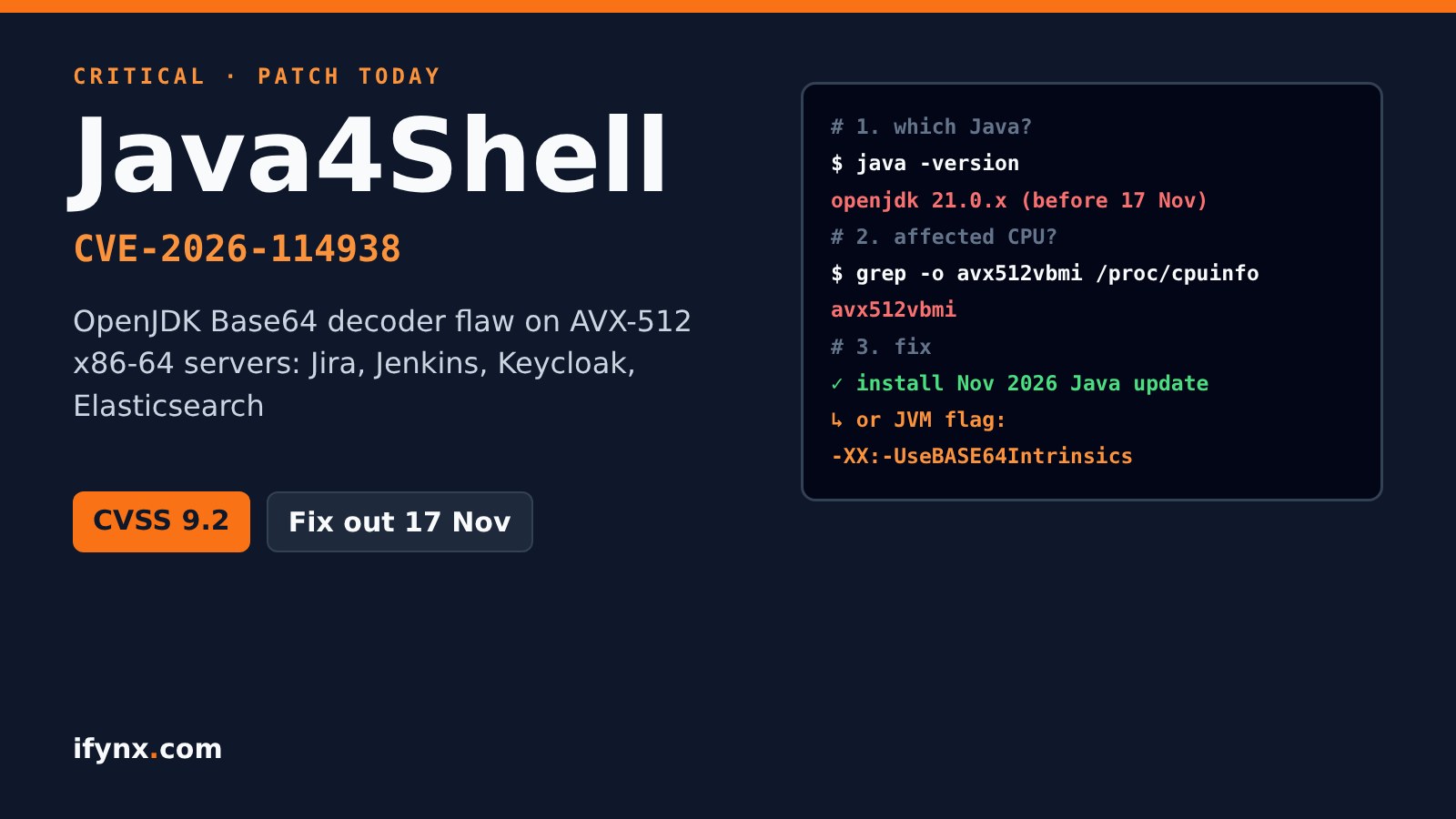
Patch Java today: Java4Shell (CVE-2026-114938, CVSS 9.2) is a memory-corruption bug in OpenJDK’s Base64 decoder on modern x86-64 servers that can lead to remote code execution in apps such as Jira, Confluence, Jenkins, Keycloak and Elasticsearch. Fixes from OpenJDK and Oracle came out on 17 November 2026. No attacks reported yet.
Primary source: Calif.io’s write-up and Oracle’s November 2026 security update. If you cannot patch now, run the JVM with -XX:-UseBASE64Intrinsics.
At iFynx we build and run web platforms for banks, fintechs and government-facing teams in the UAE, Saudi Arabia, Egypt and Palestine, and a lot of that region’s back office runs on Java: SSO, Jira and Confluence, Jenkins, Elasticsearch and core banking middleware. This is the Java bug to fix first this week. Below: what it is, who is affected, and a patch order you can use today. We do not publish exploit details.
What is Java4Shell? Key facts
| Point | What we know |
|---|---|
| CVE | CVE-2026-114938, nicknamed Java4Shell |
| Severity | CVSS 4.0: 9.2 Critical |
| Where | Base64 decoder fast path (intrinsic) in OpenJDK HotSpot, x86-64 only |
| Hardware | CPUs with AVX-512 VBMI: Intel Xeon Ice Lake and newer, AMD Zen 4 and newer. ARM64 not affected |
| Versions | OpenJDK 17.0.6 and newer, and builds made from it (Oracle, Corretto, Temurin, Zulu, Red Hat, Microsoft and more) |
| Impact | Memory leak or remote code execution, depending on how the app uses Base64 |
| Fix | Vendor updates published 17 Nov 2026, 1:00 p.m. PT (23:00 Gaza) |
| Exploited? | No public reports of attacks as of 07:00 Gaza, 18 Nov |
Am I affected? Three quick checks
Checklist (menu-free, five minutes per server)
java -version on each server and container. OpenJDK 17.0.6 or newer (including 21, 25, 27) built before 17 Nov 2026 is in scope./proc/cpuinfo lists avx512vbmi. If it does not, or the server is ARM64 (AWS Graviton, Ampere), this bug does not apply, but patch anyway.How to fix it: patch order for Gulf and Egypt teams
-XX:-UseBASE64Intrinsics to JVM options and restartDo not just patch the system Java. Many apps ship their own runtime inside the install folder or Docker image. Updating the OS package alone can leave Jira, Jenkins or a vendor appliance still vulnerable. Restart every JVM after updating.
Why this matters in the UAE, Saudi Arabia and Egypt
Many cloud and on-premise servers bought in recent years use Intel Xeon Ice Lake or newer or AMD EPYC Zen 4 or newer, the chips this bug needs. Banks and ministries in the region also lean heavily on Java for SSO and internal tools. Under the UAE’s and Saudi Arabia’s information security rules and Egypt’s Law 151 of 2020, a known critical flaw left unpatched is hard to defend after a breach. Calif is holding back working exploit chains for now; that time is your patch window.
If you run remote-management tools as well, see N-able N-central Able2Shell: hotfix and RMM checklist.
How iFynx can help
iFynx builds and maintains Java and web platforms in Arabic and English for the UAE, Saudi Arabia, Egypt and Palestine. We can:
- Inventory every Java runtime across your servers, containers and vendor appliances
- Roll out the patch or the safe JVM flag without downtime on SSO and customer APIs
- Review which apps decode user-supplied Base64 and harden them
Frequently asked questions
What is Java4Shell (CVE-2026-114938)?
A critical memory-corruption bug (CVSS 4.0 score 9.2) in the fast Base64 decoder built into OpenJDK’s HotSpot JVM on x86-64 servers whose CPUs support AVX-512 VBMI. Malformed Base64 input can write past a heap buffer, which can leak memory or, in some apps, allow remote code execution. Calif.io found it; OpenJDK and Oracle published fixes on 17 November 2026.
Which Java versions and servers are affected?
OpenJDK 17.0.6 and newer and the builds made from it, including Oracle Java SE, Amazon Corretto, Eclipse Temurin, Microsoft OpenJDK, Azul Zulu, Red Hat OpenJDK, SAP SapMachine, BellSoft Liberica and GraalVM for JDK, but only on x86-64 CPUs with AVX-512 VBMI, such as Intel Xeon Ice Lake and newer and AMD Zen 4 and newer. ARM64 servers, including AWS Graviton, are not affected.
Is it being exploited?
As of 07:00 Gaza time on 18 November 2026 we found no report of attacks in the wild. Calif says exploitation is complex and differs per app, and it is holding back product-specific exploit chains so people can patch first. That window will not last, so treat it as urgent.
Are Jira, Confluence, Jenkins, Keycloak and Elasticsearch affected?
Calif says it reached remote code execution in default setups of products including Keycloak, Jira, Confluence, Jenkins and Elasticsearch, some of which needed a login. Any Java app that decodes Base64 from users, for example in login tokens or file uploads, may be exposed.
How do I fix it?
Install your Java vendor’s November 2026 update and restart every Java service. If you cannot patch today, start the JVM with -XX:-UseBASE64Intrinsics to switch off the vulnerable fast path, or -XX:UseAVX=2 on x86-64 only. Check bundled Java runtimes inside appliances and containers, not just the system Java.
What should banks and government teams in the Gulf and Egypt do first?
Patch internet-facing Java first: SSO such as Keycloak, Jira and Confluence, CI servers such as Jenkins, and search clusters. Then container images and vendor appliances. iFynx can help inventory Java runtimes and roll out the fix for teams in the UAE, Saudi Arabia, Egypt and Palestine.
Sources
- Calif.io: Java4Shell (CVE-2026-114938) research write-up
- Oracle Critical Security Patch Update, November 2026
- GBHackers: Critical Java4Shell flaw in OpenJDK Base64 decoder