ZERO-DAY · VMWARE vCENTER · CVE-2026-123890 · CHECKED 09:00 ASIA/GAZA, 20 NOV 2026
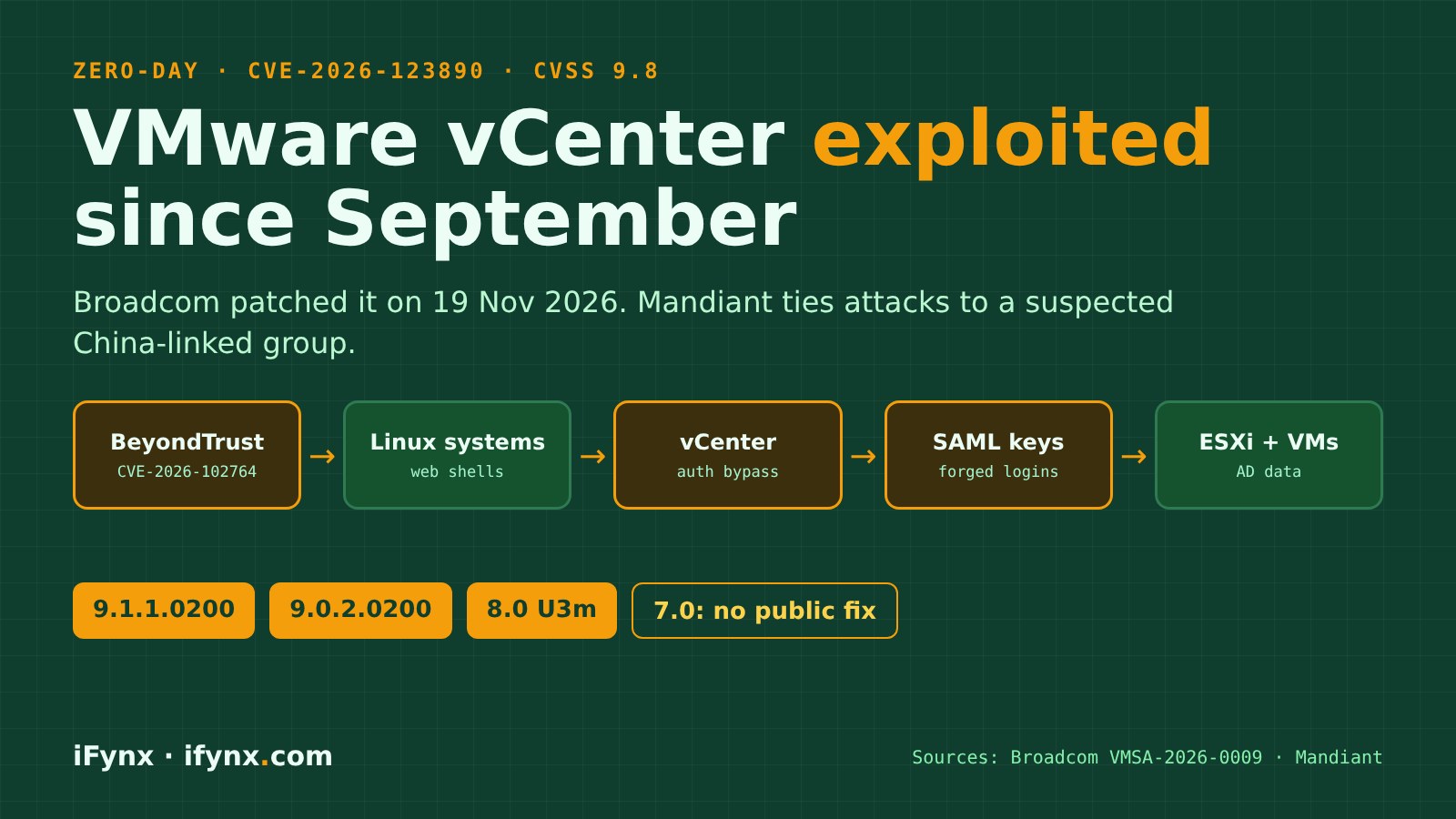
Yes, patch vCenter now. Broadcom fixed CVE-2026-123890, a critical (CVSS 9.8) authentication bypass in vCenter, on 19 November 2026, and Mandiant says a suspected China-linked group was already exploiting it from early September. There is no workaround, and vCenter 7.0 has no public fix.
Sources: Broadcom advisory VMSA-2026-0009 and reporting by SecurityWeek and BleepingComputer on Mandiant’s findings. Patching closes the hole but does not remove an attacker who is already inside, so check for compromise too.
At iFynx we build and run platforms for banks, fintechs, telecoms and government-facing teams in the UAE, Saudi Arabia, Egypt and Palestine, and most of them sit on VMware somewhere underneath. vCenter is the control room of that infrastructure: whoever controls it can reach every virtual machine. This guide sets out what Broadcom confirmed, what Mandiant reported, which builds fix it, and the checks to run today.
What is CVE-2026-123890 and which vCenter versions are affected?
CVE-2026-123890 is a flaw in the VMware Directory Service, the identity component inside vCenter. Broadcom rates it Critical, CVSS 9.8 (network, no privileges, no user interaction). In Broadcom’s words, an attacker with network access to vCenter may bypass authentication and get unauthorized access to the system. Broadcom says it is a new issue, separate from the July vCenter bug CVE-2026-59309, and not limited to Enhanced Linked Mode setups.
| Product | Issue | Fix (Broadcom VMSA-2026-0009) |
|---|---|---|
| vCenter 9.1.x (VCF / vSphere Foundation) | CVE-2026-123890, 9.8 | Fixed in 9.1.1.0200 |
| vCenter 9.0.x | CVE-2026-123890, 9.8 | Fixed in 9.0.2.0200 |
| vCenter 8.0 | CVE-2026-123890, 9.8 | Fixed in 8.0 U3m |
| VCF 5.x | vCenter + SDDC Manager | vCenter 8.0 U3m (KB 88287) + SDDC Manager 5.2.5 |
| vCenter 7.0 | End of general support, 2 Oct 2025 | No public fix: extended-support customers contact Broadcom |
| Telco Cloud Platform / Infrastructure | Same vCenter issue | Follow Broadcom KB463116 |
| Workaround | Any version | No workaround, per Broadcom |
Was the vCenter flaw exploited as a zero-day?
According to Mandiant, which reported the bug to Broadcom, and Google, yes. As reported by SecurityWeek and BleepingComputer, they attribute the attacks to a suspected China-linked espionage group they call Armory Castle, formerly tracked as UNC5221. Broadcom’s advisory does not mention in-the-wild exploitation, so the exploitation claim rests on Mandiant and Google. We have not been able to read Mandiant’s own report directly yet; the details below are as those outlets reported them.
| Late Aug 2026 | Attackers exploit a BeyondTrust Remote Support zero-day (CVE-2026-102764) to get a first foothold | Mandiant, via BleepingComputer |
| Early Sep 2026 | vCenter targeted with the then-unknown CVE-2026-123890 | Mandiant, via BleepingComputer |
| 29 Jul 2026 | Earlier vCenter bug CVE-2026-59309 disclosed; Google says the group already knew of CVE-2026-123890 by then | Google, via SecurityWeek |
| 19 Nov 2026 | Broadcom publishes VMSA-2026-0009 with fixes; Mandiant and Google publish attribution | Broadcom; SecurityWeek 19:21 UTC |
| 20 Nov 2026 | Advisory updated to 0009.1 (VMware Tools versions clarified) | Broadcom |
How did the attack work? The reported chain
This is the high-level shape Mandiant described, not a how-to. The attackers did not start at vCenter. They came in through a remote-support appliance, moved to internal Linux systems, then used the vCenter flaw to make themselves an administrator, and finally stole the keys that let them sign in as anyone.
1 · ENTRY
BeyondTrust Remote Support
Zero-day CVE-2026-102764 on an internet-facing appliance
2 · MOVE
Internal Linux systems
Web shells and root on appliances
3 · vCENTER
CVE-2026-123890
Auth bypass, new SSO admin, directory database taken
4 · IDENTITY
Forged SAML tokens
Signing keys stolen, MFA bypassed
5 · REACH
ESXi hosts and VMs
Windows AD database files taken from VMs
The tool names reported are BONESAW (used against vCenter), SAWSNAKE (to forge SAML tokens), and the web shells or backdoors SLIMSAVAGE, CAGEMATCH, BEARBONES and LAZYBONES. SecurityWeek adds that the attackers took the vCenter master encryption key and database credentials. The SAML part is what makes this serious: once signing keys are stolen, an attacker can create valid-looking logins, including past multi-factor authentication, until those keys are replaced.
Patching alone does not evict an intruder. If someone used this flaw before you upgraded, they may hold stolen signing keys, credentials or a web shell. Patch, then look for traces, and replace SSO signing material if you find any.
Patch and hunt checklist for Gulf and Egypt IT teams
Do these in order
- Inventory: list every vCenter, including lab, DR and VCF management domains, with its exact build. Anything below 9.1.1.0200, 9.0.2.0200 or 8.0 U3m is exposed.
- Patch: upgrade to the fixed build in Broadcom’s matrix. Note Broadcom’s warning that 8.0 U3m and 9.0.2.0200 block upgrades to VCF 9.1.1 and that these fixes are not eligible for Quick Patch, so plan the maintenance window properly.
- Shrink exposure: make sure vCenter’s management interface is reachable only from a dedicated admin network, never from the internet or general user VLANs.
- Check the front door: if you run BeyondTrust Remote Support, confirm it is patched for CVE-2026-102764, the reported entry point of this campaign.
- Hunt: review vCenter SSO for administrator accounts nobody created, unusual SSO logins since September, unexpected files or web shells on Linux appliances, and access to ESXi hosts outside change windows.
- If anything looks wrong: treat it as an identity incident. Replace vCenter SSO signing certificates and keys, reset the credentials stored in vCenter, and review Active Directory, because the attackers took AD database files from virtual machines.
- Other fixes in the same advisory: SDDC Manager (CVE-2026-123891 to 123893) and VMware Tools for Windows (CVE-2026-123894) are fixed in the same bulletin. Patch them in the same window.
Why this matters in the UAE, Saudi Arabia and Egypt
Banks and fintechs
Core banking, card and payment systems often run as VMs on vSphere. Control of vCenter means control of those VMs and their backups.
Telecoms and data centres
Large shared vSphere estates and VCF clouds put many tenants behind one vCenter. One compromise can reach many systems.
Government and regulated teams
Old 7.0 estates are common where upgrades need long approval cycles. Those have no public fix, so isolation and a dated migration plan matter.
The public reports do not name targeted countries, and we found no Gulf-specific advisory at the time of writing. Check whether your national CERT, such as aeCERT in the UAE, Saudi Arabia’s NCA or EG-CERT in Egypt, has issued guidance. This is the third actively exploited server flaw we have covered this week after Apache HTTP Server CVE-2026-119618: exploited mod_http2 RCE, and the pattern is the same: internet-facing infrastructure, patched late, used as the way in.
How iFynx can help
iFynx builds and secures bilingual (Arabic and English) platforms for the UAE, Saudi Arabia, Egypt and Palestine. We can:
- Check which of your vCenter, VCF and BeyondTrust builds are exposed
- Plan the upgrade window, including the VCF 9.1.1 upgrade-path caveat
- Review SSO, SAML and Active Directory for signs of misuse and plan key rotation
Frequently asked questions
What is CVE-2026-123890?
A critical flaw (CVSS 9.8) in the VMware Directory Service inside vCenter. Broadcom says an attacker with network access to vCenter may use it to bypass authentication and get unauthorized access. It is fixed in vCenter 9.1.1.0200, 9.0.2.0200 and 8.0 U3m (advisory VMSA-2026-0009, 19 November 2026).
Was it exploited before the patch?
Mandiant, which reported the bug, and Google say a suspected China-linked espionage group they call Armory Castle (formerly UNC5221) exploited it as a zero-day from early September 2026. Broadcom’s advisory itself does not mention in-the-wild exploitation.
Is there a workaround?
No. Broadcom lists no workaround for CVE-2026-123890. You have to upgrade vCenter.
We still run vCenter 7.0. What now?
Broadcom has published no public fix for 7.0, which reached end of general support on 2 October 2025. Customers with an extended support contract should contact Broadcom. Everyone else should plan the move to 8.0 U3m or 9.x, and until then keep vCenter off any network an attacker can reach and watch it closely.
Is patching enough?
Not if attackers already got in. Mandiant’s Charles Carmakal said organizations should both apply the patches and look for evidence of compromise. In this campaign the attackers stole SAML signing keys, so forged logins can keep working after the patch until the keys are replaced.
Were Gulf or Egyptian organizations targeted?
The public reports do not name any targeted country or sector in the Middle East, and we found no Gulf-specific advisory yet. vCenter is widely used by banks, telecoms and government data centres in the region, so every team running it should treat this as urgent. iFynx can help review exposure.
Sources
- Broadcom security advisory VMSA-2026-0009 (Notification 39495), first published 19 Nov 2026, updated 20 Nov 2026
- Broadcom VMSA-2026-0009 questions and answers (GitHub)
- SecurityWeek: newly patched VMware vCenter flaw exploited as zero-day by Chinese APT (19 Nov 2026)
- BleepingComputer: VMware patches vCenter zero-day exploited in attacks since September (19 Nov 2026)
Related reading
- Apache HTTP Server CVE-2026-119618: exploited mod_http2 RCE
- Nvidia and The Gentlemen ransomware claim
Every Sunday: the most serious confirmed CVEs and breaches, who is exposed in Saudi Arabia, the UAE and Egypt, and what to patch first. Free, in English and Arabic, one-click unsubscribe.
✓ You’re subscribed. A welcome email is on its way; the first issue arrives on Sunday.