Published 2 November 2026, 19:02 Asia/Gaza. Developing story: the loss figure is reported by a security firm and not confirmed by the exchange. We will add dated updates.
Update, 10 November 2026, 10:26 Asia/Gaza
Mercado Bitcoin’s official help-centre FAQ says view-only access to balances, holdings and investments returned on Monday 9 November, released gradually through the day until 18:00 local time. The crypto balances shown are each account’s position as of 2 November, before the incident, and BRL valuations use prices from that moment until trading resumes. Still unavailable in this first stage, according to the same FAQ: trading; withdrawals, deposits and transfers of reais or crypto; the card; Pix and TED; new products; and opening a new account. API access will return later. The FAQ says the next stage will include Pix — withdrawals at first only to accounts in the customer’s own name and CPF; deposits may come from accounts of different ownership — and payments of Digital Fixed Income, and that before those stages every client must complete a cadastral revalidation and set new passwords, exclusively in the Mercado Bitcoin app. The official FAQ does not itself date the next stage. TokenPost, and Valor Econômico citing Mercado Bitcoin’s Instagram on 9 November, reported that the next phase is planned for next week. Valor, citing that Instagram post, also said website access began at 16:00 local time (BRT); the FAQ itself describes a gradual release until 18:00 and does not name 16:00. The exchange says it is already replacing the affected assets with its own funds. The current FAQ states that more than 33% of the diverted assets have been frozen, in work with partners including Tether, Circle, BRL1, Paxos, Stellar and Chainalysis, and that the still-unrecovered portion is about 3% of assets under Mercado Bitcoin’s custody. The current FAQ does not republish dollar totals. In its official 2 November, 21:00 update, Mercado Bitcoin said it had already blocked about US$11 million and that about US$38 million was not yet blocked, and that those figures could change, including because of asset-price moves. Official channels remain the site, the app, and @mercadobitcoin on Instagram and X. Mercado Bitcoin says it does not ask for passwords, verification codes or recovery phrases off the platform.
Update, 3 November 2026, 07:10 Asia/Gaza
Chainalysis, which is working on the response, says about $49 million was stolen across 17 blockchains and that nearly $10 million has been frozen so far, more than $9 million of it by Tether (Chainalysis blog, 2 November). It names Paxos, Anchorage, Ripple, Circle and Tether as its partners in the recovery effort. These are Chainalysis’s estimates. Mercado Bitcoin has not published a final figure.
Update, 2 November 2026, 22:15 Asia/Gaza
Blockchain analytics firm Arkham said at 16:03 UTC that wallets it attributes to the attacker hold about $46 million in crypto. That is Arkham’s valuation of those wallets, not a loss figure from the exchange. Mercado Bitcoin told Bloomberg it will absorb the loss in full and does not expect customer losses, Bloomberg Línea reports. The exchange has not posted that pledge or a figure on its own channels. In a reply on X at 18:57 UTC it said all transactions remain suspended.

Quick answer: Brazil’s largest crypto exchange, Mercado Bitcoin, paused deposits and withdrawals on 2 November after what it calls a contained security incident in one of its systems overnight. In its official statement it says no client lost money and no data leaked. Security firm Hypernative reported more than $40 million in suspected outflows across at least 10 blockchains, a figure the exchange has not confirmed. Tether froze more than 4.5 million USDT tied to the incident. No one has been blamed, and there is no evidence of a link to the Binance hack. If you hold crypto on any exchange in the UAE, Saudi Arabia or Egypt, keep long-term holdings in self-custody and ignore anyone offering “recovery”.
Key facts
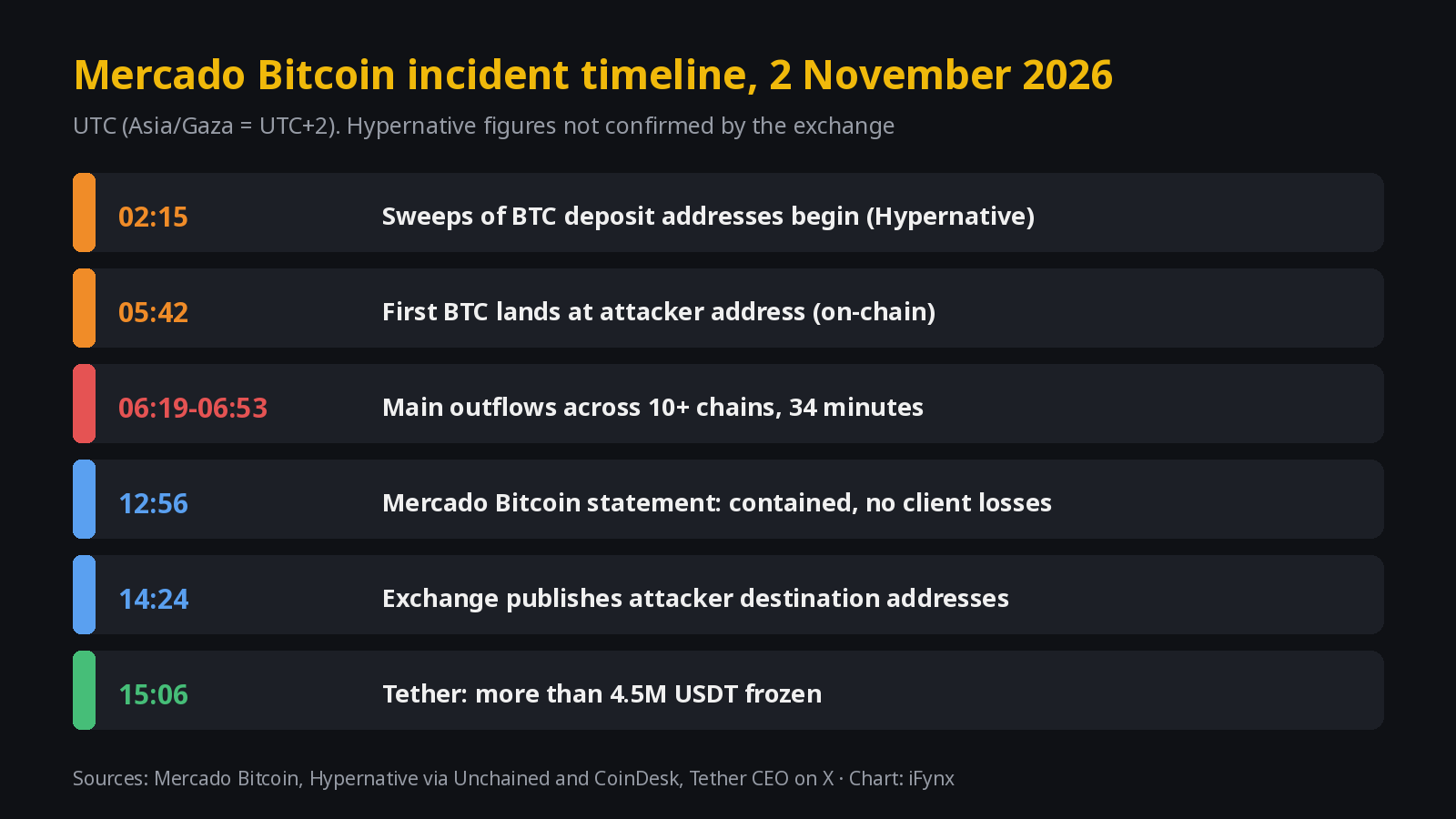
- Statement: Mercado Bitcoin on X, 2 November, 12:56 UTC (14:56 Asia/Gaza). It later published the attacker’s destination addresses on EVM chains, Bitcoin, Solana, Stellar and Tron.
- Reported amount: $40M+ (Hypernative). Holdings reported at about 2,852 ETH, 106 BTC, 10,700 SOL and 6.7M XLM plus 200+ other tokens.
- Timing: BTC deposit-address sweeps from 02:15 UTC; main outflows 06:19 to 06:53 UTC, per Hypernative.
- Method: plain transfers, not a smart-contract exploit. How signing access was obtained is unknown.
- Freeze: more than 4.5M USDT frozen, per Tether’s chief executive. A freeze is not a recovery.
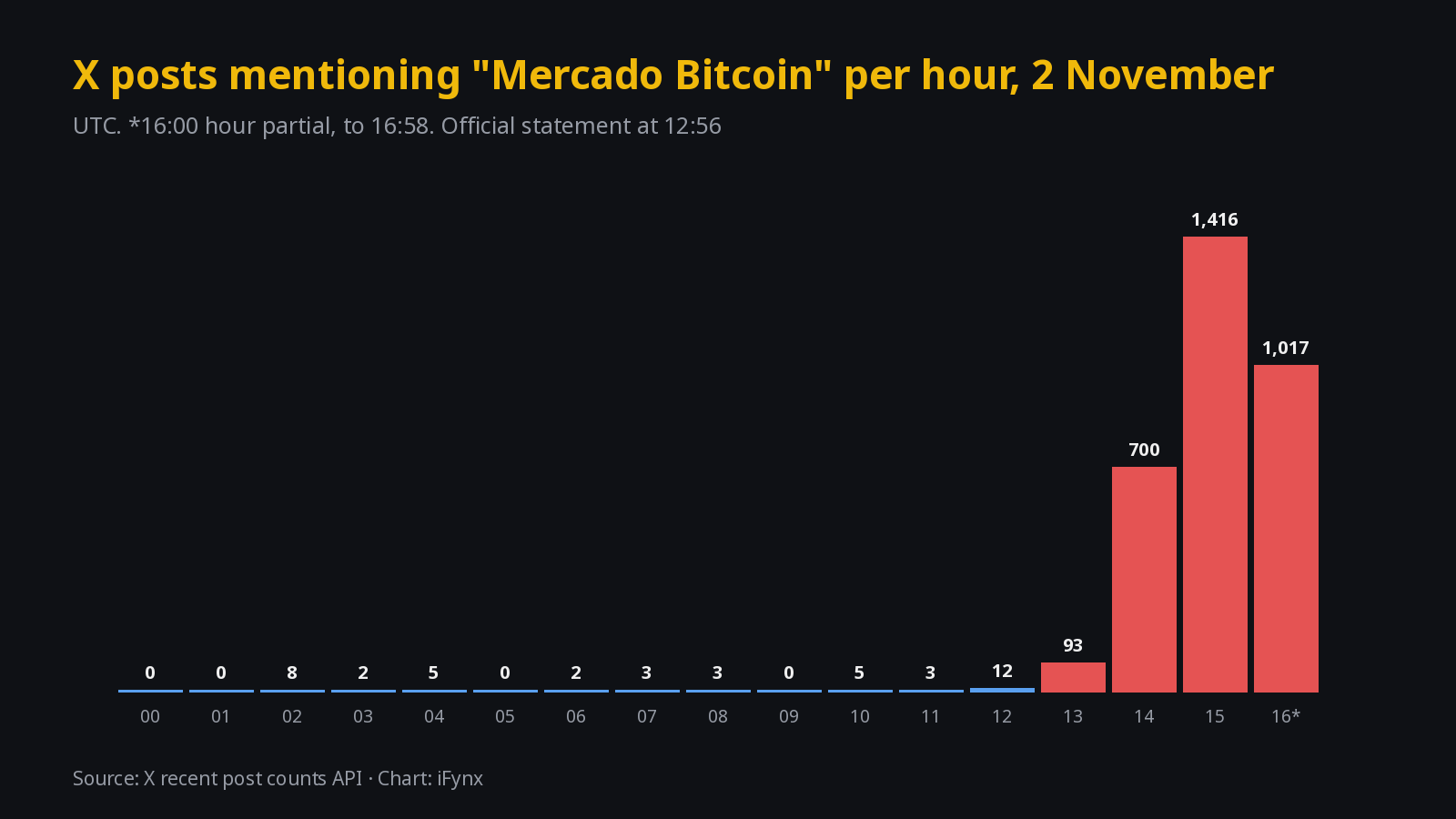
- Attention: X posts mentioning Mercado Bitcoin went from single digits per hour to 1,416 in the 15:00 UTC hour.
What we know about the Mercado Bitcoin hack
Mercado Bitcoin said in Portuguese that it “identified and quickly contained a security incident in one of our systems” in the early hours, and paused deposits and withdrawals as a preventive measure. It has not called the incident a hack and has not given a loss figure, Unchained notes. Hypernative’s alert, shared by Opsek’s founder, described the outflows as “plain transfers, not a smart contract exploit”. Unchained checked the Bitcoin address the exchange named and found about 106.07 BTC received, the first at 05:42 UTC.
| Item | What is reported | Status | Source |
|---|---|---|---|
| What happened | Security incident in one system, overnight 2 Nov | Confirmed by Mercado Bitcoin | MB on X |
| Amount | $40M+ across 10+ chains | Reported by Hypernative; not confirmed by MB | Unchained |
| Customer losses | None, says MB; no data leak | MB statement | MB on X |
| Deposits and withdrawals | Paused | No restart date | Decrypt |
| Method | Plain transfers; how signing access was gained is unknown | Not disclosed | CoinDesk |
| USDT | 4.5M+ frozen by Tether | Freeze, not recovery | Tether CEO on X |
| Attribution | None; no evidence of a Binance link | Open | CoinDesk |
Status as of 2 November 2026, 19:02 Asia/Gaza.
Three exchange incidents in five days
This comes after the $6.3 billion Binance hack on 29 October and the suspected $106 million theft from an EU entity’s exchange accounts on 1 November. The common thread is not one attacker; it is that hot wallets and signing systems connected to the internet are the target. CoinDesk says there is no public evidence tying Mercado Bitcoin to the Binance attack.
Is your money safe on a crypto exchange? A checklist for UAE, Saudi and Egypt users
- Move long-term holdings to self-custody. A hardware wallet you control is not exposed to an exchange’s hot wallets. Keep only what you trade on the exchange.
- Turn on a withdrawal allowlist and hardware-key 2FA. We covered the settings step by step in our $106M theft guide.
- Check your exchange’s proof of reserves and licence. In the UAE, look the firm up on VARA’s or ADGM’s public register before you deposit.
- Watch only official channels. During a pause, the exchange’s verified X account, app and website are the only sources to trust.
- Ignore “recovery” and “compensation” offers. Scammers message victims in Arabic on Telegram, WhatsApp and Facebook asking for a fee to release funds. No real exchange does this.
- Screenshot your balances now. If a loss is ever shared out, a dated record helps your claim.
Recovery scams warning
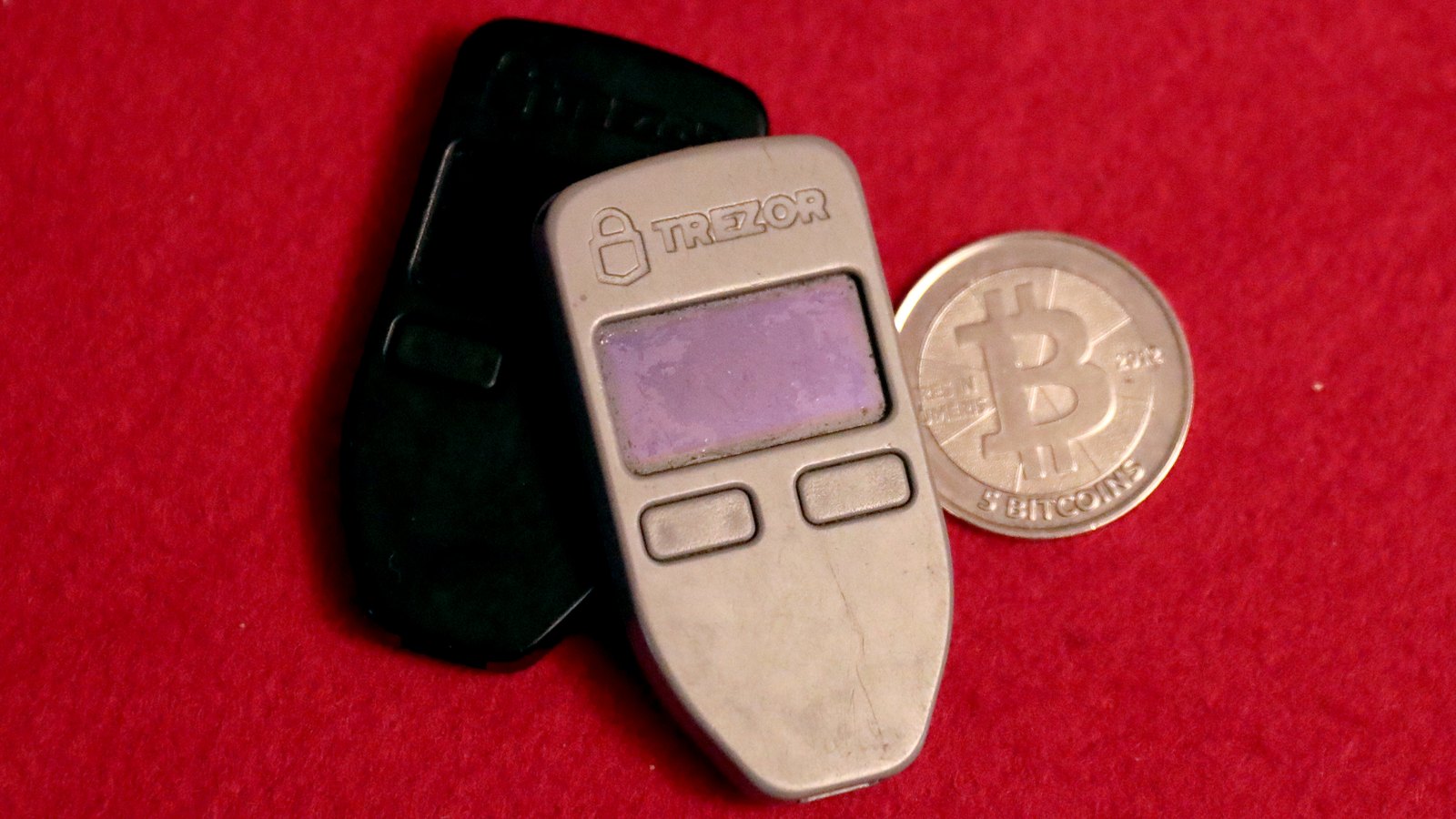
When withdrawals pause, fake “support agents” and “recovery experts” appear within hours, often writing in Arabic. Mercado Bitcoin, Binance and every real exchange will never ask you for a fee, a seed phrase or remote access to release funds.
For Gulf and Egypt exchanges and wallet teams: the engineering box
In Dubai, VARA’s Custody Services Rulebook asks custodians to run a risk-based analysis of hot versus cold storage, document and audit transfers between wallets, keep keys stored online unable to move funds without controls, and consider multi-signature; its segregation rules keep each client’s assets in separate wallets. Beyond the rulebook:
- Hot/cold split with a hard floor. South Korea’s FSC on 2 November asked exchanges to raise cold-wallet shares above the legal 80% minimum; Upbit is above 99%, TokenPost reports.
- Isolate signing keys. Use HSM or MPC signing with no single person, server or laptop able to approve a large withdrawal alone.
- Monitor deposit-address sweeps. Unexpected sweeps of deposit addresses, as reported here from 02:15 UTC, should page someone at once.
- Per-chain outflow circuit breakers. Auto-pause a chain when outflows pass a set limit per hour, so one compromised path cannot empty 10 chains in 34 minutes.
- Publish incident statements users can act on. Say what is paused, whether balances are safe, when the next update comes, and that staff will never ask for fees or keys.
For merchants running their own node, our BTCPay Server hot-wallet guide covers the same ideas at a smaller scale. User data matters too, as the Coinbase data breach showed.
Attention on X
What we are watching next
- Whether Mercado Bitcoin confirms an amount and explains how signing access was gained.
- When deposits and withdrawals resume, and on which networks first.
- Further freezes by Tether, Circle or other exchanges on the published addresses.
How iFynx can help
iFynx builds bilingual fintech and crypto products for the UAE, Saudi Arabia and Egypt, including wallet dashboards with approval workflows, outflow alerts and clear incident pages. See our services. Related: opening a crypto-friendly bank account in the UAE.
Frequently asked questions
Was Mercado Bitcoin hacked, and how much was taken?
Mercado Bitcoin says it identified and contained a security incident in one of its systems overnight on 2 November. It has not called it a hack or given a figure. Security firm Hypernative reported more than $40 million in outflows across at least 10 blockchains. That figure is not confirmed by the exchange.
Are Mercado Bitcoin customers’ funds safe?
The exchange says there were no losses to clients and no data leak. Deposits and withdrawals are paused as a precaution, and no date for resuming them has been given.
Can stolen USDT be frozen?
Yes. Tether can blacklist addresses holding USDT. Tether’s chief executive said on X that more than 4.5 million USDT tied to the incident was frozen. A freeze stops the tokens moving; it is not the same as returning them.
Is this linked to the Binance hack?
There is no public evidence linking the two, and no one has been blamed for the Mercado Bitcoin incident, CoinDesk reports.
Is my crypto safe on an exchange in the UAE, Saudi Arabia or Egypt?
No exchange is risk-free. In Dubai, VARA’s custody rules require client assets to be segregated and key storage to be risk-assessed and audited. Keep long-term holdings in self-custody, use withdrawal allowlists and hardware-key 2FA, and keep only trading balances on an exchange. Note that Saudi Arabia and Egypt do not license crypto exchanges.
What should I do if an exchange pauses withdrawals?
Wait for updates on the exchange’s official channels only. Never pay anyone who offers to recover or release your funds. These are scams, often in Arabic on Telegram and WhatsApp.
Sources
- Mercado Bitcoin official statement on X and address update, 2 November 2026
- Tether’s chief executive on X
- Opsek founder sharing Hypernative’s alert
- CoinDesk; Decrypt; Unchained; crypto.news
- FSC Korea press release; TokenPost
- VARA Custody Services Rulebook: wallet management and segregation
- X post counts: X recent counts API, queried 2 November 2026
- Cover photo: Mauro Cateb, Wikimedia Commons, CC BY-SA 4.0, cropped. In-article photo: Gage Skidmore, Wikimedia Commons, CC BY-SA 3.0, cropped. Charts: iFynx.


Related reading
- Crédit Mutuel Arkéa Crypto Hack: What We Know About the Alleged $133M Theft, and 10 Exchange-Account Controls for Gulf and Egypt Banks
- Across Protocol Hack: How a Registrar Social-Engineering Attack Turned across.to Into a Wallet Drainer, and the Domain Hijacking Checklist Gulf and Egypt Crypto Apps Need
- Lighter Suspected Exploit: $10.39M USDC Pulled, Withdrawals Suspended, What Lighter Says, and Lessons for Gulf and Egypt Exchanges