Update, 11 November 2026, 09:15 Asia/Gaza
Related: N-central 2026.4 HF1 shipped the fix for this kernel CVE; on 10 November N-able followed with an emergency Hotfix 2 for the "Able2Shell" flaws: see N-able N-central Vulnerability (Able2Shell): 33 Exploits, Emergency Hotfix 2026.4.1.26 and the RMM Security Checklist for Gulf and Egypt Companies.
Update, 9 November 2026 (20:40 Asia/Gaza): Ubuntu’s CVE tracker now lists a fixed kernel for Ubuntu 26.10 (linux 7.3.0-10.10). Every Ubuntu LTS release (26.04, 24.04, 22.04, 20.04, 18.04 and 16.04) is still listed as “Vulnerable, work in progress”, so the temporary mitigations below still apply to LTS servers.
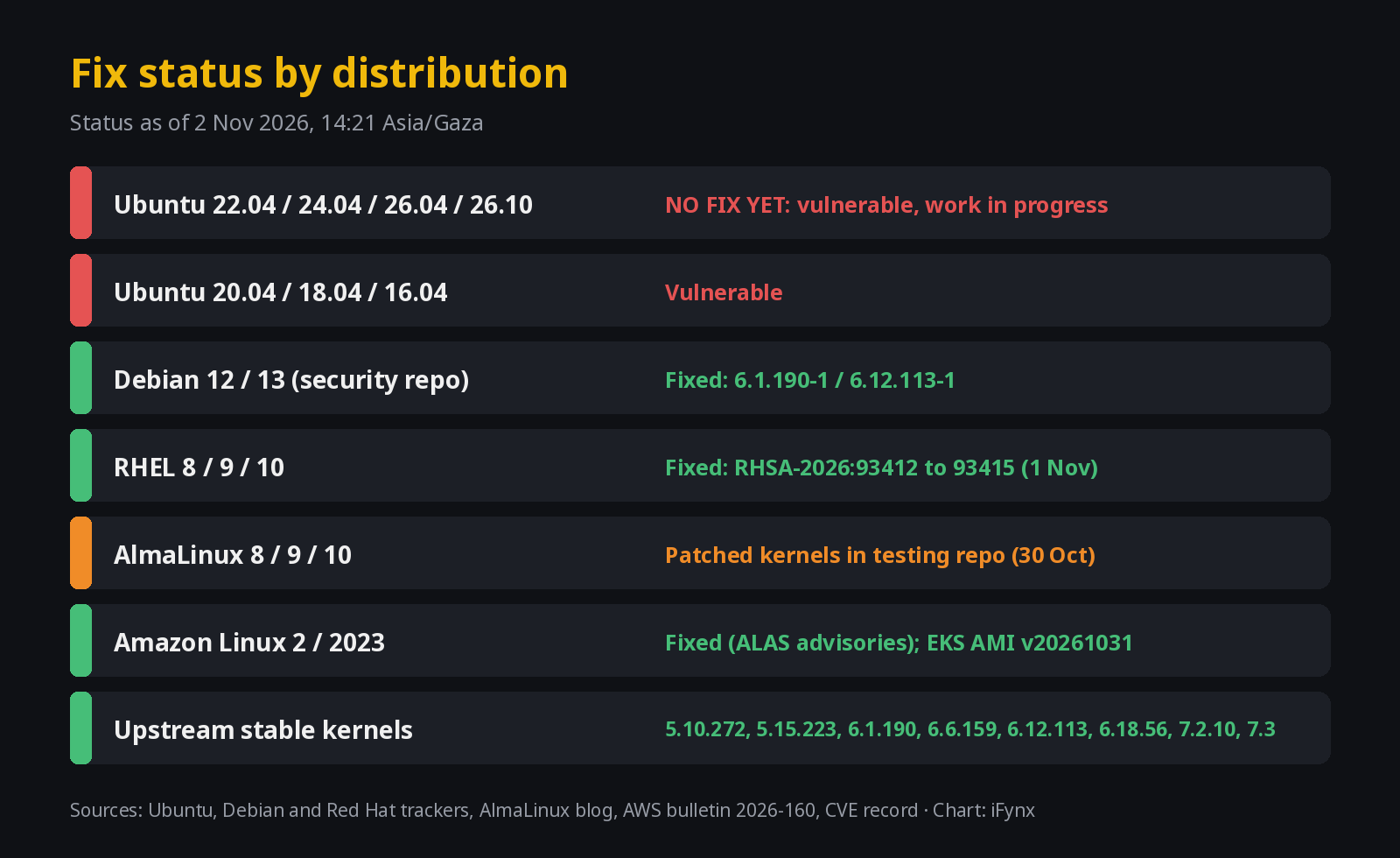
Published 2 November 2026, 14:21 Asia/Gaza. Developing story: we will add dated updates when Ubuntu ships a fixed kernel or vendors change their guidance.
Quick answer: CVE-2026-98432 is a critical Linux kernel vulnerability (CVSS 9.8) in the code that accepts new IPv4 TCP connections. It affects kernels from 4.4 onward and can be triggered over the network with no login. Researchers have shown remote root on servers with a Multipath TCP listener. Debian, Red Hat and Amazon Linux have fixed kernels. Ubuntu has no fix yet, so Ubuntu servers need temporary mitigations today and a patch plus reboot as soon as Canonical ships.
Key facts
- CVE: CVE-2026-98432, published by the Linux kernel CVE team on 15 October 2026. Fix: “ipv4: free inet_opt and ireq_opt after an RCU grace period” (commit e3f33b0a1d89), written by Eric Dumazet.
- Severity: CVSS 3.1 base score 9.8 Critical, vector AV:N/AC:L/PR:N/UI:N. Red Hat rates it Critical; Ubuntu priority High.
- Affected: Linux 4.4 and later. Fixed upstream in 5.10.272, 5.15.223, 6.1.190, 6.6.159, 6.12.113, 6.18.56, 7.2.10 and 7.3. IPv6 is not affected by the main issue.
- Impact: kernel crash, kernel memory disclosure or memory corruption (AWS). Anthropic’s proof of concept runs commands as root on servers with an MPTCP listener.
- Ubuntu: no fixed kernel as of 2 November 2026, 14:21 Asia/Gaza; tracker last updated 30 October.
- Crypto angle: the Solana Foundation’s validator relations lead and Anza told Ubuntu validators to mitigate immediately (2 November, 02:04 Asia/Gaza).
- Exploitation: AWS is not aware of exploitation in the wild.
What is CVE-2026-98432, in plain terms?
Every time a client opens a TCP connection, the server kernel briefly keeps a “request socket” for the half-open connection. If the client’s SYN packet carries IPv4 options, the kernel stores a copy of those options so it can echo them in its SYN-ACK. According to the official CVE record and AlmaLinux’s explanation, when the handshake completed the kernel handed that copy to the new socket without duplicating it. If the client retransmitted its SYN, another CPU could be building a SYN-ACK from the same options while the new socket was closed and freed. The code then read memory that had already been freed.
A similar problem exists when TCP request socket migration is turned on (the net.ipv4.tcp_migrate_req sysctl or a BPF program that migrates requests); that setting is off by default. The fix waits for an RCU grace period before freeing the options, the same way the kernel already handles them elsewhere. The bug dates back to Linux 4.4, which is why the list of affected systems is so long.
Any AlmaLinux system that accepts IPv4 TCP connections from untrusted networks should be treated as exposed.
AlmaLinux, 30 October 2026
Why this Linux kernel vulnerability is rated 9.8
The vulnerable code runs inside the kernel before any application sees the connection, so it does not matter which service listens on the port: SSH, a web server, a database or a validator. The attacker needs no account and no user action. Red Hat’s statement says reliable code execution needs precise heap control, but the lack of network prerequisites and the risk of severe instability push it above Important to Critical.
In its 27 October research post, Anthropic’s Frontier Red Team says a research model wrote an exploit that lets a remote attacker run commands as root on Linux servers with a Multipath TCP listener, without credentials. A failed attempt only fails the handshake, so an attacker can keep retrying; their proof of concept took about 53 minutes end to end. We do not publish exploit details or links. The Go Security Team adds that the bug is not specific to MPTCP, and systems with no MPTCP listener may be open to similar attacks.
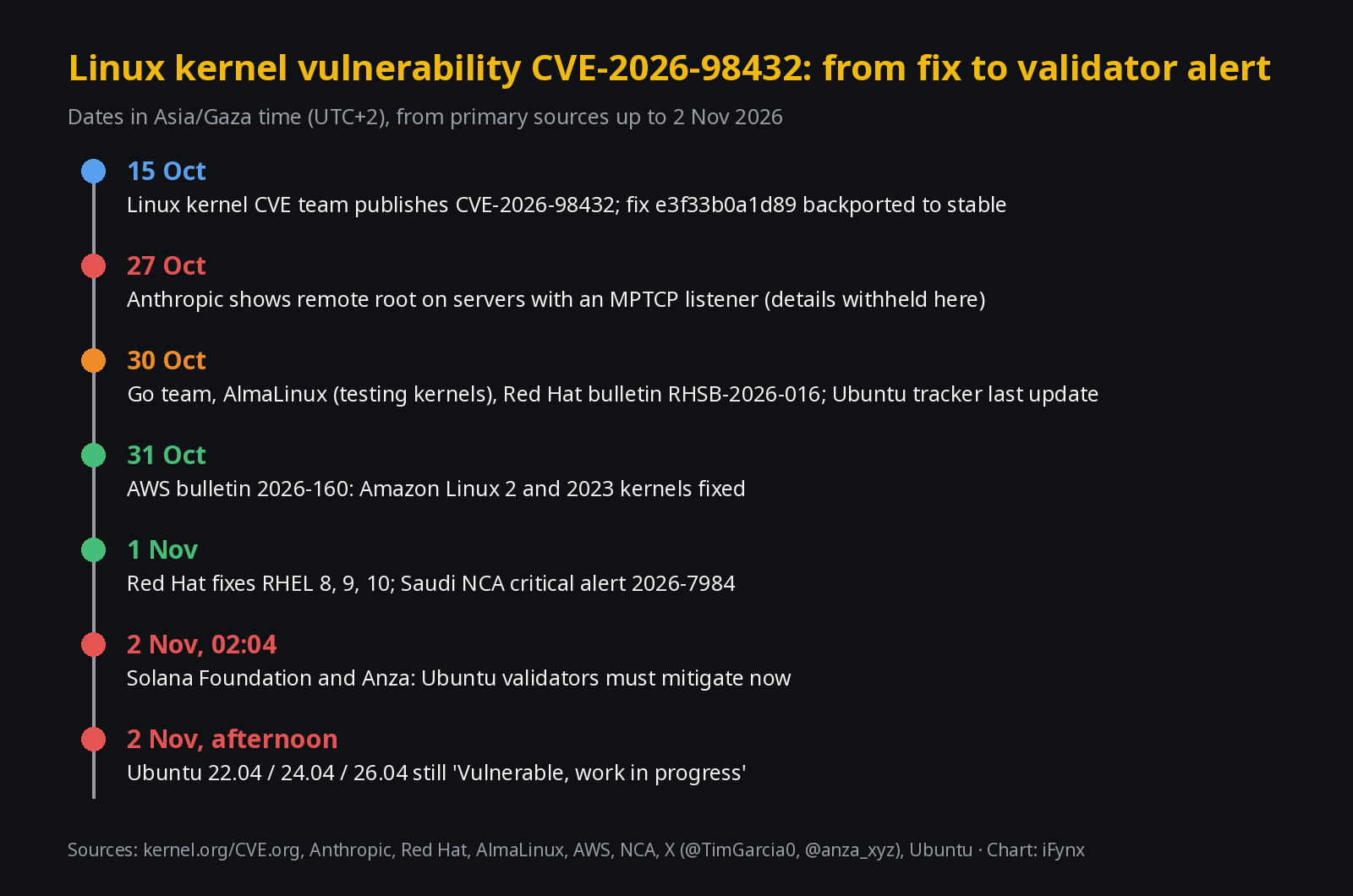
Distro status table: who has a fix (status as of 2 November 2026, 14:21 Asia/Gaza)
Distributions backport the upstream fix into their own kernel versions, so always check your distribution’s tracker rather than comparing version numbers with kernel.org. Plainly: Ubuntu has not released a fixed kernel yet.
| Distribution | Status | What to do | Source |
|---|---|---|---|
| Ubuntu 22.04 / 24.04 / 26.04 / 26.10 | No fix yet. Vulnerable, work in progress | Mitigate now, patch and reboot when Canonical ships | Ubuntu |
| Ubuntu 20.04 / 18.04 / 16.04 | Vulnerable | Mitigate; check ESM / Pro status | Ubuntu |
| Debian 12 bookworm | Fixed in security repo: 6.1.190-1 (also linux-6.12 6.12.113-1~deb12u1) | Update and reboot | Debian |
| Debian 13 trixie | Fixed in security repo: 6.12.113-1 (DSA-6568-1) | Update and reboot | Debian |
| RHEL 8 / 9 / 10 | Fixed: RHSA-2026:93412, 93413, 93414, 93415 (dated 1 Nov). RHEL 6 and 7 not affected | Update and reboot; OpenShift RHCOS listed as affected | Red Hat |
| AlmaLinux 8 / 9 / 10 | Patched kernels in the testing repo since 30 Oct | Check AlmaLinux errata for the production release | AlmaLinux |
| Amazon Linux 2 / 2023 | Fixed (ALAS2-2026-4065, ALAS2023-2026-3365 and others) | Update and reboot; EKS AMI v20261031+ | AWS |
| Upstream stable | 5.10.272, 5.15.223, 6.1.190, 6.6.159, 6.12.113, 6.18.56, 7.2.10, 7.3 | Custom kernels: rebuild on these | CVE record |
Temporary mitigations for Ubuntu servers (vendor-published)
These are the interim steps published by Red Hat, AlmaLinux, AWS and, for validators, the Solana Foundation’s Tim Garcia. They lower the risk while you wait for a kernel. They are not a fix. Test them on one host first.
1) Drop inbound IPv4 TCP packets that carry IP options
Normal traffic almost never uses IPv4 options (standard TCP options live in the TCP header and still pass), so this rule blocks the trigger without affecting regular connections. This is Red Hat’s table; AlmaLinux publishes an equivalent prerouting version, and AWS gives an iptables equivalent. It does not survive a reboot unless you save it with your distribution’s tooling.
sudo nft -f - <<'EOF'
table inet cve_2026_98432 {
    chain input {
        type filter hook input priority -310; policy accept;
        ip protocol tcp ip hdrlength > 5 counter drop
    }
}
EOF
2) Turn off Multipath TCP and restart existing MPTCP listeners
Setting net.mptcp.enabled=0 stops new MPTCP sockets but does not close existing listeners, so AlmaLinux says to list them with ss -lnMp and restart the services that own them. Go programs built with Go 1.24 or later enable MPTCP on Linux listen sockets by default; the Go team says GODEBUG=multipathtcp=0 turns that off per program.
# Disable Multipath TCP system-wide, then find services that still hold MPTCP listeners
sudo sysctl -w net.mptcp.enabled=0
sudo ss -lnMp
# Keep TCP request socket migration off (off by default)
sudo sysctl -w net.ipv4.tcp_migrate_req=0
Know the limits
Red Hat says filtering reduces exposure but cannot fully prevent exploitation. A contributor on oss-security notes that a host packet filter can be bypassed by traffic between containers on the same host, and suggests the init_on_free=1 boot parameter as extra hardening (post). That is a community suggestion, not a vendor fix. The only complete remediation is a patched kernel and a reboot (AWS).
Patch-and-reboot runbook for Gulf and Egypt hosting and cloud teams
- Inventory today: list every Linux host with a public IPv4 address or behind a TCP pass-through load balancer. AWS notes that Network Load Balancer TCP listeners and Global Accelerator pass IP options through to targets, while ALB, CloudFront and API Gateway do not take raw TCP from the internet.
- Patch what can be patched: Debian, RHEL and Amazon Linux hosts can be updated and rebooted now. Do it in waves, behind your load balancer, starting with the most exposed.
- Mitigate Ubuntu: apply the nftables rule and the MPTCP settings on Ubuntu hosts, then watch the Ubuntu tracker and install the kernel the day it ships. If you use Livepatch, check whether Canonical lists a livepatch for this CVE before relying on it.
- Kubernetes and containers: node pools need new node images or a kernel update and reboot. Container image rebuilds do not help. On AWS, EKS AMI v20261031 or later; Bottlerocket AMIs from 2 November.
- Managed services: read your provider’s bulletin. AWS says Lambda is not affected and RDS, Redshift and others are getting mitigations; check the same for your local cloud region and hosting provider in the UAE, Saudi Arabia or Egypt.
- Record it: keep a log of hosts, kernel versions before and after, mitigation dates and reboot times. It is the evidence your regulator’s patch-management controls ask for.
uname -r                                   # which kernel is running now
sudo dnf update kernel && sudo reboot      # RHEL / Alma / Amazon Linux 2023 (AL2: yum)
sudo apt update && sudo apt full-upgrade && sudo reboot   # Debian (security repo)
Crypto angle: Solana validators and hot-wallet servers
At 02:04 Asia/Gaza on 2 November, Tim Garcia, who leads validator relations at the Solana Foundation, posted that the CVE “is patched in the linux kernel but not yet patched on ubuntu” and listed three steps: the nftables rule, net.mptcp.enabled=0 and net.ipv4.tcp_migrate_req=0. Minutes later Anza, the team behind the Agave validator client, quoted it as “URGENT, Critical Linux Kernel Vulnerability — Action Required” for mainnet-beta validators.
The reason is simple: a validator’s identity key lives on the host, and a root compromise of the host exposes it. Updating the validator client does not patch the kernel underneath. The same applies to any server holding hot keys, including self-hosted payment servers like the BTCPay instances we covered this morning in the BTCPay Server hack, and exchange infrastructure in the week of the Binance hack. Keep withdrawal and cold keys off internet-facing servers.
Gulf and Egypt angle: regulators and what to report
Saudi Arabia’s National Cybersecurity Authority published critical alert 2026-7984 on 1 November, telling organisations across government, finance, energy, health and other sectors to review the Linux kernel advisory and apply updates. Organisations under NCA’s Essential Cybersecurity Controls, UAE entities following the Cyber Security Council’s guidance and the UAE Information Assurance standards, and Egyptian firms working with EG-CERT should treat this as an out-of-cycle critical patch and document both the mitigation and the final kernel update.
For banks, payment firms and licensed virtual-asset providers, the practical question from auditors will be: which internet-facing Linux hosts were exposed, when were they mitigated, and when were they patched? Answer it now, while the data is fresh.
What we are watching next
- Canonical publishing fixed kernels (and any livepatch) for Ubuntu 22.04, 24.04 and 26.04.
- AlmaLinux moving its kernels from testing to production, and Rocky Linux, SUSE and other vendors’ status.
- Any confirmed exploitation in the wild or a CISA KEV listing.
- The separate IPv6 CALIPSO migration fix the kernel developers said will come in another patch.
We will add a dated update when any of these change.
How iFynx can help
iFynx builds and maintains bilingual web and mobile products for teams in the UAE, Saudi Arabia and Egypt, including the server, CI and patch processes behind them. See our services or read what iFynx is. More patch guides from us: the Brotli Node2Shell checklist, the PHP php2shell update and WordPress 7.1.4.
Frequently asked questions
What is the Linux kernel vulnerability CVE-2026-98432?
It is a use-after-free bug in the code that sets up incoming IPv4 TCP connections. When a connection request carries IPv4 options, the kernel could free those options while another CPU was still using them to build its reply. The Linux kernel CVE team scores it CVSS 9.8 (Critical): network attack, no login, no user action. Red Hat also rates it Critical.
Is my server affected?
Probably, if it runs Linux 4.4 or newer and accepts IPv4 TCP connections from untrusted networks. Check your kernel with uname -r and compare it with your distribution’s tracker. Upstream fixed kernels are 5.10.272, 5.15.223, 6.1.190, 6.6.159, 6.12.113, 6.18.56, 7.2.10 and 7.3, but distributions backport fixes into their own version numbers, so the distro tracker is what counts.
Has Ubuntu released a fix?
No. As of 2 November 2026, 14:21 Asia/Gaza, Ubuntu’s CVE page lists the main linux package on 22.04, 24.04, 26.04 and 26.10 as “Vulnerable, work in progress” and 20.04, 18.04 and 16.04 as “Vulnerable”. The page was last updated on 30 October. Until a fixed kernel ships, Ubuntu servers need the temporary mitigations below. Update 9 November 2026: Ubuntu 26.10 now has a fixed kernel (7.3.0-10.10); all LTS releases are still listed as vulnerable, work in progress.
What are the safe temporary mitigations?
The vendors’ interim steps are: drop inbound IPv4 TCP packets that carry IP options (an nftables rule published by Red Hat and AlmaLinux), disable Multipath TCP with net.mptcp.enabled=0 and restart services that already hold MPTCP listeners, and keep net.ipv4.tcp_migrate_req at 0. These reduce exposure but do not fix the bug. Red Hat says filtering cannot fully prevent exploitation.
Do containers and Kubernetes nodes need a reboot?
Yes. Containers share the host kernel, so updating container images does nothing for this bug. Each node needs a fixed kernel and a reboot, or replacement with a patched node image. AWS, for example, says to move EKS nodes to AMI release v20261031 or later. Updating a Solana validator client also does not patch the host kernel.
Is there exploitation in the wild?
AWS says it is not aware of exploitation in the wild. Anthropic’s researchers built a working proof of concept that runs commands as root on servers with an MPTCP listener, and Hong Kong’s GovCERT says PoC code is reported to be available. Treat it as urgent.
What should banks, fintechs and crypto teams in the Gulf and Egypt do this week?
Inventory every internet-facing Linux host, patch and reboot distributions that have fixes today, apply the interim filter on Ubuntu hosts, and record what you did for your regulator’s patch-management controls. Saudi Arabia’s National Cybersecurity Authority issued critical alert 2026-7984 on 1 November. Crypto teams running validators or hot-wallet servers on Ubuntu should treat this as a key-exposure risk.
Sources
- CVE record, NVD, kernel CVE announcement, upstream fix
- Ubuntu CVE page (checked 2 November 2026, 14:21 Asia/Gaza)
- Debian security tracker
- Red Hat CVE page and bulletin RHSB-2026-016
- AlmaLinux, 30 October 2026
- AWS security bulletin 2026-160, last updated 1 November 2026
- Anthropic Frontier Red Team, 27 October 2026
- Go Security Team via oss-security; init_on_free note on oss-security
- Tim Garcia on X and Anza on X, 2 November 2026
- Saudi NCA alert 2026-7984; GovCERT.HK alert A26-10-64
- X post counts: X recent counts API, queried 2 November 2026
- Cover photo: Carl Lender, Wikimedia Commons.jpg), CC BY 2.0, cropped. In-article photo: Derrick Coetzee, Wikimedia Commons, CC0. Charts: iFynx.

Related reading
- APT Vulnerability CVE-2026-109518: Debian and Ubuntu Fixed apt Versions, How to Update apt First, and a Mirror and Proxy Checklist for Gulf and Egypt Servers
- OpenAI Bug Bounty Now Pays Up to $172,000: The New Reward Table, How the Multipliers Work, and What Arab Bug Hunters and Gulf and Egypt Companies Should Do
- WorkOS Breach Involved ARTEX, an AI Agent Attack Framework: What Was Taken, What ARTEX Is, and an AI-Speed Defence Checklist for Gulf and Egypt Banks, Fintechs and SaaS Teams
- Android TV Box Malware: Google Takes Down the XCPE Botnet in 1.3 Million Boxes. Is Your Box or IPTV Receiver Infected? A Check-and-Replace Guide for Egypt, Iraq, the Gulf and Palestine