Direct answer — 10 November 2026: The German web host Mittwald says an attacker used a vulnerability in its own Model Context Protocol (MCP) server — the interface customers used to connect AI assistants to its mStudio hosting platform — to read the session tokens of people who used that interface. Those tokens worked with each user’s own rights. In its 7 November incident post, founder and managing director Robert Meyer says the attacker first probed the flaw on the evening of 21 October, exploited it at 15:03 on 27 October, and was spotted on the morning of 4 November: about eight days inside. Mittwald says it forensically examined 56 compromised projects, that “no passwords were read, but session tokens”, that all those tokens were revoked, and that the MCP server stays offline for now. Mittwald also says the speed in its logs “points to the use of AI tools”. That is the company’s inference, not proven, so we describe the attack as allegedly AI-assisted.

This is the first widely reported breach in which the way in was a hosting company’s own MCP connector. It will not be the last. Agencies and SaaS teams across the Gulf and Egypt that iFynx works with are plugging Claude, ChatGPT and Cursor into hosting panels, Git, ticketing, banking sandboxes and e-invoicing back offices through MCP. This guide pulls together what Mittwald and its FAQ actually say, a companion case about trusted vendor access (Qubole’s AWS roles, reported by Wiz on 9 November), and a practical MCP server security checklist you can apply this week. We do not describe how the flaw was exploited, and Mittwald has not published that either.
What Mittwald says happened, day by day
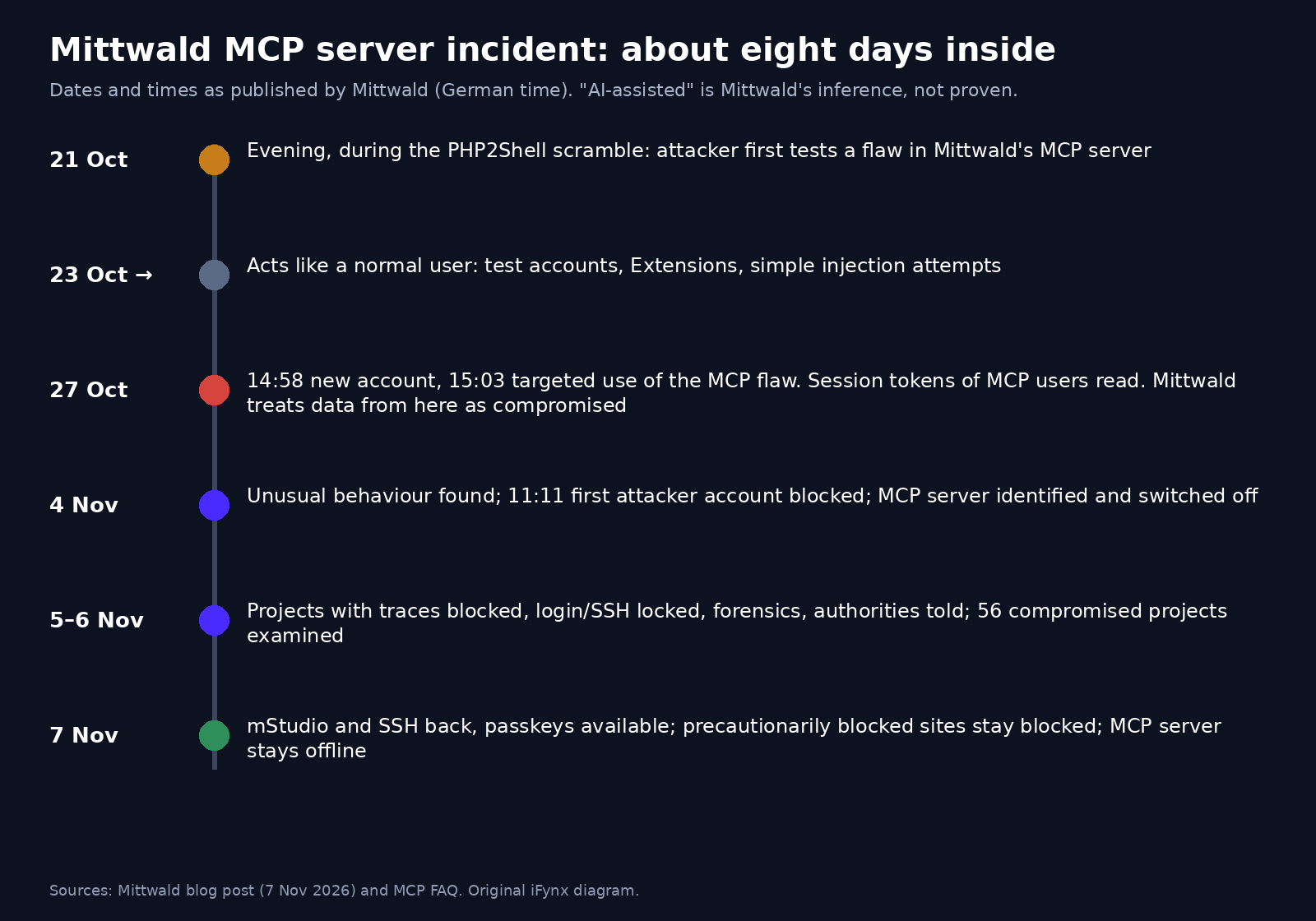
Mittwald’s post is titled “Sicherheitsvorfall am MCP-Server” (security incident at the MCP server). Its timeline, translated from German:
- 21 October, evening: “the whole IT world was busy with PHP2Shell.” At that moment, Mittwald says, the attacker first tested a vulnerability in its MCP server. (iFynx covered PHP2Shell in our PHP2Shell update guide.)
- From 23 October: the attacker moved around the platform as a regular user, registered test accounts, used Extensions and made “simple injection attempts”.
- 27 October, 14:58 and 15:03 (German time): a further account was registered, and five minutes later it was used to exploit the MCP-server flaw in a targeted way. Mittwald says it treats all data from 27 October onward as compromised.
- 4 November: unusual behaviour was found in the morning; the first attacker account was blocked at 11:11; the status page went to “investigation” at 12:53. The MCP server was identified as the entry point and switched off. Web projects stayed reachable.
- 5 November: projects with traces of the attacker were blocked shortly after midnight, new sign-ups paused, and mStudio login and SSH access to customer projects locked during the day. External forensic experts joined, and “we have informed the relevant authorities.”
- 6 November: 56 compromised projects and the MCP server were forensically evaluated; repeated scans found no further compromised projects, and no current attacker activity could be detected.
- 7 November: mStudio and SSH access were re-enabled, and passkeys can now be set up. Websites Mittwald blocked as a precaution “remain blocked for the time being.” The Kundencenter (customer centre) and the websites managed there “were not affected at any time.”
Mittwald says it will publish a detailed account “next week”, once analysis and recovery are complete. When we re-checked its blog and status page at 09:00 Asia/Gaza on 10 November, that account had not yet appeared.
What was taken, and what Mittwald says was not
The Mittwald MCP FAQ is more specific than the blog post:
- What: on 4 November Mittwald found, through its own analysis, unauthorized access to its MCP server on 27 October, “and credentials (tokens) of users of this interface were read.”
- Passwords: “No. No passwords were read, but session tokens. These tokens have all been revoked and are no longer valid.”
- What a token allowed: “The token allowed access to your mStudio with your rights. The attacker could use it to access projects you had access to.”
- Who is affected: only people who used the MCP server; they get a personal email. Anyone who used the MCP server after 27 October should treat that use as potentially compromised.
- Leaks: Mittwald says it has no indication the data has appeared online and keeps checking.
- API keys: some were blocked as a precaution during the first response.
In short, the stolen item was a delegated session, not a password. That is the core lesson for anyone running an MCP server: the connector holds a key that already has the user’s power.
“AI-assisted”: what the evidence actually is
Meyer writes that the logs show the attacker “worked extremely quickly through our system”, with “sometimes only seconds between steps that would take significantly longer for a human attacker.” He adds: “AI attacks will become more frequent in the future.” The Record, reporting on 9 November, notes that Mittwald “provided no other evidence of AI involvement” and had not answered a question about how it told AI tools apart from ordinary scripts. The Record also says it is unclear whether the flaw was in Mittwald’s own code or in open-source MCP libraries. Mittwald’s FAQ says “the gap was in our MCP server.”
Our reading: whether the attacker used an AI agent or a fast script does not change the defence. The attacker blended in with normal-looking user actions for days. Detection that waits for “obviously malicious” behaviour will be late against either.
Why an MCP server is a high-value target
MCP lets an AI assistant call “tools” on a server: list projects, read files, change DNS, open tickets, create invoices. To do that, the server holds or brokers credentials for every connected user. Compromise the connector, and you can pick up many users’ sessions at once, each with real permissions. The official MCP security best practices make several points that match this incident:
- “MCP servers MUST NOT accept any tokens that were not explicitly issued for the MCP server” — so-called token passthrough is forbidden.
- “MCP Servers MUST NOT use sessions for authentication”, and session IDs must be random and bound to the user.
- Scope minimisation: broad scopes “increase token compromise impact”; start with read-only, low-risk tools and elevate step by step.
Earlier iFynx coverage shows the same pattern from other angles: the GitBook breach and its AI-agent tokens, the WorkOS / ARTEX agent-attack framework, and the product side of MCP in our AWS MCP server for Lambda piece. The common thread: whatever an assistant can do, a thief with its token can do too.
Companion case: Qubole’s trusted AWS roles
On 9 November, Wiz, working with Sentra and Mandiant, reported that between 14 and 26 October 2026 a threat actor used IAM credentials from an AWS account associated with Qubole, a data-lake platform, to assume the integration roles customers had created to trust Qubole. Every request carried the External ID and every one succeeded. Most of those roles were not otherwise in use, but the trust policies were still in place. Inside, the actor collected secrets from Lambda environment variables, Secrets Manager and SSM Parameter Store, tested the credentials it found, and copied data out of S3, sometimes whole buckets. The Hacker News notes that how the attacker got the credentials has not been disclosed, and that Qubole and its owner Idera had not posted a statement when it checked.
Mittwald and Qubole are different incidents with no reported link. They teach the same lesson: access you grant to a connector or a vendor is a standing door. Wiz’s own advice: check CloudTrail from 1 October in every account that holds a Qubole role (the account Wiz lists is 805246085872), remove roles you no longer need, narrow the trusted principal, add aws:SourceIp or aws:SourceVpce conditions, and do not treat the External ID as a secret. Wiz says “a source IP condition alone would have blocked every role assumption we observed.”
MCP server security checklist for Gulf and Egypt teams
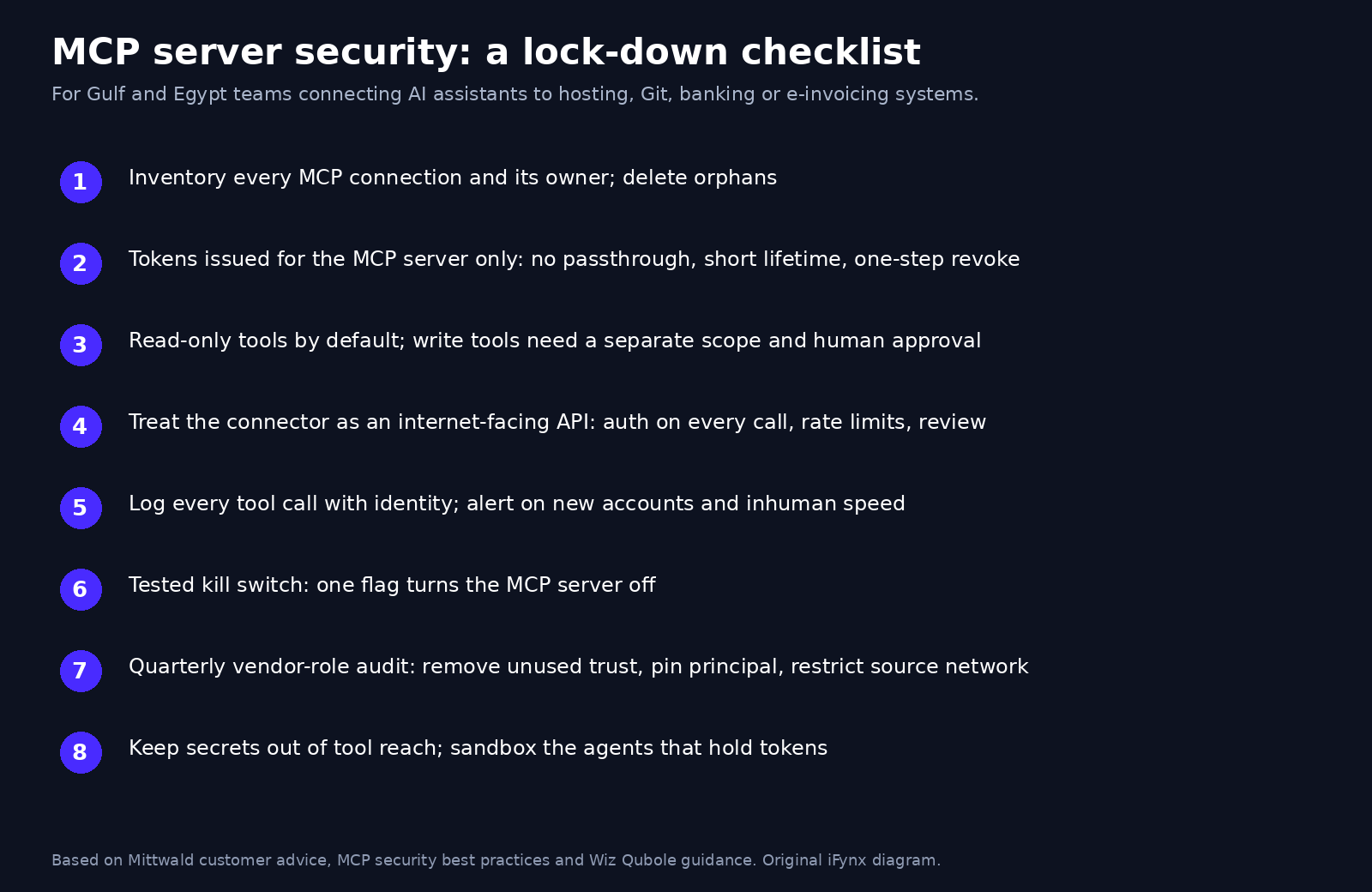
If you run an MCP server for your product, or let staff connect AI assistants to client systems, work through this list. It is drawn from Mittwald’s customer advice, the MCP specification and Wiz’s vendor-role guidance, not from any single vendor.
- Inventory every MCP connection. Which assistants (Claude, ChatGPT, Cursor, internal agents) are connected to which hosting panels, Git hosts, CRMs, banking sandboxes or e-invoicing systems, and by whom? Remove the ones nobody owns.
- Issue tokens for the MCP server only. No passthrough of upstream tokens. Short lifetimes, rotation, and server-side revocation that works in one step, the way Mittwald revoked every MCP token.
- Least privilege by default. Read-only tools first. Write tools (deploy, delete, DNS, payments, invoice submission) need a separate scope and a human approval step.
- Treat the connector as an internet-facing API. Authentication on every request, rate limits, input validation, and a security review before launch, not after the first customer asks.
- Log tool calls with identity. Who, which assistant, which tool, which project, and how fast. Alert on new accounts that call sensitive tools within minutes, and on bursts of tool calls faster than a person types.
- Make kill switches boring. One flag that turns off the MCP server, and per-user token revocation, tested in a drill. See our OpenAI Control Room explainer for the fail-closed pattern.
- Audit vendor and integration roles quarterly. Delete unused trust (the Qubole lesson), pin the vendor principal, and restrict by source network.
- Keep secrets out of reach of tools. Agents should not be able to read
.envfiles or project settings that hold database, mail or payment credentials; see our Claude Code secrets checklist. - Plan the notice. If a connector held personal data for customers in the UAE, Saudi Arabia or Egypt, know in advance which privacy-law notice duties may apply, and who decides.
Sandboxing the agents that call your MCP servers
The other half of MCP security is the client side: the AI coding agents and assistants that hold the tokens. A plain container shares the host kernel and often sees mounted credentials, so “it runs in Docker” is not the same as “it is isolated”. Docker Sandboxes describes microVM isolation for coding agents and lets admins centrally manage network, filesystem and MCP policies. Whatever tool you use, the rules are the same: give the agent a disposable workspace, mount only the repository it needs, block outbound traffic except to an allowlist, route MCP access through a gateway that logs calls, and never mount your home directory or cloud credentials. Our Plugin4Shell guide covers the supply-chain side, and the Fireworks AI breach shows that AI infrastructure itself is now under attack.
If you or your clients host at Mittwald
Mittwald’s FAQ says that if you never set up the MCP server and did not get a personal email, you are not affected according to its current findings; it still recommends turning on two-factor authentication. If you did use the MCP server, Mittwald asks you to: change your mStudio password; turn on two-factor authentication; check API keys, Project Tokens and SSH keys in your projects and delete unknown entries, watching for SSH users you did not create; renew third-party credentials stored in your projects (databases, mail, external APIs); and inform the users of your project. Agencies in Dubai, Riyadh or Cairo that host European clients there should also tell those clients what was checked, in writing.
How iFynx can help
iFynx AI & Data builds AI Agents & Automations and AI Development projects with MCP servers that use scoped tokens, approval steps for write actions, tool-call logging and a tested kill switch. Maintenance & Growth covers Software Maintenance: token rotation, vendor-role audits and monitoring after launch. If your team in the Gulf or Egypt is connecting AI assistants to production systems, book a free 30-minute discovery call. iFynx is not affiliated with Mittwald, Qubole or Wiz and cannot tell you whether your account was affected.
Frequently asked questions
What is an MCP server, and why is it an attack surface?
An MCP (Model Context Protocol) server exposes tools that an AI assistant can call, such as reading files or changing settings in another system. To act for users it holds or brokers their credentials, so a flaw in the server can expose many users’ sessions at once, each with real permissions. Mittwald’s incident is an example: session tokens of MCP users were read, and each token worked with that user’s rights.
What exactly happened at Mittwald, and how many projects were hit?
Mittwald says an attacker first tested a flaw in its MCP server on 21 October 2026, exploited it on 27 October, and was detected on 4 November. It forensically evaluated 56 compromised projects, found no further ones after repeated scans, revoked all MCP session tokens, and says no passwords were read. The MCP server remains offline, and Mittwald has promised a detailed account.
Was the Mittwald attack really carried out with AI?
Mittwald says the speed in its logs, sometimes seconds between steps, points to AI tools. That is its inference. The Record notes Mittwald gave no other evidence and had not explained how it ruled out ordinary automation, so the AI element is alleged, not proven.
Was the flaw in Mittwald’s own code or in the MCP SDK?
Mittwald’s FAQ says the gap was in its MCP server. The Record reports it is unclear whether that means Mittwald’s own code or open-source MCP libraries. Until Mittwald publishes its detailed account, treat this as open and check your own MCP server and its dependencies either way.
How do I lock down my own MCP server, and audit vendor roles like Qubole’s?
Issue tokens only for the MCP server, keep scopes minimal with read-only tools by default, require human approval for write actions, log every tool call with identity, and keep a tested kill switch. For vendor access, remove unused trust, restrict the trusted principal and source network, do not treat an External ID as a secret, and review CloudTrail for the dates the vendor or researcher names.
Sources and update policy
Primary sources: Mittwald, “Sicherheitsvorfall am MCP-Server” by Robert Meyer, 7 November 2026; the Mittwald MCP FAQ (updates to 7 November 2026, 10:56 CET); the Mittwald status page; Wiz, “Trusted by Default: Qubole Cross-Account Access Abused in the Wild,” 9 November 2026; and the MCP security best practices. Secondary: The Record and The Hacker News, 9 November 2026; Docker Sandboxes documentation. Quotes from Mittwald are iFynx translations from German. We do not describe exploit steps. We will update this article, with the time, when Mittwald publishes its detailed account or if Qubole or Idera make a statement.
Related reading
- GitBook Breach by AI Agents: What Was Exposed (Git Sync Secrets, API and Integration Tokens, Assistant Questions), What to Rotate Now, and a Docs-Platform Security Checklist for Gulf and Egypt Crypto, Fintech and SaaS Teams
- Claude Code Secrets on GitHub: What Apiiro Found in settings.local.json — A Rotate-First Checklist
- WorkOS Breach Involved ARTEX, an AI Agent Attack Framework: What Was Taken, What ARTEX Is, and an AI-Speed Defence Checklist for Gulf and Egypt Banks, Fintechs and SaaS Teams
- Fireworks AI Data Breach: What Was Exposed (Secrets, Datasets, Model Weights), What LLMjacking Is, and What AI Teams in the Gulf and Egypt Should Rotate Now
- Chrome zero-day CVE-2026-125350: update Chrome now (157.0.8103.50) — what Gulf and Egypt teams should do
- Outlook Zero-Day CVE-2026-124194: November 2026 Patch Tuesday and What to Patch First in Gulf and Egypt Companies
- Grok Build Apps Exposed: Why 35,000 AI-Built Apps Were Open to Anyone, and the AI App Builder Security Checklist for Gulf and Egypt Teams
- Cursor Security Breach: How a Key Exposed at Fireworks AI Led to a Malicious Claude Code Extension, and What Dev Teams Should Check Now
- FBI ARTEX Warning (FLASH-20261113-001): What the FBI Says About the AI Agent Hacking Tool, Its Mitigations, and a 10-Step Checklist for Gulf and Egypt Banks, Fintechs and SaaS Teams