Update, 9 November 2026: GitBook’s post-mortem is out. In its incident post-mortem (4 November, 20:30 CET), GitBook says the attacker used a flaw in its SSO login flow to create sessions acting as GitBook staff, then reached internal repositories, a Cloudflare API key and production secrets. The attacker had production access for about 2 hours 45 minutes on 2 November and about 40 minutes on 3 November, and GitBook was offline for about 16 hours. GitBook now treats all customer data as exposed, including API tokens, integration tokens and secrets, session signing secrets, Assistant questions and authenticated-access docs. Its current advice: create a new API token, rotate third-party and integration secrets, and regenerate the authenticated-access signing key if you use a custom backend. For Git Sync (GitHub app) and GitLab, GitBook says no action is needed because it rotated those keys. It also published three attacker IP addresses to check in your logs.
Published 3 November 2026, 20:22 Asia/Gaza. Based on GitBook’s own incident notice and press coverage; we will add dated updates when GitBook publishes its post mortem.

Quick answer: Yes, GitBook was breached. In its incident notice the documentation platform says an attacker “using AI agents” gained unauthorized access to some of its infrastructure credentials at 19:00 CET on 2 November 2026. The attacker may have accessed integration tokens, Git Sync secrets, API tokens and questions visitors asked GitBook Assistant. GitBook revoked all personal API tokens and says it found no evidence customer content was modified. If you use GitBook: rotate your GitBook API tokens, rotate third-party and integration secrets, and re-authenticate the GitBook MCP server today.
Key facts
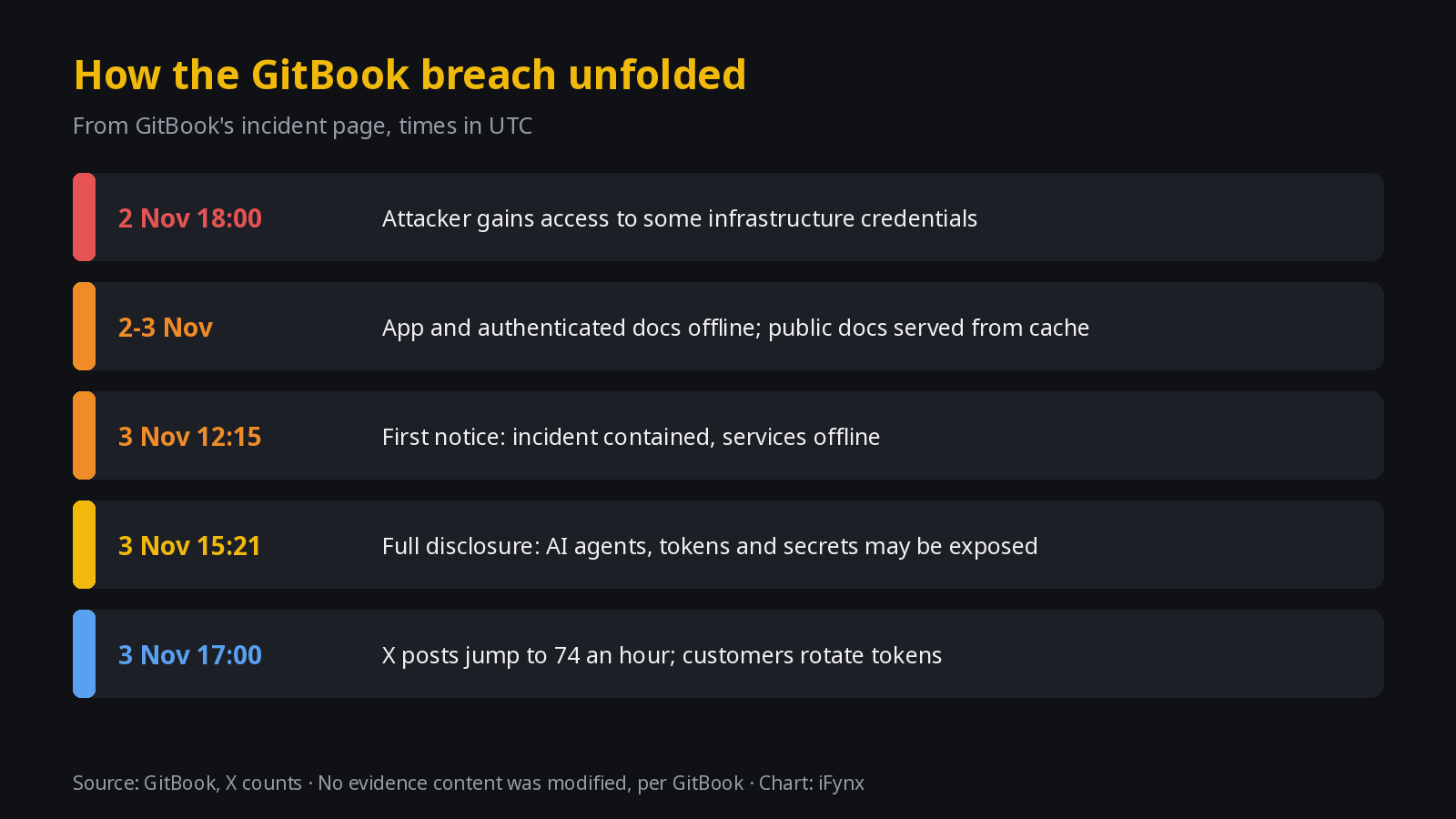
- When: the attack began at 19:00 CET on 2 November (18:00 UTC, 20:00 Asia/Gaza). GitBook’s first notice came at 13:15 CET on 3 November, and its full disclosure at 16:21 CET.
- How: GitBook calls it “a sophisticated, highly targeted attack using AI agents”. No technical details yet; a full post mortem is promised.
- Response: attacker blocked, vulnerabilities closed, every infrastructure credential replaced, every customer API token invalidated, app and authenticated docs taken offline, public docs served from cache.
- May have been accessed: integration tokens, Git Sync secrets, API tokens, GitBook Assistant questions from site visitors.
- Not found: any evidence that customer content was modified (GitBook).
- Disputed: trade.xyz reported unauthorized changes to its hosted site earlier the same day. A link to GitBook has not been confirmed, and GitBook’s finding points the other way.
- Reaction: PancakeSwap moved its docs to self-hosting, according to crypto media coverage.
The third AI-agent intrusion in 48 hours
This is not a one-off. In two days we have now covered three intrusions where AI agents did the work: WorkOS and the ARTEX attack framework, the Railway employee whose agents probed rival cloud Primcloud, and now GitBook. Different targets, same pattern: agents move faster than humans, go straight for credentials and tokens, and turn one stolen secret into access across connected tools.
Documentation platforms used to hold text. Now they hold keys to your Git repos, your integrations and your AI tools.
iFynx analysis
Why this matters for crypto teams in the Gulf and Egypt
GitBook is the default docs tool for a large part of the crypto industry, and many Gulf and Egypt fintech and SaaS teams use it for help centres and API docs, often with Git Sync to GitHub or GitLab. That means three risks at once: tokens that reach into your code repos, public pages where users copy contract addresses and download links, and an AI assistant that may have collected personal questions from your customers.
The lesson is the same as in the Coinbase and Amplitude case: a supplier breach is your incident too. And as with AI coding agent plugins and Lovable apps, the weak spot is the access you granted and forgot about.
What to rotate now: a docs-platform security checklist
- Rotate every GitBook API token today. GitBook says it revoked all personal API tokens, so scripts and CI jobs that call the GitBook API will fail until you issue new ones. Store the new tokens in a secrets manager, not in repos.
- Rotate the secrets behind Git Sync. If GitBook syncs with GitHub or GitLab, revoke and re-create the GitHub App install, deploy key or personal access token it used, and scope the new one to the docs repo only.
- Rotate third-party integration secrets you connected to GitBook (analytics, chat, search, Slack, Jira and similar), and any secrets used by integrations you published yourself.
- Re-authenticate the GitBook MCP server in Claude, Cursor, VS Code or any other AI tool that uses it, and remove the old connection.
- Audit your docs repo since 2 November, 18:00 UTC. Review commits, branches and pull requests made through Git Sync or the GitBook bot. GitBook says it has found no evidence content was modified, but checking your own history is cheap.
- Verify the values users copy. For crypto teams: compare every contract address, wallet address, RPC URL, download link and install command in your public docs with a trusted source, and sign or pin the canonical list somewhere else too (website, GitHub, X).
- Warn users about docs phishing. Attackers love outages: tell users which domain is your real docs site and that you will never ask for a seed phrase or private key in docs or support chats.
- Check what visitors asked GitBook Assistant. If questions may contain names, emails, account numbers or wallet details, treat it as a possible personal-data incident and ask your lawyer about notice duties under UAE Federal Decree-Law 45 of 2021, the Saudi Personal Data Protection Law and Egypt Law 151 of 2020.
- Least privilege for docs tools. Give documentation platforms read or write access to one repo, never org-wide tokens, and review the list of connected apps every quarter.
- Plan for the docs host going down. Keep a static mirror or self-hosted build of critical pages, such as contract addresses and status, so users are never left with nothing.
Do not panic, but do not wait
Rotating tokens takes an hour. A stolen Git Sync secret left in place can give someone a path into your code. Do the rotation today, then audit. Never test other companies’ systems yourself; report issues through their security contact.
Search interest
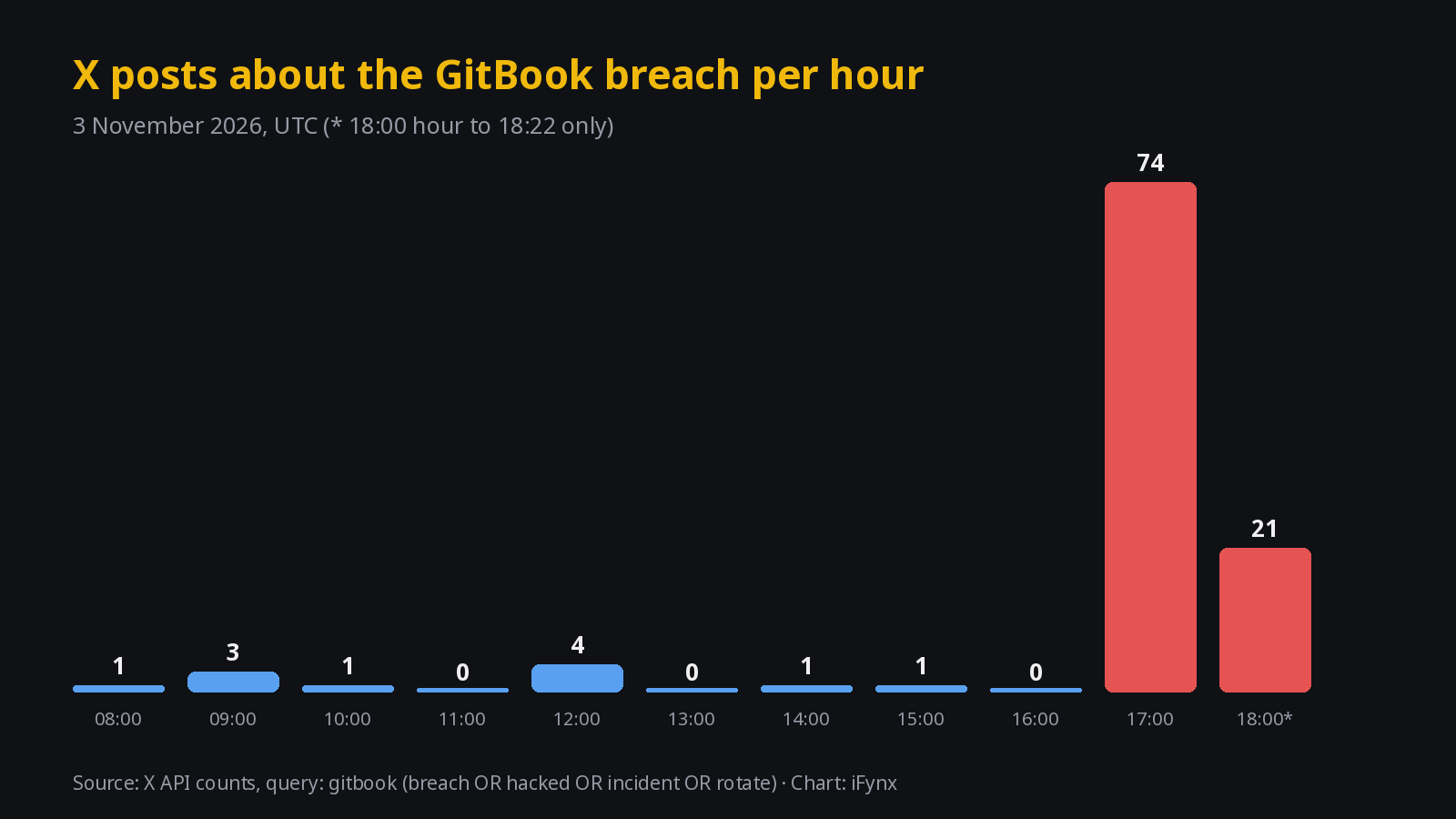
Posts on X about the GitBook breach jumped from 0 to 4 an hour to 74 in the 17:00 UTC hour on 3 November, and the story reached the Hacker News front page, The Defiant, PANews, ChainCatcher and BeInCrypto. We found no Arabic coverage.
Related: WorkOS and ARTEX, Railway’s agents and Primcloud, Lovable apps data exposure, agent plugin security and the Coinbase vendor breach.
Status as of 3 November 2026, 20:22 Asia/Gaza. GitBook’s post mortem is still pending.
How iFynx can help
iFynx builds and secures bilingual crypto, fintech and SaaS products for the UAE, Saudi Arabia and Egypt, including secrets management, Git and CI hardening and incident-ready docs. See our services.
Frequently asked questions
Was GitBook hacked?
Yes. GitBook says it was the target of a sophisticated, highly targeted attack using AI agents. At 19:00 CET on 2 November 2026 (18:00 UTC) the attacker gained unauthorized access to some of its infrastructure credentials. GitBook took the app and authenticated docs offline, replaced every credential, and brought services back on 3 November.
What data was exposed in the GitBook breach?
GitBook says the attacker may have accessed integration tokens, Git Sync secrets, API tokens and questions asked to GitBook Assistant by site visitors. It says it has found no evidence that customer content was modified.
Do I need to rotate my GitBook API token and Git Sync GitHub token?
Yes. GitBook revoked all personal API tokens and asks customers to rotate GitBook API tokens, third-party tokens and secrets connected to GitBook, and secrets in published integrations. Rotating the GitHub or GitLab credentials behind Git Sync is a sensible extra step. Update 9 November 2026: GitBook’s post-mortem says you must create a new API token and rotate integration and third-party secrets, but no action is needed for Git Sync (GitHub app) or GitLab because GitBook rotated those keys itself.
Are my crypto project’s GitBook docs safe? Could contract addresses be changed?
GitBook says it found no evidence content was modified. Separately, trade.xyz reported unauthorized changes to its hosted site the same day; any link to GitBook is unconfirmed and disputed. Check your docs history and verify contract addresses against a trusted source anyway.
How did the attackers use AI agents?
GitBook has not published technical details yet and promises a full post mortem. We will add it when it is out. We do not publish attack techniques.
How do I re-authenticate the GitBook MCP server?
Remove the existing GitBook MCP connection in your AI tool (for example Claude, Cursor or VS Code), add it again and sign in so a fresh token is issued. GitBook asks every MCP user to do this.
How was GitBook hacked?
According to GitBook’s post-mortem of 4 November 2026, the attacker used a flaw in GitBook’s SSO login flow to create sessions acting as GitBook staff, queried a misconfigured GitHub App integration to reach internal code repositories and a Cloudflare API key, and then used production secrets to gain full infrastructure access. GitBook fixed the SSO flaw on 2 November and says the attack targeted one customer.
Sources
- GitBook: security incident page, 3 November 2026 (13:15 and 16:21 CET)
- GitBook status page
- The Defiant, 3 November 2026
- PANews (Chinese)
- Hacker News discussion
- AggrNews on X
- Hero photo: Victor Grigas, Wikimedia Commons, CC BY-SA 3.0, cropped. Charts: iFynx.

Related reading
- Copilot Chat Restriction: Enterprise Lessons From Goldman Sachs' AI Tools Ban for Banks in the UAE, Saudi Arabia and Egypt
- Keplr Wallet Hack: Web3Auth Incident Hits Some Google and Apple Login Accounts — What Users Should Do Now
Related reading
- Claude Code Secrets on GitHub: What Apiiro Found in settings.local.json — A Rotate-First Checklist
- MCP Server Security After the Mittwald Breach: What Happened, Why AI-Assistant Connectors Are Now an Attack Surface, and a Lock-Down Checklist for Gulf and Egypt Teams
- Cursor Security Breach: How a Key Exposed at Fireworks AI Led to a Malicious Claude Code Extension, and What Dev Teams Should Check Now