Update 15 Nov 2026 · 21:56 Asia/Gaza
Luxor has confirmed that the hijack went through its Commander fleet-management tool, and the attacker’s address has now received a payout.
- Luxor’s statement: in a post at 17:25 UTC (19:25 Asia/Gaza), Luxor said its monitoring caught “an unauthorized redirect of hashrate through Commander”, affecting “just over a dozen client accounts”. Machines were pointed to a different pool for a limited window.
- What Luxor says it did: it patched Commander within 2 hours and started restoring machines to their original pool settings. It says no data was leaked or exfiltrated from its systems, every affected client “will be paid in full for the redirected hashrate, as if it had mined normally”, no user action is needed, and a full post-mortem will follow.
- Scope: in a follow-up at 17:32 UTC, Luxor said the issue was isolated to Commander and that Luxor Pool and LuxOS were not affected.
- Payout: OCEAN found block 975,995 at 17:22 UTC (19:22 Asia/Gaza). Its coinbase transaction paid 0.08088977 BTC to the attacker address, the TIDES caveat we flagged below. As of 19:56 UTC the coins were unspent. Newly mined coins cannot be moved until block 976,095, 100 blocks after the one that created them.
Still not confirmed: how the attacker got into Commander, OCEAN’s role beyond receiving the redirected hashrate (OCEAN has made no statement), and the Hiveon claim. The 64,000-machine and 13 EH/s figures come from operators, Bitcoin News and CoreX Hosting, not from Luxor, which counted client accounts, not machines.
Status · 15 Nov 2026 · updated 21:56 Asia/Gaza
Overnight, the mining settings of an estimated 64,000 Bitcoin machines, about 13 EH/s of hashrate, were changed without their owners’ permission. Their work was sent to the OCEAN pool, with payouts set to an attacker’s Bitcoin address.
It began around 02:00 UTC on 15 November (04:00 in Gaza, 05:00 in Riyadh, 06:00 in Dubai). CoreX Hosting raised the first public alarm at 03:08 UTC and said at 06:40 UTC that it was over. Bitcoin itself was not hacked, and no coins were taken from wallets. Owners lost the hours their machines worked for someone else. Luxor has since confirmed that the hashrate was redirected through its Commander fleet-management tool, and an OCEAN block at 17:22 UTC paid 0.08088977 BTC to the attacker’s address (see the update above). How the attacker got in is not yet confirmed.

At iFynx we build and maintain the dashboards, APIs and monitoring that companies use to run fleets of connected machines, from payment terminals to industrial devices, for clients in the UAE, Saudi Arabia, Egypt and Palestine. This incident is a textbook case of what happens when one management console controls thousands of devices. Below: what is confirmed and what is only claimed, whether the attacker could still get paid, how to check your ASICs right now, and a fleet-management security checklist for mining hosts in the Gulf and anyone running remote device-management tools. We re-checked CoreX Hosting’s posts, Luxor’s and OCEAN’s X accounts and the attacker address on mempool.space on 15 November 2026 at about 15:50 Asia/Gaza (13:50 UTC). We describe no attack technique.
Key facts: confirmed, reported and claimed
| Status | What we know |
|---|---|
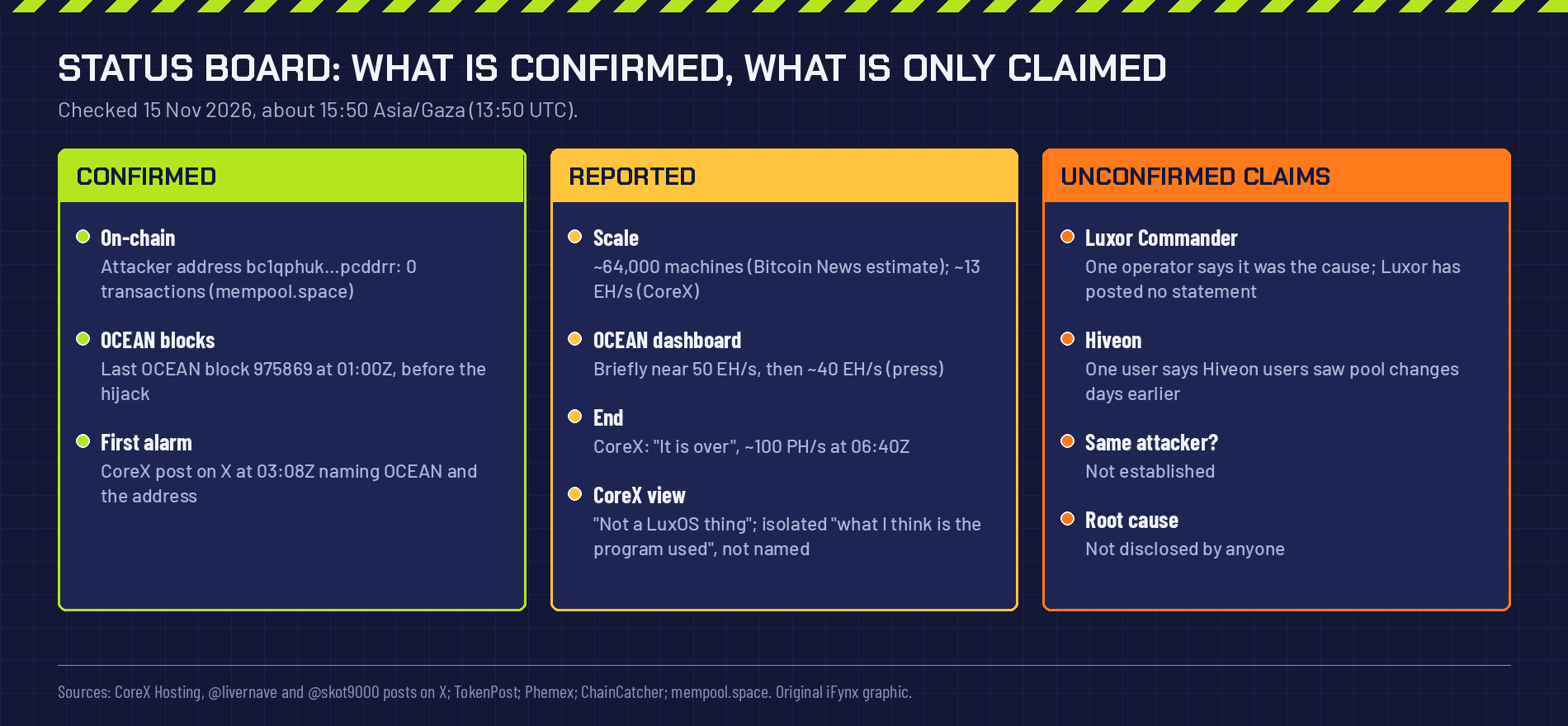
| Confirmed | The attacker address bc1qphukp9rjfc4rcej7erpm9ae20xmtspw8pcddrr received 0.08088977 BTC from the coinbase of OCEAN block 975,995 at 17:22 UTC on 15 November, unspent as of 19:56 UTC (mempool.space). OCEAN’s previous block, 975,869 at 01:00 UTC, came before the hijack. |
| Confirmed | CoreX Hosting’s first post at 03:08 UTC said machines were being “pointed at” OCEAN with that address. |
| Reported | About 64,000 machines (Bitcoin News estimate) and about 13 EH/s (CoreX). OCEAN’s dashboard briefly showed close to 50 EH/s, then about 40 EH/s (press reports). |
| Reported | CoreX said at 06:40 UTC: “It is over. Hacker is down to 100PH.” |
| Confirmed by Luxor | Luxor says hashrate was redirected through its Commander tool, affecting just over a dozen client accounts. It says Commander was patched within 2 hours, no data was exfiltrated, affected clients will be paid in full, and Luxor Pool and LuxOS were not affected (Luxor on X, 17:25 and 17:32 UTC). |
| Unconfirmed claim | Another user says Hiveon users saw their pools changed to OCEAN a couple of days earlier. Not verified. |
| Unknown | How the attacker got into Commander (Luxor’s post-mortem is pending), the total number of operators and machines hit, OCEAN’s role beyond receiving the hashrate, and whether OCEAN will act on the hijacked work. |
The hijack window, hour by hour
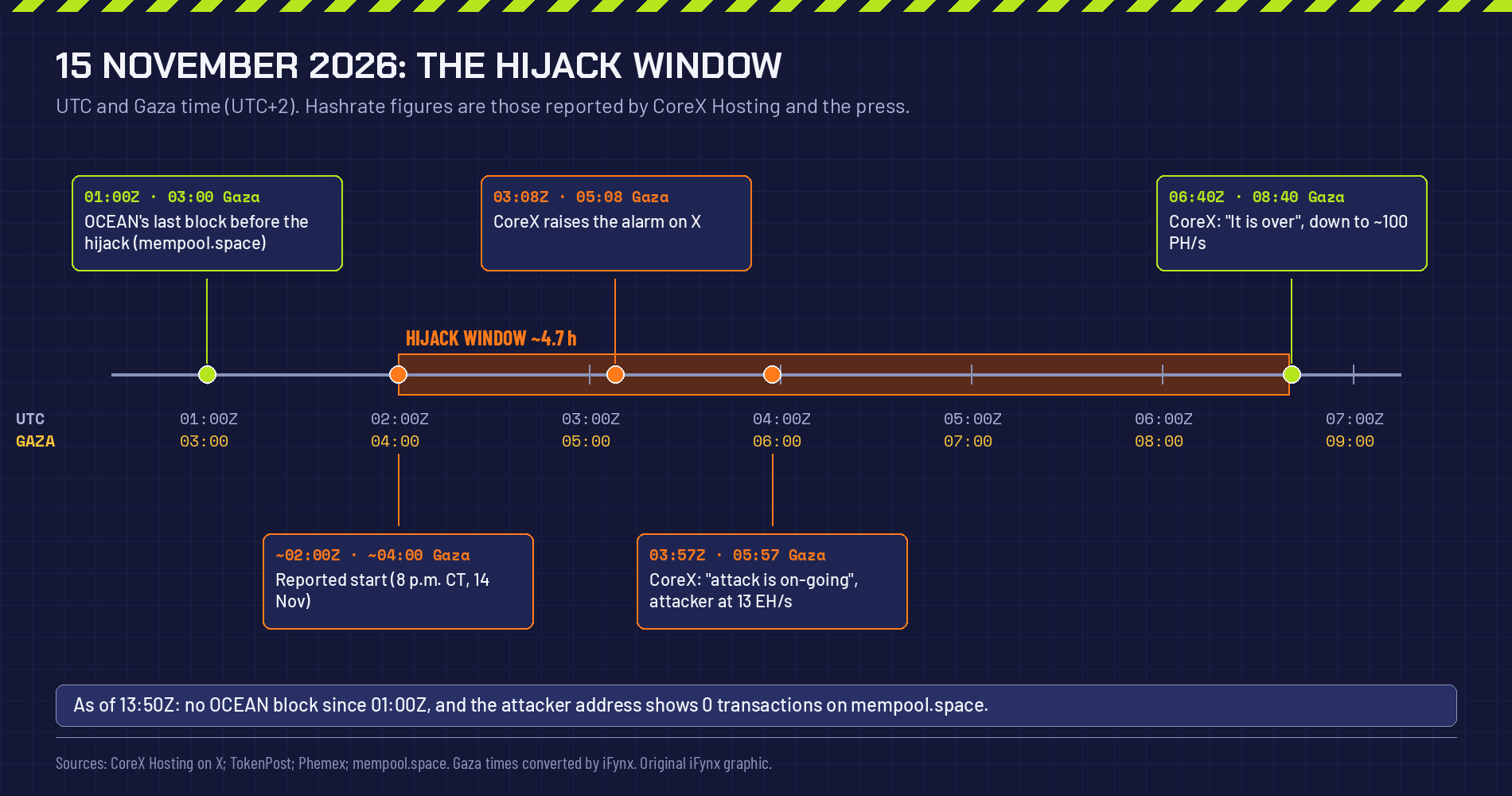
- 01:00 UTC (03:00 Gaza): OCEAN finds block 975,869, its last block before the incident, according to mempool.space.
- About 02:00 UTC (04:00 Gaza): the reported start, 8 p.m. US Central Time on 14 November. Machines begin switching to OCEAN.
- 03:08 UTC (05:08 Gaza): CoreX Hosting posts the first public alarm: “there is a big miner hack going on as we speak”, naming OCEAN and the payout address.
- 03:49 UTC: asked whether it was linked to LuxOS firmware, CoreX replies: “Not a LuxOS thing. The hack vs any and all miners, even non-BTC miners.”
- 03:57 UTC (05:57 Gaza): CoreX says it is changing miners back, is “pretty sure” it has “isolated what I think is the program used”, and that the attacker’s pool address is “still sitting at 13EH”.
- 06:40 UTC (08:40 Gaza): CoreX posts “It is over”, with the attacker down to about 100 PH/s.
- From 11:20 UTC: the story spreads through Bitcoin News, TokenPost, Phemex and ChainCatcher.
- 17:22 UTC (19:22 Gaza): OCEAN finds block 975,995; its coinbase pays 0.08088977 BTC to the attacker address.
- 17:25 UTC (19:25 Gaza): Luxor confirms an unauthorized redirect of hashrate through Commander and promises full compensation. At 17:32 UTC it says Luxor Pool and LuxOS were not affected.
Did the attacker get any bitcoin?
Yes, so far 0.08088977 BTC. At 17:22 UTC (19:22 Asia/Gaza), OCEAN found block 975,995, and its coinbase transaction paid that amount to the attacker’s address, according to mempool.space. The coins were unspent as of 19:56 UTC. Earlier reports said the attacker “got nothing” because no block was found during the hijack. This is the caveat we flagged when we first published.
OCEAN pays miners through a system it calls TIDES. According to OCEAN’s documentation, work submitted to the pool is kept in a share log and rewarded each time the pool finds a block, as long as it falls inside a window worth eight blocks’ difficulty. That is why work done during the hijack could still be rewarded when OCEAN found its next block. As we read the documentation, later OCEAN blocks could pay the address again while the hijacked shares stay inside that window, unless OCEAN excludes them. OCEAN has made no statement. Newly mined coins cannot be moved until block 976,095, 100 blocks after the one that created them.
For the owners, the loss was real: hours of electricity and machine time spent earning for someone else. Luxor says it will pay its affected clients in full for the redirected hashrate. That compensation is separate from the attacker’s payout, which a Bitcoin transaction cannot reverse.
How a fleet-wide pool hijack works
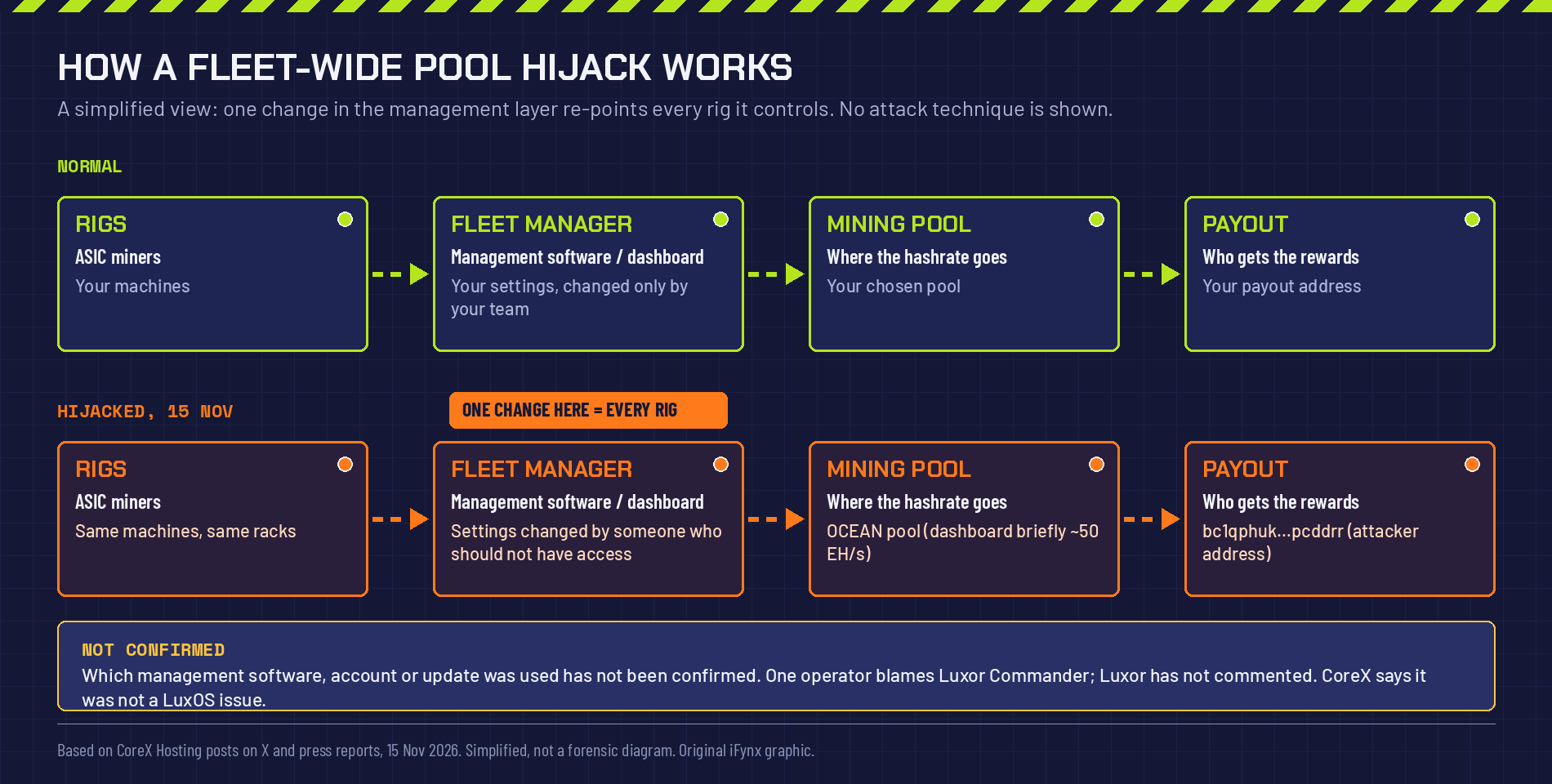
Every ASIC miner has three settings that decide who gets paid: the pool address, the worker name and, depending on the pool, a payout address or account. Large farms rarely change these by hand. They use fleet-management software, a dashboard that can push the same settings to thousands of machines at once. That is efficient, and it means one compromised console, account or software update can re-point a whole fleet in minutes.
That is the pattern operators describe here: machines in different farms switched to the same pool and the same address at the same time. Which tool, account or update was used has not been confirmed. CoreX said it uses “3 different management softwares depending on the need” and declined to name the one it suspects: “I am not qualified enough to point fingers.”
Is Luxor Commander to blame?
Yes, confirmed by Luxor. Luxor sells Commander, a fleet-management tool, alongside its LuxOS firmware and mining pool. In a post at 17:25 UTC on 15 November, Luxor said its internal monitoring caught “an unauthorized redirect of hashrate through Commander”, affecting “just over a dozen client accounts”. It said Commander was patched within 2 hours, no data was leaked or exfiltrated from its systems, and every affected client will be paid in full. In a follow-up, it said the issue was isolated to Commander and that Luxor Pool and LuxOS were not affected. Earlier, an operator had posted on X that “the reason was Luxor commander”, and CoreX had said it was “not a LuxOS thing”; both are consistent with Luxor’s account.
Luxor counted client accounts, not machines, and one account can control many machines. The 64,000-machine and 13 EH/s figures come from Bitcoin News and CoreX; Luxor has not confirmed them. How the attacker got into Commander is not confirmed, and Luxor has promised a full post-mortem. A separate user said Hiveon users saw their pools changed to OCEAN a couple of days earlier; that remains unverified. If you use any remote management tool, apply the checks below.
Check your ASICs right now
- Open each miner’s pool settings, or export them from your management tool, and compare all three: pool URL, worker name and payout address or account. Any pool or address you don’t recognise is a red flag.
- Look at your pool dashboard, not just the machines. A sudden hashrate drop overnight on 15 November between about 02:00 and 07:00 UTC means your machines were likely mining elsewhere.
- If you find the OCEAN address above, restore your settings and record when and where. Report it to your hosting provider, your management software vendor and your pool.
- Rotate every credential the management tool uses: dashboard passwords, API keys, vendor portal logins and miner web-interface passwords. Turn on MFA wherever it is offered.
- Check what changed besides the pool: firmware versions, admin accounts and remote-access settings.
- If you host with a provider, ask them directly: which management software do you use, who can change my pool settings, and will I be alerted when they change?
Does this threaten Bitcoin itself?
No. About 13 EH/s is roughly 1.4% of the network’s hashrate, which mempool.space estimated at about 930 EH/s over three days. Even OCEAN’s brief peak near 50 EH/s was a small minority. Bitcoin’s rules and blocks were not affected, and no wallet keys were involved. The damage was to individual operators’ revenue, and to trust in the software they use to manage their machines.
Why Gulf mining hosts should care
The Gulf is part of this industry. In Abu Dhabi, MARA and Zero Two announced in 2023 a joint venture to run two immersion-cooled mining sites with 250 MW of capacity. In Oman, Blockspace reports two licensed mining-infrastructure operators, Exahertz and Green Data City. Hosts like these, and anyone running hosted ASICs for clients, depend on the same kind of remote fleet tools.
The lesson goes beyond mining. A fleet manager is a remote-management tool, just like the RMM software IT teams use to control laptops and servers. We covered what happens when one of those is exposed in our piece on the N-able N-central Able2Shell vulnerability and RMM security. It is also a third-party dependency, like the domain registrar in the Across Protocol domain hijack or the support contractor in today’s Coinone data breach: you inherit its security whether you audit it or not. For more on this week’s crypto incidents, see the Kava Lend exploit and our guide to buying a hardware wallet safely.
The fleet-management security checklist
| Control | Why it matters here | How |
|---|---|---|
| Known-good configuration | You can only spot a hijack if you know what “right” looks like | Keep a signed list of pool URL, worker and payout for every rig, and diff the fleet against it daily |
| Pool-change alerts | This attack ran for hours before a public alarm | Alert on any pool or payout change, and on sudden hashrate drops at your pool |
| Egress allow-list | Machines should only be able to reach pools you chose | Allow outbound mining connections only to approved pool hosts; block everything else |
| Network segmentation | Miners and their management interfaces should never face the internet | Separate mining VLAN, no public web UIs, management only over VPN |
| MFA and IP allow-lists | One stolen password should not control a fleet | MFA on dashboards and vendor portals; restrict logins to known IPs |
| Least privilege and two-person approval | Pool changes are rare and high-impact | Separate read-only and change roles; require a second approver for pool or payout changes |
| Credential and key rotation | Old API keys and shared logins are easy targets | Rotate on a schedule and after any vendor incident; remove unused accounts |
| Firmware admin passwords | Factory defaults make machines easy to re-point | Unique admin passwords per site; keep firmware current |
| Audit logs | You need to know who changed what, and when | Central logs for every config push, kept outside the management tool |
| Vendor-incident runbook | You may need to cut off a vendor tool in minutes | Know how to disable the integration, restore configs from backup and contact the vendor |
How iFynx can help
Frequently asked questions
Were my miners hijacked, and how do I check?
Compare each machine’s pool URL, worker name and payout address with what you set, and check your pool dashboard for a hashrate drop between about 02:00 and 07:00 UTC on 15 November. Machines pointed at OCEAN with address bc1qphukp9rjfc4rcej7erpm9ae20xmtspw8pcddrr were affected. Restore settings, then rotate all management credentials.
Was Luxor hacked?
Luxor says an attacker redirected hashrate through its Commander fleet-management tool, affecting just over a dozen client accounts. It says Commander was patched within 2 hours, no data was leaked or exfiltrated, Luxor Pool and LuxOS were not affected, and affected clients will be paid in full. How the attacker got in is not yet confirmed; Luxor has promised a post-mortem.
Did the attacker get any bitcoin?
Yes: OCEAN block 975,995, found at 17:22 UTC on 15 November, paid 0.08088977 BTC to the attacker’s address, and the coins were unspent when we checked. Under OCEAN’s TIDES system, hijacked work can keep earning in later blocks unless OCEAN excludes it. OCEAN has made no statement.
What is hashrate hijacking, and how is it different from stealing coins?
Hashrate hijacking means taking over someone’s mining machines so their computing work earns rewards for the attacker. No wallet is emptied. The victim loses the income the machines would have earned, plus electricity, while the attacker hopes for pool payouts.
Does this threaten Bitcoin’s network security?
No. About 13 EH/s is roughly 1.4% of Bitcoin’s hashrate, far from enough to rewrite blocks. Bitcoin’s rules and wallets were not affected. The risk is to individual mining operators and to trust in the remote tools that manage their machines.
Sources and update policy
Checked on 15 November 2026 at about 15:50 Asia/Gaza (13:50 UTC): CoreX Hosting on X, first alarm, “not a LuxOS thing”, “attack is on-going” and “It is over”; operator claim on Luxor Commander; user report on Hiveon; Bitcoin News on X; TokenPost; Phemex; ChainCatcher; mempool.space, attacker address and OCEAN pool page; OCEAN, TIDES documentation; Gulf context: MARA and Zero Two and Blockspace. At that check, Luxor’s and OCEAN’s official X accounts had posted nothing about the incident. Update, 15 November at 21:56 Asia/Gaza: Luxor’s statements on X at 17:25 UTC and 17:32 UTC; OCEAN block 975,995 and its coinbase transaction on mempool.space. OCEAN had still posted no statement. Gaza times converted by iFynx.
We will update this article when Luxor publishes its post-mortem, if OCEAN or Hiveon comments, or if the attacker address moves funds or receives more. We do not publish attack techniques.
Related reading
- N-able N-central Vulnerability (Able2Shell): 33 Exploits, Emergency Hotfix 2026.4.1.26 and the RMM Security Checklist for Gulf and Egypt Companies
- Coinone Data Breach: A Support Contractor Hack Exposed What Users Typed Into Support Chats — What to Do Now, and the Support-Desk Data Checklist for Gulf and Egypt Exchanges