Update 17 Nov 2026, 19:15 Asia/Gaza: withdrawals are back, about $5M returned, and the leak came from reused nonces.
Lighter said on X at 18:21 UTC on 16 November that deposits and withdrawals are back to normal after Guardian mode was switched off. In its post-mortem, as reported by Tech Times, Lighter says the affected accounts used their own signing code, outside Lighter’s official SDKs, that reused cryptographic nonces, which let the attacker compute the private API keys from public signatures. The Lighter Security Council returned about 5 million USDC to one affected trader. On-chain researchers count about $15.5 million taken from two market-maker accounts (about $10.39M and $5.09M); Lighter has not confirmed a total. Lighter has made API-key signatures private, now requires a wallet signature for transfers into public pools, and plans IP allowlists and per-key permissions. If you trade on Lighter with an API key: rotate it now and move to the official SDK.
Update 16 Nov 2026, 14:49 Asia/Gaza: Lighter confirms the cause was a leaked API key for a specific trader’s account, not a protocol bug. It says its protocol and smart contracts are unaffected, Guardian mode is on, a Lighter Security Council upgrade will recover funds from an additional withdrawal attempt by the attacker, and withdrawals stay paused with a target to resume by the end of the day. Source: Lighter on X. This article has been updated throughout.
CAUSE: TRADER API KEYS LEAKED VIA REUSED NONCES · WITHDRAWALS RESUMED · UPDATED 19:15 ASIA/GAZA, 17 NOV 2026
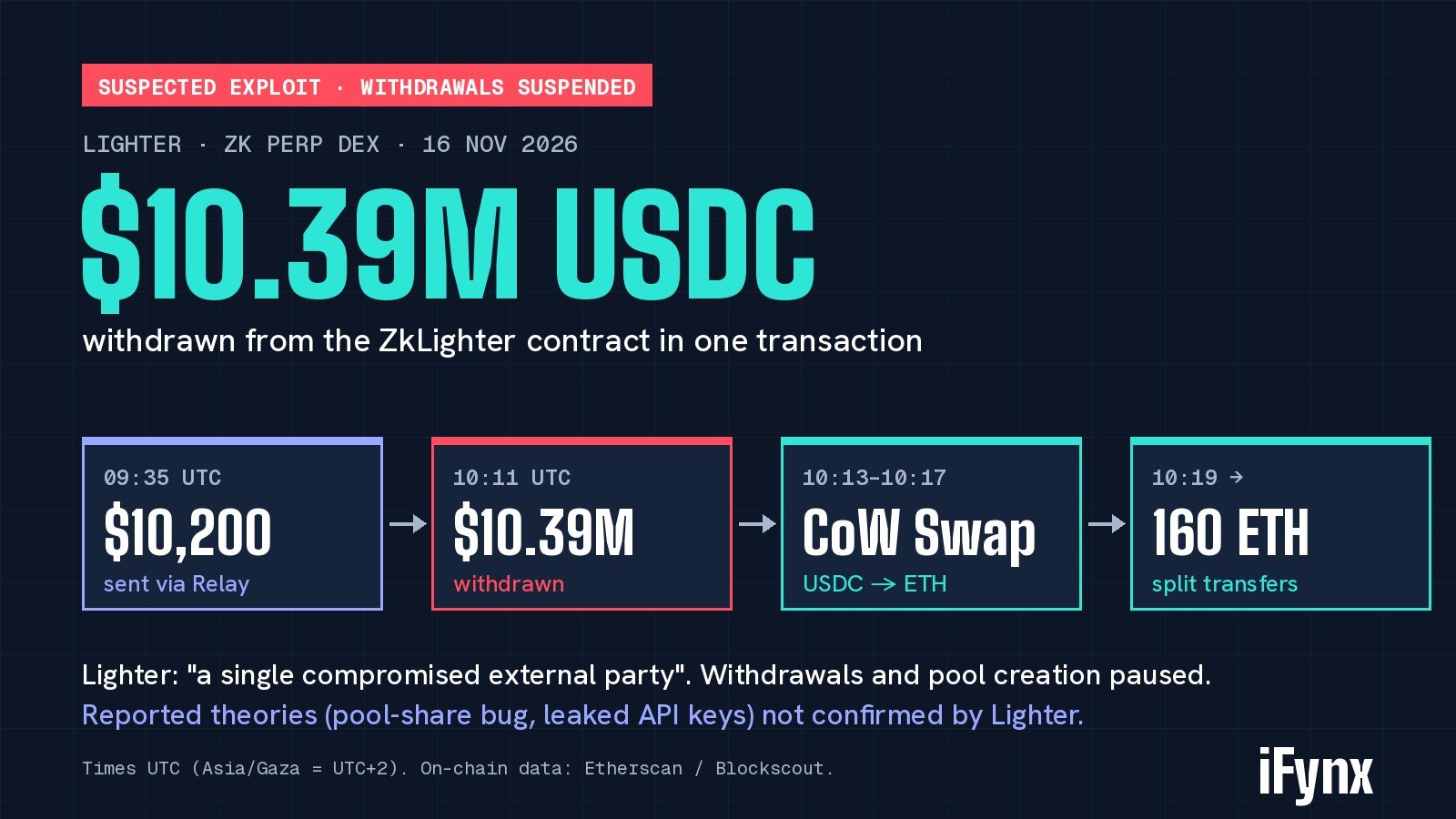
A single Ethereum transaction on Monday 16 November 2026 moved 10,393,056.79 USDC out of Lighter’s ZkLighter contract to a wallet funded only hours earlier. Lighter says the cause was “a leaked API key for a specific trader’s account” and that “the Lighter protocol and smart contracts are unaffected”. Withdrawals were paused and resumed at 18:21 UTC the same day.
The withdrawal is on Etherscan at 10:11:47 UTC (12:11 Asia/Gaza). Within six minutes the wallet sent 10.36 million USDC to CoW Protocol to swap for ETH, then began moving ETH out in 160 ETH pieces. Security firm Hacken said it was investigating a “suspected exploit”.
Lighter’s update on X at 12:49 UTC (14:49 Asia/Gaza) rules out a protocol bug and confirms the leaked-API-key explanation analysts had floated. It has enabled Guardian mode on its smart contract, says a Lighter Security Council upgrade will recover funds from an additional withdrawal attempt by the attacker, and is targeting resuming withdrawals by the end of the day. Security firm PeckShield reports that the attacker bridged 640 ETH to Hyperliquid and bought about 2,240 XMR.
iFynx builds trading, payments and fintech back ends for companies in the Gulf and Egypt, so we follow incidents like this for what they teach the people who run exchanges. This article sticks to what can be checked: the on-chain record, Lighter’s own documentation, and what named analysts have said, clearly labelled as reports. It gives no exploit steps, does not name the affected accounts, and offers no price or trading advice. We read the wallet’s full history on Etherscan and Blockscout and re-checked Lighter’s and its founder’s X accounts and the main security firms at about 13:05 Asia/Gaza (11:05 UTC).
Minute by minute: the on-chain money flow
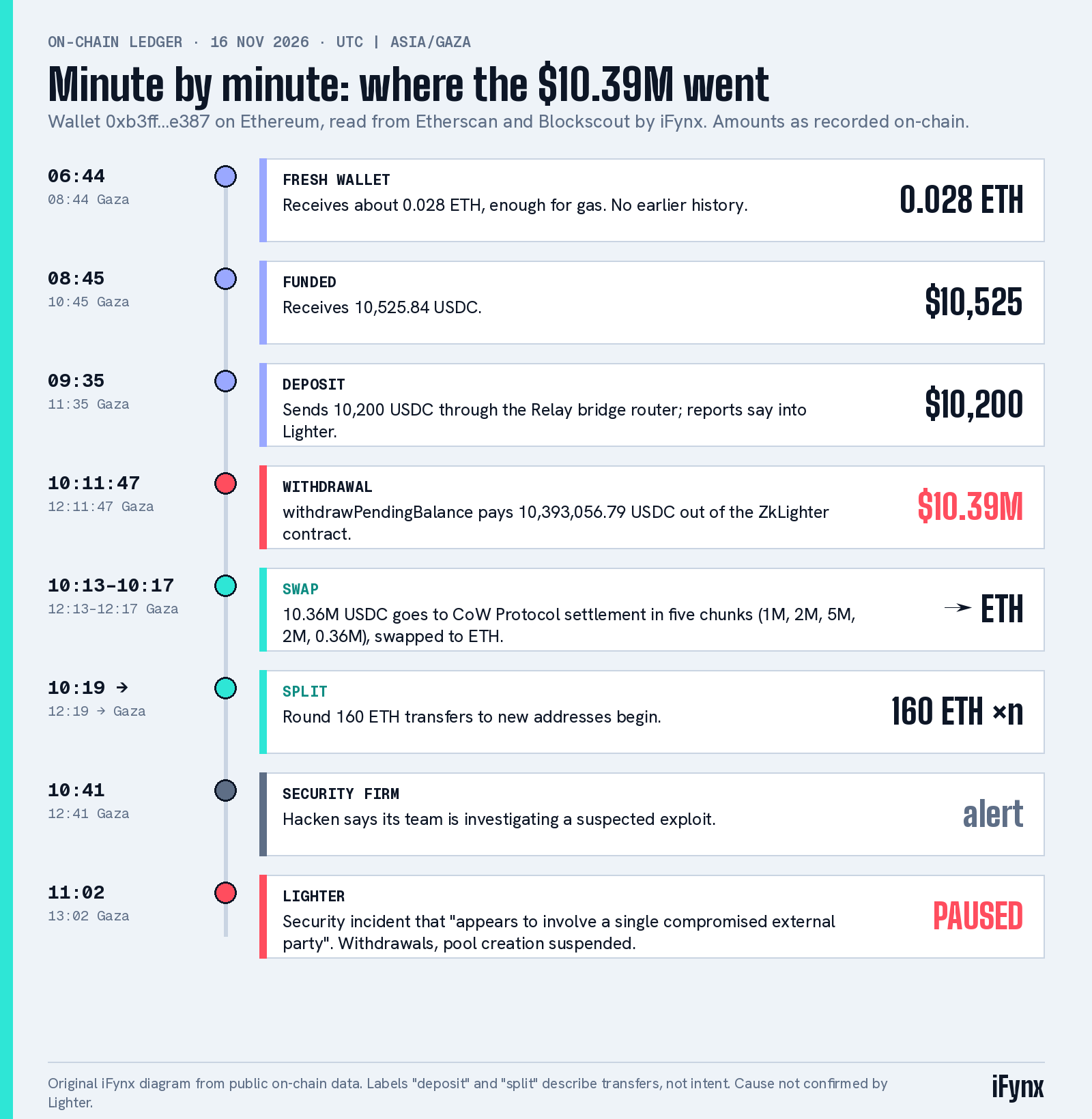
The wallet at the centre of the reports, 0xb3ff…e387, has a short and public history. The contract that paid out is tagged “Lighter: ZkLighter” on Etherscan, and Lighter’s documentation describes that address as the contract “which holds the platform’s collateral”.
| UTC (Asia/Gaza) | What the chain shows |
|---|---|
| 06:44 (08:44) | The wallet receives about 0.028 ETH, enough to pay fees. Nothing earlier. |
| 08:45 (10:45) | It receives 10,525.84 USDC. |
| 09:35 (11:35) | It sends 10,200 USDC through the Relay bridge router. Analysts say this was a deposit into Lighter. |
| 10:11:47 (12:11:47) | A withdrawPendingBalance call pays 10,393,056.79 USDC from the ZkLighter contract to the wallet. |
| 10:13 to 10:17 (12:13 to 12:17) | 10.36 million USDC goes to CoW Protocol’s settlement contract in five chunks (1M, 2M, 5M, 2M and 0.36M) and comes back as ETH. |
| From 10:19 (12:19) | Round transfers of 160 ETH to new addresses begin. |
| 10:41 (12:41) | Hacken posts that it is investigating a suspected exploit. ChainCatcher publishes an on-chain analyst’s warning at the same minute. |
| 11:02 (13:02) | Lighter confirms it is investigating a security incident that “appears to involve a single compromised external party” and suspends all withdrawals and pool creation. |
| 11:58 (13:58) | PeckShield reports the attacker bridged 640 ETH (about $1.12M) to Hyperliquid and bought about 2,240 XMR. |
| 12:49 (14:49) | Lighter says the cause was a leaked API key for a specific trader’s account; protocol and smart contracts unaffected; Guardian mode enabled; withdrawals still paused, target to resume by end of day. |
Two numbers matter. The deposit the analysts point to was about $10,200, and the withdrawal was about $10.39 million, roughly 1,000 times larger, 37 minutes later. That ratio is exactly the kind of signal an exchange’s risk engine should flag, whatever the cause turns out to be. Hacken put the ETH bought at about 5.4K; Blockscout showed the wallet still holding about 4,805 ETH at 13:04 Asia/Gaza, after at least six direct 160 ETH transfers out.
Two theories: Lighter confirmed the API-key one
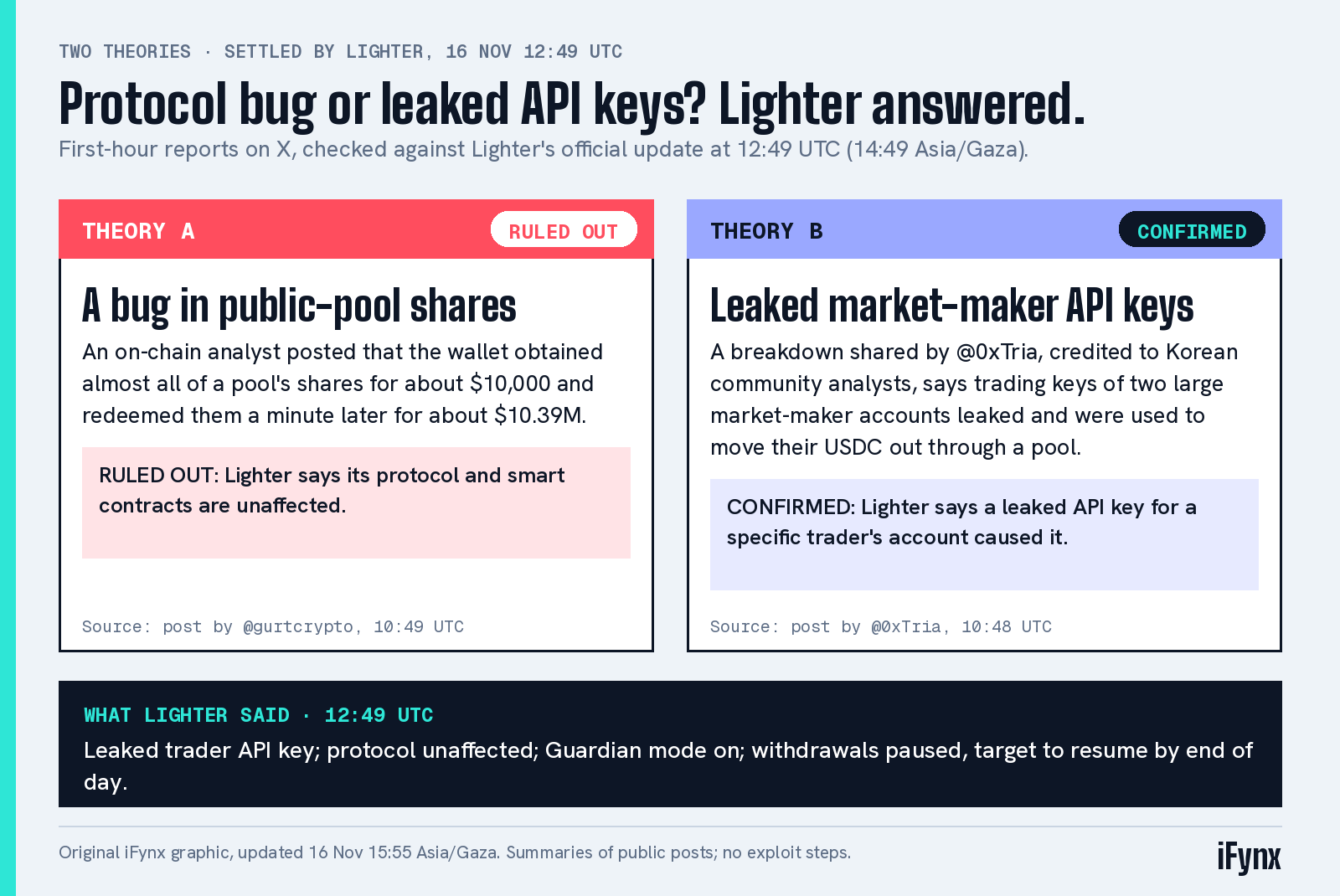
Within an hour of the first alerts, two very different explanations were circulating on X. Lighter’s 12:49 UTC update has since settled the main question: it confirmed the leaked-API-key explanation and ruled out a protocol bug.
Theory A: a protocol bug (ruled out by Lighter). An analyst posting as @gurtcrypto wrote that the wallet obtained 9,999,000 shares in a pool for 9,999.99 USDC and redeemed the same number of shares about a minute later for 10,392,825.88 USDC. Lighter has since said “the Lighter protocol and smart contracts are unaffected”, which rules this out as a flaw in its code.
Theory B: leaked market-maker API keys (confirmed by Lighter). A breakdown shared by @0xTria, credited to Korean community analysts, says this “wasn’t a protocol hack” but leaked API keys for two large market-maker accounts, used to close the victims’ positions and move their USDC out through a pool the attacker controlled. The same post puts total losses at about $15.5 million across two accounts; that figure is reported, not confirmed by Lighter, which refers to “a specific trader’s account”.
Lighter’s update says: “Our investigation indicates that today’s incident was caused by a leaked API key for a specific trader’s account. The Lighter protocol and smart contracts are unaffected.” It has not said how the key leaked, and it has not named the trader. Neither do we.
What Lighter has said, and what users should know now
Lighter’s position. At 11:02 UTC (13:02 Asia/Gaza), about 51 minutes after the withdrawal, Lighter posted: “We are actively investigating a security incident that appears to involve a single compromised external party. As a precaution, we have temporarily suspended all withdrawals and pool creation while we investigate the circumstances and assess the full impact.” It has not said who the external party is, how much was lost in total, or when withdrawals will reopen. Crypto Banter had reported paused withdrawals a few minutes earlier.
Update, 12:49 UTC (14:49 Asia/Gaza). In a follow-up, Lighter said the incident “was caused by a leaked API key for a specific trader’s account” and that “the Lighter protocol and smart contracts are unaffected”. As a precaution it has enabled Guardian mode on its smart contract. Its “main priority is to recover funds involved in an additional withdrawal attempt by the attacker”, through an upgrade performed by the Lighter Security Council. “Withdrawals remain temporarily paused,” with a target to complete the contract upgrades and resume withdrawals by the end of the day. Lighter also named 0xb3ff…e387 as the wallet believed to be the attacker’s. When we checked at 15:50 Asia/Gaza, it had not announced that withdrawals had resumed or that funds had been recovered.
Where the funds went. According to PeckShield, the attacker bridged 640 ETH (about $1.12 million) to Hyperliquid and used it to buy about 2,240 XMR (Monero). We have not traced that leg on-chain ourselves.
The escape hatch, explained neutrally. Lighter documents a way for users to act directly on Ethereum even if its own systems are unavailable. Its priority transactions let an account request a withdrawal or cancel orders through the ZkLighter contract, and its architecture page says that if those requests are not processed in time, an “Escape Hatch” mode freezes the contract and lets users prove and withdraw their balances on Ethereum. The docs set that deadline at 14 days. This is how the system is designed; it is not advice to use it now.
Has Lighter been hacked before? DeFiLlama’s public hacks database listed no earlier Lighter exploit when we checked today. Its best-known incident was the 10 October 2025 market crash, when, as PANews reported, Lighter compensated traders for a slowdown and a 4.5-hour database outage.
The token. CoinGecko showed LIT at about $2.65, down about 12.6% over 24 hours, at 13:04 Asia/Gaza, after earlier readings near $2.53 (down about 16%) at 12:54. Reports gave falls between 7% and 17% depending on the time and source. This is not a price forecast.
EXPECT SCAMS WITHIN HOURS
- Incidents like this bring fake “refund”, “claim” and “compensation” sites, and impersonators replying as Lighter staff. Lighter’s real announcements come from its verified accounts and its own domain.
- No genuine refund asks you to sign a wallet approval, share a seed phrase or send funds first.
- If you use Lighter through a bot or a third-party app, check which API keys exist on your account and remove any you do not recognise.
Lessons for exchanges and fintechs in the Gulf and Egypt
Lighter says a leaked API key for one trader’s account was enough, and the incident maps onto controls that any exchange, broker or trading app can check this week. That includes platforms licensed in Dubai, Abu Dhabi, Saudi Arabia or Egypt, and the fintechs that let customers connect bots. Our earlier coverage of exchange accounts drained despite withdrawal allow-lists, the Mercado Bitcoin withdrawal halt and the Kava Lend dormant-market exploit points the same way: the damage happens in minutes, so controls have to be automatic.
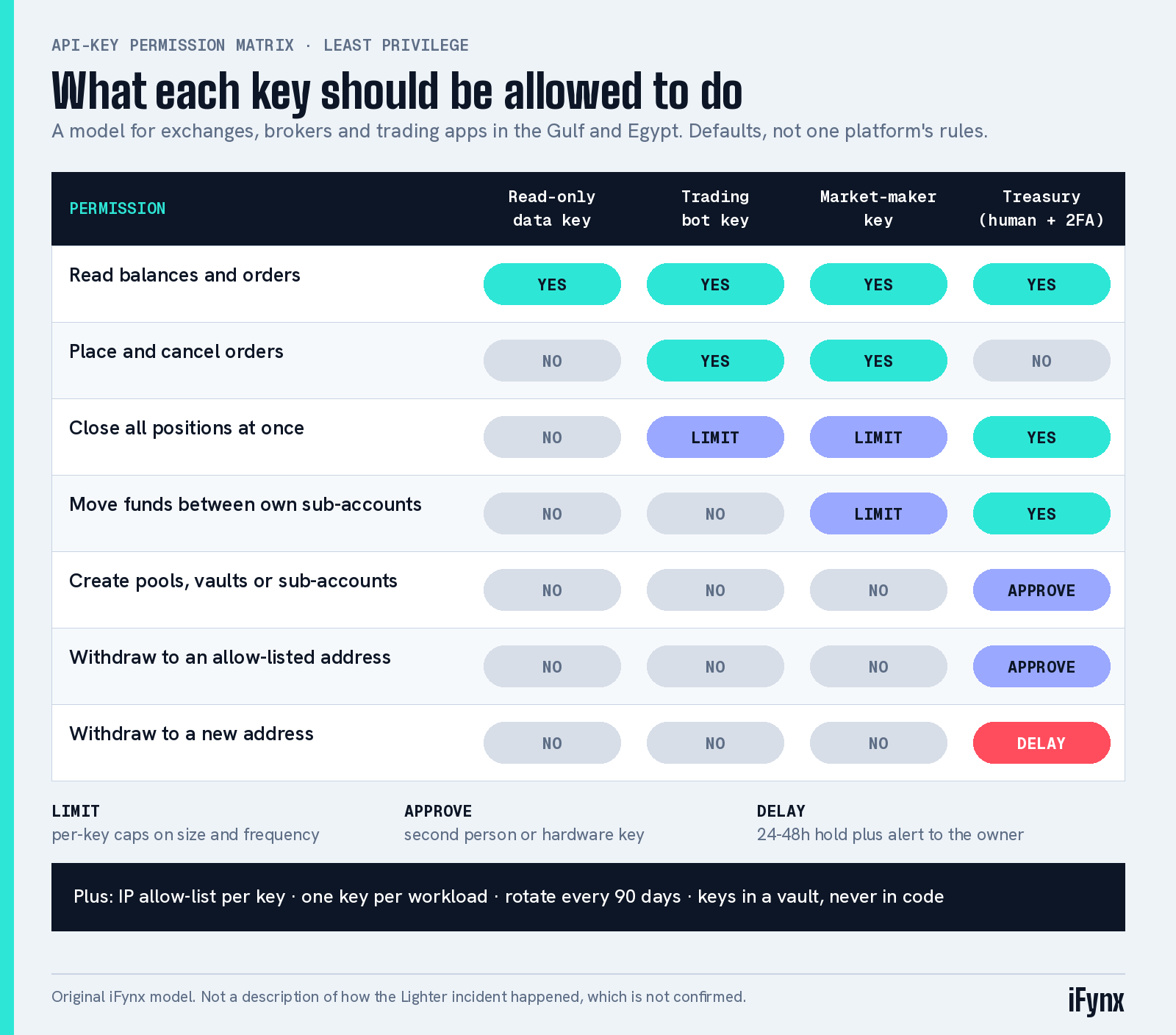
1. API-key permissions: least privilege by default. Lighter’s own API-key documentation shows how much a key can do on some platforms. It lists trading, sub-account management, secure withdrawals and same-owner transfers, while transfers to another owner need a wallet signature. Lighter also documents read-only tokens and maker-only keys. Here, by Lighter’s account, one leaked key was enough. The general rule: a key that trades should not be able to move money, create pools or vaults, or change account structure.
2. Withdrawal risk rules. Treat a withdrawal that is many times larger than an account’s deposits, from a recently funded wallet, within the hour, as a hold-and-review event. Add per-key and per-account limits, a delay for new destination addresses, and a second approval for anything that creates a new pool, vault or sub-account.
3. Monitoring that fires in minutes. Alert on mass position closures on one account, sudden transfers between related accounts, and large outflows from the main contract or hot wallet, and send those alerts to a person who can pause the flow. Here, Lighter’s own notice came about 51 minutes after the withdrawal, and the first public warning on X came about 24 minutes after the withdrawal.
4. An honest incident status page. When something looks wrong, users need a first notice from the platform within minutes, even if the cause is unknown: what is affected, whether withdrawals are paused, what users should not do, and when the next update is due. For platforms in the region, publish it in Arabic and English, on your own domain, and pin the same text on your official social accounts so scammers cannot fill the gap.
For traders and bot builders: lock down your keys
If you run a trading bot on any exchange, the basics are the same: create a separate key for each bot, turn off withdrawal and transfer permissions unless the bot truly needs them, use read-only access for dashboards, restrict keys to known IP addresses where the platform allows it, keep keys in a secrets manager rather than in code or chat, and rotate them regularly. Our Binance hack explainer and the Crédit Mutuel Arkéa case cover the account-takeover side in more depth.
How iFynx can help
We design and build the controls that stop a bad hour from becoming a $10 million day, for exchanges, brokers and fintechs in the Gulf and Egypt.
- API-key permission models. Our API & Backend Engineering team builds scoped keys (read-only, trade-only, maker-only), IP allow-lists, per-key limits and secure key storage.
- Withdrawal risk rules and monitoring. As part of our Software Development services, we add deposit-to-withdrawal checks, new-address delays, second approvals and real-time alerts that reach a person in minutes.
- Incident status pages and security settings people understand. Our Design team designs bilingual Arabic and English status pages, alerts and API-key screens, so users know what is safe and what to do next.
Want a review of your API-key and withdrawal controls? Talk to iFynx.
Frequently asked questions
Was Lighter hacked?
A trader’s account was compromised, not Lighter’s protocol. On 16 November 2026, 10,393,056.79 USDC was withdrawn from Lighter’s ZkLighter contract to a newly funded wallet and swapped to ETH. Lighter says the cause was a leaked API key for a specific trader’s account and that its protocol and smart contracts are unaffected.
Was it a protocol bug or leaked API keys?
Leaked API keys. In its 12:49 UTC update, Lighter said the incident was caused by a leaked API key for a specific trader’s account and that the protocol and smart contracts are unaffected, which rules out the pool-share bug theory. Lighter has not said how the key leaked.
Are user funds on Lighter safe, and should I withdraw?
We do not give financial advice. Lighter says its protocol and smart contracts are unaffected. Withdrawals resumed on the evening of 16 November after the Lighter Security Council performed a contract upgrade to recover funds from an additional attacker withdrawal attempt, with a target to resume by the end of 16 November. Follow Lighter’s verified channels and ignore “refund” links.
Why did the LIT token fall?
Reports of the suspected exploit spread on X from about 12:36 Asia/Gaza. CoinGecko showed LIT at about $2.53, down about 16% over 24 hours, at 12:54 Asia/Gaza, and about $2.65, down about 12.6%, at 13:04. This is a description of the market, not a forecast.
How should exchanges and trading apps protect API keys?
Use least privilege: separate keys for reading, trading and treasury actions, no withdrawal or transfer rights on trading keys, IP allow-lists, keys stored in a secrets manager and rotated, per-key limits, delays for new withdrawal addresses, and real-time alerts on unusual outflows.
Sources and update policy
On-chain: the withdrawal transaction, the receiving wallet (also on Blockscout) and the ZkLighter contract. Reports: the first public warning on X; Hacken; the first transaction flag; theories from @0xTria and @gurtcrypto; Crypto Banter on paused withdrawals; ChainCatcher; the X news story. Lighter documentation: priority transactions, architecture and escape hatch, API keys. History: DeFiLlama hacks, PANews on the October 2025 compensation. Price: CoinGecko. Lighter’s incident statement on X (11:02 UTC, 13:02 Asia/Gaza) and update confirming the leaked API key (12:49 UTC, 14:49 Asia/Gaza); PeckShield on the Hyperliquid and XMR movements. Times converted to Asia/Gaza by iFynx.
We will update this article when Lighter publishes a statement or post-mortem, or if a security firm confirms the cause. This is general information, not financial or legal advice.
Related reading
- $106 Million Crypto Theft: An EU Company's Exchange Accounts Reportedly Drained, and the Withdrawal Whitelist Checklist Gulf and Egypt Businesses Need Now
- Mercado Bitcoin Hack: Brazil's Largest Crypto Exchange Halts Withdrawals After a Reported $40M Drain. Is Your Money Safe on an Exchange in the UAE, Saudi Arabia or Egypt?
- Suspected Gnosis Safe Drain: $6.45M Reportedly Moved Through a Zodiac Roles Module, What We Know, and a Module-Permission Audit for Gulf and Egypt Custodians