Direct answer — 9 November 2026: SSHole (CVE-2026-123158) is an OpenSSH vulnerability that lets an attacker log in over SSH without the right password, but only on Linux systems that use the musl C library with PAM disabled. The best-known example is Alpine Linux, which is also the base of many Docker images. CISA added it to its Known Exploited Vulnerabilities catalog on 9 November 2026 with a 12 November deadline for US federal agencies, after GreyNoise, Previdian and watchTowr reported attacks. Ubuntu, Debian, RHEL and other glibc systems that use PAM are a different case: Red Hat and SUSE say their products are not affected, while Debian and Ubuntu have not marked their releases “not affected” (details in the table below). The fix is OpenSSH 10.6p2 or your distribution’s patched package, followed by a restart of sshd. If you cannot patch today, set PasswordAuthentication no. The severity is CVSS 8.1 (High), not 10.


What CISA added on 9 November, and what the deadline means
CISA’s KEV entry names the flaw “OpenBSD OpenSSH Unexpected Status Code or Return Value Vulnerability” and says OpenSSH on Linux “could allow for authentication bypass”. The entry was added on 9 November 2026 (catalog version 2026.11.09, released at 16:16 UTC) with a due date of 12 November 2026, and it is flagged for CISA’s forensic triage requirements. Ransomware use is listed as “Unknown”. The required action points federal agencies to the vendor fixes and to Binding Operational Directive 26-04.
That three-day deadline is a US federal rule. It does not bind companies in the UAE, Saudi Arabia or Egypt, and no Gulf regulator has set the same date. Treat it as a strong signal of how fast to move, not as your compliance deadline. In Saudi Arabia, the National Cybersecurity Authority published OpenSSH alert 2026-7996 on 6 November 2026, rated Critical, which asks users to apply the update in the OpenSSH 10.6p2 release. It does not quote the CVE number. Teams under Saudi, UAE or Egyptian rules should follow their own regulator’s and sector’s patch timelines.
The score matters too. NVD shows a CVSS 3.1 base score of 8.1 (High), vector AV:N/AC:H/PR:N/UI:N/S:U/C:H/I:H/A:H, from the CVE record’s source; the EU Vulnerability Database (EUVD-2026-117552) also lists 8.1. Some social posts call it a 10. It is not.
Who is affected: the quick triage table
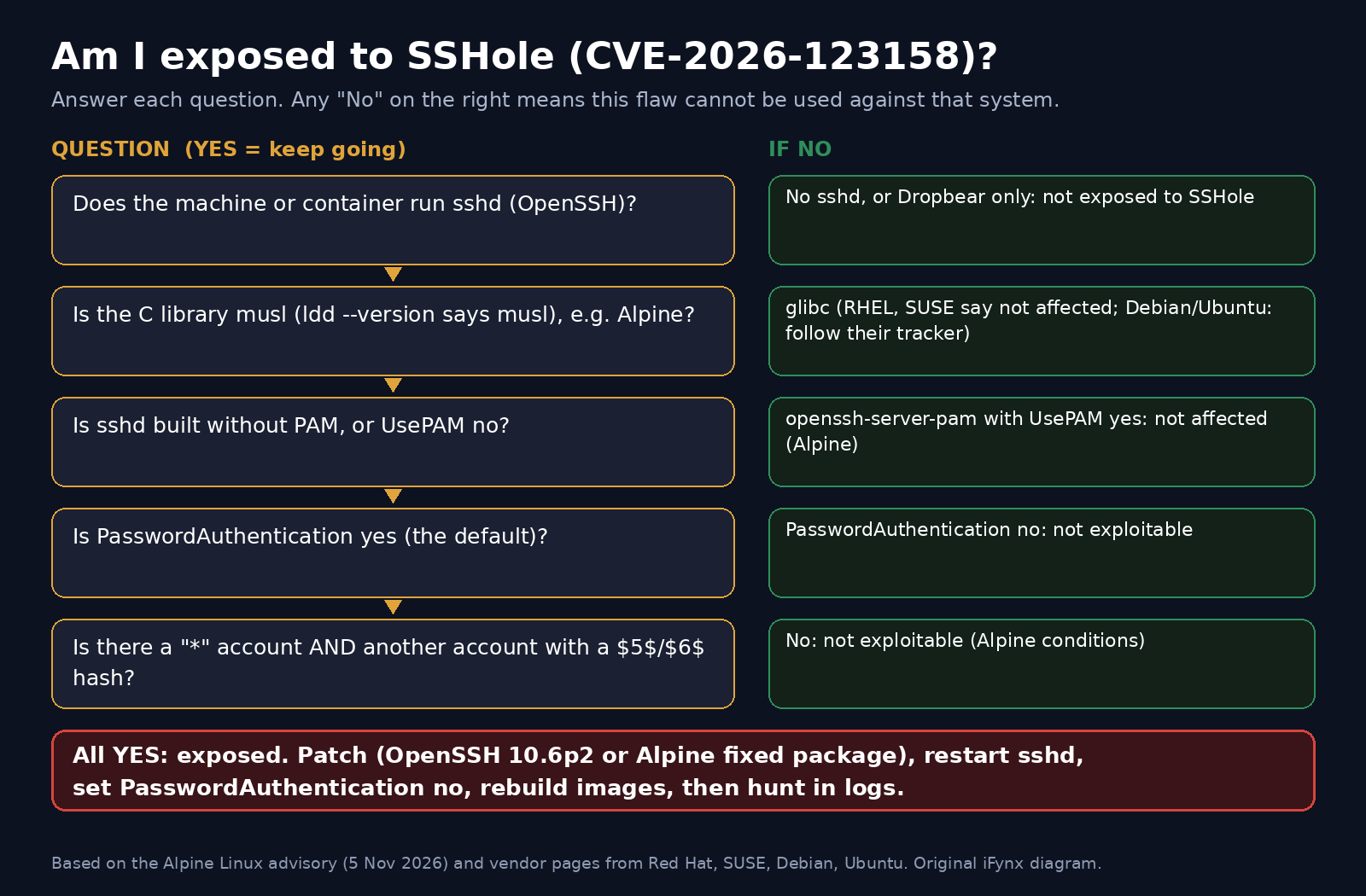
Exposure depends on how OpenSSH was built, not only on its version. In plain terms, the bug needs sshd built without PAM on musl, password logins switched on, an account whose password field is just * (normal for root on Alpine and for key-only users), and at least one other account with a real password hash. The Alpine advisory lists every condition. Statuses below are what each vendor published, read on 9 November 2026.
| Platform | Affected? | Fix or status |
|---|---|---|
Alpine Linux 3.16 to 3.24 and edge (openssh-server, or openssh-server-pam with UsePAM no) |
Yes, when the account conditions above are met | Fixed openssh: edge 10.6_p2-r0, 3.24 10.3_p1-r2, 3.23 10.2_p1-r1, 3.22 10.0_p1-r11, 3.21 9.9_p2-r1, 3.20 9.7_p1-r6, 3.19 9.6_p1-r3, 3.18 9.3_p2-r4, 3.17 9.1_p1-r7, 3.16 9.0_p1-r6 |
| Docker and other containers based on Alpine | Only if the container runs sshd (Alpine: containers without sshd are not affected) | Rebuild on a fixed base, redeploy, and restart |
Alpine openssh-server-pam with UsePAM yes |
Not affected, per Alpine | No action for this CVE |
| Red Hat Enterprise Linux and Red Hat products | Not affected, per Red Hat: its builds use glibc and PAM by default | No action for this CVE |
| SUSE and openSUSE products | Listed “Not affected” by SUSE | No action for this CVE |
| Debian 12 and 13 | Debian tracker lists them as “vulnerable” with urgency “unimportant” | Fixed in unstable (1:10.6p2-1); no stable update yet |
| Ubuntu (all releases) | Ubuntu says “Needs evaluation” (priority Medium) | No verdict yet; watch the Ubuntu CVE page |
| OpenWrt, Buildroot, Yocto and other musl builds | No vendor statement found; the researcher lists them as worth checking | Check whether OpenSSH (not Dropbear) runs, and how it was built |
| Upstream OpenSSH (portable) | Fixed | OpenSSH 10.6p2, released 5 November 2026 |
OpenSSH itself says it considers “the root cause of this bug to be outside sshd”, in musl’s password-hashing function, and calls 10.6p2 “a critical security workaround”. The fix commit is public. The researcher who reported it, Özgün Kültekin of Wakefield, told Help Net Security that glibc systems such as Debian, Ubuntu and Fedora, PAM setups, Dropbear and OpenBSD are safe. That is the researcher’s view; the table keeps to what each vendor has published.
How SSHole works, without the exploit details
When sshd is built without PAM, it checks a password by hashing the attempt with the C library’s crypt() function and comparing the result with the stored password field. According to Alpine, musl’s crypt() returns the string * as an error marker when it is given an over-long password. On accounts that have no password, the stored field is also *, so the two match and the login succeeds. Root on Alpine ships with that field. OpenSSH’s default PermitRootLogin prohibit-password still blocks root itself, but any other passwordless account that can become root, for example through doas, is enough.
Alpine adds one trap for cloud users: official tiny-cloud images from 3.18.11 to 3.24.3 ship an alpine user with that same empty field and passwordless doas. They are safe on first boot, but become exploitable as soon as any account on the machine gets a password hash. Images configured through cloud-init are not affected, because cloud-init turns password logins off.
What the attacks look like so far
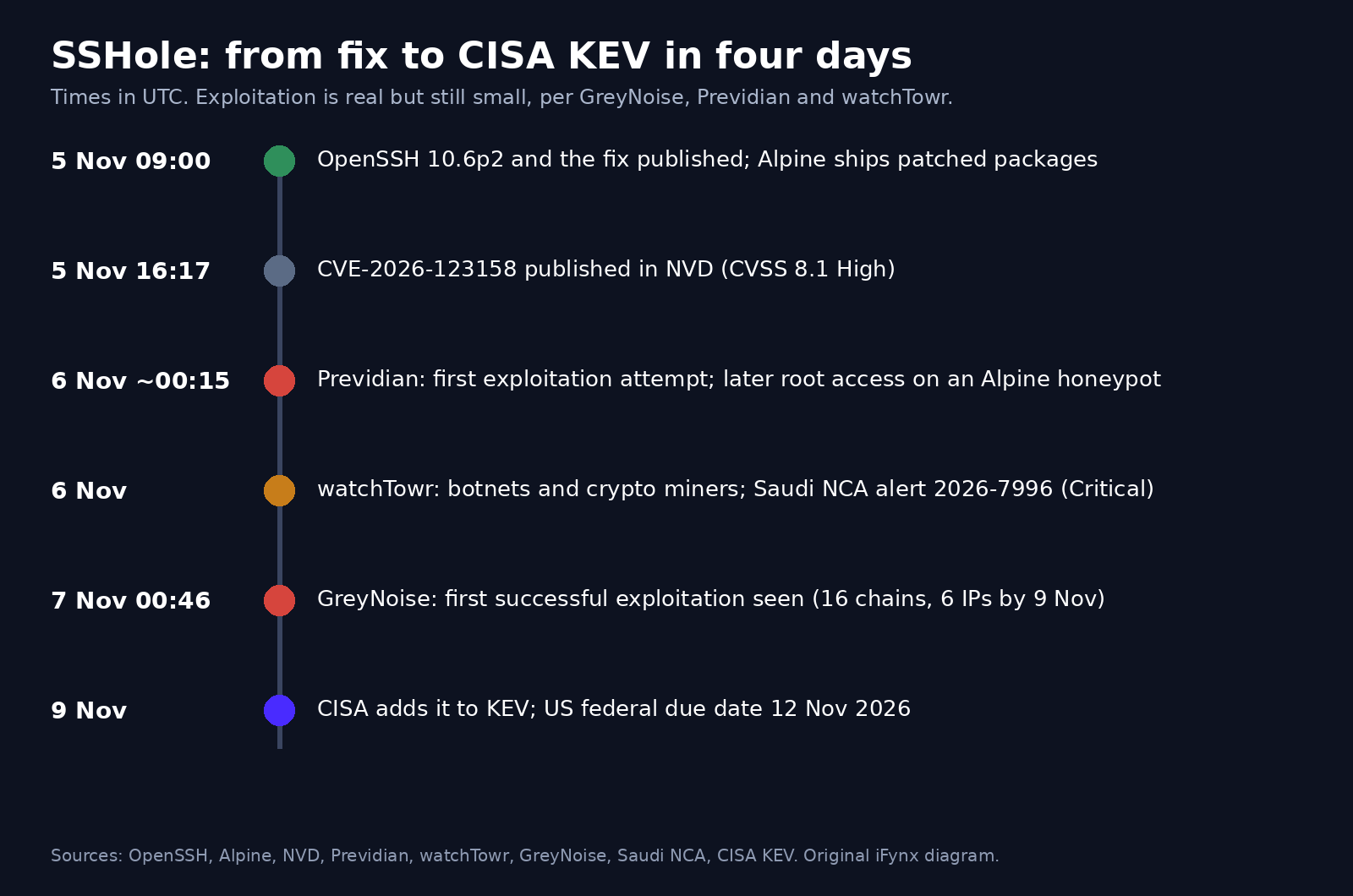
Exploitation started fast and is still small. Here is the timeline from the sources, in UTC:
- 5 November, 09:00: OpenSSH publishes the fix and 10.6p2; Alpine ships patched packages for every branch from 3.16 to edge the same day. NVD publishes the CVE at 16:17.
- 6 November, about 00:15: Previdian sees the first attempt on its sensors, less than nine hours after the CVE was published, and later confirms root access on an Alpine honeypot. By 8 November it had counted 20 attempts from 13 IP addresses in 9 countries, according to SecurityWeek.
- 6 November: watchTowr says only “botnets and crypto miners” are using it so far. Saudi NCA issues its Critical alert.
- 7 November, 00:46: GreyNoise records the first successful exploitation it observed. As of its 9 November update, it had confirmed 16 post-exploitation chains from 6 attacker IPs, and it stresses these numbers are not representative of all activity. BleepingComputer reports the same figures.
- 9 November: CISA adds the flaw to KEV with a 12 November due date.
Public proof-of-concept code appeared within hours of disclosure. We do not link to it.
MENA checklist: Alpine images, VPS and edge boxes
Startups and agencies in the Gulf and Egypt often run on small Alpine-based Docker images, cheap VPS and edge boxes, and ISP-supplied routers. Work through this list today, starting with anything that has port 22 open to the internet.
- Find musl systems. On each server or image,
cat /etc/os-releaseshows Alpine (or another musl distribution), andldd --versionprints “musl” instead of “GNU libc”. For images, run the same command in a throwaway container from the image. - Confirm sshd is actually there and running. Most application containers never run SSH. Check with
psor by looking for ansshdbinary and an exposed port 22. No sshd means SSHole does not apply to that container. - Upgrade and restart. On Alpine,
apk upgrade -U -a, thenrc-service sshd restart. Alpine is clear that the package upgrade does not restart a running sshd, so the old, vulnerable daemon keeps accepting logins until you restart it. - Rebuild and redeploy pinned images. An image built last week still contains last week’s OpenSSH. Rebuild without cache on a fixed base, push, and redeploy. It is the same lesson as the Brotli Node2Shell fix: pinned base images do not heal themselves.
- Turn off password logins. Set
PasswordAuthentication no, test a new key-based login before closing your current session, and restart sshd. OpenSSH developer Damien Miller urged anyone on musl without PAM to do this or disable SSH immediately. - Rotate keys if a host was exposed. Replace host keys and the user keys that were stored on any machine you cannot clear, and remove keys you do not recognise.
- Hunt in the logs (see the next section) and close port 22 to the internet where you can; use a VPN or bastion instead.
How to check whether you were already hit
Alpine’s advice is to search /var/log/messages for sshd lines reading “Accepted password for” an account that has no password, such as alpine, root or any key-only user. A successful password login to an account whose /etc/shadow field is * should never happen. Then review doas use, new user accounts, recently changed files, unknown entries in authorized_keys, new services or cron jobs, and unexpected outbound connections, for example to mining pools. If you cannot rule out a login, Alpine says to treat the machine as compromised: rebuild it from a clean image rather than cleaning it in place, and rotate every secret that was on it.
Also added to KEV on 9 November: GPUStack and FreeSWITCH
CISA added two more flaws the same day, both with the same 12 November federal due date:
- GPUStack CVE-2026-102895 (improper authentication): according to the KEV entry, it can give an unauthenticated attacker administrative access, persistent admin API keys, worker and cloud-provider secrets, and code execution. The GitHub advisory rates it critical (9.8) and lists 2.2.0 as the fixed version. AI teams in the region that self-host models on GPU clusters should update now and rotate API keys.
- FreeSWITCH CVE-2026-116779 (code injection): an inbound SIP message can run FreeSWITCH API commands. The SignalWire advisory rates it critical (9.8), says exploitation has been observed in the wild, and lists 1.11.3 as the fix. Call centres and VoIP providers should patch and check call logs and configuration.
For teams: the same pattern as other recent KEV entries
SSHole follows a pattern we have seen all autumn: a fix ships, exploit code follows within hours, and CISA confirms attacks days later. The SonicWall SSL-VPN MFA bypass, Plex2Shell on QNAP NAS and php2shell all rewarded teams that knew exactly where each component ran. Our Linux kernel CVE-2026-98432 guide covers the case where a distribution has no patch yet and mitigation has to come first. An up-to-date inventory of base images, servers and what they expose is what turns a three-day deadline into a one-hour task.
How iFynx can help
iFynx Maintenance & Growth handles patch management, container rebuilds, server hardening and monitoring after launch, so fixes like OpenSSH 10.6p2 reach every running server and image, not only the package list. Software Development builds secure Docker and CI pipelines that rebuild images on a fixed base automatically and keep SSH off the internet by design. If you are not sure which of your servers or images run Alpine with sshd, book a free 30-minute discovery call.
Frequently asked questions
Am I affected by SSHole if I use Ubuntu, Debian or RHEL?
Red Hat says RHEL and its products are not affected because they use glibc and PAM, and SUSE lists its products as not affected. Debian rates the issue “unimportant” for its stable releases and has the fix in unstable, and Ubuntu still lists all releases as “needs evaluation”. Install vendor updates when they arrive and set PasswordAuthentication no where you do not need password logins.
How do I check whether my Docker image or server is Alpine or musl and runs sshd?
Run cat /etc/os-release to see the distribution and ldd –version to see whether the C library is musl or GNU libc. Then check whether an sshd process is running or an sshd binary and port 22 are present. A container that does not run sshd is not affected, according to Alpine.
Which OpenSSH version fixes SSHole, and why must I restart sshd?
Upstream OpenSSH 10.6p2, released on 5 November 2026, fixes it, and Alpine has patched packages for 3.16 to edge, such as 10.3_p1-r2 on 3.24. Upgrading the package does not replace the sshd process that is already running, so restart sshd or the old daemon keeps accepting attacks. Rebuild and redeploy container images too.
How do I mitigate SSHole now, and how do I know if I was hacked?
If you cannot patch today, set PasswordAuthentication no, test a key login, and restart sshd. Then search the logs for “Accepted password for” on accounts that have no password, such as root, alpine or key-only users, and review doas use, new users, authorized_keys entries and new services. If you cannot rule out a login, rebuild the machine and rotate its keys.
Are routers running OpenWrt and IoT devices built with Buildroot or Yocto at risk?
They can be, if they run OpenSSH built on musl without PAM and allow password logins. We found no OpenWrt, Buildroot or Yocto advisory as of 9 November 2026. OpenWrt uses Dropbear by default, which the researcher says is not affected, so check whether OpenSSH was added, and keep SSH on routers closed to the internet.
Sources and update policy
Primary sources: the CISA KEV catalog and its JSON feed (CVE-2026-123158, dateAdded 2026-11-09, dueDate 2026-11-12), the OpenSSH 10.6p2 release notes, the Alpine Linux advisory of 5 November 2026, the OpenSSH fix commit, NVD and EUVD for CVSS 8.1, and vendor pages from Red Hat, SUSE, Debian and Ubuntu linked above. Exploitation data: GreyNoise (updated 9 November, 16:40 UTC), Previdian and watchTowr on X, BleepingComputer, SecurityWeek and Help Net Security. Saudi NCA alert 2026-7996. We do not link to exploit code. We will update this article, with the time, when Debian, Ubuntu or OpenWrt publish a verdict or if attacks change in scale.
Related reading
- Linux Kernel Vulnerability CVE-2026-98432: Ubuntu Still Has No Fix, What Is Patched, and How Gulf and Egypt Server Teams Should Mitigate Now
- Brotli Vulnerability CVE-2026-111497 (Node2Shell): Node.js, .NET and Python Patch Checklist for Gulf and Egypt Teams
- SonicWall Vulnerability CVE-2026-19868: SSL-VPN SAML and MFA Bypass Enters CISA KEV — Fixed Builds and Checklist
- Chrome zero-day CVE-2026-125350: update Chrome now (157.0.8103.50) — what Gulf and Egypt teams should do
- Outlook Zero-Day CVE-2026-124194: November 2026 Patch Tuesday and What to Patch First in Gulf and Egypt Companies
- N-able N-central Vulnerability (Able2Shell): 33 Exploits, Emergency Hotfix 2026.4.1.26 and the RMM Security Checklist for Gulf and Egypt Companies