Published 2 November 2026, 22:04 Asia/Gaza. We will add dated updates as Google and its partners publish more.
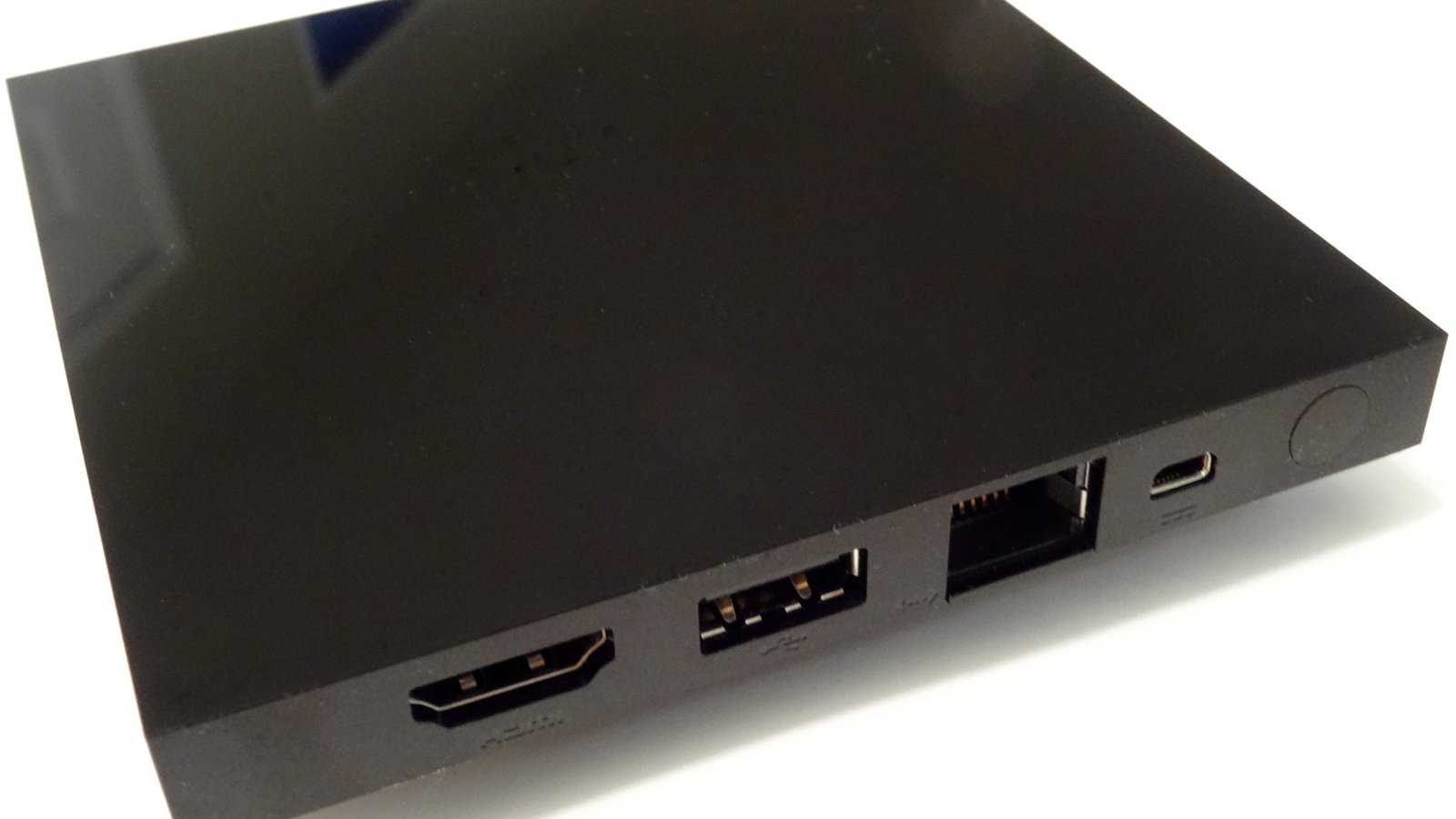
Quick answer: Google and partners have taken down the control servers of the XCPE botnet, malware that came preinstalled on more than 1.3 million Android TV set-top boxes. In its report, Google says it assesses with high confidence that the Shenzhen device maker Videostrong Technology built and ran the backdoor and sold access to criminals for ad fraud and residential proxies. TrendAI counted 1,472,554 infected devices across 206 models, with Iraq among the top five countries. The takedown cut the operators off, but the malware is still on the boxes and owners cannot remove it. If your box is not Play Protect certified, move it to a separate Wi-Fi, never bank on it, and plan to replace it.
Key facts
- Announced: 2 November 2026 by Google’s Threat Intelligence Group, with Plume, TrendAI, Lumen, HUMAN Security, Synthient and Japan’s National Police Agency (Plume release).
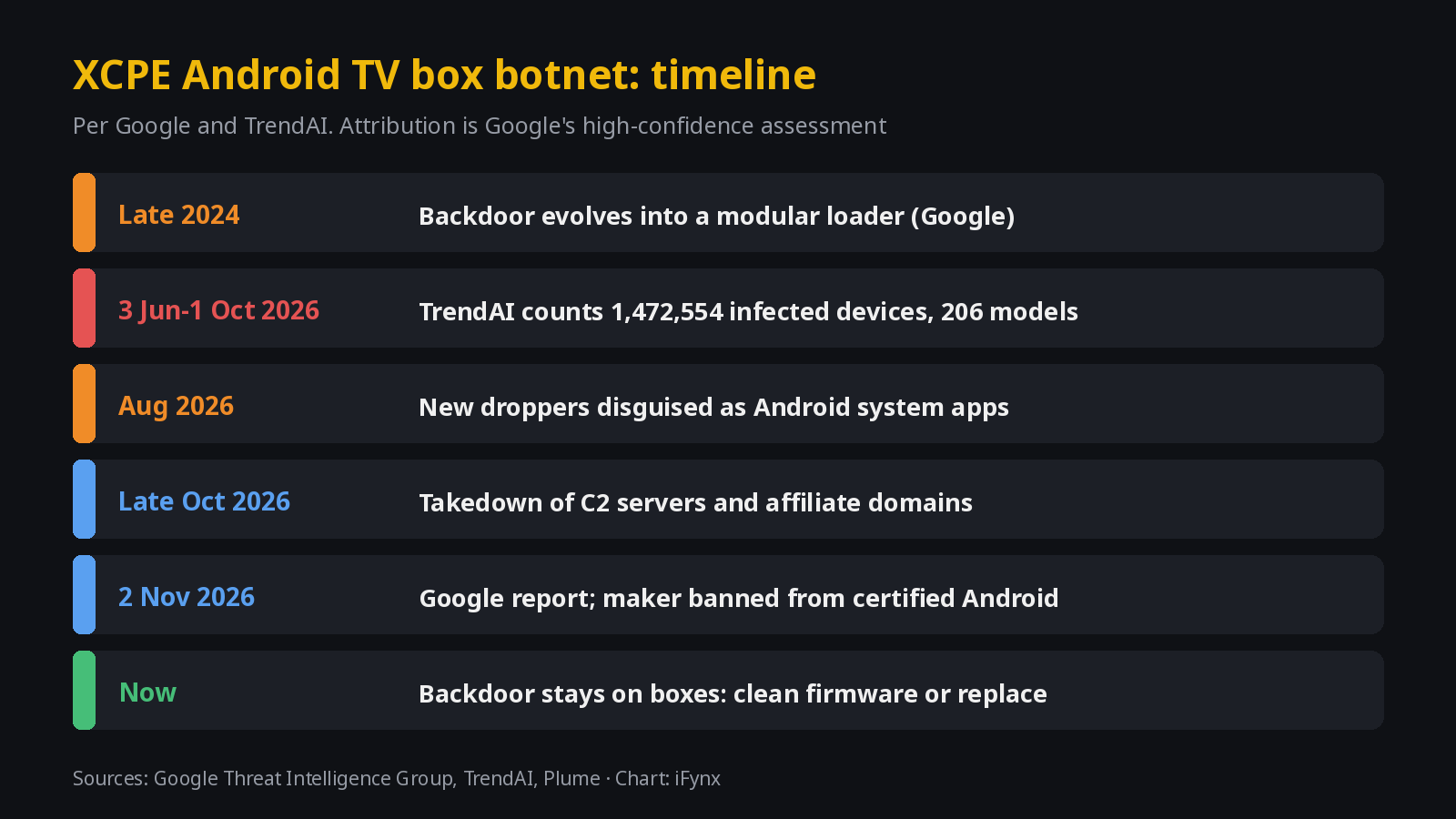
- Scale: 1,472,554 infected devices, 206 models, 170+ countries; about 1.33 million were given proxy and ad-fraud modules (TrendAI, 3 June to 1 October).
- Abuse: 3,849,226 distinct home and mobile IP addresses were used as residential proxies over four months.
- What it could do: install apps silently, turn off Google Play Protect app checks, run commands, take screenshots and collect account and Wi-Fi information.
- Takedown: control servers seized last week; affiliate C2 domains also hit, cutting off at least 10 million more devices, Google says.
- Maker: Google banned Videostrong and any future affiliates from building certified Android devices or supplying software to certified vendors.
What is the XCPE botnet?
XCPE is a backdoor app, called x.cpe or com.oemservice, placed in the firmware of the boxes before they were sold. It runs with system privileges. Google says it hid from Google’s pre-release tests by loading its malicious code only after the first boot, and Google has since changed its review process. Once online, the box took orders from the operators and downloaded “monetization modules” from other criminal groups: residential proxy software, ad-fraud clickers and more backdoors. “A device manufacturer intentionally infecting their users with malware is an unacceptable breach of trust,” Google wrote.
The attribution is Google’s own assessment, stated “with high confidence”. Researchers at Synthient tied the servers and code-signing to Videostrong, as BleepingComputer reports. Videostrong builds boxes for many white-label brands, so the name on your box may not be Videostrong. We have not seen a public response from the company.
| Item | What is reported | Status | Source |
|---|---|---|---|
| Infected devices | 1,472,554 across 206 models, 170+ countries (3 Jun-1 Oct) | TrendAI telemetry; joint figure 1.3M+ | TrendAI |
| Top countries | Malaysia, Brazil, Iraq, Mexico, Taiwan | TrendAI | TrendAI |
| Home IPs abused as proxies | 3,849,226 over four months | TrendAI | TrendAI |
| Control servers | Taken down last week, plus affiliate C2 domains | Done; Google says 10M+ more devices cut off | |
| Who is behind it | Videostrong Technology, per Google’s high-confidence assessment | Google assessment | |
| Maker’s status | Banned from certified Android and preloaded Google apps | Done | |
| Malware on your box | Still there; reinstalls itself; blocks Play Protect | Clean firmware or replace | TrendAI |
Status as of 2 November 2026, 22:04 Asia/Gaza.
Why this matters in Egypt, Iraq, the Gulf and Palestine
Iraq is one of the five countries with the most infected boxes in TrendAI’s data, after Malaysia and Brazil. Cheap uncertified Android boxes and “Android receivers” sold with IPTV subscriptions are a mass-market product across Egypt, Iraq, Jordan, Palestine and the Gulf. Shoppers search for them by price and channel bundles, not by certification. TrendAI notes that owners “cannot remove the implant themselves” because it is signed with the maker’s key.
Is your Android TV box infected? A six-step checklist
- Check Play Protect certification. Play Store > profile icon > Settings > About. “Device is not certified” or no Play Store means the box is untrusted (Google’s guide).
- Look for apps you never installed. System apps with odd names, or a “bandwidth sharing” app, are a warning sign. You cannot remove the backdoor, but they tell you the box is compromised.
- Check your router. In the router app, look for a TV box that keeps uploading data when no one is watching.
- Put TV boxes on a separate guest Wi-Fi. Keep them away from the phones and laptops you use for banking and work. Google and TrendAI both say infected boxes collected Wi-Fi details and could reach other devices on the network.
- Never sign in to banking, email or WhatsApp Web on the box. If you already did, sign out of all sessions from another device and change those passwords.
- Replace uncertified boxes, or unplug them. A factory reset does not help. Buy a Play Protect certified box from a brand on Google’s Android TV partners page.
You cannot clean this one yourself
XCPE reinstalls itself from a protected partition after every reboot, and a factory reset puts it back. Do not download “cleaner” apps or custom firmware from forums. Use only official firmware from the maker, or replace the box.
For banks and fintechs in the Gulf and Egypt: residential proxies break IP checks
TrendAI says residential proxies “let criminals look like ordinary local customers”: the traffic passes IP reputation and geolocation checks. HUMAN has reported buyers of a related proxy service using such access for account takeover and fake account creation. Fraud teams should change how they use IP data:
- IP geolocation is no longer a trust signal. A login from a home broadband address in Cairo, Baghdad or Riyadh may be a rented proxy. TrendAI says data-center blocklists did not catch this traffic.
- Bind sessions to devices. Use app attestation and device-bound keys so a stolen password from a new device triggers extra checks.
- Step up on risk, not on location. Ask for an in-app approval or passkey when a new device, a new payee or a large transfer appears.
- Combine network fingerprints with behaviour. TrendAI recommends logging network fingerprints such as JA4T and pairing them with signals like repeated failed logins before acting.
- Do not punish victims. A customer whose box was a proxy exit node is a victim. Explain the block and point them to this checklist instead of closing the account.
For the customer-facing side of fraud, see our UAE online fraud guide and our exchange account lockdown checklist.
For ISPs and telcos
- Watch for MQTT control traffic. Google says infected boxes kept a persistent MQTT connection to the operators on non-standard ports. Use your own threat feeds and the indicators in Google’s report.
- Notify subscribers in plain language. Say which device looks infected, that it is not their fault, that a reset will not fix it, and what to do: unplug, move to guest Wi-Fi, or replace.
- Audit the boxes you supply. If you bundle Android boxes with IPTV or broadband plans, require certified firmware from suppliers, as TrendAI and Google recommend.
This is the second connected-device story today, after the supermarket fridge attacks in Europe. If you run Linux servers behind your network, also see today’s Linux kernel patch guide.
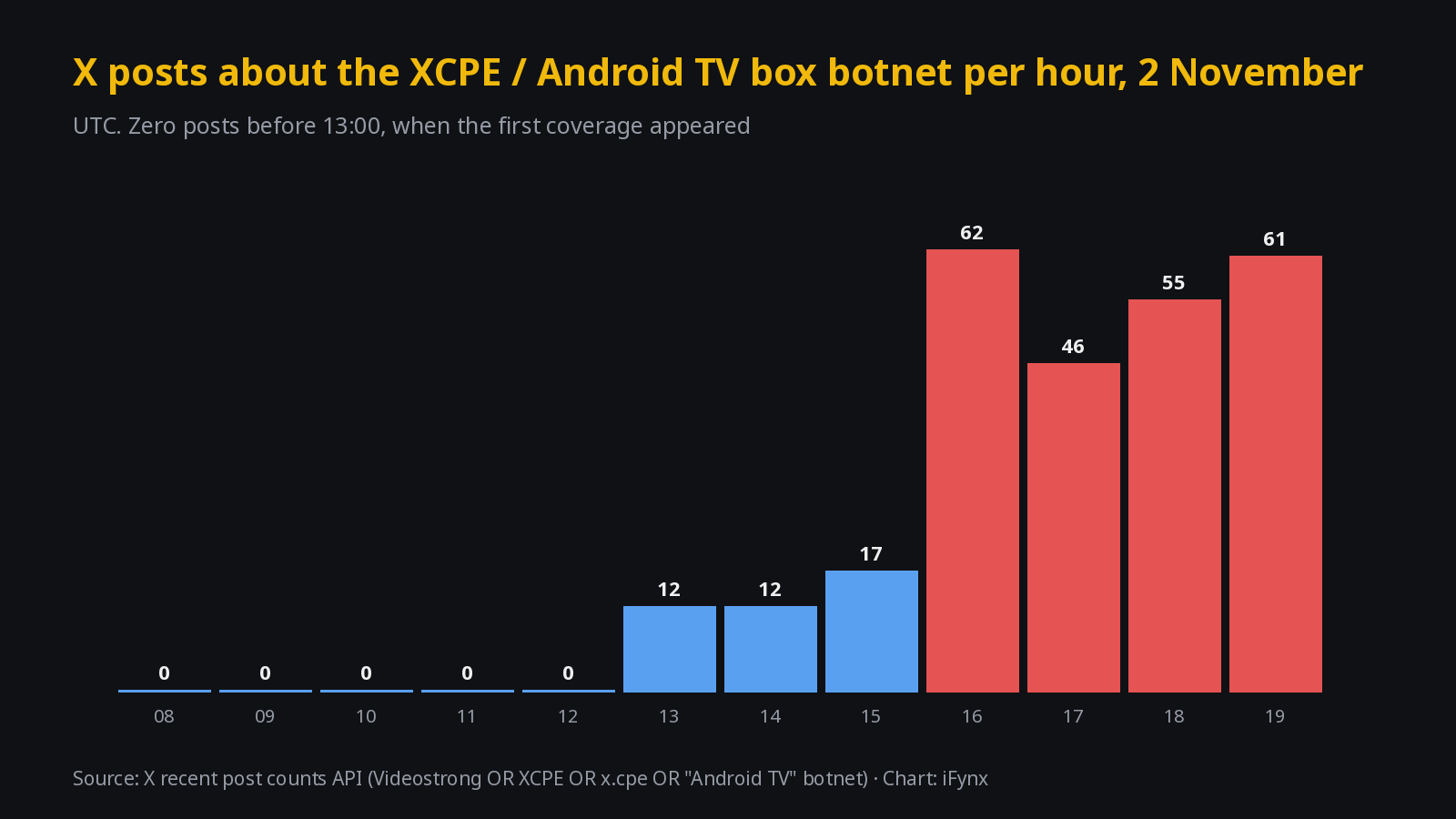
Attention on X
What we are watching next
- Whether Videostrong responds, and whether a list of affected brands and models is published.
- Whether box makers ship clean firmware updates, or whether owners must replace their boxes.
- Whether regulators or ISPs in the region issue warnings to subscribers.
How iFynx can help
iFynx builds bilingual banking and fintech apps for the UAE, Saudi Arabia and Egypt, including device binding, risk-based step-up authentication and clear in-app security notices. See our services.
Frequently asked questions
Which Android TV boxes are infected with XCPE?
Google says the backdoor was built into many device models and brands made by one Shenzhen manufacturer, Videostrong Technology, over several years. TrendAI counted 206 affected models. No full public list of retail brands has been published. Researchers at Synthient reported first finding it on a MECOOL KM9PRO Max box bought in late 2025, BleepingComputer reports.
How do I check if my Android TV box is safe?
Open the Google Play Store on the box, tap your profile icon, then Settings, then About, and look at Play Protect certification. If it says the device is not certified, or there is no Play Store at all, treat the box as untrusted. Also check your router for a box that uploads a lot of data while you are not watching.
Can I remove the XCPE malware myself?
No. It sits in the firmware as a system app and reinstalls itself after a reboot if you uninstall it. A factory reset does not remove it. Only clean firmware from the maker or replacing the box fixes it. Until then, unplug it from the internet.
Is my bank or WhatsApp account at risk if I used the box?
The operators could take screenshots, inject keystrokes and collect account information on infected boxes, Google says. If you ever signed in to banking, email or WhatsApp Web on the box, sign out of all sessions from another device and change those passwords.
Why would my bank flag my home internet connection?
Infected boxes were rented out as residential proxies: strangers sent their traffic through owners’ home connections. TrendAI saw 3.85 million distinct home and mobile IP addresses over four months. Fraud checks can then link your home IP to logins that were not yours.
Are cheap IPTV receivers in Egypt, Iraq or the Gulf safe?
Not all are unsafe, but uncertified boxes carry more risk. Buy boxes that are Play Protect certified, from a brand listed on Google’s Android TV partners page, and avoid apps that pay you to share your bandwidth.
Sources
- Google Threat Intelligence Group: Shutting the Door on the XCPE Botnet, 2 November 2026
- TrendAI Research, 2 November 2026
- Plume joint press release
- BleepingComputer; The Hacker News
- Google Play Help: Play Protect certification; Android TV partners
- X post counts: X recent counts API, queried 2 November 2026
- Cover photo: Justin Ormont, Wikimedia Commons, CC BY-SA 3.0, cropped. In-article photo: Syced, Wikimedia Commons, CC0, cropped. Charts: iFynx.

