Direct answer: The Crédit Mutuel Arkéa crypto hack is an alleged theft of more than $133 million that on-chain investigator ZachXBT attributed on 4 November 2026 to the French bank Crédit Mutuel Arkéa. Bitquery’s analysis confirms that about $108.8M in USDC left accounts at Kraken, Crypto.com and OKX on 1 to 2 November in roughly 21 hours, but says the chain alone cannot prove a bank was the victim. Arkéa has not confirmed anything. The exchanges say their own platforms were not breached. For banks and fintechs in the UAE, Saudi Arabia and Egypt, the lesson is that a per-withdrawal limit is not a defence: you need velocity limits, two-channel approval and a ready freeze plan.
Key facts (checked 4 November 2026, 09:17 Asia/Gaza)
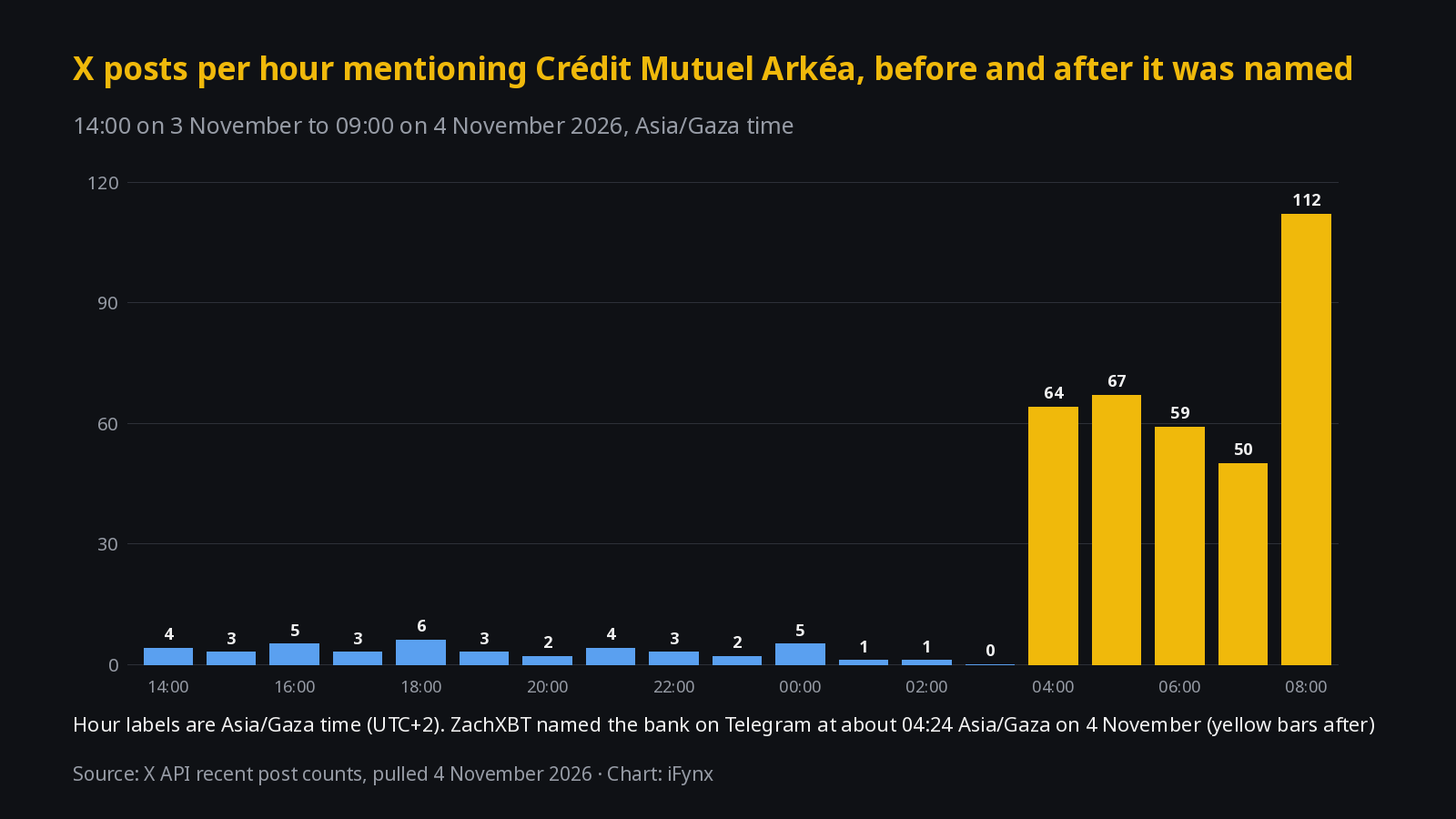
- Alleged victim: Crédit Mutuel Arkéa, a French cooperative bank with about $235B in assets, named by ZachXBT on 4 November (around 04:24 Asia/Gaza) (The Block, Cointelegraph). Not confirmed by the bank.
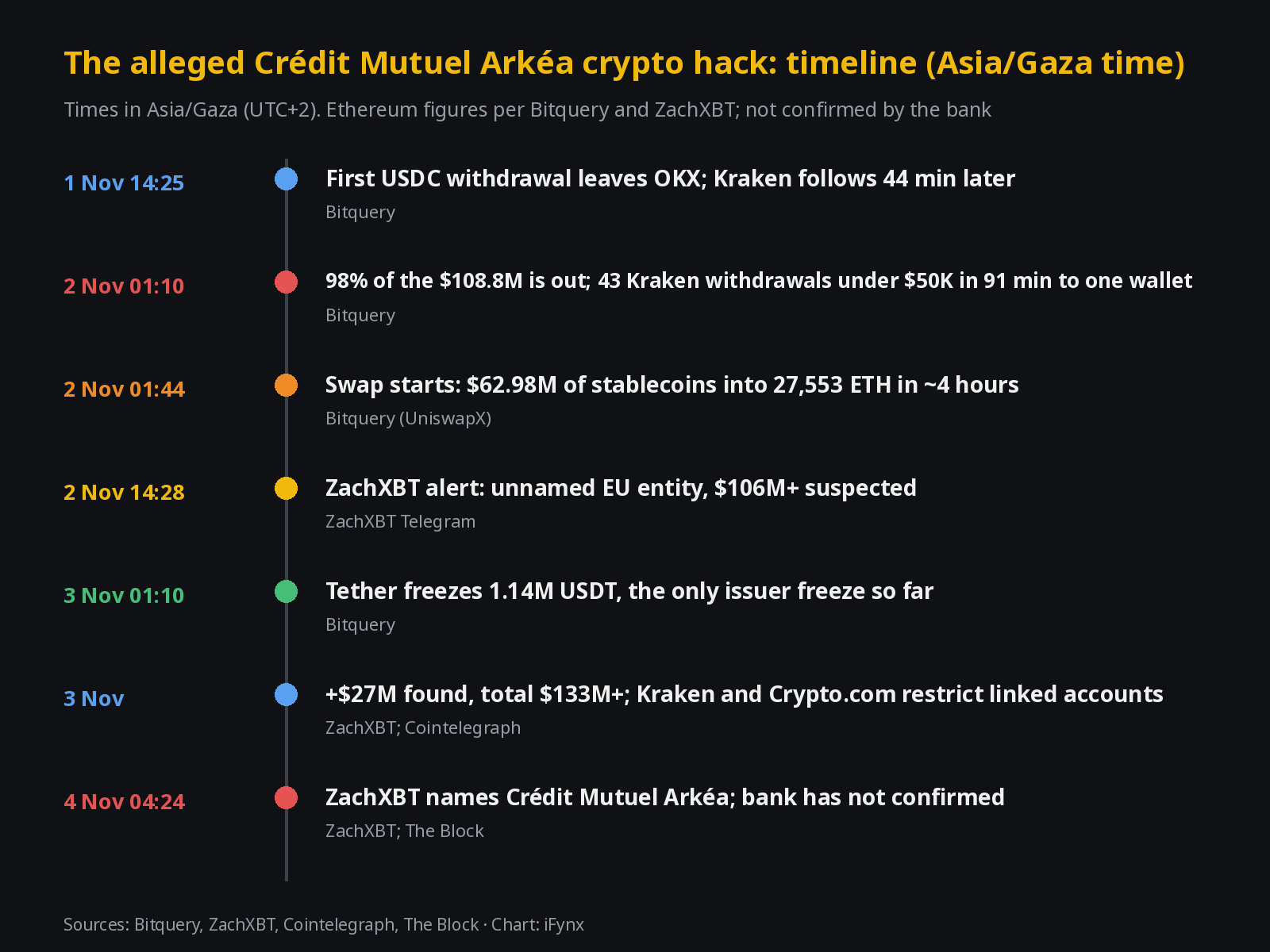
- Traced on-chain: $108.80M USDC withdrawn from Kraken, Crypto.com and OKX to 15 wallets between 1 Nov 14:25 and 2 Nov 11:09 Asia/Gaza; Kraken paid 95% in 178 withdrawals (Bitquery).
- Claimed total: $133M+ after ZachXBT found a further $27M on 3 November; he says the real figure may be higher once OTC trades are counted (Cointelegraph).
- Speed: $73.2M left in the three hours to 01:00 Asia/Gaza on 2 November; 98% was gone by 01:10.
- Laundering: $62.98M swapped to 27,553 ETH in about four hours; funds then moved through bridges, instant-swap services and Wagyu into Monero, according to ZachXBT and Bitquery.
- Frozen so far: Tether froze 1.14M USDT; Circle froze none of the 2.53M USDC still freezable (Bitquery snapshot, 3 Nov). Kraken and Crypto.com restricted linked accounts.
- Not Lazarus: ZachXBT says he has “a high degree of confidence” North Korea’s Lazarus Group is not behind it.
- Gulf context: Standard Chartered has offered VARA-licensed crypto trading to clients in the UAE since 14 October 2026 (our report).


The Crédit Mutuel Arkéa crypto hack went from an anonymous alert to a named bank in less than three days. On 2 November ZachXBT warned that an unnamed EU entity had lost more than $106 million from accounts on centralised exchanges. We covered that first stage in our $106 million crypto theft report. On 3 November he raised the figure to more than $133 million and accused the victim of a cover-up. In the early hours of 4 November he named Crédit Mutuel Arkéa, the Brittany-based banking group behind Crédit Mutuel de Bretagne and Fortuneo.
This article separates what is proven on-chain from what is alleged, explains why the withdrawal pattern matters more than the name, and turns the case into a practical playbook for Gulf and Egyptian banks and fintechs that now hold balances on crypto exchanges. We write about attacks only to help defenders. There is no attack method here.
What do we actually know about the Crédit Mutuel Arkéa crypto hack?
The strongest public evidence comes from Bitquery’s investigation, which traced the money on Ethereum. On 1 November at 14:25 Asia/Gaza the first USDC withdrawal left OKX. Kraken followed 44 minutes later and ended up paying 95% of the total in 178 withdrawals. Crypto.com was the third source. Scorechain independently counted $108.2M in USDC from two hot wallets to 14 addresses, which matches closely.
The pace is the story. $73.2M left in just three hours, and by 01:10 Asia/Gaza on 2 November, 98% was out. The last payment arrived at 11:09 that morning, about 21 hours after the first. One wallet alone received 43 Kraken withdrawals in 91 minutes, each under $50,000. Bitquery reads that as working around a per-withdrawal limit. Funds usually moved on within three minutes of arriving.
| Claim | Status on 4 Nov 2026 | Source |
|---|---|---|
| ~$108.8M USDC withdrawn from Kraken, Crypto.com and OKX to 15 wallets | Confirmed on-chain | Bitquery, Scorechain |
| Total theft above $133M | Claimed, partly traced | ZachXBT via Cointelegraph |
| Victim is Crédit Mutuel Arkéa | Alleged, not confirmed | ZachXBT via The Block |
| Incident was covered up | Alleged opinion | crypto.news |
| Kraken, OKX or Crypto.com systems were breached | No evidence; Kraken denies | Cointelegraph |
| Lazarus Group behind it | ZachXBT says no (high confidence) | ZachXBT Telegram |
| Trust Wallet flaw | No evidence; 8 receiving wallets were Trust Wallet smart accounts | Bitquery |
What is not confirmed
Crédit Mutuel Arkéa has made no public statement and did not reply to The Block or Cointelegraph. Bitquery says “the chain cannot confirm” the bank theory and that the flow looks more like a trading or payments business than a custodied fund. The $133M total, the cover-up claim and the victim’s identity all come from ZachXBT. We will add a dated update if the bank, French authorities or the exchanges say more.
Why ZachXBT says it is a bank, and why Bitquery is more careful
My working theory is a large financial institution in Western Europe was exploited and it’s currently being covered up.
ZachXBT on Telegram, 3 November 2026, quoted by Cointelegraph
ZachXBT’s argument is about silence. Some withdrawals came after his first public alert, and he says the lack of disclosure let more than $30M be laundered that EU law enforcement might have frozen. In his naming post he added that he suspects the amount “is larger when accounting for OTC activity” (The Block).
Bitquery reads the same data more narrowly. Eleven of the 15 receiving wallets had been paid before, and they took 84% of the money. That suggests the thief had both the account logins and the keys to the destination wallets, so this was most likely a compromise of the victim’s own operations, not of an exchange. Bitquery also notes that the four addresses missing from public lists took $28.0M, and that without two indirect wallets the total would be $95.71M. Both readings agree on one thing: the victim’s controls let a single actor empty several exchange accounts overnight.


Where did the $133 million go, and can any of it be frozen?
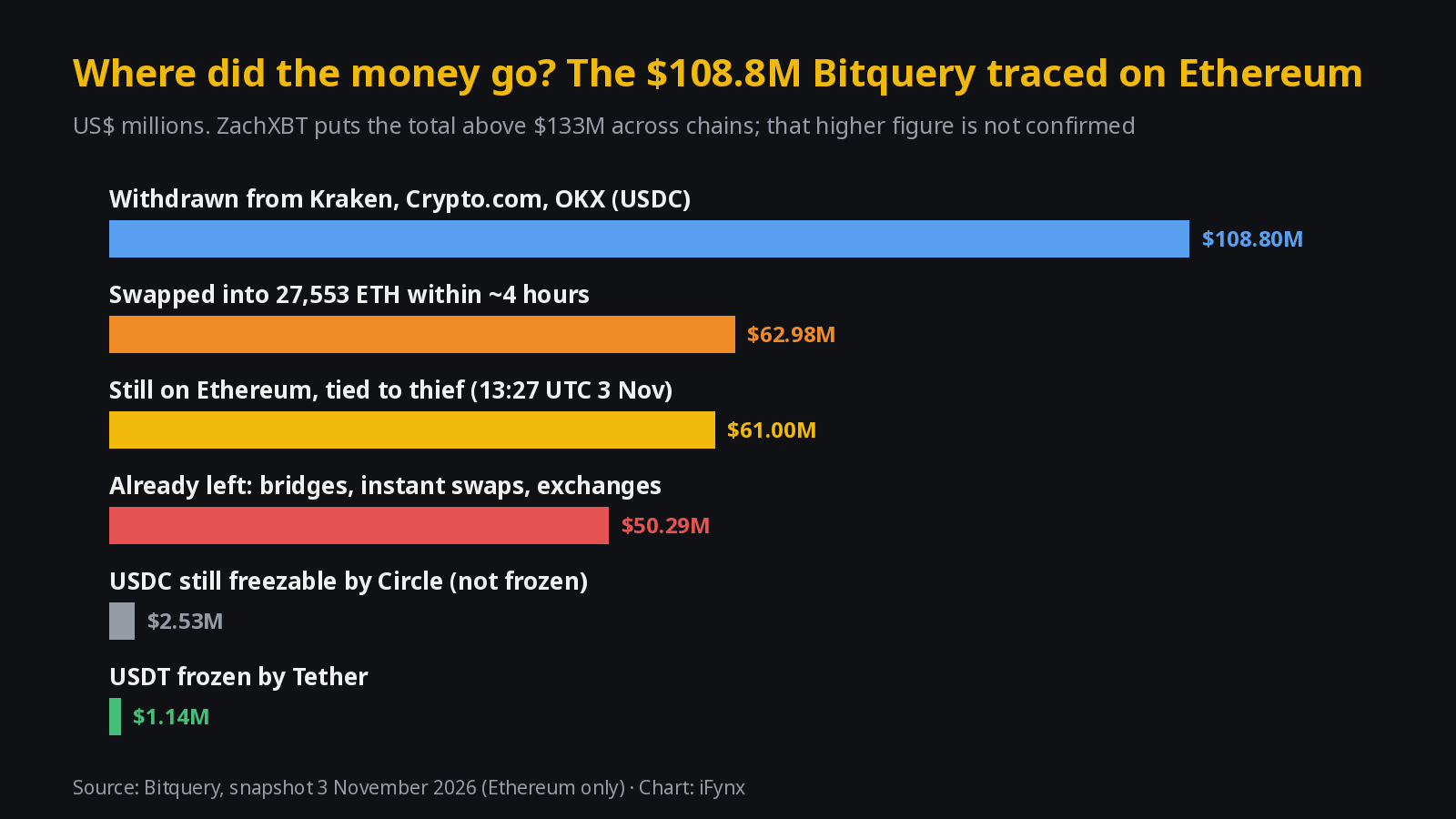
Between 01:44 and 06:02 Asia/Gaza on 2 November, $62.98M of stablecoins was swapped into 27,553 ETH through UniswapX, at about $2,286 per ETH. That step matters: stablecoins can be frozen by their issuer, ETH cannot. From there, ZachXBT and Bitquery traced funds to instant-exchange services, to Wagyu for conversion into Monero, and across bridges such as LI.FI ($8.70M).
By Bitquery’s snapshot on 3 November, $61.0M was still on Ethereum in wallets tied to the thief and $50.29M had already exited. Tether froze 1.14M USDT. Circle did not freeze the 2.53M USDC that was still freezable. Kraken said it had “restricted the accounts in question” and was “working with law enforcement”, Crypto.com said it had blocked funds linked to the incident, and 396 ETH was sent into a Kraken deposit address on 3 November (Cointelegraph).
The iFynx reading
This case is not a smart-contract bug or an exchange breach. It is an operations failure: one actor with logins and keys, no velocity limit, and no one stopping withdrawals for 21 hours. That makes it more relevant to banks, not less, because every bank entering crypto will hold exchange accounts like these.
Why this matters for banks in the UAE, Saudi Arabia and Egypt
Gulf banks are no longer watching crypto from the outside. In the UAE, Standard Chartered has offered Bitcoin and Ether trading since 14 October 2026 under a VARA broker-dealer licence (VL/26/08/003), with per-trade sizes from $50 to $50,000. A cap like that protects the client trade, but the Arkéa pattern shows why a bank’s own treasury and settlement accounts need a second kind of limit: 43 withdrawals under $50,000 in 91 minutes still add up to about $2M from one wallet.
In Saudi Arabia, SAMA’s Cyber Security Framework already asks banks to inform SAMA immediately of medium and high incidents. In Egypt, Article 206 of Central Bank Law 194 of 2020 bars issuing, trading or promoting crypto assets without a CBE licence, so most Egyptian banks hold no exchange balances at all; the risk sits with licensed fintechs and with Egyptian clients of foreign exchanges. The table compares the disclosure clocks, which is the part of the Arkéa case regulators will look at first.
| Jurisdiction | Rule | First notice to regulator | What it means for a crypto drain |
|---|---|---|---|
| EU (France) | DORA and Delegated Reg. 2025/301 | Within 4 hours of classifying a major ICT incident, and no later than 24 hours after becoming aware; intermediate report in 72 hours | A 21-hour drain should already have triggered a notice |
| UAE (VASPs) | VARA Technology and Information Security Rulebook | Incident notification to VARA required; check the rulebook for the current deadline | Banks also report to CBUAE under their own rules |
| Saudi Arabia | SAMA Cyber Security Framework | Inform SAMA immediately for medium or high incidents | No retail crypto licences; exposure mainly through fintech and client activity |
| Egypt | CBE Law 194/2020, Art. 206 | CBE licence required for any crypto activity; incidents reported under CBE cyber rules | Main risk is unlicensed exposure and clients of foreign exchanges |
This is a summary, not legal advice. Check the current text of each rule with your compliance team.
10 exchange-account controls for Gulf and Egypt banks and fintechs
Each control below maps to a specific failure seen in this case. Most can be configured on the major exchanges today.
- Cap velocity, not just size. One wallet received 43 Kraken withdrawals in 91 minutes, each under $50,000, which Bitquery reads as a way around a per-withdrawal limit. Set a rolling limit per hour and per day across all withdrawals and all exchanges, not only per transaction.
- Two people, two channels for every large withdrawal. Any withdrawal above a threshold needs a second approver on a separate device and channel (for example a call-back to a named treasury officer). A stolen session should never be enough.
- Hardware security keys on every exchange login. Replace SMS and app codes with FIDO2 keys for treasury accounts, and remove API keys that have withdrawal rights unless a system truly needs them.
- Keep exchange logins and wallet keys apart. 11 of the 15 receiving wallets had been paid before, so the attacker likely held both the exchange access and the destination keys. Store them on different devices, with different people.
- Cooling period for new allowlist addresses. Add a 24 to 48 hour delay before a new address can receive funds. It would not have stopped this case on its own (most funds went to known addresses), which is why it must sit next to items 1 and 2.
- Alert on behaviour, not only on amounts. Flag first withdrawals from an account in weeks, bursts of identical sizes, night-time activity and withdrawals to addresses that then move funds within minutes (the median here was 3 minutes).
- Pre-agree an issuer and exchange freeze playbook. Keep 24/7 contacts for Tether, Circle and every exchange you use. In this case Tether froze 1.14M USDT while 2.53M USDC remained freezable but was not frozen, according to Bitquery. Speed decides how much is recovered.
- Know your disclosure clock before the incident. EU firms under DORA have hours, not days, for the first notice. Gulf and Egyptian regulators have their own rules (table above). Write the timeline into the incident plan.
- Reconcile exchange balances in near real time. A treasury team that reconciles daily will learn of a 21-hour drain after it has finished. Pull balances by API every few minutes and alert on any drop outside approved movements.
- Test it. Run a tabletop exercise this quarter: “a staff laptop with exchange sessions is compromised on a Saturday afternoon”. Time how long it takes to freeze accounts, call issuers and notify the regulator.
What to watch next
- A statement from Crédit Mutuel Arkéa, or from French authorities (ACPR or AMF), confirming or denying the incident.
- Whether Circle freezes the remaining USDC and whether more exchanges block deposits linked to the 15 addresses.
- Updated totals from ZachXBT, especially any OTC flows that would push the figure above $133M.
- Whether the case becomes the first public test of DORA major-incident reporting for a crypto loss at a bank.
Frequently asked questions
What happened in the Crédit Mutuel Arkéa crypto hack?
On 1 and 2 November 2026 about $108.8M in USDC was withdrawn from accounts at Kraken, Crypto.com and OKX to 15 wallets in roughly 21 hours, according to Bitquery’s on-chain analysis. Investigator ZachXBT first flagged an unnamed EU entity on 2 November, raised his estimate to more than $133M on 3 November, and on 4 November named the French bank Crédit Mutuel Arkéa as the suspected victim. Most of the money was swapped into ETH and part of it has already been moved through bridges and instant-swap services.
Has Crédit Mutuel Arkéa confirmed it was hacked?
No. As of 4 November 2026 the bank had not made a public statement, and both The Block and Cointelegraph said it did not reply to requests for comment. The link to Arkéa comes from ZachXBT. Bitquery says the blockchain data alone cannot confirm the bank theory. Treat the victim’s identity as alleged until Arkéa, a regulator or law enforcement confirms it.
Were Kraken, OKX or Crypto.com hacked?
There is no evidence of that. The withdrawals were made from customer accounts on those exchanges, not from the exchanges’ own wallets. Kraken said the incident did not originate on its platform and that it had restricted the accounts and was working with law enforcement. Crypto.com said it had blocked funds linked to the incident. OKX said it was looking into it. If you hold funds on these exchanges, your balance is not affected by this case, but it is a good moment to review your own withdrawal security.
Is Trust Wallet safe after the $133M theft?
Bitquery found that 8 of the 15 receiving wallets were Trust Wallet smart accounts, but it says nothing points to a flaw in the app. The thief simply used Trust Wallet addresses to receive stolen funds, the same way any wallet app could be used. The real lesson is about the victim’s controls: 11 of the 15 addresses had been paid before, which suggests the attacker controlled both the exchange logins and the wallet keys.
Could a similar crypto hack hit a bank in the UAE, Saudi Arabia or Egypt?
Any bank or fintech that holds balances on crypto exchanges faces the same risk if one compromised login can withdraw everything. In the UAE, Standard Chartered launched VARA-licensed crypto trading on 14 October 2026, so Gulf banks are already in this market. The defence is boring but effective: velocity limits across all withdrawals, out-of-band approval, hardware security keys, keeping exchange logins and wallet keys on separate devices, and a pre-agreed plan to call stablecoin issuers and exchanges within the first hour. Our 10-point checklist below covers each item.
Related reading
- $106 million crypto theft: the first report on this case, with a withdrawal whitelist guide
- Standard Chartered crypto trading in the UAE: a crypto bank account under VARA
- Binance hack: what we know about the $6.3 billion theft
- Mercado Bitcoin hack: Brazil’s largest exchange halts withdrawals
- BTCPay Server hack: hot wallet lessons for Gulf and Egypt merchants
- Coinbase data breach via Amplitude: the analytics SDK checklist
- UAE online fraud: the Dh1 million government-impersonation scam
Sources
- Bitquery: EU $106M crypto theft investigation (on-chain flows, timings, freezes)
- The Block: French bank Crédit Mutuel Arkéa exploited, ZachXBT says
- Cointelegraph: ZachXBT names French bank in $133M crypto theft
- Cointelegraph: ZachXBT says EU crypto theft tops $133M, alleges cover-up
- crypto.news: ZachXBT alleges cover-up
- Scorechain: EU entity crypto theft analysis
- ZachXBT investigations channel
- EU DORA Regulation 2022/2554; Delegated Regulation 2025/301
- Photos: Wikimedia Commons, headquarters and Mirabeau building, CC BY-SA 4.0
*Published 4 November 2026, 09:17 Asia/Gaza by iFynx. Times are Asia/Gaza (UTC+2). This article reports allegations that have not been confirmed by Crédit Mutuel Arkéa.*