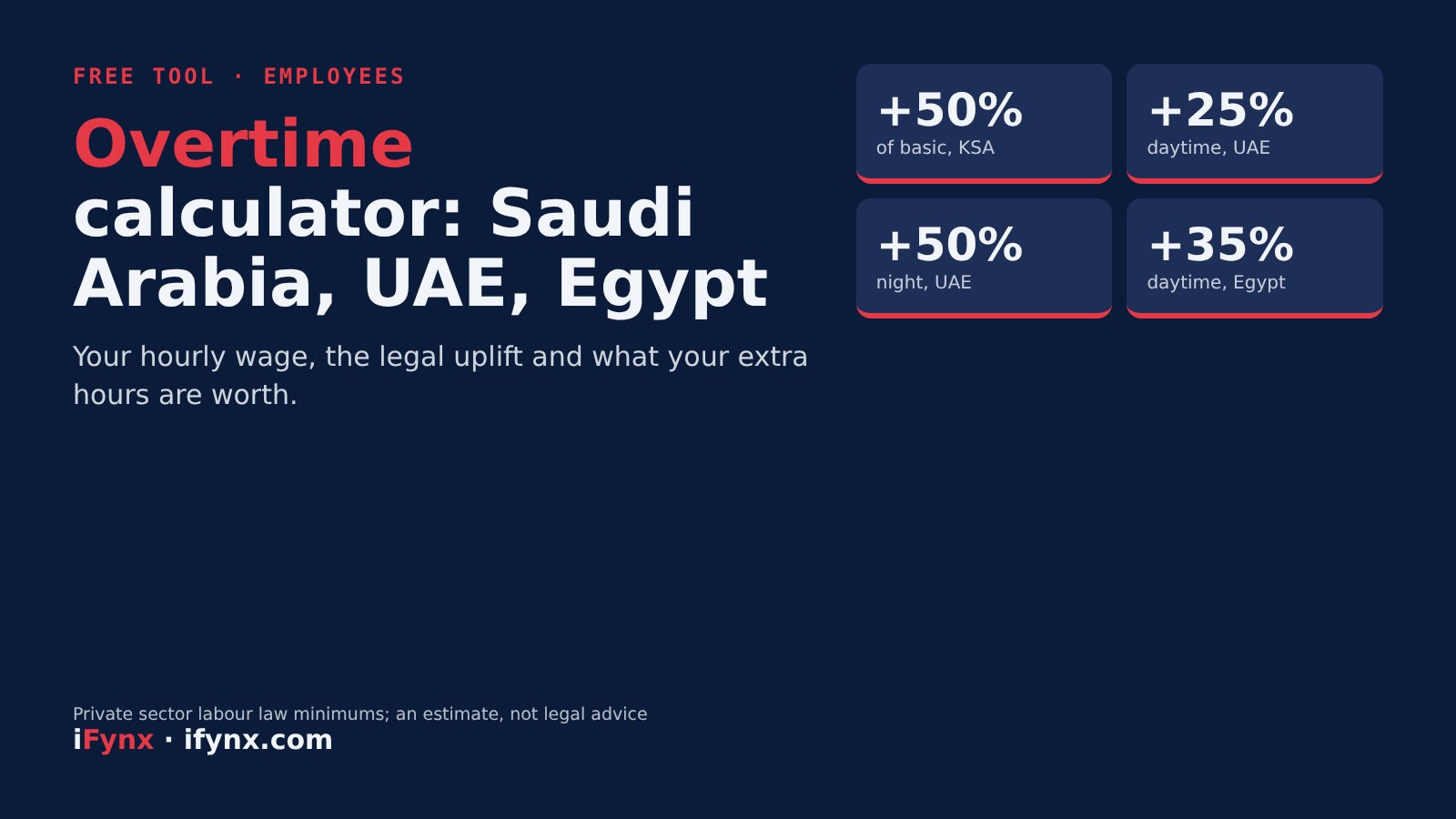
This overtime calculator works out what your extra hours are worth under private sector labour law in Saudi Arabia, the UAE and Egypt: enter your salary and hours to see your hourly wage and the amount due, and edit the rates if your contract gives more. A free tool from iFynx.
How overtime pay is calculated
- Saudi Arabia: under Article 107 of the Labour Law, an overtime hour is paid at the actual hourly wage plus 50% of the basic hourly wage. Hours worked on holidays and Eids count as overtime.
- UAE: the basic hourly wage plus at least 25%, rising to 50% when the hours fall between 10 pm and 4 am. Work on the rest day is compensated with a substitute day or the day’s wage plus 50%.
- Egypt: the calculator starts with the well-known Labour Law rates: 35% for daytime hours and 70% for night hours, with double pay for the rest day. Check your contract and the law in force, and edit the rates in the calculator if yours differ.
The hourly wage
The common method is monthly salary ÷ 30 ÷ daily working hours. In Saudi Arabia the first part uses the actual wage (with allowances) and the uplift uses the basic wage. This is an awareness tool, not legal advice, and some roles are excluded from overtime rules.
Want to know what you are owed when you leave? Try the end of service calculator.
Frequently asked questions
How much is an overtime hour in Saudi Arabia?
Your actual hourly wage plus 50% of your basic hourly wage, under Article 107 of the Labour Law.
How much is an overtime hour in the UAE?
The basic hourly wage plus at least 25%, and 50% for hours between 10 pm and 4 am.
Is overtime based on basic or total salary?
It depends on the country. In Saudi Arabia the actual wage enters the sum with an uplift on the basic wage; in the UAE the calculation uses the basic wage.
Is the result binding on my employer?
No. It is an estimate that helps you review what you are owed. Your contract, the labour law and the labour authority in your country are the reference.