Short answer: The Binance hack on 29 October 2026 drained about $6.3 billion (Binance’s estimate; Elliptic counts $6.43 billion) from Binance hot wallets on about ten blockchains, most of it in roughly 20 minutes from 20:05 UTC. It is the largest crypto theft on record, about four times the 2025 Bybit hack. Binance says user funds are safe, it will cover all losses, about $3 billion has been frozen, deposits work, and it targets a phased restart of withdrawals around Sunday 1 November with a Proof of Reserves report by Monday 2 November. Analytics firms suspect North Korea’s TraderTraitor; no government has confirmed it.
Update, 14 November 2026, 13:21 Asia/Gaza: US moves to seize more than $1.2 billion of the stolen funds
On 12 November the US Justice Department said that members of the North Korean military, which the FBI calls “TraderTraitor”, stole more than $6 billion worth of virtual assets from Binance on or about 29 October. US government and private-sector efforts have so far frozen more than $2.7 billion, and the Department has already obtained court authorization to seize or restrain more than $1.2 billion of that amount (Justice Department press release 26-1356). Work to trace, freeze, seize and forfeit the rest continues, as the hackers launder funds through cryptocurrency bridges, mixers and exchanges. The release adds that last week the FBI, with the Secret Service and IRS-CI, issued a Cyber Alert attributing the theft and urging virtual asset service providers to block transactions linked to the laundering addresses. This official attribution supersedes the earlier lines in this article saying no government had named the attacker. Frozen or seized is not the same as returned: the release does not say when or how assets will go back to Binance. In the same release, the FBI said it had seized cloud infrastructure behind a separate North Korean scheme it calls “FaceStealer”: fake video meetings that use recorded webcam video and deepfakes to push a malware “fix”. The FBI says the scheme led to the theft of more than $400 million in the last 18 months, and that it seized over 900 webcam videos of victims under a federal warrant (FBI FaceStealer resources). If an unexpected video call asks you to install something to fix your audio or camera, leave the call.
Update, 9 November 2026, 13:09 Asia/Gaza
A separate, unverified claim that 335 million Binance user records are for sale is not part of this hack, and Binance says it is likely a scam: see our Binance data breach claim explainer.
Update, 3 November 2026, 07:10 Asia/Gaza
The Binance founder said on X at 17:07 UTC on 2 November that Binance “did not borrow money”, did not sell assets or raise money, and covered the loss from its balance sheet (post on X). In an earlier post he said 100% of the funds had been allocated, with about 5% still to convert. At 02:30 UTC on 3 November Binance posted Recovery Update #6, “Withdrawals Reopen for More Assets” (Binance on X). It has not said which assets yet, and we will add them once it does. Update #3 is still the latest proof-of-reserves reference: 90% coverage, from a 31 October snapshot (Binance announcement). These are the company’s own statements, not an independent audit.
Update, 2 November 2026, 19:10 Asia/Gaza
Binance says withdrawals are back. It restored them in phases from 06:00 UTC on 1 November, and all 15 networks in phase one were live by 12:36 UTC (Binance on X). On 2 November it added fiat withdrawals in USD, AED, VND, PHP and IDR (Binance on X). It says its Proof of Reserves snapshot can now be checked (Recovery Update #5). It also warned users about scammers posing as Binance support during the recovery (Binance on X). Binance support will never ask for your password, 2FA codes or a transfer to a “safe” wallet.
Update, 2 November 2026, 16:25 Asia/Gaza
South Korea’s Financial Services Commission held an emergency meeting on 2 November with major exchanges and asked them to raise the share of customer assets in cold wallets, monitor deposits and withdrawals around the clock and set aside more reserves. Korean law already requires at least 80% in cold storage. Separately, Lookonchain said the Binance hacker deposited about $250,000 into Gate over 12 hours, and Gate said it froze two accounts it linked to the attacker, as TokenPost and PANews reported. Gate did not say how much was frozen.
The Binance hack is the story the whole crypto market has been watching since Thursday night. Binance, whose global platform Binance.com has operated under Abu Dhabi Global Market (ADGM) licences since January 2026, says an attacker got into its systems through a compromised engineer’s laptop and then through further breach points, and made Binance’s own infrastructure sign withdrawals out of its hot wallets. This guide sets out what is confirmed, what is still disputed, what users in the UAE, Saudi Arabia and Egypt should do today, and the engineering lessons for every Gulf exchange, wallet and fintech team. We will add dated updates as Binance publishes its post-mortem.
Key facts (as of 31 October 2026, 15:15 Asia/Gaza)
- When: first unauthorised transfers at about 20:05 UTC on 29 Oct (22:05 Asia/Gaza, 00:05 UAE on 30 Oct); most chains drained within about half an hour, a second wave on Avalanche and Polygon after 23:00 UTC (Elliptic).
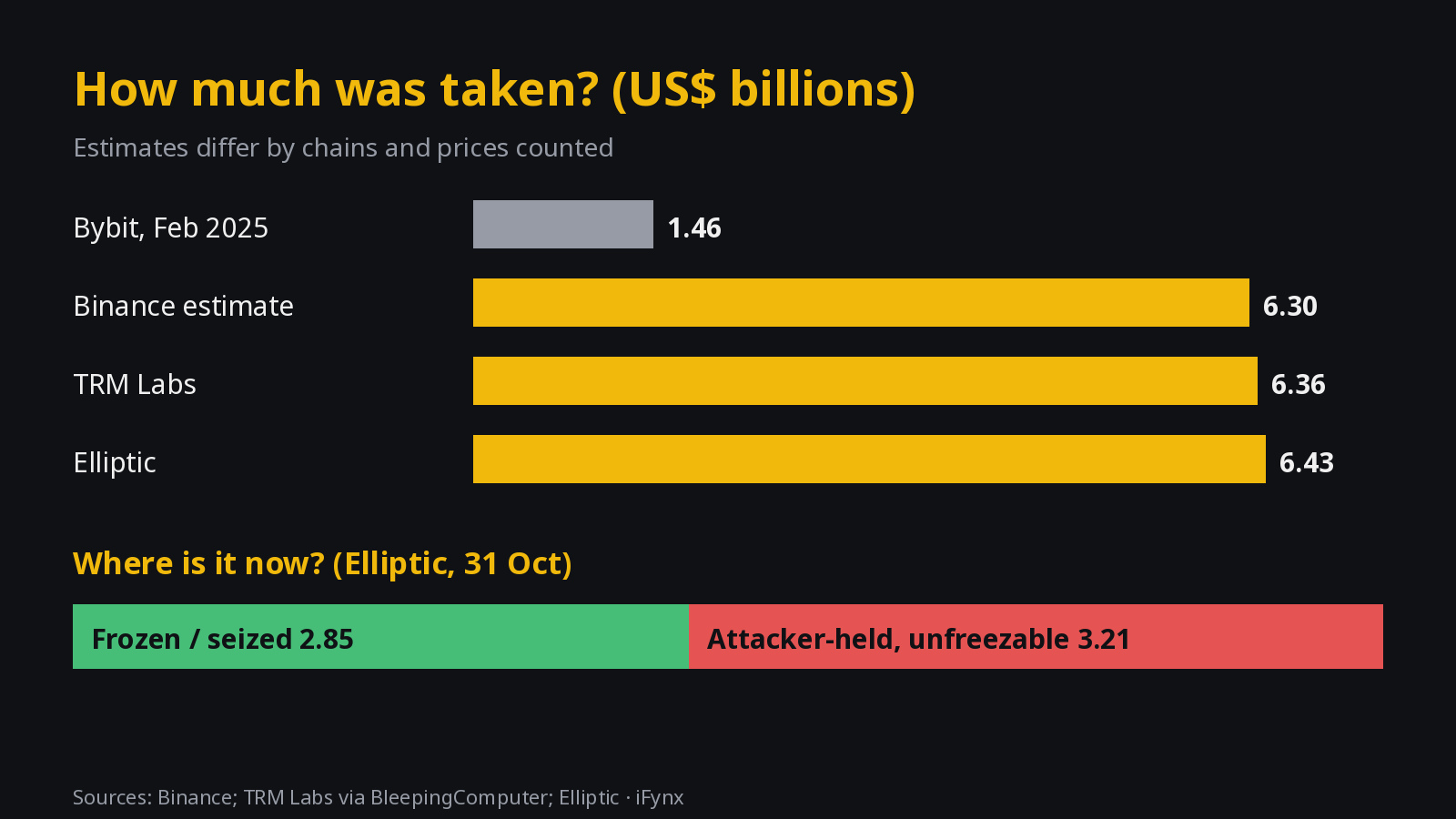
- How much: about $6.3 billion per Binance (Binance); $6.36 billion per TRM Labs (BleepingComputer); $6.43 billion per Elliptic. The spread comes from which chains and prices each counter uses.
- Frozen: about $3 billion per Binance; Elliptic has verified $2.85 billion, 94% of it USDT and USDC. Roughly $3.2 billion sits in ETH, BTC, XRP and TRX that no issuer can freeze.
- Cause (so far): a compromised DevOps engineer’s laptop gave access to a service container; Binance later found additional breach points; no evidence of a private-key leak (Binance update #2).
- Cover: Binance says it set aside more than $6.34 billion, $5 billion already in the stolen tokens (about 80%), buying the rest on market and OTC.
- Next dates: phased withdrawal restart targeted about 34 hours after update #2 (around 05:30 UTC, 1 Nov); Proof of Reserves result by Monday 2 Nov; technical findings and a full post-mortem to follow.
- UAE regulator: ADGM’s FSRA says it is aware, engaging closely with Binance and monitoring the incident (FSRA statement).
- Attribution: TRM Labs and Chainalysis say TraderTraitor (North Korea) with high confidence; Elliptic says likely but not yet certain; no government confirmation.
What happened in the Binance hack, minute by minute
According to Elliptic’s on-chain reconstruction, the first move came at about 20:05 UTC on 29 October, when Binance wallets on the XRP Ledger sent 233 million XRP to an attacker address. Over roughly the next half hour Binance hot wallets on other chains, including Bitcoin, Tron and Ethereum, paid out too. The largest losses were on Ethereum: about $3.8 billion across 186 tokens. Bitcoin losses were 18,270 BTC (about $1.48 billion) and 612.7 million USDT left on Tron. Binance then paused withdrawals, which it says stopped the outflows.
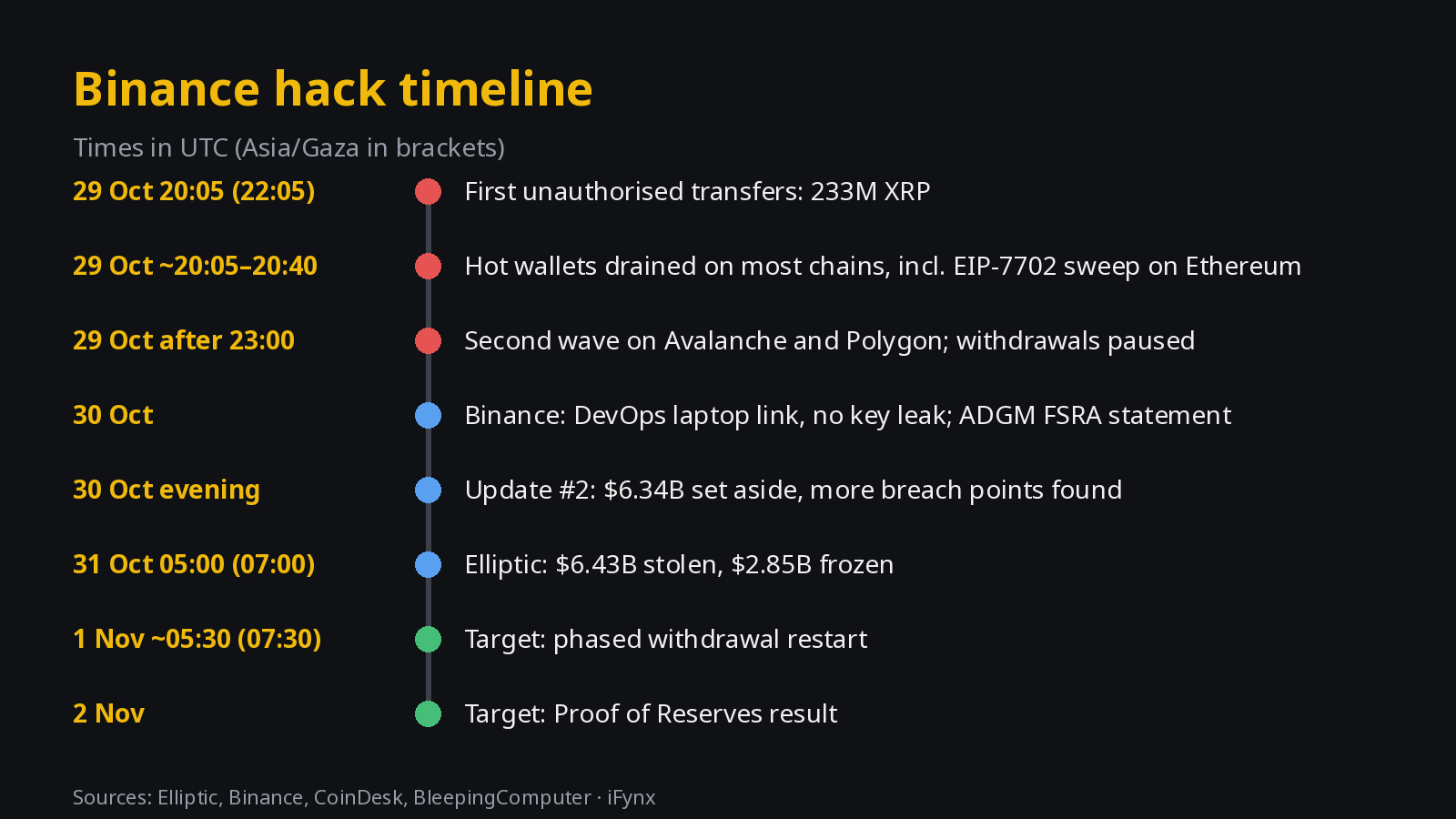
On Ethereum the attacker used EIP-7702, a 2025 upgrade that lets an ordinary wallet delegate its behaviour to a smart contract. One transaction carried 50 delegation authorisations, all validly signed with the key of the hot wallet labelled “Binance 14”. About three and a half minutes later the attacker’s contract swept 167,464 ETH and 63 other tokens out of that wallet. A second hot wallet simply signed ordinary transfers to the attacker. That pattern matters: nobody broke the cryptography. The attacker got Binance’s signing layer to sign what it wanted, which is what Binance’s own investigation now says.
“Binance will absorb the financial impact of these stolen funds, not our users.”
Binance, Security Incident Update #2, 30 October 2026
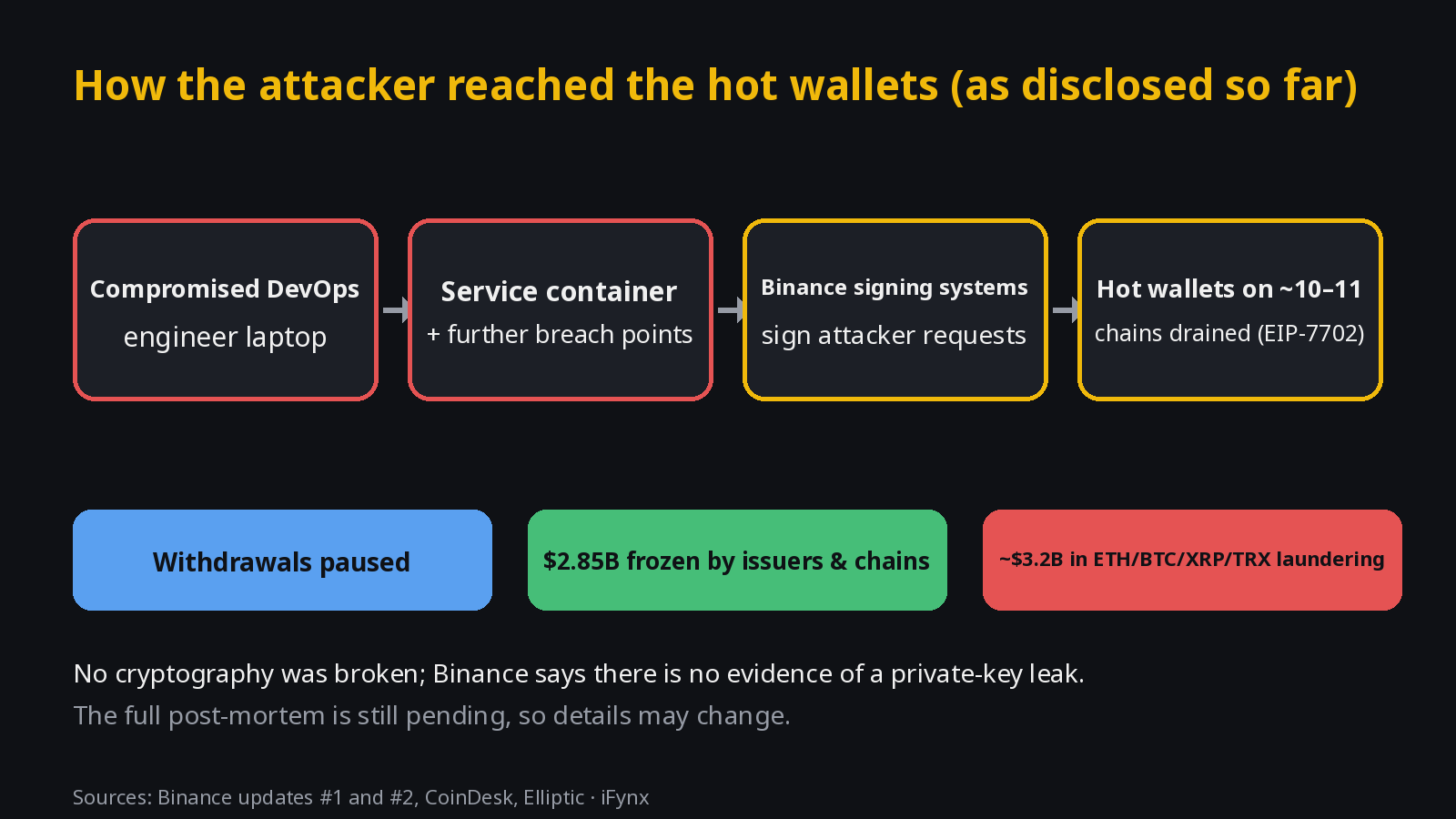
Binance’s first statement, published on the night of the attack and updated on 30 October, said the incident “may involve a compromised DevOps engineer’s laptop, which allowed an attacker to gain access to a service container and submit unauthorized withdrawal transactions.” In a video on 30 October, co-CEO Richard Teng said investigators had found additional points of breach, that the attacker did “not simply use one engineer’s permissions” and it was “not a single ‘one-click’ action”, that a self-destruct mechanism erased traces, and that the EIP-7702 delegation bypassed normal approval controls (CoinDesk).
Is Binance safe right now? What is confirmed and what is not
| Claim | Status on 31 Oct | Source |
|---|---|---|
| Users will not lose money; Binance covers all losses | Binance’s commitment; $6.34B+ set aside, ~80% already in the stolen tokens | Binance update #2 |
| Deposits and trading work, withdrawals paused | Confirmed by Binance | Binance update #1 |
| No private keys leaked | Binance says no evidence so far; investigation ongoing | Binance update #2 |
| Only Binance’s own hot wallets were hit, not customer funds | Disputed: CoinDesk found the compromised wallets were previously listed among assets backing customer balances | CoinDesk |
| North Korea’s TraderTraitor did it | Not confirmed: TRM and Chainalysis high confidence; Elliptic “likely, not yet certain”; no government statement | BleepingComputer, Elliptic |
| An insider or one engineer did it | Not supported: Binance says it has not attributed responsibility to any individual | BleepingComputer |
| Binance.US affected | No: Binance.US says it was not affected | BBC |
Our reading: Binance has the balance sheet to absorb this, and the speed of the freezes by Tether, Circle, Ripple, WLFI and Arbitrum’s Security Council shows the industry’s emergency playbook working. But “safe” will mean something concrete only when two things happen: the Proof of Reserves report shows assets covering every user balance, and withdrawals flow without surprise limits. Until then, treat the phrase as a company statement.
Bottom line on safety
Binance says users will not lose money and deposits work. The independent checks come next: the Proof of Reserves result (target Monday 2 November) and whether withdrawals actually flow after the phased restart.
Why this is a UAE story, not only a crypto story
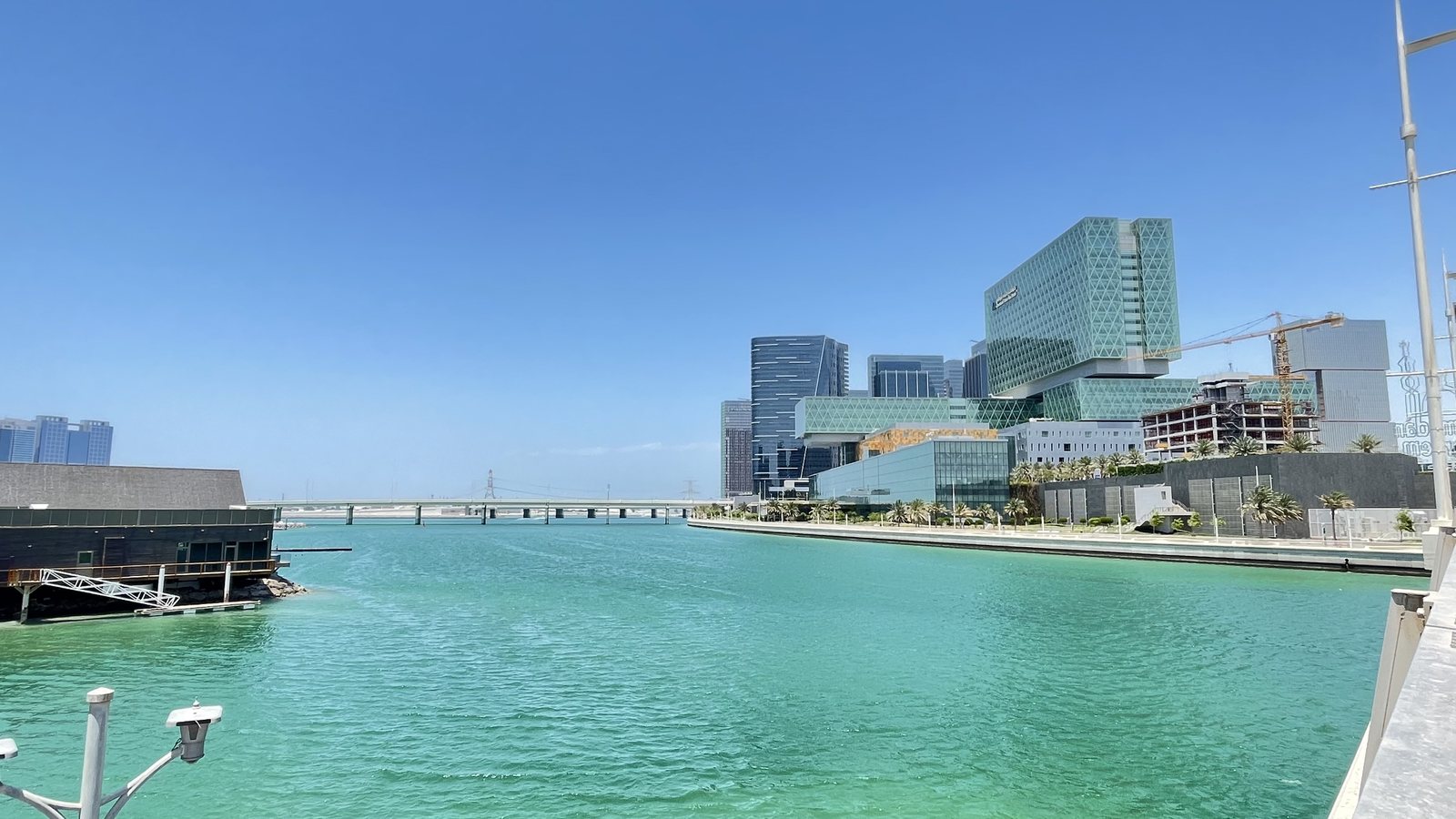
- Binance’s global regulator sits in Abu Dhabi. ADGM’s FSRA authorised Binance.com’s global platform through three entities, an exchange, a clearing and custody house and a broker-dealer, which began operating on 5 January 2026 (ADGM). The custody entity is the one that safeguards user digital assets, which is why the FSRA’s statement on 30 October matters (Khaleej Times, Gulf News).
- Abu Dhabi money is on the cap table. MGX invested $2 billion in Binance in March 2025 and became a minority shareholder (Reuters).
- Dubai has seen this script before. Bybit, which is headquartered in Dubai, lost about $1.46 billion in February 2025 when North Korean hackers compromised a developer machine at its wallet provider. Elliptic says the Binance theft “closely resembles” it: the infrastructure and people around the wallets were compromised, not the cryptography.
- Expect tougher questions for every VASP in the region. Regulators in ADGM, Dubai (VARA) and Bahrain will be asking licensed platforms how a laptop compromise could reach a signing service. That review will reach fintechs, wallets and banks that custody crypto too.
What Binance users in the UAE, Saudi Arabia and Egypt should do today
⚠️ Scam warning
Binance says users do not need to claim compensation. Anyone asking you to move funds to a “safe wallet”, pay a “recovery fee” or share a code, password or recovery phrase is a scammer, whatever logo they use.
- Do not move funds to a “safe wallet” and do not pay “recovery fees”. Binance says users do not need to apply for compensation. Any DM, call, email or website offering a claim is a scam.
- Open the app yourself. Check updates only in the official Binance app or by typing binance.com; never through links in messages, Telegram groups or WhatsApp forwards.
- Lock down the account: passkey or app-based 2FA (not SMS), an anti-phishing code for Binance emails, a withdrawal address whitelist, and a review of active devices and API keys.
- Take a screenshot of your balances today, before the Proof of Reserves report, so you have your own record.
- When withdrawals reopen, do not panic-withdraw through unofficial P2P or OTC sellers offering “instant” exits at a discount. Expect phases and queues.
- UAE: Binance.com users are served by ADGM-licensed entities; complaints go to Binance first, then the FSRA’s channels. Saudi Arabia: there is no Saudi licence for Binance, and local authorities have long warned about unlicensed virtual-currency platforms. Egypt: Egypt’s banking law bars trading or promoting crypto without a Central Bank of Egypt licence, so there is no local route to recovery; keep evidence and use Binance’s support only.
Engineering lessons for Gulf exchanges, wallets and fintech teams
The one-line lesson
Nobody broke the cryptography. The attacker reached the systems that sign. Protect the path from people and laptops to your signer, and make the signer enforce its own policy.
The Binance hack is a supply-chain and operations failure, the same family as the Coinbase–Amplitude breach and the Polymarket third-party script incident this week. Here is the checklist we would run with any UAE, Saudi or Egyptian team that holds customer money or signs transactions:
- Separate the people who deploy from the systems that sign. A DevOps laptop should never be one hop from a service that can request withdrawals. Put signers behind their own network boundary, with access only through audited, short-lived, hardware-key sessions.
- Make the signer enforce policy itself. The signing service should check amount, destination, velocity and transaction type on its own, and refuse anything outside policy no matter which internal service asks.
- Block unusual transaction types by default. On Ethereum, a hot-wallet key should never sign an EIP-7702 delegation or any authorisation it was not designed to sign. Allow-list the transaction types each key may sign.
- Cap hot wallets and add circuit breakers. Binance’s pause stopped the outflow. Automate it: if outflows on several chains spike within minutes, freeze withdrawals and page a human.
- Screen what you receive. Elliptic has published a free blocklist of more than 1,000 addresses linked to the theft (Elliptic). UAE- and Bahrain-licensed VASPs should load it into deposit screening now.
- Treat hiring tests and “take this coding test” files as attack surface. Binance has not said how the laptop was compromised, but fake job offers and coding tests carrying malware are a long-documented TraderTraitor tactic.
- Plan incident communication before you need it: an in-app banner, a status page, bilingual Arabic and English updates with exact times, and a standing scam warning. Never ask users to “verify” anything during an incident.
What is still unclear
- The full attack path: Binance has not said what the “additional points of breach” were. A technical post-mortem is promised.
- Whether the restart holds: the 34-hour window is a target. A slip would not be unusual after an attack of this size.
- Recovery: frozen is not recovered. Returning the frozen stablecoins requires issuer and legal processes; the unfreezable $3.2 billion can only be stopped when it reaches an exchange or OTC desk.
- Attribution: no government has named the attacker. For comparison, the FBI publicly attributed the Bybit theft within days.
How iFynx helps Gulf fintech teams
iFynx designs and builds bilingual Arabic and English apps for fintechs, exchanges and banks in the UAE, Saudi Arabia and Egypt. After an incident like this we usually run a short review: map who and what can reach your signing or payout services, test withdrawal limits and circuit breakers, and rewrite incident and anti-scam screens in both languages. See our app development work in the UAE or contact us.
FAQ
Is my money safe on Binance after the hack?
Binance says yes: it calls user funds safe, says it will cover all losses from its SAFU fund and company funds, and says it has already set aside more than $6.34 billion, about $5 billion of it in the exact tokens that were stolen. Deposits and trading kept working; withdrawals were paused. That is Binance’s own statement, not an independent audit. The way to check is the updated Proof of Reserves, which Binance says will be ready by Monday 2 November 2026, and then whether withdrawals actually flow normally once they reopen.
When will Binance withdrawals resume?
In its Security Incident Update #2, posted on the evening of 30 October 2026, Binance said its tech team targets starting to resume withdrawals within about 34 hours, in phases and subject to security checks. That points to around 05:30 UTC (07:30 Asia/Gaza, 09:30 UAE) on Sunday 1 November. It is a target, not a promise: expect a token-by-token restart, queues and possibly lower limits at first. Follow only the Binance app and binance.com announcements.
Who hacked Binance?
Not officially known. Blockchain analytics firms TRM Labs and Chainalysis attributed the theft with high confidence to TraderTraitor, a North Korean state-linked group also tracked as Lazarus. Elliptic calls that likely but not yet certain, and notes no government has confirmed it; the FBI has only said it is aware of the incident. Binance says its investigation has not attributed responsibility to any individual.
How did the Binance hack happen?
Binance’s first finding was a compromised DevOps engineer’s laptop that gave the attacker access to a service container, from which unauthorised withdrawals were submitted. It later said it found additional points of breach and that the attack was complex and used a self-destruct mechanism to erase traces. It says it has found no evidence that wallet private keys leaked. On-chain analysis shows Binance’s own signing systems signed the attacker’s transactions on about ten chains in roughly half an hour, including an Ethereum EIP-7702 delegation that handed one hot wallet to the attacker’s contract. A full post-mortem has been promised.
I use Binance in the UAE, Saudi Arabia or Egypt. What should I do now?
Do not move funds to any ‘safe wallet’, do not pay any ‘recovery’ or ‘compensation’ fee, and ignore DMs, calls and emails about refunds: Binance says users do not need to claim anything. Open the official app yourself, check your balance and active sessions, turn on passkeys or app-based 2FA, set an anti-phishing code and a withdrawal address whitelist. In the UAE, Binance.com’s global platform is licensed by ADGM’s FSRA, which says it is monitoring the case. In Saudi Arabia and Egypt there is no local licence covering Binance, so local regulators cannot help you recover funds; keep records and screenshots of your balance.
Related reading
- Crédit Mutuel Arkéa Crypto Hack: What We Know About the Alleged $133M Theft, and 10 Exchange-Account Controls for Gulf and Egypt Banks
- Mercado Bitcoin Hack: Brazil’s Largest Crypto Exchange Halts Withdrawals After a Reported $40M Drain. Is Your Money Safe on an Exchange in the UAE, Saudi Arabia or Egypt?
- $106 Million Crypto Theft: An EU Company’s Exchange Accounts Reportedly Drained, and the Withdrawal Whitelist Checklist Gulf and Egypt Businesses Need Now
- Linux Kernel Vulnerability CVE-2026-98432: Ubuntu Still Has No Fix, What Is Patched, and How Gulf and Egypt Server Teams Should Mitigate Now
- BTCPay Server Hack: Versions 2.4.1 and Older Hit, and What Self-Hosted Bitcoin Merchants in the UAE, Saudi Arabia and Egypt Should Do Now
- Coinbase data breach via Amplitude: what leaked and the analytics SDK checklist
- UAE online fraud: the anti-scam features UAE banking apps should ship
- Standard Chartered crypto trading in the UAE: Bitcoin and Ether inside a bank account
- Robinhood UAE: what the DFSA licence covers and the GCC trading-app checklist
- AI agent bank account access and the Open Finance consent spec for the Gulf
Sources
- Binance, Security Incident Update (published 29 Oct 2026, updated 30 Oct) and Security Incident Update #2 (X post, 30 Oct 2026)
- ADGM FSRA, Statement regarding security incident involving Binance (30 Oct 2026); ADGM, Binance global licence under ADGM framework
- Elliptic, The largest theft in history: North Korea likely behind the $6.4 billion Binance hack (last updated 31 Oct 2026, 05:00 UTC); free blocklist
- BleepingComputer, Binance links $6.3 billion crypto theft to compromised DevOps laptop (30 Oct 2026), quoting TRM Labs and Chainalysis
- CoinDesk, Binance uncovers wider breach, targets Sunday withdrawal restart (30 Oct 2026)
- BBC News, Binance hack coverage and scam warnings (30 Oct 2026)
- Khaleej Times, UAE’s FSRA issues statement; Gulf News, FSRA monitoring Binance incident (30 Oct 2026)
- Reuters, Abu Dhabi-backed MGX buys into Binance with $2 bln (12 Mar 2025)
- Hero photo: Photo: Bretwa via [Wikimedia Commons](https://commons.wikimedia.org/wiki/File:Binance_t-shirt_and_bag_-_2022-07-09.jpg), CC BY-SA 4.0, cropped. In-body photo: MAVARIZ, Al Mariah Island, Abu Dhabi, Wikimedia Commons, CC BY-SA 4.0, cropped.

Related reading
Related reading
LNbits Hack: Team Urges All Operators to Stop Servers After Attacks