Update 14 Nov 2026 (19:01 Asia/Gaza): On 13 Nov the FBI issued FLASH-20261113-001 on ARTEX
The FBI’s FLASH-20261113-001 (TLP:CLEAR, 13 November 2026) says malicious actors have used ARTEX since at least August 2026 against organisations in financial services, government, technology and other sectors, and that some intrusions went from initial targeting to privileged access in under three hours. It cites a supply chain compromise of ConnectWise Cloud Backup customers that gave access to more than 2,250 downstream tenants, and attacks on South Korean financial institutions that exposed personal data of about 67,000 people. The developer made the GitHub repository unavailable on 8 October, but forks, archived copies and a commercial “ARTEX PRO” still circulate, and more than 1,600 ARTEX consoles were publicly exposed in early November. The FBI also cautions that some indicators, such as IP addresses, may not mean compromise on their own. The FLASH does not mention WorkOS. Our full briefing, with a 10-step checklist and a Microsoft 365 decision tree: FBI ARTEX warning: what the FLASH says and what Gulf and Egypt teams should do.
Published 3 November 2026, 04:07 Asia/Gaza. WorkOS says its investigation is ongoing; we will add dated updates as it publishes more.
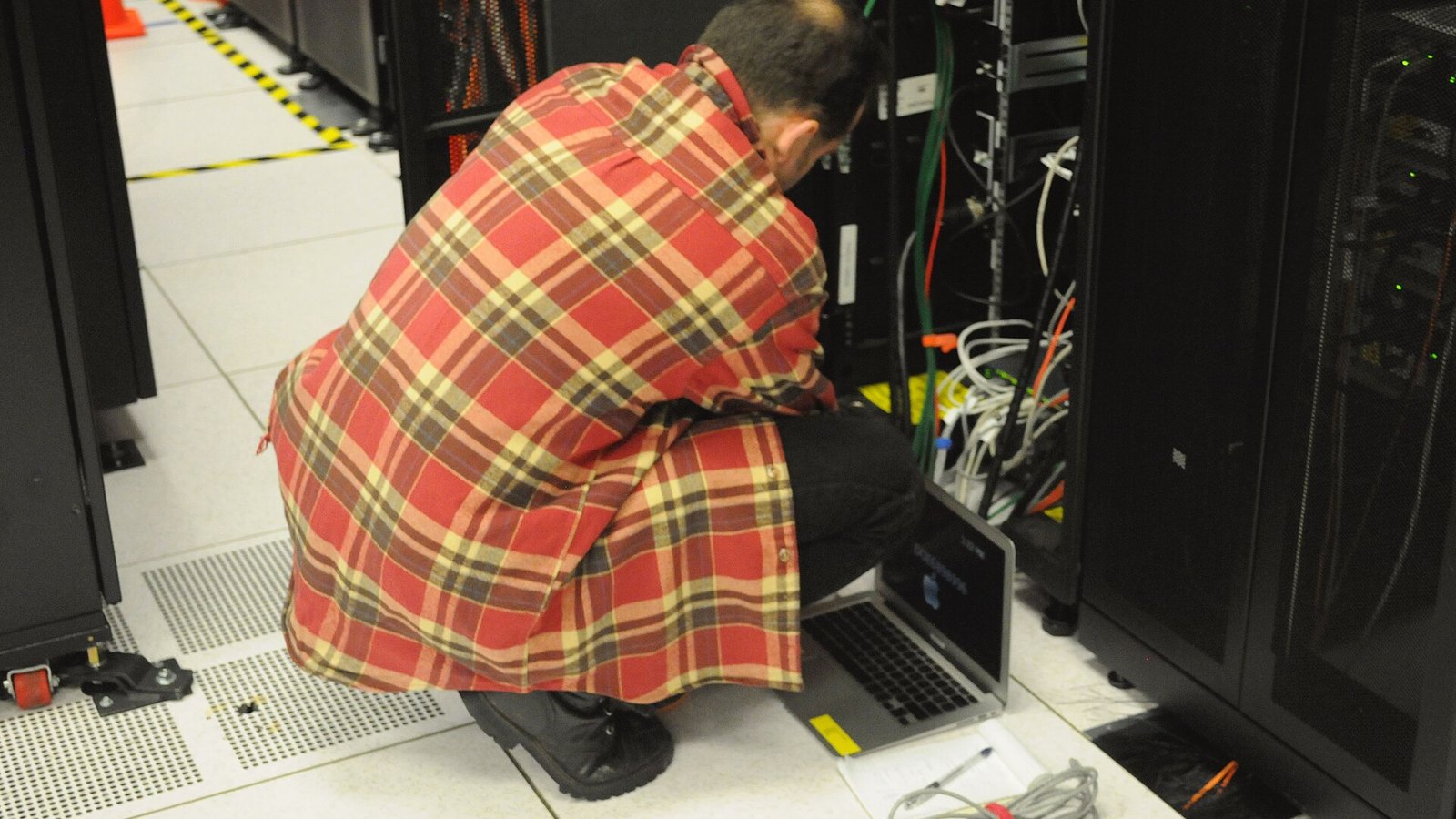
Quick answer: On 30 October 2026, identity company WorkOS found unauthorised access to an internal application used by its sales team. In its security bulletin dated 2 November it says business contact details and summaries and excerpts of sales calls, support discussions and customer Slack conversations were exposed, and that the attacker used an AI-assisted offensive security framework. WorkOS’s chief executive said on Hacker News that the attack involved ARTEX, an autonomous AI agent framework, and that production systems are secure and no customer platform data was accessed. The same framework has been documented by Microsoft, Google and Zscaler in attacks on banks, cloud tenants and hundreds of organisations.
Key facts
- When: WorkOS’s customer notice, as posted on Hacker News, says anomalous traffic to an internal business system was detected on 30 October 2026 at 16:39 UTC. The public bulletin is dated 2 November.
- What was reached: per that notice, an internal API used by sales and marketing tools, and through it data from WorkOS’s Salesforce and Snowflake instances: business contacts, account and commercial information, aggregated product-usage metrics, marketing contacts and support tickets.
- What WorkOS says was not reached: production services and customers’ application data. It says it has no evidence of either.
- Response: external access to the tool disabled, a broader review of internal access controls, and an independent digital forensics and incident response firm retained.
- Origin: the notice says IP addresses based in Hong Kong and China. IP location does not identify who is behind an attack, and WorkOS does not name an actor.
What happened at WorkOS
WorkOS sells single sign-on, directory sync and audit features to software companies. Its bulletin lists four kinds of exposed data: business contact details held in its CRM; account histories and relationship information; summaries and excerpts from sales calls, support discussions and customer Slack conversations; and operational metadata such as product usage and connection or directory health. It says it is reviewing records to work out the impact for each organisation and will contact affected customers directly.
The bulletin itself describes “an AI-assisted offensive security framework” used to automate reconnaissance and exploitation attempts. The name ARTEX comes from the customer notice and from WorkOS’s chief executive, who wrote on Hacker News: “The attack involved ARTEX, an autonomous AI agent framework used to carry out offensive security operations.” RuntimeWire reported the disclosure at 6:57pm US Central time on 2 November. WorkOS has not said how the attacker first got in.
Business contact information and details from previous conversations can help an attacker make fraudulent requests look legitimate.
WorkOS security bulletin, 2 November 2026
What is ARTEX?
According to Google Threat Intelligence Group, ARTEX is an autonomous, multi-agent, LLM-driven pentesting and offensive command-and-control platform written in Go with a Next.js web console. It was released on GitHub by a user called Autumn-27. Google says the original repository was taken down by its creator in October 2026 because of widespread abuse, but forks keep spreading, including ScopeWeaver and a commercial version called ARTEX PRO. Microsoft describes it as a system of agents that run a penetration test from reconnaissance to data exfiltration with little human input, and says it can use any AI model.
Like Cobalt Strike or Metasploit before it, ARTEX was built for security testing and is being abused. The difference is speed: the agents choose the next step from the target’s responses and retry when something fails. We do not link to the code or describe how it runs.
ARTEX in the wild: what the primary sources say
| Source | Date | What it reports |
|---|---|---|
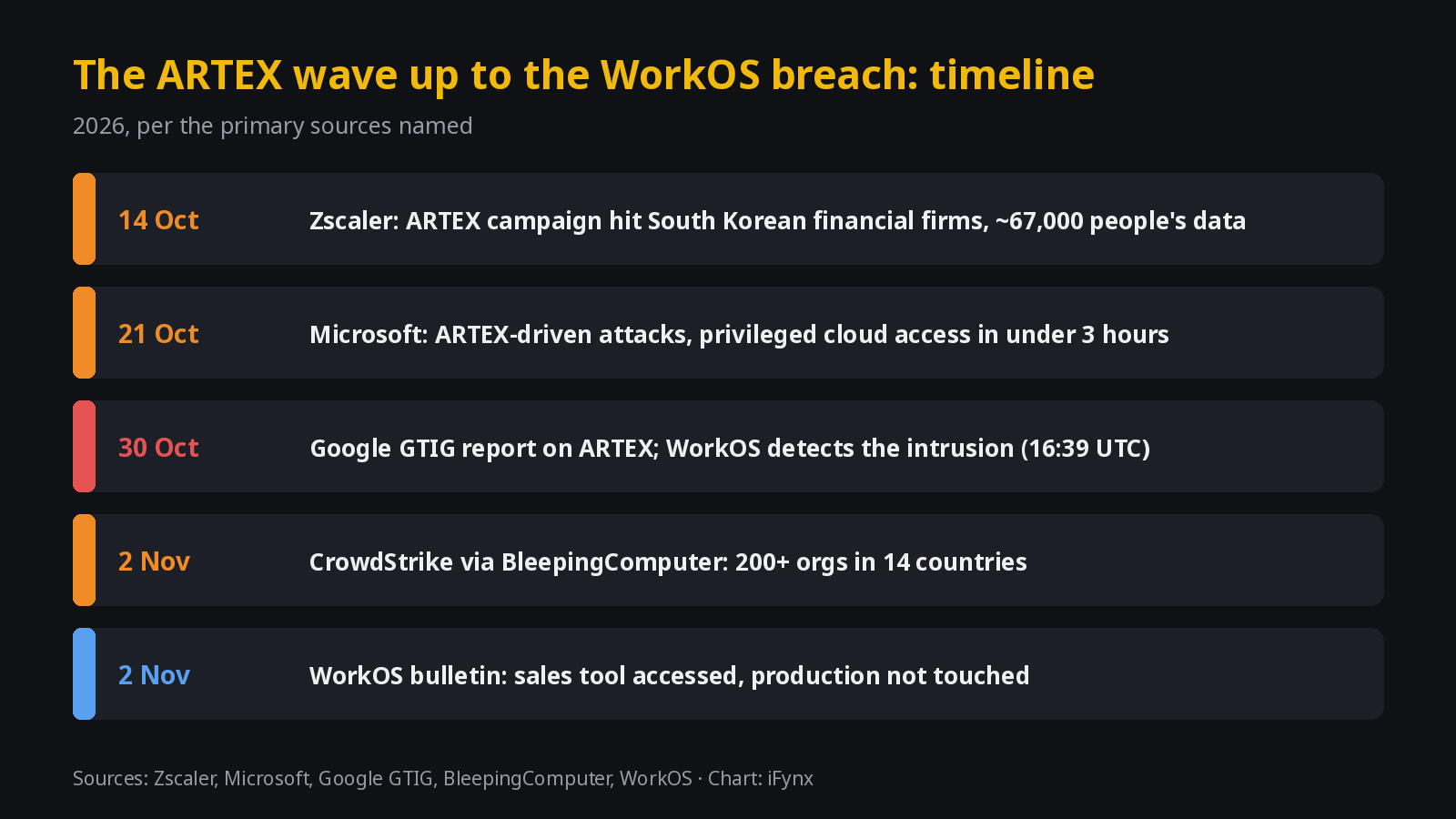
| Zscaler ThreatLabz | 14 Oct 2026 | ARTEX used against South Korean financial firms; PII of about 67,000 people stolen via customer inquiry portals and employee mobile-app backends |
| Microsoft | 21 Oct 2026 | ARTEX-driven attacks on hundreds of organisations; several reached privileged cloud access in under 3 hours; linked to the ConnectWise supply-chain compromise |
| Google GTIG | 30 Oct 2026 | Multiple actors using ARTEX since late August 2026; bursts of 2 to 25 seconds; one campaign moved from first account to deep access in about 4 hours, once in 15 minutes |
| BleepingComputer | 2 Nov 2026 | CrowdStrike: ARTEX used against more than 200 organisations in 14 countries, at least nine compromised |
| WorkOS | 2 Nov 2026 | Internal sales tool accessed; CRM, support and conversation data exposed; production not affected, per WorkOS |
BleepingComputer also reports that the Dutch Institute for Vulnerability Disclosure (DIVD) said an ARTEX agent went from initial access to root on its network in 12 minutes, with more than 450,000 requests, activity it called “super loud and messy”. Google makes the same point: these tools trade stealth for speed, so they are detectable, but detection alone is not enough if no one can act within minutes.
Why sales and support tools are the target
Production platforms tend to get the best controls. CRM, support desks, call-recording summaries and BI connectors often do not, yet they hold exactly what a fraudster needs: names, titles, phone numbers and the real history of a customer relationship. WorkOS’s warning is the key takeaway for customers: expect emails and calls that quote a real ticket or colleague. We saw the same pattern when an analytics vendor led to the Coinbase data breach.
If you are a WorkOS customer
Treat any unexpected request that cites your WorkOS account, ticket or call as suspicious until verified through a known channel. Rotate any secret you ever pasted into a WorkOS support ticket or shared Slack channel. WorkOS says customers can request a call via security@workos.com, per its chief executive’s Hacker News post.
AI-speed defence checklist for Gulf and Egypt banks, fintechs and SaaS teams
Zscaler’s finding matters most for the region: the South Korean campaign did not break core banking. It went through peripheral apps, the same kind of inquiry portals, staff apps and partner backends that banks and fintechs in the UAE, Saudi Arabia and Egypt run alongside their core systems. Map this list to your SAMA, NCA, CBUAE or Central Bank of Egypt obligations.
- Inventory the peripheral apps. Zscaler says the South Korean campaign hit customer inquiry portals and employee mobile-app backends, not core banking. List every internet-facing app, admin panel and internal API that touches customer data, including the ones marketing and sales own.
- Put SSO and network limits on CRM, support, BI and warehouse connectors. No internal tool that can read Salesforce-style CRM or warehouse data should be reachable from the open internet without SSO, device checks and an allowlist.
- Kill long-lived tokens. Google’s Mandiant team recommends short-lived, workload-bound credentials instead of static keys. Give every integration an owner, a scope and an expiry.
- Detect machine speed. Alert on sequential lookups, unusually many records per session and bursts of API calls from one identity, as Zscaler and Google advise. Rate-limit search and export endpoints.
- Scrub secrets from tickets and chat. API keys, passwords and recovery codes pasted into support tickets or Slack become loot when a CRM or support tool is breached. Scan and rotate.
- Run a vendor-breach phishing drill in Arabic. WorkOS warns that stolen conversation details make fraud look legitimate. Train staff to verify any request that quotes a real ticket, colleague or call, especially payment or credential changes.
- Keep logs long enough. Microsoft and Google both say automated attacks are loud. You only see the pattern if identity, API and data-access logs are centralised and kept.
- Know your notification duties. Check what your data-protection law and your regulator require if customer data in a vendor or internal tool is exposed, and who signs off the notice.
If you are giving AI agents access to customer accounts yourself, read our guide to AI agents in bank accounts and open finance and our note on AI coding agent plugin security. For patch-speed examples, see the Linux kernel CVE-2026-98432 guide and the Brotli Node2Shell checklist.
Search interest
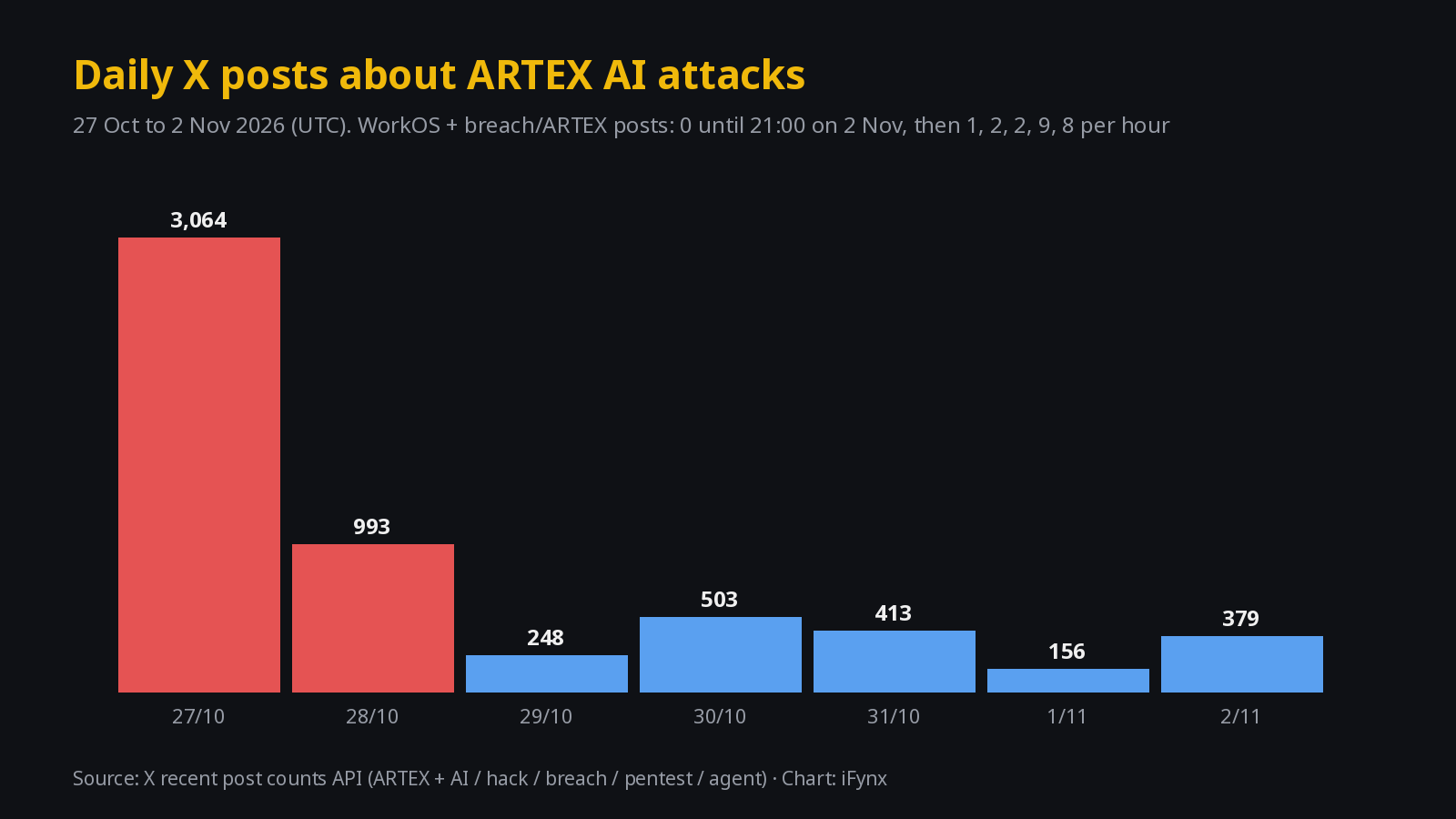
Posts about ARTEX peaked at 3,064 on 27 October and have held at a few hundred a day since. Posts pairing WorkOS with breach or ARTEX were zero until 21:00 UTC on 2 November, then rose to 9 in the 00:00 UTC hour on 3 November.
What we do not know yet
- How the attacker first got in, and whether a vulnerability or stolen credential was used.
- How many WorkOS customers had records in the affected systems.
- Who is behind the attack. IP addresses in Hong Kong and China are not attribution, and we do not speculate.
Status as of 3 November 2026, 04:07 Asia/Gaza.
How iFynx can help
iFynx builds bilingual banking, fintech and SaaS apps for the UAE, Saudi Arabia and Egypt, with SSO, short-lived credentials, rate limiting and audit logging built in. See our services.
Frequently asked questions
What happened in the WorkOS breach?
On 30 October 2026 WorkOS found unauthorised access to an internal application used by its sales team. Business contact details, account and relationship information, summaries and excerpts of sales calls, support discussions and customer Slack conversations, and product-usage metadata were exposed. WorkOS disabled external access to the tool and hired an independent forensics firm. The investigation is ongoing.
Is my WorkOS-based SSO safe?
WorkOS says its production systems are secure and no customer platform data was accessed; its customer notice says it has no evidence that application data or production services were accessed. The bigger risk for customers right now is phishing that quotes real conversations. If you shared any secret in a support ticket or Slack thread with WorkOS, rotate it.
What is ARTEX AI and is it still available?
ARTEX is an open-source, multi-agent penetration testing and command-and-control framework written in Go with a Next.js console, driven by large language models. Google says the original GitHub repository was taken down by its creator in October 2026 because of abuse, but forks, including ScopeWeaver and a commercial ARTEX PRO, keep circulating. We do not link to or describe how to run it.
How fast are AI agent attacks?
Microsoft saw several ARTEX-driven attacks reach privileged cloud access in under three hours from first targeting. Google saw single ARTEX bursts of 2 to 25 seconds, and a related campaign that went from first compromised account to deep access in about four hours, once in 15 minutes.
Why did the attacker go after sales and support tools?
They sit outside the controls that guard production, they hold contacts and real conversation history that make phishing convincing, and they often connect to CRM and data warehouses through internal APIs and long-lived tokens.
What should Gulf and Egypt banks and fintechs do first?
Inventory internet-facing peripheral apps and internal APIs, put SSO and network limits on CRM, support and BI connectors, replace long-lived tokens with short-lived ones, rate-limit and alert on machine-speed enumeration, scrub secrets from tickets and chat, and run an Arabic phishing drill based on a vendor breach.
Sources
- WorkOS: October 30th, 2026 Data Security Incident, 2 November 2026
- Hacker News: WorkOS reports security breach (customer notice and WorkOS CEO comment)
- RuntimeWire, 2 November 2026
- Microsoft Security Blog, 21 October 2026
- Google Cloud: ARTEX and Friends, 30 October 2026
- Zscaler ThreatLabz, 14 October 2026
- BleepingComputer, 2 November 2026
- X post counts: X recent counts API, queried about 02:00 UTC, 3 November 2026
- Cover photo: Derrick Coetzee, Wikimedia Commons, CC0, cropped. In-article photo: Carl Lender, Wikimedia Commons.jpg), CC BY 2.0, cropped. Charts: iFynx.

Related reading
- GitBook Breach by AI Agents: What Was Exposed (Git Sync Secrets, API and Integration Tokens, Assistant Questions), What to Rotate Now, and a Docs-Platform Security Checklist for Gulf and Egypt Crypto, Fintech and SaaS Teams
- Lovable Apps Left Passports, Payments and 200,000 Chats Open: What Crissy Field Found in 159,041 Projects, Why Supabase RLS Is the Weak Spot, and a Pre-Launch Checklist for Gulf and Egypt Builders
- Railway Employee’s AI Agents Probed Rival Cloud Primcloud: What Each Side Says, Why Agent Testing on Competitors Crosses a Line, and an AI-Agent Guardrails Checklist for Gulf and Egypt Teams
- Goldman Sachs AI Tools Ban: Claude Code and GitHub Are Now for Engineers Only. What Banks in the UAE, Saudi Arabia and Egypt Should Copy
- OpenAI Bug Bounty Now Pays Up to $172,000: The New Reward Table, How the Multipliers Work, and What Arab Bug Hunters and Gulf and Egypt Companies Should Do
Related reading
- Claude Code Secrets on GitHub: What Apiiro Found in settings.local.json — A Rotate-First Checklist
- OpenAI Control Room Explained: How a 35-Second AI Kill Switch Works, and How Gulf and Egypt Teams Can Build One for Their Own AI Agents
- MCP Server Security After the Mittwald Breach: What Happened, Why AI-Assistant Connectors Are Now an Attack Surface, and a Lock-Down Checklist for Gulf and Egypt Teams